Buyer Fit Snapshot
| Best fit | Wholesale Kraft Tuck Boxes projects where brand print, material claims, artwork control, MOQ, and repeat-order consistency need to be specified before quoting. |
|---|---|
| Quote inputs | Share finished size, material target, print colors, finish, packing count, annual reorder estimate, ship-to region, and any compliance wording. |
| Proofing check | Approve dieline scale, logo placement, barcode or warning zones, color tolerance, closure strength, and carton packing before bulk production. |
| Main risk | Vague material claims, crowded artwork, missing packing details, or unclear freight terms can make a low unit price expensive after revisions. |
Fast answer: Wholesale Kraft Tuck Boxes: Specs, Pricing, and Orders should be specified like a repeatable production item. The safest quote records material, print method, finish, artwork proof, packing count, and reorder notes in one written spec.
Production checks before approval
Compare the actual filled-product size with the drawing, then confirm tolerance on folds, seals, hang holes, label areas, and retail display edges. Reserve space for logos, QR codes, warning copy, and material claims before decorative graphics fill the panel.
Quote comparison points
Review material grade, print process, finish, sampling route, tooling charges, carton quantity, and freight assumptions side by side. A quote is only useful when the supplier can repeat the same color, closure quality, and packing count on the next order.
Wholesale kraft tuck boxes are often the first format I point buyers toward when the product is light to medium weight, the shelf presentation needs to feel clean rather than overworked, and the packaging has to ship flat without pushing freight costs out of line. A carton that looks inexpensive on a screen can become the expensive choice once corners crush in transit, returns start climbing, and the fulfillment team spends time repacking boxes that should have held up the first time.
I have seen that happen more than once. A buyer falls for a low unit price, then pays for it with damaged goods, rushed reorders, and a warehouse team that ends up babysitting bad packaging. Wholesale kraft tuck boxes avoid a lot of that trouble because they give you a balanced mix of structure, presentation, and predictable production.
That practical appeal is easy to understand: wholesale kraft tuck boxes bring a natural look, a controlled unit cost, and enough rigidity to keep packaging consistent across larger production runs. For brands comparing Wholesale Programs with broader Custom Packaging Products, the tuck box is often the format that gives the clearest path from concept to production without unnecessary detours.
There is a brand reason these cartons stay in circulation too. Kraft feels sturdy, honest, and efficient, and it does that without depending on heavy decoration to seem intentional. Soap, cosmetics, supplements, candles, stationery, and small gift items all sit comfortably inside wholesale kraft tuck boxes because the format supports the product without trying to outshine it. That restraint matters. Packaging should frame the product, not fight with it.
The buying logic stays simple when the project is organized: Choose the Right board, confirm the dimensions, settle the print method, and scale the order with confidence. Everything else tends to be noise. Buying wholesale kraft tuck boxes in a real production quantity usually makes more sense than treating packaging like a last-minute add-on.
Wholesale Kraft Tuck Boxes: Why They Win at Shelf and Ship
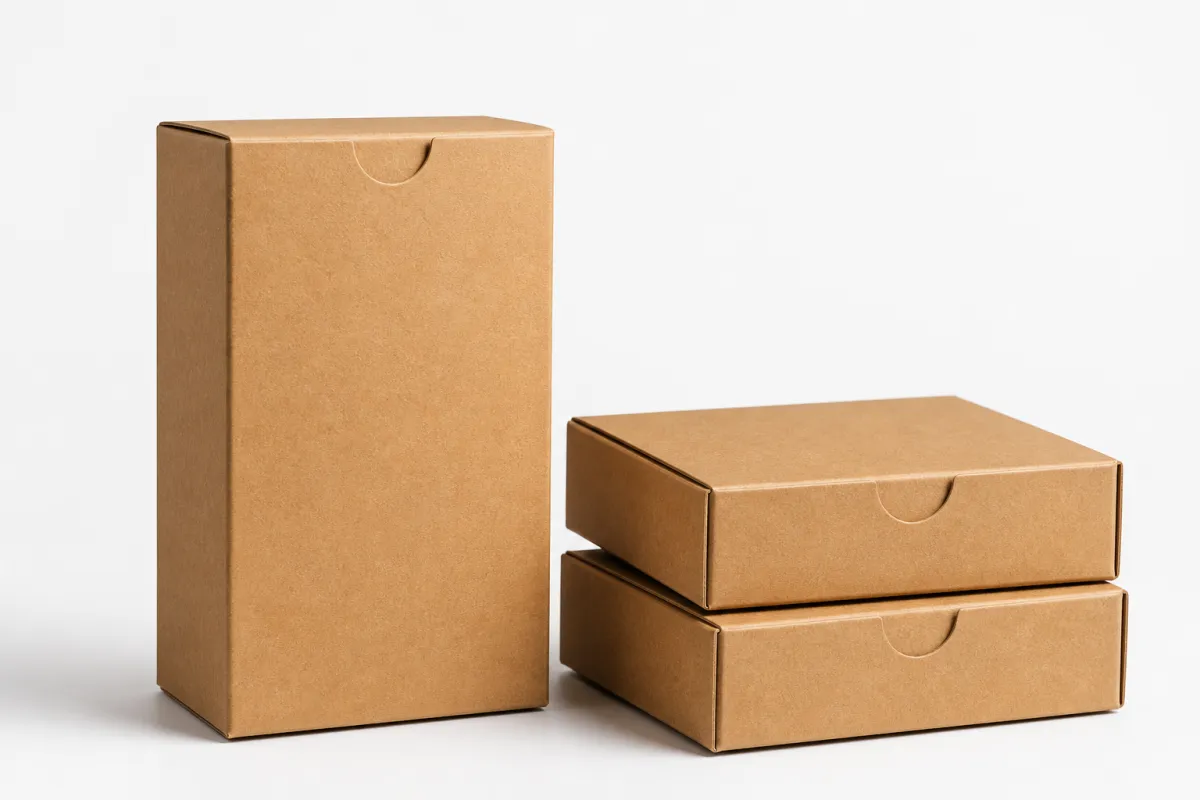
Wholesale kraft tuck boxes work because they solve two jobs at the same time. They display well on shelf and they ship flat, which sounds basic until you start adding up the labor, warehouse space, and freight savings that basic decisions can unlock. A folding carton that stacks neatly, assembles quickly, and stays consistent from box one to box ten thousand trims rework and keeps inventory easier to manage.
Retail buyers notice inconsistency faster than they notice perfection. If one carton stands square and the next one buckles at the corners, the product starts to feel less dependable before it is even opened. Wholesale kraft tuck boxes help control that problem because they are easy to standardize. Once the dieline is dialed in, the packing line moves with fewer surprises and fewer improvised fixes.
Kraft carries a useful signal all by itself. It reads natural, practical, and less wasteful than packaging that depends on gloss and coatings to create interest. That does not mean every box should look raw or unfinished. It means wholesale kraft tuck boxes let you build a credible, clean presentation without forcing the budget into decorative tricks just to look premium. A disciplined layout, readable type, and a simple logo often do more than a stack of special effects.
The cost argument is just as strong. A well-planned wholesale run lowers the unit price, though the bigger savings often show up in the places teams forget to measure: fewer split shipments, fewer rush reorders, less time spent chasing small emergency batches, and fewer corrections after production. Wholesale kraft tuck boxes make sense for buyers who want repeatable supply, not a new packaging headache every month.
The cheapest box is rarely the cheapest choice once the product reaches the customer. If the carton is off by a few millimeters, the product can shift inside, the front panel may wrinkle, or the top flap may never sit quite right. That is how a supposedly low-cost carton turns into waste. With wholesale kraft tuck boxes, the fit is the whole conversation. Everything else comes after.
Use cases are easy to map. Soap brands like the natural look. Cosmetics brands value the clean print area. Supplement brands need straightforward label space. Candle makers need a box that protects the jar and still leaves room for warnings and ingredients. Stationery and gift brands want tidy presentation and flat-pack shipping. Wholesale kraft tuck boxes fit those jobs because they balance presentation with practical handling.
Packaging teams often borrow thinking from shipping and sustainability standards to keep the conversation grounded. A good place to start is the ISTA test framework for transit concerns and the fiber sourcing references at fsc.org when recycled or certified material matters. A carton that looks polished but fails in transit is still just an expensive sheet of paper.
Wholesale kraft tuck boxes also make internal approvals easier because the production logic is clean. You are not paying for decorative extras to compensate for weak structure. You are paying for a carton that fits, prints well, and scales without constant revision. Operations teams like that. Finance teams usually tolerate it. That overlap is rarer than it should be.
Wholesale Kraft Tuck Boxes Product Details That Matter
The structure matters before anything else. Wholesale kraft tuck boxes are commonly built as tuck top, tuck bottom, reverse tuck, or straight tuck cartons. Straight tuck boxes stay popular because both flaps close in the same direction, which keeps the front panel tidy and gives the customer a clean open-close experience. Reverse tuck can be better in some fulfillment workflows because the top and bottom flaps move in opposite directions. Tuck top and tuck bottom styles come into play when product presentation or assembly habits point toward a specific fold pattern.
What you choose depends on how the box will be handled. If the carton is opened by a shopper on a shelf or inside a subscription box, a neat closure matters. If the box is packed quickly on a line, assembly speed matters more. Wholesale kraft tuck boxes can support both priorities, but the dieline needs to be chosen with intent. Picking a style because it sounds familiar is an easy way to pay for the wrong fold.
The board itself is where a lot of performance differences begin. Natural brown kraft gives you the earthy, raw appearance that many sustainable products want. White-lined kraft provides a cleaner print surface and stronger color contrast. Heavier board adds stiffness, which matters when the product is larger, heavier, or likely to be stacked. Wholesale kraft tuck boxes can be made from several board types, but the wrong choice leads to overbuilding or underbuilding, and both cost money.
Print decisions change value just as quickly. A one-color logo on brown kraft often looks more thoughtful than a cluttered full-color design that tries to say too much at once. Full-color printing can look excellent on white-lined kraft, especially for cosmetics or retail gift packaging, but the design still needs a reason to exist. If the job only calls for branding, product name, barcode, and a short ingredient block, wholesale kraft tuck boxes do not need an oversized ink bill to do their work.
That is where a lot of buyers overcomplicate the order. They assume more decoration always means more value. It does not. On kraft, restraint tends to look better and cost less. Inside print, spot treatment, embossing, and foil can all be useful, but each one should have a clear purpose. Premium unboxing and shelf differentiation are valid goals, though they can turn a sensible order into an expensive one if they are added just because they are available. Wholesale kraft tuck boxes should earn their keep first and look good second.
Real-world function matters too. These cartons ship flat, assemble quickly, and provide enough face area for barcodes, ingredients, directions, warnings, and short brand messaging. That is why they show up so often in health and beauty packaging, candle packaging, and small gift packaging. Wholesale kraft tuck boxes are not only a visual choice; they are a workflow choice.
There are limits, and they should be stated plainly. If the item is fragile, oily, unusually heavy, or prone to moving around inside the carton, the box may need an insert, a barrier coating, or a different structure entirely. Kraft board is strong, but it is not a cure-all. Wholesale kraft tuck boxes can handle a lot, yet they still need the right product fit and the right handling conditions.
One practical rule helps a great deal: use the lightest spec that protects the product without making the carton feel flimsy. If the box is fighting the product, the spec is wrong. If the product rattles inside, the spec is wrong too. Wholesale kraft tuck boxes perform best when the structure disappears into the background and the product feels like the focus.
Specifications That Shape Wholesale Kraft Tuck Boxes Performance
Before anyone can quote wholesale kraft tuck boxes properly, they need a spec sheet that answers a handful of basic questions: finished size, product weight, board thickness, print coverage, finish, and quantity. Missing one of those usually means the quote is rough at best and wrong at worst. Buyers who send incomplete specs tend to get vague pricing back, which helps no one.
Dimensions matter more than most teams expect. A few millimeters too tight and the product tears the carton or jams during insertion. A few millimeters too loose and the item shifts, looks less considered, and feels poorly fit. Wholesale kraft tuck boxes are forgiving only within a narrow range. Precision always beats guesswork.
Board thickness should match the product weight and the amount of abuse the carton will see. A lightweight soap bar may work in a thinner kraft board. A candle jar, supplement bottle, or heavier cosmetic kit usually needs more stiffness. If the box will travel through rough handling, compression resistance and edge crush deserve attention too, not just visual appearance. Wholesale kraft tuck boxes are a packaging format, not a substitute for material logic.
Finish changes both appearance and durability. Matte coatings feel understated. Gloss coatings sharpen contrast and can protect the surface a bit better. Soft-touch feels premium, yet it often adds cost without adding much functional value. Water-based coatings are often the most sensible middle ground for wholesale kraft tuck boxes because they preserve the natural character of the board while adding light scuff resistance.
Artwork complexity is another hidden cost driver. A box with a clean logo, disciplined typography, and one or two ink colors is easier to produce than a carton with inside print, foil, windows, and fine registration across several panels. None of those extras are wrong on their own. They just need a reason. Wholesale kraft tuck boxes reward clean design more than crowded design.
Here is a useful spec-check list for buyers comparing options:
- Use case: retail shelf, subscription box, e-commerce shipper, or hybrid.
- Product fit: exact dimensions, product weight, and whether the item moves inside the carton.
- Print needs: logo only, full-color outside, inside messaging, or barcode and regulatory text.
- Handling conditions: humidity, warehouse storage, transit distance, and stack pressure.
- Sustainability goals: FSC-certified fiber, recyclable coatings, or reduced ink coverage.
That list sounds basic because it is. Most mistakes in wholesale kraft tuck boxes happen before production starts. Buyers skip one or two questions, then discover the box needs an insert, a different board, or a different fold style after the proof is already approved. That becomes expensive fast, and it is completely avoidable.
Standards matter here as well. Packaging teams think in terms of shipping abuse, compression, and distribution testing for good reason. If the box has to survive fulfillment or parcel transit, a sensible reference point is the test language used by the ISTA community. If the board source matters, ask for documentation on fiber claims and certification status through fsc.org. That is not marketing language. That is how the procurement conversation stays honest.
If the packaging spec cannot be explained in one clear paragraph, the order is probably too vague. Good wholesale kraft tuck boxes are built on simple decisions made early, not emergency decisions made after the proof arrives.
The smartest buyers treat wholesale kraft tuck boxes like a controlled system. They define the product, the environment, and the print job before chasing price. That sequence makes quotes more accurate and keeps the order easier to approve. It also keeps the project from turning into a slow redesign disguised as procurement.
Wholesale Kraft Tuck Boxes Pricing, MOQ, and Volume Breaks
Pricing for wholesale kraft tuck boxes depends on size, stock, print method, finish, insert requirements, and total quantity. That list is not glamorous, but it is the truth. A larger box uses more board. A more complex print layout uses more setup time. A specialty finish adds labor and machine steps. Nobody gets around that by wishing harder.
For practical budgeting, a common starting point for standard production runs looks something like this: simple natural kraft cartons with one-color print may land around $0.18-$0.32 per unit at 5,000 pieces, depending on size and coverage. White-lined kraft with fuller graphics often moves into the $0.24-$0.42 range. If you add heavier board, inserts, or premium finishes, wholesale kraft tuck boxes can move into $0.30-$0.55 or more. Those numbers are directional rather than universal, and freight region, board market swings, and finishing choices can push them around. Still, they are close enough to keep a buyer from guessing wildly.
The MOQ question gets attention because it affects cash flow. Smaller runs are possible, but the per-unit cost rises when the production batch gets too short. That is not a trick. It is basic press and setup economics. Wholesale kraft tuck boxes usually become meaningfully cheaper once the order reaches a cleaner production quantity, where setup time is spread across more units.
Volume breaks deserve close attention. A slightly larger order can cut unit cost enough to pay for itself, but only if the buyer can store and move the inventory. Overbuying is not a bargain if cartons sit untouched in a warehouse for a year. With wholesale kraft tuck boxes, the sweet spot is usually the point where the price improves without creating dead stock.
There are easy ways to save money without hurting the carton. Simplify the artwork. Cut back on special finishes. Use a standard dieline if one fits the product. Keep ink coverage disciplined. Choose one strong surface message instead of three competing design tricks. Wholesale kraft tuck boxes reward clarity more than decoration.
Here is a simple comparison to frame the tradeoffs:
| Option | Best For | Typical Price Impact | Practical Note |
|---|---|---|---|
| Natural brown kraft, one-color print | Soap, stationery, simple retail items | Lowest baseline | Clean, efficient, and usually the easiest version of wholesale kraft tuck boxes to approve |
| White-lined kraft, full-color outside print | Cosmetics, gift sets, branded retail packaging | Moderate increase | Better image reproduction and a more polished shelf presence |
| Heavier board with insert and finish | Fragile, premium, or heavier products | Highest baseline | More protection and a stronger unboxing feel, but only worth it if the product needs it |
| Standard dieline with minimal setup | Fast repeat orders and cost control | Best setup efficiency | Usually the smartest path for repeat wholesale kraft tuck boxes |
Quotes should also spell out exactly what is included. A serious quote for wholesale kraft tuck boxes should identify setup, proofing, any plate or die cost, shipping, sample charges if applicable, and the conditions for reprints or corrections. If that list is fuzzy, the final invoice will probably be fuzzy too. That is not a good place to manage procurement.
One more practical point: the lowest quote is not always the best quote. If two vendors differ by a few cents, ask what is actually different. Board grade? Print coverage? Structural accuracy? Packaging buyers get burned when they compare only the headline number and ignore the spec behind it. Wholesale kraft tuck boxes should be judged on total usefulness, not just sticker price.
Wholesale Kraft Tuck Boxes Process and Timeline
The process is usually straightforward when the buyer is organized. A typical wholesale kraft tuck boxes order moves from brief to dimensions, dieline, artwork, proof, sample if needed, production, packing, and shipping. That sounds linear because it should be linear. Every extra back-and-forth cycle usually means someone skipped a detail in the first round.
Timing depends on complexity. Simple boxes with standard sizing and limited print can move faster than cartons with custom dimensions, inside print, or multiple finishing steps. If the order needs a physical sample or prototype, add time for review and correction. Wholesale kraft tuck boxes are not difficult to produce, but they are not instant either.
Most delays happen before the press run starts. Missing measurements, unclear fold direction, low-resolution files, and vague color expectations cause more trouble than the actual manufacturing step. That is why the proof stage matters so much. If the proof is wrong, the production run will be wrong in bulk. Wholesale kraft tuck boxes deserve a careful proof review, even when the team wants to move quickly.
A realistic planning window helps. Buyers should allow time for approval and transit rather than assuming every order can be rushed without consequence. For many projects, a little more time upfront leads to a much cleaner delivery. Wholesale kraft tuck boxes are far easier to buy well when the team is not asking for miracles at the last minute.
There are simple ways to speed things up:
- Send final dimensions, not estimates.
- Provide vector logo files and print-ready artwork.
- State quantity, board preference, and finish preference in one message.
- Tell the supplier whether the box is for retail display, shipping, or both.
- Approve the dieline carefully before asking for production.
That list reads almost too obvious, yet it saves real time. Wholesale kraft tuck boxes move faster when the supplier does not need to chase basic facts. A buyer who sends a complete brief usually gets a cleaner quote, a better proof, and fewer revision loops.
Inventory planning matters too. If you are running replenishment, it is smarter to order before the shelf is empty. A modest buffer protects you from shipping delays, artwork revisions, and small production variance. That buffer matters more for wholesale kraft tuck boxes than people think, because once the inventory drops to zero, every delay feels larger.
In practical terms, the order should be treated like a packaging project rather than a stationery purchase. You are aligning spec, print, and logistics. When those three line up, wholesale kraft tuck boxes are easy to repeat. When they do not, the second order is often harder than the first.
A good supplier should help reduce friction too. Clear answers, careful file checks, and a sane recommendation on structure or stock matter more than sales chatter. Wholesale kraft tuck boxes should feel predictable by the time the proof is approved.
Why Choose Us for Wholesale Kraft Tuck Boxes
The advantage should be practical, not theatrical. Buyers want wholesale kraft tuck boxes that match the product, the budget, and the timeline without needing ten rounds of clarification to figure out what is being quoted. Clear communication matters because packaging spec errors become expensive quickly. A neat box with a bad fit is still a bad box.
Good support starts with the dieline. If artwork needs adjustment, the fold needs checking, or the box dimensions need a small correction, that should happen before the order is locked. A supplier that understands wholesale kraft tuck boxes should be able to guide the buyer toward the least expensive spec that still performs properly. That is real value. Everything else is decoration around the edges.
Design help matters as well. Many brands do not need a full creative overhaul. They need the logo placed properly, the product name readable at a sensible distance, and the barcode positioned where it does not interfere with handling. For wholesale kraft tuck boxes, less chaos usually means better results. Strong packaging is often disciplined layout and accurate dimensions, nothing more complicated than that.
Sustainability claims should be grounded in materials and manufacturing, not slogans. Kraft board, efficient flat-pack shipping, and a format that reduces freight volume all support a cleaner packaging story. If FSC-certified stock is required, ask for it clearly. If the buyer wants recyclable coatings or lower ink coverage, say that early. Wholesale kraft tuck boxes can support those goals when the order is specified correctly.
Quality control is the other part people underestimate. Checking dimensions, print alignment, glue areas, and finish consistency before cartons leave production protects the buyer from costly sorting later. A thousand nearly-right boxes are still a problem. Wholesale kraft tuck boxes should be checked like a production system, because that is exactly what they are.
From a buyer’s point of view, the best experience is boring in the right way. No mystery pricing. No vague promises. No pushing upgrades that do not improve the pack. Just a clear recommendation based on the use case. That is how wholesale kraft tuck boxes should be sold.
If you are still comparing structure options, our Custom Packaging Products catalog is useful for seeing how tuck cartons compare with other formats. If your team is planning a larger recurring order, the Wholesale Programs page gives a clearer picture of how volume changes the economics. Either way, wholesale kraft tuck boxes should be judged on fit, price, and repeatability, not on one glossy sample alone.
Wholesale kraft tuck boxes are a strong Fit for Brands that want simple packaging decisions made well. That is the point. Good structure, honest pricing, and a proof that matches the brief matter more than packaging drama dressed up as creativity.
Next Steps for Ordering Wholesale Kraft Tuck Boxes
The fastest way to get a useful quote for wholesale kraft tuck boxes is to gather the basics first: product dimensions, product weight, quantity, print colors, and whether the box is for retail, shipping, or both. If you already know whether you need natural kraft or white-lined kraft, include that too. The more complete the brief, the less time gets wasted on back-and-forth.
I also recommend asking for two quote paths. One should be a lean spec that keeps the box as economical as possible. The other should be a premium spec with any upgrades you are considering. That comparison makes the decision easier because you can see exactly what each extra finish or board upgrade costs. Wholesale kraft tuck boxes are easier to approve when the tradeoff is visible.
Request a sample or proof if the product is fragile, expensive, or sensitive to fit. That is not overcautious. That is smart buying. A sample can catch a bad flap direction, a tight opening, or an artwork placement issue long before the full run is printed. Wholesale kraft tuck boxes are cheap compared with the cost of rework.
Then compare three things side by side: unit cost, lead time, and whether the box protects the product without extra filler. If the cheapest option needs internal padding, the price advantage may disappear. If the premium option adds little practical value, you probably do not need it. That is the sort of calm math that keeps wholesale kraft tuck boxes from turning into a messy purchasing decision.
From a packaging buyer’s point of view, the winning move is usually simple: lock the spec, confirm the quantity, review the proof, and move to quote. Do not keep polishing the order until it becomes a new project. Wholesale kraft tuck boxes are most useful when they are decided cleanly and ordered with enough volume to make the economics work.
If you want a direct path, start with a clear brief and ask for a production-ready recommendation instead of a generic sales pitch. That keeps the conversation on board grade, fit, print, and cost, which is where the actual decision lives. Wholesale kraft tuck boxes should feel easy to order once the right details are on the table.
For brands ready to move, Custom Logo Things can help turn those details into a practical quote and a box that fits the product without unnecessary extras. That is the real value here: wholesale kraft tuck boxes that balance price, durability, and presentation, then repeat cleanly on the next order too.
What are wholesale kraft tuck boxes best used for?
They work best for small to medium retail items like soap, cosmetics, candles, supplements, and gift products. The tuck style ships flat, packs quickly, and gives a clean shelf look without complicated assembly. Wholesale kraft tuck boxes are a smart fit when you want natural presentation and consistent branding at scale.
What MOQ should I expect for kraft tuck boxes wholesale?
MOQ depends on box size, print complexity, and board choice, but wholesale orders usually start at a practical production batch rather than a handful of units. Smaller runs cost more per box, while larger runs reduce unit cost quickly. If you need the lowest unit price, plan around a quantity that matches real monthly or quarterly demand for wholesale kraft tuck boxes.
Can wholesale kraft tuck boxes be printed inside and out?
Yes, but inside printing increases setup complexity and usually raises both cost and lead time. Use inside print when the unboxing experience matters, or when you need instructions, ingredients, or branded messaging inside the box. If you only need logo placement and product info, outside print is usually the smarter spend on wholesale kraft tuck boxes.
Are kraft tuck boxes strong enough for heavier products?
They can be, if the board thickness and box structure match the product weight. Heavier or fragile items may need thicker stock, inserts, or a different carton style entirely. Always confirm the product weight and shipping conditions before approving the final spec for wholesale kraft tuck boxes.
How do I prepare artwork for a wholesale kraft tuck box order?
Send vector logo files, final dimensions, and the chosen print colors. Approve the dieline carefully so folds, seams, and critical text stay in the right place. Lock the proof before production; most print problems start with avoidable artwork mistakes on wholesale kraft tuck boxes.
If you are preparing a run right now, the smartest next move is simple: gather final dimensions, confirm the product weight, choose the board finish, and ask for a proof that reflects the real carton, not a rough estimate. That one step will save more time than any amount of second-guessing, and it usually leads to wholesale kraft tuck boxes that arrive ready to work instead of requiring fixes.


