A wine club embroidered Beanies Material Sample guide is less about fabric in the abstract and more about proof. A sample shows whether the knit keeps its shape, whether the embroidery sits cleanly on the crown, and whether the finished piece feels like a member gift worth keeping. On paper, most beanies can be made to sound premium. In hand, the differences are usually obvious within ten seconds.
That speed of judgment matters. Wine club merchandise gets evaluated like a branded experience, not a commodity. Members are touching the beanie, checking the weight, and deciding whether the club feels thoughtful or improvised. The material sample is where those judgments become visible before a larger run is locked in.
It also exposes the details that mockups hide. A deep burgundy can turn flat in a looser knit. A crisp logo can blur when the yarn stretches too far. Even packaging affects the verdict: a beanie shipped in a sturdy corrugated cardboard mailer with kraft paper wrap feels different from one dropped into a basic polybag. If the brand wants FSC certified cartons, recycled materials, or post-consumer waste content called out, the sample stage is where that should be verified.
What the material sample is really for
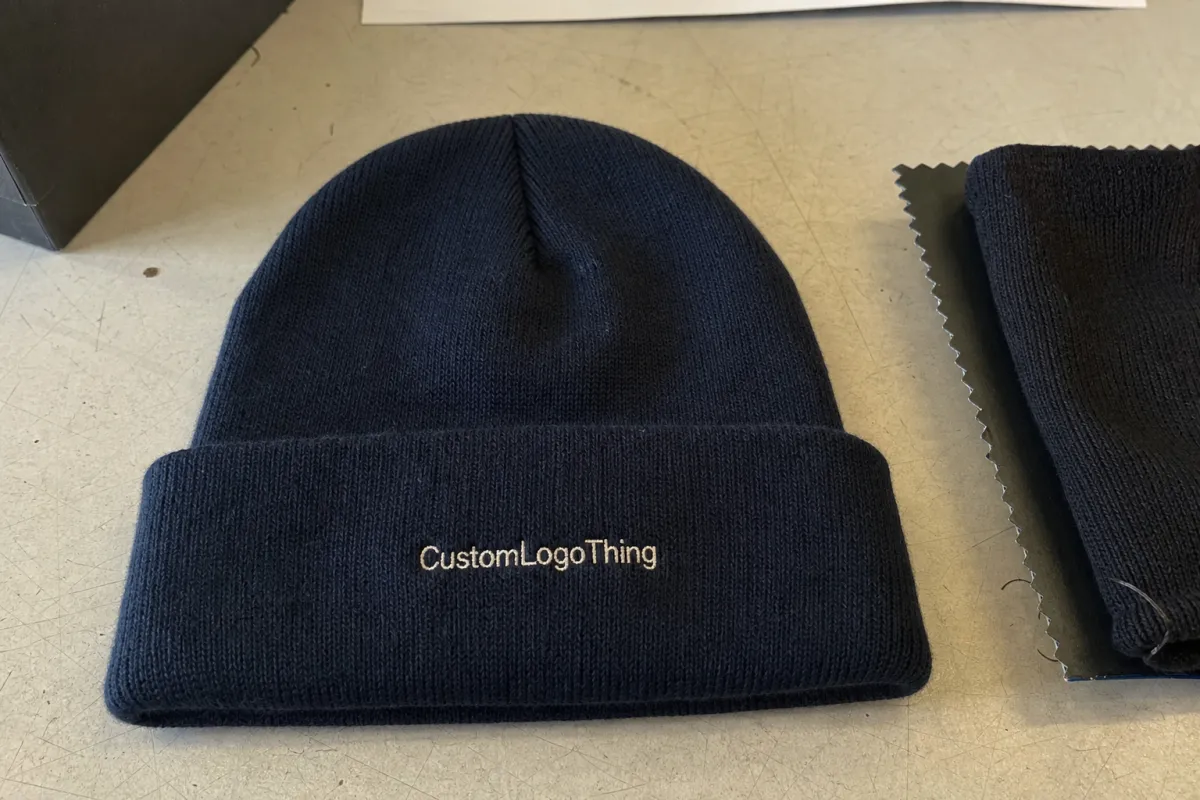
The sample is not a decorative extra. It is the shortest route from concept to reality. A flat swatch cannot tell you how the cuff rebounds after being stretched, whether the crown slouches in a flattering way, or whether the embroidery remains legible when the knit moves. The finished beanie is the product. Everything else is a guess.
For wine club buyers, that distinction is especially important because the item has to do two jobs at once. It needs to keep people warm, and it needs to carry the club’s identity without feeling promotional. A member should be able to wear it on a cold walk, in a tasting room, or around town without the piece looking like disposable event swag. That only happens when the material, knit density, and decoration method are aligned.
There is another detail people often underestimate: color behaves differently depending on substrate. The same thread can look richer on a tight wool blend, flatter on acrylic, and more restrained on a recycled knit with a matte surface. That is not a defect. It is the interaction between fiber, stitch structure, and light. A sample is the only reliable way to see that interaction before ordering hundreds or thousands of units.
From a buyer’s perspective, the right sample answers three practical questions: does it feel good, does it decorate cleanly, and does it still look intentional after wear and handling? If the answer to any of those is uncertain, the order is not ready yet.
How material choice changes fit, warmth, and decoration
Material choice affects more than softness. It changes stretch recovery, warmth, embroidery clarity, perceived value, and the price band the product can plausibly support. Acrylic, wool blend, cotton blend, and recycled synthetic yarn each create a different result on the same artwork.
| Material | Handfeel and warmth | Embroidery behavior | Typical buyer fit | Relative cost pressure |
|---|---|---|---|---|
| Acrylic | Soft, light, generally moderate warmth | Usually supports clean edges on denser knits | Broad distribution, price-sensitive promotions | Lowest |
| Wool blend | Warmer, more structured, more premium in hand | Looks refined if the knit is tight enough | Higher-end retail or holiday gifting | Medium to high |
| Cotton blend | Breathable and comfortable in mild climates | Can show detail well, but feels less winter-specific | Shoulder-season merchandise or indoor tasting rooms | Medium |
| Recycled synthetic blend | Close to acrylic in wear, with a lower-impact story | Performance depends on yarn consistency and knit control | Brands that want recycled materials without changing the look | Medium |
Fabric weight matters just as much as fiber type. A tighter 7-gauge or 9-gauge knit typically gives embroidery a more stable surface than a loose, airy body. The stitches have something firmer to anchor to, which reduces distortion. A lighter knit can still work, but the logo is more likely to shift as the fabric moves.
Comfort testing should be blunt. Does the yarn itch at the forehead? Does the cuff recover after being stretched? Does the crown collapse in a way that makes the beanie look underbuilt? Those are the questions to answer while the sample is in hand. A spec sheet cannot substitute for that.
Material also shapes the product story. A wool-rich beanie supports a colder-weather identity and usually sits in a higher price tier. A recycled blend can support a sustainability narrative, provided the claim is specific enough to stand up to scrutiny. Neither choice is inherently better. They simply position the item differently, and the sample should make that position visible.
For quality control, many teams use the same basic discipline they apply to other soft goods: check handfeel, stretch recovery, pilling tendency, stitch alignment, and color stability against internal references or ASTM-style benchmarks. The sample does not need a lab report to be useful. It does need to behave predictably.
Sample process and timeline: from request to approval
The cleanest sample process starts with a useful brief. Send the logo file, target quantity, preferred yarn type, cuff style, color references, and packaging requirements up front. If the beanie will ship in a corrugated cardboard mailer with kraft paper wrap, say so before the first sample is built. If FSC certified cartons or recycled inserts are part of the presentation, that belongs in the first round of instructions, not the second.
Once the request is clear, the supplier usually confirms the decoration method, suggests a material, and builds a sample or pre-production piece. A straightforward sample can move through in roughly 7-10 business days. Custom yarns, complex embroidery, woven labels, or special finishing often extend that to 2-3 weeks before shipping. International transit can add a few more days, especially during peak season.
Expect at least one revision. Placement may shift by a few millimeters. Thread density may need to change. A burgundy that felt balanced in one light may look too dark under indoor bulbs. That is normal. The sample exists to catch those issues while the cost of correction is still low.
- Request the base specification and quote.
- Submit vector artwork and color targets.
- Confirm yarn, knit gauge, cuff size, and decoration method.
- Review the first sample in hand or on a detailed video call if shipping is delayed.
- Approve, revise, or reject with specific notes.
One common planning error is assuming the sample timeline equals the production timeline. It rarely does. A supplier may deliver a sample quickly and still need 15-30 business days for bulk production after approval. Holiday demand, sourced yarn, and custom labels can stretch that further. If the launch is tied to a tasting event or seasonal membership drop, the calendar has to account for both stages separately.
Shipping durability is part of the evaluation too. If the sample arrives crushed, warped, or scuffed, the package itself may be part of the lesson. Package transit behavior is its own category, and the standards published by groups like ISTA are useful because soft goods do not travel in a vacuum. They move through warehouses, trucks, and parcel networks that can flatten a weak presentation.
Cost, pricing, MOQ, and what drives unit cost
Sample pricing and production pricing should be treated separately. A sample fee for a standard style is often modest, sometimes around $25-$80, though custom embroidery, special labels, or bespoke packaging can raise that. Production cost is where the real decision sits.
For a basic acrylic embroidered beanie, landed unit pricing at scale often falls somewhere around $2.80-$4.50. A wool blend, recycled yarn, or style with a patch, woven label, or branded packing can move into the $5.50-$9 range or higher. Those are broad market ranges, not promises. Order size and decoration complexity move the numbers quickly.
MOQ matters because it changes how setup cost gets absorbed. A 100-piece order rarely prices like a 1,000-piece order, and neither behaves like a 5,000-piece clubwide run. Smaller runs carry the burden of setup more heavily. Larger runs spread it out. If the club expects recurring seasonal drops, it is often smarter to choose an MOQ that supports replenishment without creating dead stock.
Embroidery stitch count is another cost driver that buyers can actually control. A simple one-color crest might sit around 6,000-9,000 stitches. A more detailed multicolor logo can climb into the 10,000-16,000 range or beyond. More stitches mean more machine time, and machine time shows up in the quote. Added elements such as a woven label, side patch, or custom hangtag add their own cost layer.
| Cost Driver | What Changes | Buyer Impact |
|---|---|---|
| Material grade | Acrylic vs wool blend vs recycled yarn | Shifts unit price and perceived quality |
| Embroidery complexity | Stitch count, thread colors, placement | Changes setup time and logo clarity |
| Packaging | Corrugated cardboard shipper, kraft paper wrap, custom insert | Affects unboxing, freight protection, and sustainability story |
| MOQ | 100 vs 1,000 vs 5,000 pieces | Changes unit economics and inventory risk |
Low price is not the same as low cost. A beanie that pills quickly, loses shape, or reads sloppy after a few wears can damage the brand far more than the difference between a budget quote and a mid-tier one. The better comparison is price against expected wear life, member perception, and reorder flexibility. That is the kind of calculation this guide is meant to support.
Step-by-step checklist for evaluating the sample in hand
Start with fit. Pull the beanie on and check crown depth, cuff elasticity, and stretch recovery. A style meant for a broad membership base should sit comfortably on different head shapes without feeling loose at the ears or tight across the forehead. If it pinches, members will notice before they notice the logo.
Next, inspect the handfeel. Scratchy yarn may be acceptable for utilitarian workwear. For a wine club audience, it usually is not. Run the sample across the inside of the wrist or the back of the neck. That simple test can reveal more than a paragraph of supplier copy.
Then examine the embroidery from two distances. Up close, look for clean thread tension, no loose loops, and crisp edges. From arm’s length, judge legibility. The logo should still read properly after the knit stretches. If the design vanishes at a normal viewing distance, the stitch density or thread color may need to change.
Lighting is where many approvals go wrong. Check the sample under daylight, indoor warm light, and phone camera lighting if the beanie will be photographed for e-commerce or social use. Dark yarns flatten under artificial light. Muted palettes can lose contrast. Thread sheen can make a logo feel richer or more synthetic depending on the setting.
Durability checks do not need to be elaborate to be revealing. Fold the cuff several times. Tug lightly at the embroidery. Steam the knit if that is part of the care plan. Some buyers do a gentle wash test on one sample, especially for a piece that will be worn often. If the fiber relaxes oddly or the logo puckers, stop there and revise before bulk production.
Approve the sample, not the mockup. A mockup shows intent. The sample shows how the material behaves when knit, thread, and finishing are forced to work together.
That distinction matters more for membership merchandise than for one-off promo items. Wine club buyers are protecting a brand relationship. The beanie should feel warm enough, polished enough, and repeatable enough to justify production at scale. If it does not, the sample has done its job by failing early.
Common mistakes buyers make when approving beanie samples
The most common mistake is approving from photos alone. Images hide texture. They flatten scale. They make thread sheen look better or worse than it really is. A beanie that looks perfect on screen can arrive with a logo that is too large, too small, or too soft around the edges.
Another trap is forgetting the end user. A beanie that feels fine in a climate-controlled office may feel thin or itchy at an outdoor tasting event. A member in a windy vineyard cares about warmth, recovery, and comfort under a hood or jacket. That use case should shape the approval, not just the design file.
Color approval without lighting notes causes avoidable disputes. Burgundy, charcoal, olive, and cream all shift under different bulbs. The same is true for embroidery thread. If the brand palette is nuanced, keep at least one reference image in daylight and specify the lighting used during approval. That small discipline saves a lot of back-and-forth later.
Vague feedback also slows production. Saying “make it pop” does not help a factory adjust stitch density or placement. Saying “move the crest 6 mm higher, increase border density, and reduce thread sheen” does. Specific notes shorten the revision loop and reduce the risk of an off-target second sample.
Packaging is another frequent blind spot. It is not separate from the product experience. If the beanie ships in a flimsy mailer, the member encounters that weakness before they touch the knit. If the club wants an elevated presentation, packaging should be part of the approval: corrugated cardboard for protection, kraft paper for a natural look, and FSC certified components where the brand story needs that signal. If the plan relies on recycled materials or post-consumer waste content, that should be documented rather than implied.
Next steps after approval: lock specs and place the order
Once the sample is approved, turn it into a written spec sheet. Record the fiber content, knit gauge, cuff dimensions, embroidery placement, thread colors, label type, and packaging details. Add approved tolerances if the supplier is willing to work to them. That document becomes the reference point when production questions appear later, and they usually do.
It also helps to confirm the order plan in one place. Quantity by color, ship-to address, delivery target, split fulfillment requirements, and warehouse notes should all be written down before the purchase order goes out. If the beanies are tied to a seasonal wine club release, loose assumptions become expensive very quickly.
A final pre-production proof is worth requesting if the artwork is complex or the packaging is branded. One last visual check can catch color drift, misaligned labels, or a thread substitution that happened after sample approval. That is not overcautious. It is standard control for a product that has to look right the first time it reaches a member.
For clubs that care about sustainability claims, this is the point to verify the packaging stack. If the cartons are supposed to be FSC certified, ask for that in writing. If the inner wrap is meant to use recycled materials or post-consumer waste content, request the specification before production starts. Claims are easy to make and harder to defend if the paperwork is thin.
Archive the sample photos, save the final quote, and set a reorder reminder before stock gets low. A good wine club embroidered Beanies Material Sample guide does more than approve a knit cap. It reduces surprise, tightens the launch schedule, and helps the finished piece feel deliberate from the moment a member opens the box.
What should a wine club embroidered beanies material sample include?
It should show the actual body fabric, embroidery placement, thread colors, and any label or patch details. Ask for a sample that matches the final knit weight and cuff style, not just a loose swatch. If packaging matters, request a packed version too so you can judge the unboxing experience as well as the beanie itself.
How long does a material sample usually take before production?
Simple samples often move through in about 7-10 business days. Custom yarns, special labels, or intricate embroidery can extend that to 2-3 weeks before shipping. Production lead time starts after approval, so the sample timeline should never be treated as the full schedule.
What MOQ is typical for embroidered beanies for a wine club order?
MOQ depends on decoration complexity, knit style, and whether the factory is sourcing custom materials. Smaller runs usually cost more per unit, while larger club-wide orders tend to improve pricing efficiency. If you expect recurring reorders, choose an MOQ that supports inventory without creating unnecessary surplus.
How do I compare acrylic vs wool blend samples for comfort and cost?
Acrylic is usually easier on budget and tends to be more consistent in production. Wool blends often feel warmer and more premium, but they can cost more and may require a tighter knit to support clean embroidery. Test itch, stretch recovery, and logo clarity on both samples before deciding.
Can I approve a sample if the embroidery looks slightly different from the mockup?
Only if the difference is within a tolerance you can accept on the final product. Check whether the change comes from stitch density, thread sheen, or actual placement error, because each has a different fix. If the logo feels weaker or less refined than expected, request a revision before bulk production starts.


