Tea pom pom beanies Unit Cost Review sounds straightforward until the quote lands and the number keeps changing every time someone adds a detail. The pom is usually not the expensive part. Yarn weight, knit density, cuff height, label method, packaging, and order size do most of the damage. If you are buying for retail, promos, team merch, or a seasonal release, the right question is not “what is the cheapest beanie?” It is “what does a usable beanie actually cost at my spec level?”
A $1.80 beanie on paper can turn into a $3.10 landed item fast once you add custom yarn, sewn-in labels, retail folding, bags, and freight. Cheap quotes are easy. Usable quotes take more discipline.
That discipline matters because headwear pricing is messy in a very ordinary way. Small changes create real cost shifts. A denser knit needs more yarn and more machine time. A better-looking pom takes more labor or more material. A retail-ready pack-out adds hands-on work one step at a time. None of it is dramatic by itself. Together, it explains why two quotes that look similar on the surface can land miles apart.
Tea Pom Pom Beanies Unit Cost Review: What Moves Price
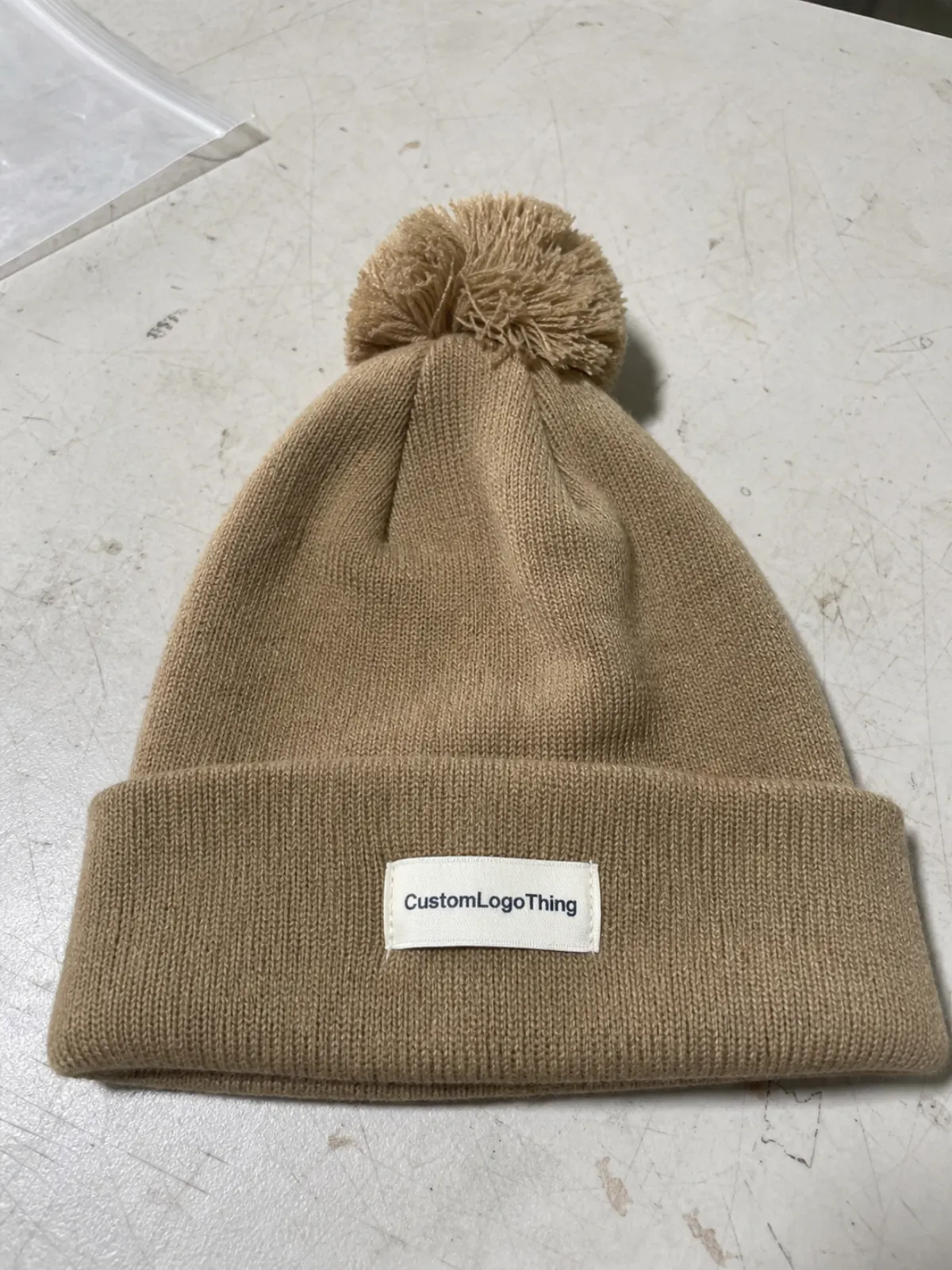
The biggest mistake buyers make is comparing a bare factory quote to a finished retail quote and pretending they are the same thing. They are not. A proper tea Pom Pom Beanies unit cost review separates the base beanie from decoration, sampling, setup, and freight. If those pieces are mixed together, the pricing conversation turns into noise.
The pom itself is usually not the cost driver people imagine. A standard yarn pom can add only a small amount to the total. Faux fur poms cost more, especially if the color is custom or the density is high enough to look premium in photos. Detachable pom hardware adds another layer of labor and inspection. If the attachment has to survive repeated use, the factory has to build and test it more carefully. That is not a line item you want to discover after shipment.
Branding changes the math too. A woven label is usually lighter on the budget than an embroidered patch. A knit-in logo can look cleaner, but it often raises minimums or setup time. Add a sewn-in care label, hangtag, barcode sticker, and retail folding, and you are paying for labor in several small places instead of one obvious one. That is how quotes drift upward without anyone feeling like the number changed much.
Buyer intent matters. A giveaway beanie can tolerate simpler construction because volume and visibility are doing the work. Retail shelves need better consistency, better handfeel, and cleaner finishing. Team merch sits in the middle. People want the logo to read clearly and the hat to look decent in a photo. Seasonal drops are the most unforgiving because presentation and timing are both part of the product.
A useful breakdown looks like this:
- Base beanie cost - knit body, cuff, and standard finishing.
- Decoration cost - label, patch, embroidery, or knit-in branding.
- Sample cost - prototype, revisions, and shipping.
- Freight and duties - the part that decides whether the quote was real.
That split keeps you from comparing a factory number against a landed number from another supplier. One looks cheaper. The other actually tells the truth.
Product Build: Knit, Pom, Cuff, and Label Options
Pom Pom Beanies are simple products with a surprising number of moving parts. Start with the knit body. Acrylic is common because it is stable, easy to source, and priced well for bulk. Wool blends usually cost more, but they bring better warmth and a more premium feel. Recycled fibers can work well too, although pricing depends on yarn availability and the paperwork required to support the material claim. If you need traceability, ask for documentation early. Vague promises do not help when the compliance team gets involved later.
Cuff height changes both appearance and cost. A deeper cuff gives the beanie a heavier retail look and more room for branding. It also uses more yarn. A shallow cuff can save a little money and fit a cleaner promotional brief. Neither version is automatically better. The better choice depends on whether the product has to feel elevated or simply hit a price point.
Pom construction deserves its own discussion because it can quietly move a quote. Yarn poms are generally the least expensive and easiest to match to the knit body. Faux fur poms look richer, but they add material cost and sometimes require more care in attachment. Sewn-on poms are common for fixed retail styles. Detachable poms give buyers styling flexibility, but they bring hardware, extra inspection, and more chances for a weak connection.
Labels change presentation and price at the same time. Common options include:
- Woven label - low profile, clean, and widely used for retail.
- Embroidered patch - more dimensional and usually more expensive.
- Sewn-in care label - often required for retail programs and compliance.
- Hangtag - useful for shelf appeal, but it adds setup and packing labor.
If the design uses multiple yarn colors or a pattern across the body, expect more machine setup and more yarn matching work. That is not marketing fluff. It is labor, and labor is what the unit cost is built from.
Specs That Affect Fit, Feel, and Shelf Appeal
Buyers often ask for a price before the spec is fully defined. That usually leads to useless quotes. A serious tea pom pom beanies Unit Cost Review needs basic technical detail so the factory is not guessing. Ask for gauge, stretch recovery, crown depth, cuff width, and finished dimensions after wear. If the fit is sloppy, the beanie will look cheap even if the yarn was decent.
Knit density matters more than most people expect. A tighter knit usually feels warmer, holds shape better, and looks cleaner on shelf. A looser knit can feel softer at first touch, but it may sag, show uneven tension, or look inconsistent from one piece to the next. Retail buyers notice that. So do customers who try it on and decide it feels flimsy.
Color control is another place where pricing and reality separate. Pantone-matched yarn is useful, but it is rarely free. Melange yarns can hide minor variation and give the hat more visual depth, though they are not the right choice if exact brand color is non-negotiable. Multi-color knitting raises setup complexity and can push both MOQ and lead time upward. A simple two-tone body with one accent element is usually easier than a fully patterned knit, and the quote will show that difference.
Packaging deserves real attention because it changes shelf appeal immediately. A folded beanie in a clean polybag with an insert card looks far better than a loose item tossed into a carton. Retail-ready folding, custom bagging, and barcode labels cost money, but they also affect how the product is perceived. That matters in a store. It matters even more in an online listing where the first image has to carry the whole sale.
If the product will travel through rough channels, ask about transit testing. The ISTA test family is a useful reference for packaging performance, especially if the order is going to distribution, fulfillment, or retail receiving with strict carton rules. A crushed display pack is a small problem on a quote sheet and a very annoying problem on arrival.
Cost, Pricing, MOQ, and What Changes the Unit Quote
Here is the practical version of bulk pricing. The cost per piece drops as quantity rises, but not in a straight line. Factory setup, yarn sourcing, and machine time are easier to absorb at larger volumes. At smaller runs, the same prep work gets divided across fewer units, so the unit cost climbs fast. That is why 100 pieces can feel awkward while 500 pieces starts to look reasonable.
For a standard custom pom pom beanie, these are realistic working bands before freight and duties:
| Quantity | Typical Build | Approx. Unit Cost | Notes |
|---|---|---|---|
| 100-199 | Single-color acrylic, standard yarn pom, woven label | $3.20-$5.20 | Setup pressure is high here; sample costs matter more. |
| 300-499 | Single or two-color knit, standard branding, retail folding optional | $2.40-$3.80 | Common MOQ range for simpler custom styles. |
| 500-999 | Better knit density, cleaner finishing, custom label or patch | $1.85-$3.10 | Often the sweet spot for bulk pricing. |
| 1,000+ | Custom yarn, refined packaging, stronger color control | $1.45-$2.65 | Lower unit cost, more cash tied up upfront. |
Those numbers are a starting point, not a promise. A wool blend, faux fur pom, embroidered patch, or multi-color body can move the quote up quickly. So can packaging upgrades, especially if you want retail-ready folding, hangtags, barcode labels, or individual polybags. Setup fees also show up in less obvious places, such as yarn matching, artwork prep, and machine programming.
Ask what kind of quote you are getting. EXW, FOB, and DDP are not interchangeable, and they can change the way the price looks by a lot. A low ex-factory number can become a very average landed cost once freight, brokerage, and duties are added. That is how a “great” quote turns into a spreadsheet full of regret.
MOQ can also change by variant. A factory may quote 300 total units for a single-color style, then ask for 500 or 1,000 if you want mixed colors, detachable poms, or multiple logo placements. Sometimes the total order meets minimums, but each color still needs its own threshold. Ask early. It saves the awkward moment where both sides pretend the minimum was obvious.
Sample fees are another small trap. Some suppliers credit them back on a bulk order; others do not. Ask before assuming. It is not a huge amount of money, but it changes the real cost of testing a design.
Production Steps, Timeline, and Realistic Lead Times
A normal production flow is easy to describe and easy to mess up. First comes briefing. Then artwork check. Then yarn selection. Then sample development. Then approval. After that the factory moves into bulk knitting, finishing, quality inspection, and packing. If the buyer changes the logo after sampling, the clock resets in annoying ways. That is not a factory issue. That is a spec discipline issue.
For sampling, a realistic range is often 5-10 business days, depending on yarn availability and how many revisions are needed. Bulk production commonly takes 12-20 business days after approval for standard runs, and longer if the order needs custom colors, special packaging, or the factory is already busy. Winter orders fill up quickly. Holiday promo work can clog the schedule even faster.
Delays usually happen in three places:
- Artwork changes - revisions after the sample is already in motion.
- Yarn sourcing - especially for matched colors or less common fiber content.
- Approval delays - the buyer goes quiet, and the factory waits.
Add a buffer between approval and ship date. A week is fine for simple internal orders. Two weeks is safer for seasonal launches or retail programs that cannot slip. If the launch date is fixed, say so up front and ask how the supplier protects schedule risk. You do not want to discover a lead time problem after the catalog is printed.
Packaging compliance can also slow things down. If the product needs retail labeling, carton marks, or specific distribution prep, lock that in before bulk starts. The same goes for traceability needs. If you want recycled content claims or other material statements, ask for certificates and supporting documents rather than a sentence in the quote. Paper trails are boring. They also prevent expensive arguments later.
What to Compare Before You Choose a Supplier
Price matters. Consistency matters more. A supplier that quotes low but ships uneven sizing, weak pom attachment, or color drift from one batch to the next will cost you in returns, rework, and lost time. For a tea pom pom Beanies Unit Cost Review, compare the sample against the spec sheet line by line. Do not just hold it up and say it looks fine. That is how mistakes survive.
Ask for proof of similar work. Not a sales story. Just evidence that the supplier already handles winter headwear and understands how knit tension, label placement, and finishing work together. A factory that is new to this category can still produce decent work, but expect more back-and-forth. That costs time, and time has a price.
Use these checks before placing an order:
- Stitch quality - consistent knit, no loose loops, no obvious skips.
- Color accuracy - batch-to-batch consistency and a clean match to approval.
- Pom attachment - firm construction that survives wear and packing.
- Label placement - centered, straight, and repeatable across units.
- QC tolerance - clear defect limits instead of vague reassurance.
Communication speed is another real filter. Good factories answer with revision notes, not fog. They tell you what changed, what costs more, and what can be simplified without hurting the product. That kind of discipline shows up before production even starts. If the quote is messy, the order usually is too.
Ask how inspection works. Internal QC is standard, but third-party checks can be worth it for larger orders or retail programs. If the product is going into a distribution center, ask whether carton specs, pack counts, and master carton dimensions are documented. Good documentation is boring. It also prevents expensive surprises.
Next Steps: Build a Quote Brief That Gets Usable Numbers
If you want an accurate quote, send a brief that removes guesswork. Start with quantity, color count, logo file, pom style, label method, packaging needs, and ship-by date. Add the target market if the supplier needs to know whether the beanies are for giveaways, retail shelves, or team merch. Those use cases do not need the same finish level, and the quote should reflect that.
Ask for tiered pricing, not a single number. You want to see how the quote changes at 100, 300, 500, and 1,000 pieces. You also want sample cost, setup charges, and freight estimates. That is the only way to compare suppliers on equal ground. One factory may look pricier until you realize the other left out packaging or ignored shipping.
It also helps to request two or three versions of the same style. For example, ask for a basic version, a mid-tier retail version, and a premium version with upgraded yarn or labeling. That gives you a clear view of what each upgrade actually costs. Most buyers overspend because nobody showed them the cheaper path with enough detail.
Keep the brief short, but not vague. The factory does not need a brand manifesto. It needs measurable instructions. A clean tea pom pom beanies unit cost review starts with facts: how many units, what build, what finish, what deadline. Once those pieces are on the table, the quote starts making sense.
Practical quote checklist:
- Target quantity and any color splits
- Yarn type and body color
- Pom style and attachment method
- Logo file, label choice, and packaging request
- Delivery window and destination
- Sample fee, bulk unit cost, and landed cost estimate
Get those details right and you stop shopping for fantasy pricing. You start buying a real product.
What is the typical unit cost for tea pom pom beanies?
Unit cost usually depends on order size, yarn choice, pom type, and branding method. For simple bulk orders, a realistic starting range is about $1.45-$5.20 per piece before freight and duties, with lower pricing at higher volume. Ask for a tiered quote so you can compare 100, 300, and 500+ pieces instead of guessing from one number.
What MOQ should I expect for custom tea pom pom beanies?
Many factories set a lower MOQ for simple single-color styles and a higher MOQ once you add custom colors, special poms, or complex branding. A practical range is often 100-300 for basic programs and 500+ for more customized builds. If you need mixed colors, ask whether the supplier can count total pieces across variants or whether each color needs its own minimum.
Which feature raises pricing the fastest on pom pom beanies?
Custom yarn colors, multi-part branding, and premium pom styles usually raise cost faster than small knit changes. Packaging upgrades can also climb fast if you want retail-ready folding, inserts, polybags, or custom bagging. Those details are small on paper and expensive in aggregate.
How long does production usually take after approval?
Sampling often takes about 5-10 business days, while bulk production commonly lands in the 12-20 business day range after approval for standard orders. Add extra time for revisions, peak season demand, and shipping so the order does not miss the launch window.
What should I include to get an accurate quote for tea pom pom beanies?
Send quantity, size, colors, artwork, pom style, label method, packaging request, and your target delivery date. Also ask for sample fees, bulk unit cost, and freight estimates so the quote is actually usable. If the supplier has to guess, the price will wander.

