Shoppers may throw away a hang tag in five seconds. The neck label, hem label, or sleeve label stays with the garment for years, rubbing against skin, showing up in photos, and surviving wash after wash. A woven label custom order is small enough to fit between two fingers, yet it can make a garment feel finished or oddly unfinished. Funny how that works.
A Custom Woven Label is made by weaving colored threads into a logo, size mark, wordmark, or graphic. It is not ink sitting on top of fabric. The design becomes part of the label structure, which is why woven labels usually outlast basic printed branding labels through washing, abrasion, folding, and daily wear.
For apparel brands, labels are not decoration added after the “real” product is done. They are trim components. Pick the wrong fold, thread, density, or backing, and the sewing floor inherits a nuisance. Pick the right specs, and the label supports the garment instead of fighting it.
What a Woven Label Custom Order Actually Buys You
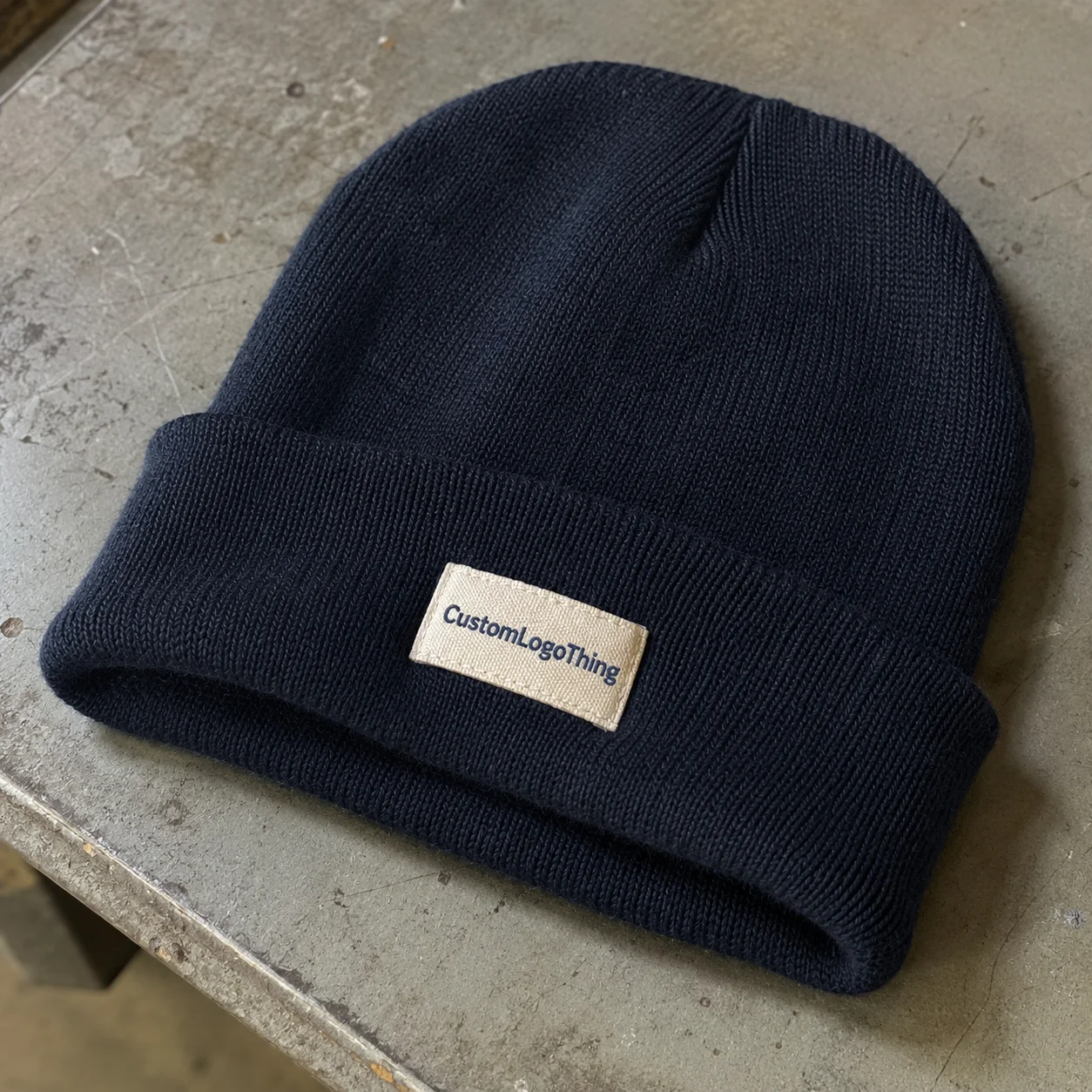
A woven label custom order buys more than a logo on fabric. It buys a label built for a specific location: neck seam, side seam, hem, sleeve, beanie cuff, tote edge, pouch, or limited-edition collection tag. Each placement creates a different problem. Neck labels need softness. Hem labels need edge durability. Outer labels need enough contrast to read from a few feet away.
Common apparel uses include neck labels, size labels, care/content labels, hem tags, sleeve labels, beanie labels, bag labels, and collection labels. Some brands use woven labels as the only permanent brand mark. Others pair them with hang tags, stickers, mailers, custom printed boxes, and other custom packaging products so the branding stays consistent from unboxing to long-term wear.
Woven and printed labels solve different jobs. Woven labels feel more premium and are generally more durable through wash cycles. Printed labels are better for tiny care copy, laundry symbols, fiber content, country-of-origin text, QR codes, gradients, and tagless alternatives. Trying to cram a full legal care label into a half-inch woven tag is how good intentions become unreadable thread soup.
Buyer reality check: the goal is not “make my logo pretty.” The goal is to Choose the Right weave, fold, size, thread colors, and backing so the label works on the actual garment.
Before requesting a quote, expect to make decisions about size, material, fold type, color count, backing, quantity, sampling, and delivery timing. None of these sound glamorous. All of them affect cost, appearance, comfort, and sewing efficiency.
How Woven Labels Are Made From Artwork to Finished Trim
The production process starts with artwork. A supplier converts your logo or design file into a weaving pattern, then a loom uses colored threads to build the label line by line. Think of it as translating a flat digital design into thread instructions. Clean artwork translates better. Messy artwork creates guesswork.
Vector files are best because they have defined edges and scale cleanly. AI, EPS, and vector PDF files usually give the production team the clearest starting point. A high-resolution PNG can work for simple marks, but it often needs cleanup before digitizing. If the logo has shadows, gradients, hairline strokes, or a tiny tagline, expect edits. Thread is not a magic printer. Sadly.
Polyester thread is the common workhorse for apparel labels because it is durable, colorfast, washable, and practical at volume. Cotton thread exists, and specialty threads can create certain effects, but polyester usually gives the best mix of cost, strength, and consistency for fashion labels, workwear, bags, and accessories.
Weave density matters. Higher-density weaving can show finer detail, smoother curves, and cleaner small shapes, but it costs more and still has limits. A 0.75-inch label cannot carry the same amount of detail as a website header. If the label needs to show a detailed crest, small letters, and four lines of copy, make it larger or simplify the art. There is no prize for making the loom suffer.
- Straight cut: flat label with cut edges, often used as a sew-on patch.
- End fold: short folded ends that hide edges and create a cleaner sew line.
- Center fold: folded in the middle, common for neck labels sewn into a seam.
- Loop fold: folded to create a loop, often used for hems and side seams.
- Miter fold: angled folded ends, useful for certain patch-style applications.
- Manhattan fold: a structured fold often used on premium neck labels.
Backings are optional. Sew-on labels remain the standard for apparel. Iron-on backing can help with patches, accessories, or low-stress applications, though wash durability depends on fabric type, heat press settings, dwell time, pressure, and adhesive quality. Temporary adhesive backing helps hold placement before sewing. It is not a substitute for stitching on garments that need to survive real use.
For larger or more complex orders, a digital proof or physical sample may be offered before bulk production. Proofs usually show size, fold lines, colors, and artwork position. Physical samples are better for checking texture, edge feel, thread contrast, and real readability under normal light.
Key Specs That Change the Look, Feel, and Durability
Size is the first spec to settle. Most apparel labels land around 0.5 to 2 inches tall and 1 to 3 inches wide, but the right size depends on placement and artwork complexity. A simple two-letter monogram can work small. A full brand name with a tagline needs more room. Shocking, I know: physics still applies to branding.
Fold style should follow the garment. Center fold labels work well in neck seams because the fold sits neatly into the seam allowance. End fold labels are good for flat branding patches because the cut edges are tucked under. Loop fold labels fit hems, side seams, cuffs, and bags. Straight cut labels are fine for simple sew-on applications, but exposed heat-cut edges can feel firmer against skin.
Material feel changes the buyer experience. Damask woven labels are smoother and better for detailed logos, so they are common for premium apparel. Satin woven labels have a glossier look and soft hand, though fine detail may not look as crisp. Taffeta is usually more basic and economical, often used for simple size labels or budget-conscious runs.
| Label Type | Best Use | Typical Feel | Detail Level |
|---|---|---|---|
| Damask woven label | Premium neck labels, outer branding, detailed logos | Smooth, soft, dense | High |
| Satin woven label | Glossy fashion labels, lingerie, boutique apparel | Soft and shiny | Medium |
| Taffeta woven label | Size labels, basic branding, economical runs | More textured | Low to medium |
| Printed care label | Care instructions, compliance copy, symbols | Varies by substrate | Very high for text |
Color count should stay controlled. Most woven labels work best with 2 to 6 thread colors. More colors can increase cost, reduce clarity, and make small details harder to read. Strong contrast beats rainbow ambition on a postage stamp almost every time.
Edge quality affects comfort. Heat-cut edges can feel slightly firm, especially on neck labels and kidswear. Folded edges hide cut ends and usually feel cleaner against skin. If a label touches the wearer, softness matters. Scratchy labels get cut out. Then the branding is gone. Great plan.
Text readability deserves brutal honesty. Minimum letter height depends on font, weave density, thread contrast, and label size, but very small copy often fails below roughly 1.5 to 2 mm in height. Legal content, multi-language care instructions, and dense fiber copy usually belong on printed satin, cotton, or nylon care labels, not on a tiny woven brand label.
Placement drives spec choices. A neck label needs comfort and wash resistance. A hem label needs durable edges and a fold that handles seam stress. An outer patch label needs strong contrast because it becomes part of visible product presentation after the box, bag, or mailer is gone.
Cost, MOQ, and Unit Pricing for Custom Woven Labels
Woven label pricing usually depends on quantity, label size, weave density, number of thread colors, fold type, backing, sampling, and shipping method. A basic 1 x 2 inch damask label with two colors and a center fold prices very differently from a large, high-density, six-color patch with iron-on backing.
Minimum order quantities vary by supplier and label type. Small runs often start around 100 to 300 pieces, but stronger unit pricing usually appears around 500, 1,000, and 5,000 pieces. The first batch absorbs setup, digitizing, and machine prep, so buying 100 labels can feel annoyingly expensive per unit. Machines do not care about your launch nerves.
| Quantity | Typical Use Case | General Unit Cost Behavior | Buyer Note |
|---|---|---|---|
| 100-300 pieces | Test launch, sample run, microbrand drop | Highest per-label cost | Good for proofing the idea, weak for margins |
| 500 pieces | Small apparel batch | Better, but setup still matters | Often a practical entry point |
| 1,000 pieces | Growing brand or repeat SKU | Noticeably more efficient | Useful for planning multiple drops |
| 5,000+ pieces | Established program or wholesale production | Lowest common unit range | Best if specs are already proven |
As a broad buying range, simple small woven labels may cost only a few cents each at higher volume. Smaller batches, larger dimensions, high-density weaving, extra colors, special folds, iron-on backing, or physical sampling can push the unit price higher. Supplier location, freight method, exchange rates, and current material costs also matter, so treat any quote without specs as a guess wearing a nice shirt.
Sample fees and setup fees vary. Some suppliers waive or credit them at higher quantities. Others charge separately for artwork conversion, loom setup, or physical samples. Ask whether revisions are included before approval. One free proof revision is common; endless design therapy is not.
Do not compare quotes by unit price alone. A cheaper label with scratchy edges, muddy lettering, wrong folds, or weak color matching is not a bargain. It is a tiny fabric problem sewn into every product. Ask for size, quantity breaks, material, fold, backing, color count, sample cost, production time, shipping time, and revision policy in writing.
If labels are part of a wider branded packaging system, keep them consistent with hang tags, mailers, retail packaging, and custom labels and tags. The goal is not making every piece identical. It is making the brand feel intentional across every touchpoint.
Production Steps and Timeline From Quote to Delivery
A typical woven label custom order follows a predictable path: submit artwork and specs, receive a quote, approve a digital proof, approve a physical sample if needed, start bulk weaving, finish and pack the labels, then ship. Simple enough. The delays usually come from missing details, not from the weaving itself.
Digital proofing often takes 1 to 3 business days for straightforward artwork. Physical sampling commonly takes about 5 to 10 business days, depending on the supplier queue and label complexity. Bulk production often takes 7 to 20 business days after approval. Large orders, specialty folds, high-density artwork, or multiple colorways can add time.
Several things slow orders down: unclear artwork, missing dimensions, undecided fold type, too many color changes, tiny text revisions, slow sample approvals, holidays, and last-minute shipping address changes. The classic buyer move is saying “same as the mockup” while the mockup has no measurements. Please do not do that to yourself.
Shipping choices matter. Express air shipping is faster and more expensive. Economy freight can help larger orders, but it may add days or weeks. International shipments can also run into customs review. No one loves freight math, but it exists, and it loves showing up right before a launch.
Build in buffer time before product launches, photo shoots, wholesale delivery dates, and cut-and-sew production schedules. If your sewing contractor needs labels by Monday, do not approve a sample on Friday and expect miracles. A reasonable production calendar gives labels the same respect as fabric, zippers, elastics, and packaging design assets.
Request a physical sample for first-time brand labels, premium garments, skin-contact labels, high-detail logos, visible outer patches, and any order over a quantity where a bad result would hurt. Repeat orders are usually faster because the weaving program, thread colors, fold style, and approved specs are already on file.
For shipping and distribution planning, packaging buyers sometimes reference transit testing standards from groups like ISTA, especially for larger retail or ecommerce programs. Labels themselves are small, but they often move inside a broader product packaging workflow that still needs sane timing.
Common Artwork and Ordering Mistakes That Ruin Labels
The first mistake is using a logo designed for a website and expecting it to weave perfectly at half an inch tall. Digital screens forgive fine lines, gradients, shadows, and micro text. Thread does not. A logo may need a dedicated woven-label version with fewer details, thicker strokes, and better contrast.
The second mistake is choosing too many thread colors. Woven labels reward restraint. Two or three strong colors often look sharper than six colors forced into tiny shapes. If your brand palette has eight shades, pick the ones that matter most for recognition.
The third mistake is skipping real measurements. Measure the garment placement, seam allowance, and visible label area before choosing size. A 1.5-inch-wide label may look fine on a hoodie neck seam and ridiculous on a baby tee. Scale is not an opinion. It is a ruler.
The fourth mistake is picking the wrong fold. A center fold label ordered as straight cut can create extra sewing labor or an awkward finish. A loop fold meant for a hem should have enough folded depth to catch securely in the seam. Ask the sewing team what they prefer before locking the spec.
The fifth mistake is ignoring skin feel. Neck labels, kidswear labels, base layers, and underwear labels need soft materials and clean edges. If the label scratches, customers remove it. For premium apparel, a soft damask center fold label may cost more than a basic taffeta label, but the garment experience is better.
The sixth mistake is approving proofs too casually. Check spelling, size, scale, thread color callouts, fold lines, logo position, front/back orientation, and cut marks. Once bulk weaving starts, “Can we move it two millimeters?” becomes expensive or impossible.
The seventh mistake is ordering exactly the number needed. Add overage for sewing mistakes, replacements, samples, photos, returns, future repairs, and quality checks. For small production runs, 5% to 10% extra is a practical buffer. For larger programs, your factory or sewing contractor may have its own trim allowance.
If your broader product launch includes mailers, inserts, stickers, or Custom Printed Boxes, keep a central spec sheet for all trim and branded packaging components. FSC can also be relevant if you are pairing labels with paper hang tags, cartons, or certified paperboard; the Forest Stewardship Council explains chain-of-custody certification for paper-based materials.
Next Steps Before You Request a Label Quote
Before requesting pricing, gather the details a supplier actually needs. A vague “How much for labels?” message creates vague answers. Then everyone wastes time pretending the quote is useful.
- Logo file: AI, EPS, vector PDF, or high-resolution PNG if vector is not available.
- Label size: width and height in inches or millimeters, plus folded and visible dimensions if applicable.
- Quantity: ask for breaks at 300, 500, 1,000, and 5,000 pieces for budget planning.
- Fold type: center fold, end fold, loop fold, straight cut, miter fold, or Manhattan fold.
- Placement: neck, hem, sleeve, side seam, beanie cuff, bag, or outer patch.
- Garment type: tee, hoodie, denim, knitwear, kidswear, activewear, accessory, or bag.
- Thread colors: Pantone references help, though thread matching is usually approximate.
- Backing needs: sew-on, iron-on, temporary adhesive, or no backing.
- Deadline: include the date labels must arrive, not just the launch date.
- Shipping destination: city, state or region, postal code, and country.
Create two artwork versions if your main logo is detailed: the full brand logo and a simplified woven-label version. The label version may remove a tagline, thicken lines, reduce colors, or increase spacing between letters. That is not watering down the brand. It is adapting the design to the manufacturing method.
Decide what job the label has. Is it functional sizing? Visible branding? Luxury positioning? Compliance support? A woven neck label, a side seam flag, and a care/content label should not all use the same spec just because they belong to the same brand. Different jobs need different materials, sizes, and artwork rules.
The cheapest smart order is usually not the smallest order. If 300 pieces costs close to 500, or 500 costs close to 1,000, review the math against your production plan. Labels are small, easy to store, and useful across repeat styles if the branding stays stable. Do not overbuy a label tied to one seasonal slogan unless you enjoy owning very organized clutter.
Order a physical sample for premium apparel, first-time brand launches, skin-contact labels, and visible outer branding. Keep an approved spec sheet with size, material, fold, colors, artwork version, backing, supplier notes, and order date. Repeat orders become much easier when the details are not buried in someone’s inbox under “final_final_label_v3.”
Before placing a woven label custom order, confirm the design can actually be woven cleanly, then match the specs to the garment instead of forcing one label to do every job. That one decision saves money, rework, and a surprising amount of swearing.
FAQs
What is the minimum order quantity for custom woven labels?
Many suppliers start around 100 to 300 pieces, but 500 or 1,000 pieces usually gives better unit pricing. MOQ depends on label size, weave type, fold, backing, color count, and whether a physical sample is required. Ask for tiered pricing so you can compare the real cost difference between a tiny test run and a more efficient bulk order.
How long does a custom woven label order take?
A straightforward order may take about 2 to 4 weeks including proofing, production, and shipping. Physical samples, complex artwork, slow approvals, holidays, and international freight can add time. Repeat orders are usually faster because the approved artwork, weave file, thread colors, and specs are already set.
Are woven labels better than printed labels for clothing?
Woven labels are usually better for premium branding, durability, and long-term wash resistance. Printed labels are better for tiny care text, detailed symbols, gradients, QR codes, or very soft tagless applications. Many apparel brands use both: woven labels for branding and printed labels for care and compliance details.
What artwork works best for woven label customization?
Simple vector artwork with clear shapes, strong contrast, and limited colors works best. Avoid tiny lettering, thin lines, shadows, gradients, and complex textures unless the supplier confirms they can translate into thread. If the logo is detailed, create a simplified label version instead of forcing the full artwork into a small woven space.
Can a woven label custom design include care instructions?
Yes, a woven label custom design can include care instructions, but it is not always the best choice if the text is small or includes many symbols. Brand marks, sizes, and short phrases can work well on woven labels if the label is large enough. Detailed care, fiber content, country of origin, and compliance copy are often cleaner on printed satin, cotton, or nylon care labels.