A dad hat leaves very little room for a label to hide. The crown is soft, the profile is low, and the trim usually sits close to a seam, strap, sweatband, or curved panel. If you are buying woven labels for Dad Hats Bulk, the quote should cover more than a unit price. It should define the size, fold, thread colors, edge finish, placement, backing, packing method, and the production window your cap run needs to hit.
That may sound like too much attention for a small piece of fabric. It is not. A label that is only 25 or 30 mm wide can still become the brand mark customers see every time the hat is worn, stacked in a retail display, or photographed for a product page. A clean woven label makes a simple cotton twill cap feel finished. A fuzzy, stiff, crooked, or oversized label can make the same cap feel like a rushed promo item.
The best label decisions are practical before they are decorative. The trim has to sew cleanly, sit flat, survive handling, and stay readable at normal viewing distance. Buyers who settle those details early usually spend less time chasing revised proofs, replacement stock, and production delays later.
Why woven labels for dad hats bulk work better than printed trims
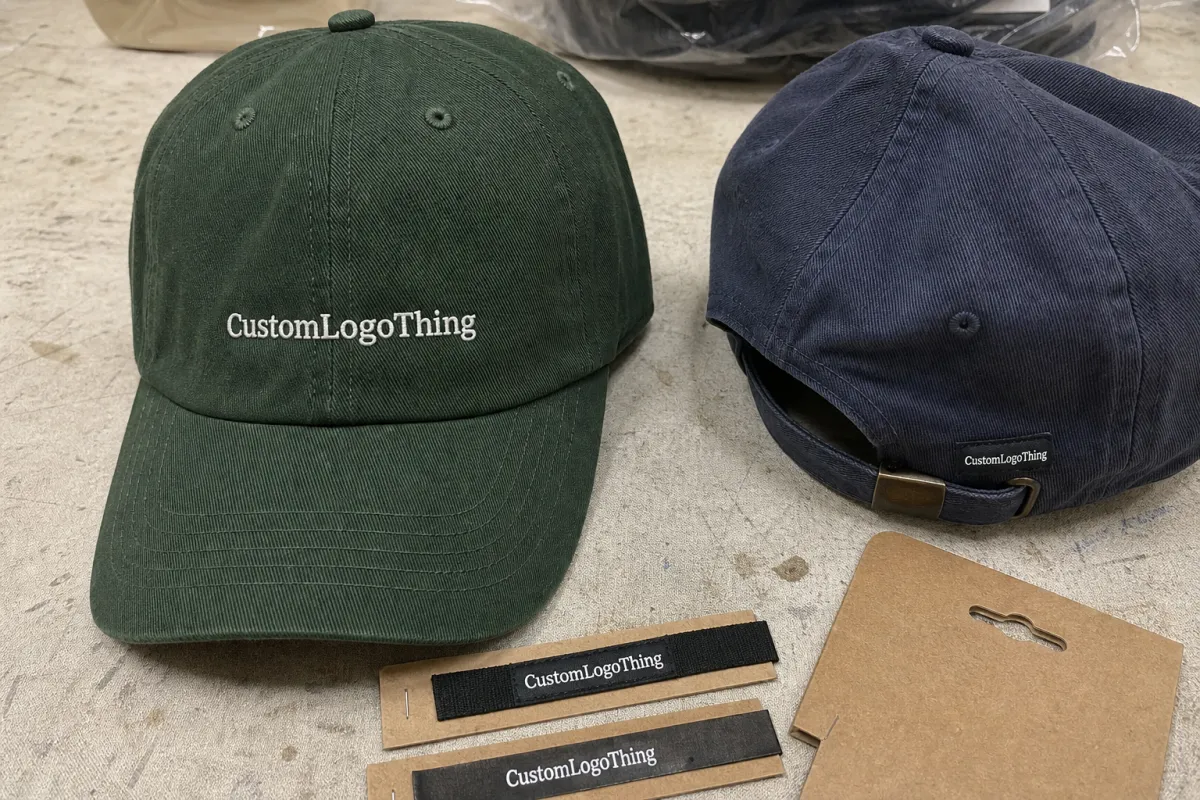
Dad hats sit relaxed on the head, so the trim has to move with the cap rather than fight it. A thick patch can look good on a structured cap but feel bulky on a low-profile front panel. A printed satin label may work for certain uses, yet it can curl, fade, or look too light once it is sewn onto washed chino, cotton twill, corduroy, brushed canvas, or pigment-dyed fabric.
Woven labels solve a specific cap-trim problem: they keep the brand mark flat, tactile, and readable without adding the weight of an embroidered patch. The logo is built from thread, not surface ink, so the design will not crack in the way some prints can after repeated flexing, packing pressure, or light washing. That matters when the same hat may be worn hard, tossed in a bag, steamed, restocked, and handled by several people before it reaches the final customer.
Printed trims still have a place. If the artwork includes photographic detail, a short-run event date, or a soft tonal effect that cannot be simplified, print may be the better construction. For repeat dad hat programs, though, woven construction usually gives better continuity across reorder cycles because width, thread color, fold, edge, and cut can be controlled as part of a repeatable production spec.
Practical callout: A small woven label often becomes the only visible brand mark on a minimal dad hat. If it looks soft, crooked, scratchy, or too bulky, the cap loses its clean retail feel before anyone studies the fabric weight or stitching.
Bulk ordering is not only a way to lower unit cost. It is also a way to reduce variation across a cap run. If the first 1,000 hats use one label width and the replenishment uses a slightly different fold or border, the mismatch will show in product photos, warehouse picks, and retail displays. Keeping the trim spec stable protects the finished cap from that kind of quiet inconsistency.
Choose the right fold, size, and edge finish for a low-profile cap
The right label spec starts with placement. A dad hat has a curved crown, a sweatband, side seams, rear opening, and adjustable closure area, and each location puts different pressure on the label. A label that looks sharp beside the back strap may feel irritating if the same construction is placed against the forehead. A label that sits nicely inside a seam may pucker if it is stitched flat across an exterior curve.
Center fold labels are common for seam inserts because the folded edge stays clean and the design can appear on one or both sides. End fold labels work well for exterior accents because the raw ends tuck under the stitch line. Loop fold labels suit small flag-style branding, especially at a side seam or back opening. Flat-cut labels are useful when the full face of the label needs to be visible and stitched down.
Size matters more than many buyers expect. For low-profile caps, common woven label sizes often sit around 20-45 mm wide and 10-30 mm tall, depending on the position and fold. A wider label can carry more detail, but it may pucker on a curved surface if the base fabric, fold, and stitch path are not matched carefully. A smaller label can look refined, but only if the artwork has enough contrast and breathing room to weave cleanly.
- Inside sweatband: Keep the label thin, soft, and narrow enough to avoid forehead irritation.
- Back closure area: Use end fold or flat-cut labels when branding needs to sit near the strap without crowding the buckle.
- Side seam flag: Choose strong contrast because the visible label face is small and often viewed from an angle.
- Exterior crown accent: Confirm edge finish and stitch alignment before committing to a larger flat label.
For most dad hat programs, a narrow, low-profile woven label with soft edges performs better than a large label trying to carry too much information. A 30 mm x 15 mm label can handle a simple logo beautifully. A 55 mm label filled with tiny wording may look impressive on a digital proof, then feel clumsy once sewn onto a curved crown.
Edge finish deserves the same attention as size. Heat-cut edges should feel clean, not sharp. Merrowed borders can add structure, but they also add visual and physical thickness. Ultrasonic cutting, soft selvage edges, or carefully specified end folds may be better for labels placed near skin or on lightweight cap fabrics.
Artwork and spec details that keep every run consistent
Good artwork saves time. A clean vector file, usually AI, EPS, or editable PDF, gives the production team a better starting point for thread mapping, border selection, and scale. A low-resolution PNG pulled from a website header can be quoted, but it often creates extra proofing questions because the true line weight, spacing, and logo shape are not clear.
The core details are simple: final label size, fold type, thread color count, border style, background color, exact wording, backing, and placement. If the design includes a small registered mark, a thin underline, a tiny icon, or text that appears below 5 points on screen, expect a discussion before production. Woven labels can be precise, but thread has physical limits. Very fine type, gradients, shaded effects, and delicate negative space often need to be simplified.
That simplification is not a downgrade. It is translation from screen artwork into thread. A logo designed for a phone screen may need wider letter spacing, fewer colors, or a stronger outline to stay sharp in woven form. Damask woven labels can hold finer detail than many basic woven constructions, yet even damask has limits if the visible face is only 20 mm wide.
Thread color should be treated as a material match, not an exact ink match. Pantone references help, but yarn reflects light differently than printed ink, and the final appearance can shift based on weave density, background color, cap fabric, and lighting. If the label will be sewn onto several cap colorways, review contrast against the lightest and darkest fabrics before approval.
Placement and orientation need clear instructions. If the label folds into a seam, confirm which face points outward, whether the artwork reads correctly after folding, and whether any reverse-side branding is needed. Mirror-image mistakes are preventable, but they still happen when the instruction says only “same as sample” without a marked photo or diagram.
Backing can affect both production speed and cap performance. Standard sew-in woven labels are flexible and widely used for cap factories. Heat-seal backing may work in some applications, but caps are curved and may include heat-sensitive components, so testing is wise before using it on a large order. Pressure-sensitive backing can help hold labels in place before sewing, though it should not be treated as the only attachment method for a wearable product.
If the cap is part of a larger trim package, keep the woven label spec aligned with the rest of the branded materials. Your Custom Labels & Tags, hang tags, care labels, stickers, and packaging sleeves should feel related without forcing every item to use the same size, material, or finish.
Pricing, MOQ, and unit cost for bulk label orders
Price is driven first by quantity, then by size, thread colors, fold style, border construction, backing, packing, and shipping method. For woven labels for Dad Hats Bulk, a simple two-color end fold label at 5,000 pieces may fall around $0.08-$0.18 per unit before freight. A larger damask label with more colors, tighter detail, special backing, or custom packing may land closer to $0.16-$0.35 per unit. These are working ranges, not fixed rules, because artwork and finishing choices can move the number quickly.
MOQ expectations vary by supplier and construction. A small brand test may start around 300-500 pieces, but stronger pricing usually appears at 1,000, 2,500, or 5,000 pieces. Larger runs spread setup, proofing, and machine preparation across more units, which is why the unit cost drops even though the total invoice is higher.
| Order size | Typical use | Common unit range | Buyer note |
|---|---|---|---|
| 300-500 labels | Small brand test or sample cap run | $0.20-$0.45 | Good for validation, usually not the lowest cost per piece |
| 1,000-2,500 labels | Promo drop or first retail batch | $0.12-$0.28 | Useful balance of cost control and manageable inventory |
| 5,000-10,000 labels | Full cap production or replenishment | $0.08-$0.20 | Best fit when label use is tied to confirmed cap quantities |
Do not judge the quote by label unit price alone. Freight, rush handling, carton labeling, polybag requirements, split shipments, and warehouse receiving rules can change landed cost. If labels ship directly to a cap sewing facility instead of your office, confirm carton marks, SKU separation, bundle counts, and packing list format before production closes.
Overage should be planned rather than guessed at the last minute. Many cap runs benefit from 3%-5% extra labels for mis-sews, production samples, quality checks, and future replacements. If the cap factory is working across several colorways or sewing lines, a slightly higher buffer may be sensible. Too little overage can stop production for a small shortage; too much creates trim inventory that may become useless if the logo, color, or label size changes.
For repeat trim orders, Custom Logo Things can align label quantities with broader purchasing through Wholesale Programs, which is useful when cap labels, patches, hang tags, and other branded components need to follow the same production calendar.
Process and timeline from proof to final shipment
The workflow is usually straightforward when the inputs are clean: quote review, artwork submission, proof preparation, buyer approval, production, quality check, packing, and shipment. The proof stage is where many schedules are either protected or lost. A clean vector logo can remove days of back-and-forth because the line weight, thread colors, fold, and final dimensions are easier to confirm.
For standard woven label orders, production often runs about 10-18 business days after proof approval, depending on quantity and finishing. A physical sample or pre-production check can add 5-10 business days, but it is often worthwhile when color, hand feel, fold, or texture needs to be verified before the full run. Rush production may be possible, although the buyer side must move quickly. A proof left unapproved for three days can erase the value of an expedited schedule.
A practical order sequence looks like this:
- Confirm cap quantity, label placement, target ship date, and required arrival location.
- Submit vector artwork with Pantone or thread color references if available.
- Review the digital proof for size, fold, orientation, visible artwork area, and backing.
- Approve a physical sample if the project requires material confirmation before bulk production.
- Release production only after quantity, overage, carton marks, and packing instructions are final.
Shipping time is separate from manufacturing time. Air freight can save an urgent launch, but it can raise landed cost sharply once cartons get larger. Ocean or consolidated freight may make sense for repeat programs with more room in the calendar. Standards such as ISTA packaging test procedures are more often discussed for finished packaged goods than loose trims, but the same principle applies: pack the labels so they arrive clean, counted, separated, and ready for sewing.
The receiving location matters. A brand office may only need a clean packing list and a few marked cartons. A sewing facility may need labels bundled by 100, separated by SKU, identified by purchase order, and packed in a way that line workers can open without mixing designs. Those details are not glamorous, but they prevent avoidable slowdowns on the production floor.
Quality control checks that matter on bulk cap trims
Quality control for cap labels is quiet work, but it protects the entire run. The first check is color consistency. Thread lots should remain stable across cartons, especially if the same logo is being sewn onto several cap colorways. Under warehouse lighting, navy and black can look close; under retail lighting, the difference may be obvious.
Edge finishing comes next. Heat-cut edges should be clean, not scratchy, shiny, or darkened. End folds should be even. Center folds should land where the proof says they land. If a label is only 25 mm wide, a 1 mm variation can affect sewing alignment and visual spacing on a small cap panel.
Weave density should match the artwork. Fine lines need enough density to hold shape, while heavy block logos need enough structure to avoid looking muddy. If the design includes small type, inspect it from normal viewing distance, not only under magnification. A label can look acceptable under a loupe and still be unreadable once sewn to a finished hat.
- Count accuracy: Verify total pieces and carton-level quantities before release.
- Fold orientation: Confirm the visible face matches the sewing instruction sheet.
- Width consistency: Spot-check measurements across cartons, not only the first bundle.
- SKU packing: Keep colorways, label versions, or size groups separated and clearly marked.
- Lighting review: Inspect labels under lighting similar to finished cap approval conditions.
For labels placed near skin, hand feel should also be reviewed. A beautiful edge that scratches the forehead or catches hair is not a good cap label. Softness, thickness, and flexibility matter more on dad hats than on rigid packaging trims because the hat bends and moves with the wearer.
Sustainability-minded programs may ask about recycled yarns, reduced poly use, FSC-certified paper packaging, or lower-waste packing methods. The Forest Stewardship Council is relevant when paper hang tags, sleeves, or cartons are part of the same branded trim package. Claims should stay tied to the actual materials used. Not every woven label needs a sustainability claim, and a vague claim can create more risk than value.
Common mistakes that raise rework and delay delivery
The most common mistake is approving artwork that is too detailed for the chosen label size. A five-letter brand name may weave beautifully at 28 mm wide. A long slogan, location line, tiny icon, and registered mark may not. If readability matters, simplify early instead of expecting thread to behave like high-resolution ink.
Another expensive mistake is changing fold type, dimensions, or logo colors after proof approval. On a small sample order, that may be frustrating. On a large bulk order, it can mean revised proofs, remade production materials, lost machine time, and a pushed delivery date. Changes are far cheaper before approval than after production starts.
Placement instructions need to be specific. “Back of hat” is not enough. Does the label sit above the closure, beside the buckle, under the sweatband, or inside the side seam? Which edge is sewn first? Which side faces out after folding? A marked cap photo can answer these questions faster than a paragraph of vague notes.
Contrast creates trouble more often than buyers expect. A cream label with tan thread may look refined on a black cap and nearly invisible on a khaki cap. If one label will be used across six cap colors, check the proof against the main fabric shades. Strong borders, limited thread colors, and clean negative space usually travel better across mixed colorways.
Buyers also sometimes overvalue complexity. A dad hat is relaxed by design. A sharp two-color woven label, correctly sized and sewn straight, often looks better than a crowded label trying to carry every brand detail at once.
Order the right label spec on the first try
Start with the production facts. Gather the cap quantity, target ship date, placement location, preferred fold, cap colorways, and required delivery location before requesting a quote. If the labels are going directly to a sewing facility, include the packing instructions the factory needs, such as bundles of 100, carton labels by SKU, or separate bags for each design.
Send the logo in a clean vector format and list the exact wording to be woven. If Pantone references exist, include them, but remember that thread is not ink. A close thread match is usually the realistic goal, and the final appearance can shift with weave density, background color, cap fabric, and light.
Confirm the budget range and MOQ early. A 500-piece order may be the right move for a test. A 5,000-piece run may be better for a retail launch with confirmed cap quantities. If a physical sample is needed, build that into the schedule from the start rather than adding it after the first proof.
Review the final proof slowly. Check size, colors, fold, orientation, quantity, backing, edge finish, and packing. Then release the order only when the spec matches the cap production plan. That is the cleanest way to buy woven labels for Dad Hats Bulk without wasting units, delaying sewing, or paying for revisions that could have been prevented at the proof stage.
FAQ
What fold works best for woven labels for dad hats bulk orders?
Center fold and end fold labels are the most common choices because they sit neatly on a soft, low-profile cap. Flat-cut labels work when the brand wants a visible exterior trim rather than an internal seam insert. The best fold depends on where the label will be sewn, how much of it should show, and whether the edge will touch skin.
How many woven labels do I need for a bulk dad hat order?
Match the label count to the cap quantity, then add overage for mis-sews, samples, quality checks, and future replenishment. For many production runs, 3%-5% extra is a practical starting point. If the same label will be used across several cap colors or sewing lines, confirm the full total before production starts.
What affects pricing for woven labels on dad hats in bulk?
Price is shaped by quantity, size, fold style, thread color count, edge finish, backing, and packing requirements. Complex artwork or very small text can require more careful weaving, which may increase cost. Rush timing, shipping method, split shipments, and carton labeling can also change the final landed price.
How long does production usually take for woven label orders?
Standard production often runs about 10-18 business days after proof approval, depending on order size and finishing details. A physical sample can add 5-10 business days. Shipping time is separate from manufacturing time, so confirm both production and transit before setting the delivery expectation for the cap run.
Can one woven label design work across multiple dad hat colors?
Yes, if the artwork has enough contrast to stay readable on both light and dark cap fabrics. Simple logos, strong borders, and limited thread colors usually perform better across mixed colorways. Review the proof against the main cap colors before committing to the full bulk run.


