Woven Labels Material Guide for Electronics Sellers
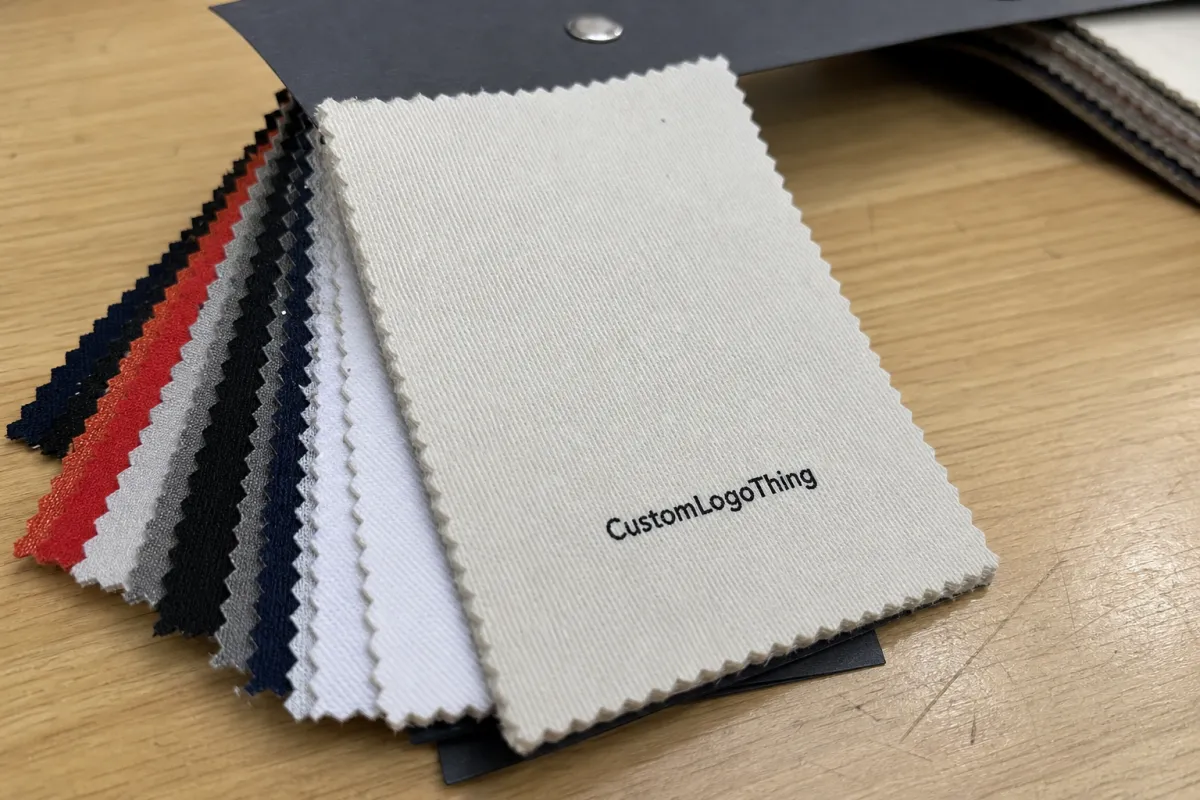
A label can look clean and premium on a fabric pouch, then turn muddy on a dark cable wrap because the yarn, weave density, and contrast were never matched to the real product. That is the practical reason this Woven Labels Material guide for electronics sellers starts with use, not decoration.
Electronics sellers use woven labels on charger cases, EVA sleeves, cable organizers, headphone pouches, power bank covers, repair kits, and branded accessory bundles. These are not static display pieces. They get handled, compressed, tossed into drawers, packed into cartons, and photographed by customers under poor lighting. A paper sticker may survive the product shot. A woven label has to survive the ownership cycle.
The main material families are damask, satin, and taffeta. Damask is the crispest and is usually the strongest fit for small logos, compact lettering, model marks, and fine icon work. Satin has more shine and a softer surface, but that reflective finish can reduce readability if the contrast is weak. Taffeta is typically more economical and a little stiffer, often used for care labels or simpler branding where detail is not the priority.
For packaging buyers, the label is part of the product experience. It touches the customer, frames the brand, and sometimes helps with return handling because the pouch, sleeve, or organizer remains identifiable after the outer carton is gone. If the rest of the pack uses clean corrugated cardboard, kraft inserts, molded pulp, or recycled board, the woven label should support that same level of intent rather than reading as a random add-on.
Practical rule: judge the label at actual size, on the actual product color, under normal retail or desk lighting. Screen artwork is only a starting point.
That sounds simple. It is also where many small electronics orders go wrong. The label is approved as an enlarged PDF, the pouch is black, the logo thread is charcoal, and nobody notices the problem until 3,000 finished units are waiting for packing.
How Woven Label Construction Affects Readability and Wear
A woven label is built from interlaced yarns. Every construction choice changes the result: yarn type, weave density, edge finish, fold style, and sometimes a backing. These sound like factory details, but they control whether the mark reads clearly after handling, whether the edge frays, and whether the label lies flat on a soft surface.
Weave density matters most for readability. A tighter weave can hold small letter shapes and thin icon lines with better edge definition, especially on labels under 40 mm wide. A looser weave may feel softer, but it can swallow detail. If a logo has tiny gaps, hairline outlines, or a serial-style model mark, those details need enough yarn resolution to survive the weaving process.
Edges are another quiet decision with a visible effect. Heat-cut edges are common for straight labels and can keep polyester yarns from fraying. Merrowed edges create a raised stitched border, which can feel substantial on larger patches but may overpower a slim cable wrap or small tech pouch. Ultrasonic cutting is also common in polyester labels where a clean, sealed edge is needed.
Fold style changes both appearance and application. End fold hides the cut ends when the label is sewn down. Center fold creates a loop label, often used in seams. Straight cut works for patches, inserts, or applications where the full rectangle remains visible. A 50 mm label on a spec sheet may show only 40 mm after folding, so visible size and unfolded size should not be treated as the same number.
Woven labels outperform many printed labels on flexible electronics accessories because the branding is part of the material rather than sitting only on the surface. Printed ink can crack, scuff, or fade faster on fabric items that rub against chargers, cables, or travel bags. A woven mark is not indestructible, but it usually handles friction, storage, and repeated customer contact better.
This is especially useful for cable organizers, protective sleeves, travel pouches, and accessory kits. Those products bend and compress. They rub inside cartons, backpacks, and desk drawers. A well-built woven label stays legible on those flexible surfaces, while a weak print or thin sticker can start looking tired after a short handling cycle.
Material Specs That Decide Feel, Durability, and Contrast
A useful Woven Labels Material guide for electronics sellers has to talk about yarn because yarn drives feel, color behavior, and production consistency. Polyester is the most common option for custom woven labels. It holds color well, resists moisture, seals cleanly at the edges, and gives repeatable results across reorder runs. Cotton can feel warmer and more natural, but it may not hold fine detail as sharply and can vary more with moisture and dye behavior. Blended yarns sit between those two, often used when a softer hand is desired without giving up too much stability.
For electronics packaging, polyester damask is often the safest starting point. It works well for labels around 25-60 mm wide, handles detailed marks better than basic weaves, and usually gives stable color from batch to batch. If the product has a premium textile surface, such as a soft-touch pouch or microfiber sleeve, satin may be worth testing. Do not choose satin purely because it sounds upscale. Shine can fight readability.
Contrast is the detail buyers underestimate most. A black logo on charcoal fabric may look refined in a mockup, then nearly disappear in a warehouse, retail shelf, or customer unboxing photo. Fine lettering needs stronger contrast than large symbols. Small white thread on a dark background generally reads better than low-contrast gray-on-black, but white thread can visually pick up lint on some dark textiles. Proofing still matters.
Line weight has a physical limit. A vector file can contain a 0.25 mm stroke. A loom cannot always translate that line cleanly, especially if the label is small and the artwork contains multiple colors. Many suppliers will recommend thickening strokes, simplifying small icons, or removing tiny taglines. That is not a lack of craftsmanship; it is textile math.
Label dimensions should follow the application area. A 20 mm x 50 mm end-fold label may suit a cable pouch, while a 30 mm x 70 mm straight-cut label may be better for a larger organizer. Thin products need careful height control because a label that is too tall can curl, bunch, or look oversized. Finished length also changes after folding, so quote the visible size and the total unfolded size if the supplier asks for both.
| Material or Weave | Best Use | Typical Strength | Watch-Out |
|---|---|---|---|
| Damask polyester | Small logos, fine text, premium electronics pouches | High clarity and stable color | Costs more than basic taffeta |
| Satin | Soft presentation labels and fashion-style accessory cases | Smooth hand feel and light sheen | Glare can reduce contrast |
| Taffeta | Simple marks, care tags, hidden or functional labels | Lower cost and firm structure | Less detail for small artwork |
| Cotton or cotton blend | Natural-feel kits with kraft paper or FSC certified packaging | Warmer texture | May vary more in color and edge sharpness |
Packaging values can influence material choice too. If your mailer, insert, or hang tag already uses FSC certified board, post-consumer recycled content, or reduced-plastic packaging, the label should not visually clash with that calmer, material-led presentation. That does not automatically mean cotton. Sometimes a crisp polyester damask label in a restrained color palette looks more honest and better controlled than a loosely woven “natural” label that blurs the mark.
Ask about backing only after the base label is right. Iron-on or heat-press backing can be useful for some textile accessories, but it adds stiffness and may not suit heat-sensitive surfaces. Adhesive backing can help with positioning before sewing, yet it is rarely a substitute for proper attachment on items that flex. For pouches and sleeves that will be handled repeatedly, sewing remains the safer long-term choice.
Cost, Pricing, and MOQ for Small Electronics Orders
Pricing changes because two labels that look similar on screen may behave very differently on a loom. Material grade, color count, weave complexity, finished size, fold style, edge finish, and backing all affect cost. A simple two-color taffeta label can price far below a four-color damask label with small lettering and a merrowed edge.
For planning, many small custom woven label orders fall into a broad range of about $0.06-$0.22 per label at quantities around 1,000-5,000 pieces, depending on size, weave, and detail. Very small runs can sit higher because setup time is spread across fewer pieces. Larger runs may drop below that range if the design is simple and the supplier can run the job efficiently. These are planning ranges, not guarantees; exact pricing depends on the quote, artwork, country of production, shipping terms, and finishing requirements.
MOQ is practical, not just a supplier rule. A minimum order might be 500, 1,000, or 2,000 pieces, depending on the construction and supplier. Loom setup, thread preparation, sampling, cutting, folding, counting, and packing all take time even when the final label is tiny. The machine does not care that the pouch is for a small SKU launch.
If a small electronics seller has three pouch styles, one approved label design may serve all three and improve unit cost. Standardizing the logo label across a cable kit, charger sleeve, and travel organizer can be smarter than buying three tiny custom runs. It also reduces the chance of mismatched color or slightly different logo proportions across the same product family.
A good quote request should include dimensions, artwork, thread colors or Pantone references, quantity, fold style, backing preference, edge finish, and the application surface. If the labels need to be sorted by SKU, packed in counted bundles, or matched with other Custom Labels & Tags, say that before quoting. Sorting and special packing add labor, and labor eventually shows up in the price.
Here is the simple pricing lens: lower unit cost usually comes from simpler constructions, fewer colors, standard sizes, and larger runs. Highly detailed branding, unusual shapes, extra-soft materials, adhesive backing, or special finishing will push cost upward. The best value is rarely the cheapest label. It is the label that reads cleanly, applies without fuss, and does not force rework after the product is packed.
Production Steps, Lead Time, and Approval Timing
The production flow is fairly straightforward, but delays usually happen at the handoff points. First, artwork is reviewed for weave feasibility. Then the supplier prepares a digital proof or woven sample. The buyer approves or requests changes. Production is scheduled, labels are woven, edges are finished, folds or backing are applied, and the order is counted and packed.
For many custom woven label orders, a realistic schedule is often 7-10 business days for sampling or proofing and 10-18 business days for production after approval. Shipping time sits on top of that. Simple labels can move faster, while detailed damask labels, high color counts, rush requests, or unusual finishes can stretch the timeline. Current production load also matters, so ask for the lead time at the quote stage rather than assuming last month’s schedule still applies.
Several decisions should be locked early. Spelling, logo shape, label size, fold style, thread colors, and backing choice all affect setup. A late change from straight cut to end fold may sound minor, but it can change the finished dimensions and how the artwork sits. A color change after sampling can also require another approval cycle.
Internal review speed is often the hidden schedule driver. If three people need to approve the label, give them the proof at the same time and ask for comments by a specific date. One slow approval can cost a production slot, especially during busy seasonal runs. The supplier controls weaving and finishing; the seller controls decision speed.
Quality control should be more specific than “looks good.” Check logo clarity at actual size, thread color against the approved reference, label dimensions within tolerance, fold direction, edge sealing, count per bundle, and any backing alignment. If the label will be sewn into a seam, confirm the seam allowance. If it will be placed near a zipper or hook-and-loop closure, rub-test the edge against the neighboring material before approving a full run.
For transport testing and pack handling, electronics sellers may also want to understand standards from groups such as ISTA, especially if pouches or kits ship inside retail cartons. Woven labels are only one component, but they still experience compression, vibration, and abrasion during distribution. If sustainability claims appear on nearby packaging, resources from the FSC can help keep material language accurate.
Step-by-Step: Choosing the Right Label Build
Start with the surface. Will the label be sewn into a pouch seam, attached to a hanging loop, inserted loose into packaging, heat-applied to a soft accessory, or stitched onto a storage sleeve? A label that works beautifully on a flat organizer may curl on a narrow cable strap. Application comes first.
- Map the use point. Measure the real application area in millimeters, then mark the visible space with tape or a paper mockup.
- Choose the weave for detail. Use damask for fine artwork, satin for a softer presentation when contrast is strong, and taffeta for simple functional marks.
- Set color contrast. Test light-on-dark, dark-on-light, and brand-color options against the actual pouch, sleeve, or packaging material.
- Pick the fold style. End fold works well for sewn edges, center fold suits looped labels, and straight cut can work for patches or inserts.
- Check attachment method. Confirm whether the label will be sewn, heat-applied, inserted, or temporarily positioned with adhesive before stitching.
- Approve from a proof or sample. View it at actual size, then bend or place it where the customer will see it.
This process is the core of a useful Woven Labels Material guide for electronics sellers. The artwork may begin as a vector file, but the final label is a textile component with thickness, texture, and physical limits. A tiny registered mark can turn into a dot if it is below the practical thread resolution. A thin circle around an icon may become uneven. A small tagline may technically weave but still be unreadable.
For accessory kits, test one label sample across the full product family. Put it on the black pouch, the gray sleeve, and the kraft paper insert if all three appear in the kit. If the label only looks good on one surface, the spec may need a stronger contrast thread, a different ground color, or a simplified logo version.
This is also the right moment to coordinate with Custom Labels & Tags. The woven label, hang tag, carton label, warranty insert, and barcode sticker should not look as if five unrelated vendors designed them in isolation. Consistency does not require identical materials. It requires controlled hierarchy: brand mark, product information, compliance details, and handling instructions each need their own job.
Common Mistakes Electronics Sellers Make With Woven Labels
The first mistake is asking for too much detail in too little space. Tiny taglines, small QR-style graphics, hairline icons, and compact model numbers can break down once woven. If the label is under 30 mm wide, simplify aggressively. Use the main logo, not every brand asset.
The second mistake is trusting screen color too much. RGB artwork can glow on a monitor, but thread is physical. It reflects light differently, especially on satin or dark grounds. A navy thread on black fabric may look subtle in a design file and nearly invisible in hand. Dark-on-dark branding has its place, but it needs scale, texture, or lighting control to work. Most electronics accessories do not get that luxury.
Skipping the sample is another common problem. Buyers sometimes skip proofing because the design looks simple, then discover the label is too stiff for the pouch, too wide for the strap, or folded in the wrong direction. A sample costs time, and sometimes money, but it is cheaper than receiving 5,000 labels that do not apply cleanly.
Placement gets overlooked too. A label may be durable on its own but fail visually because it sits where shipping compression bends it, where a zipper rubs it, or where retail packing hides half the mark. Think through the full handling path: packing bench, master carton, shelf, customer unboxing, daily use, and returns. A woven label has to survive that path and still look intentional.
- Keep small lettering bold enough for the weave.
- Avoid low-contrast thread combinations on dark textiles unless subtle branding is the explicit goal.
- Confirm visible size after folds are added.
- Test the label on the real product surface before full production.
- Check that edge finish does not scratch, snag, or overpower slim accessories.
- Do not use a care-label weave for premium front-facing branding unless the design is very simple.
- Confirm count, packing method, and SKU separation before shipment.
Another trap is treating woven labels as a last-minute branding fix. If the pouch is already cut, the seam allowance is fixed, and the packing date is close, your choices shrink quickly. The label may still be possible, but the build will be shaped by what the product can accept, not by what the brand team originally imagined.
Build a Better Quote Request
A better quote request starts with a clean spec sheet. Include finished dimensions, visible dimensions if folded, artwork file, thread colors, quantity, fold style, edge finish, backing preference, and the exact product surface. Add a photo or mockup showing where the label will be used. That one image can prevent a surprising amount of back-and-forth.
Ask for a proof or sample when the label includes fine detail, dark background contrast, premium fabric, or a launch product with tight presentation standards. If the label supports multiple SKUs, mention that too. A supplier may be able to recommend one construction that works across several pouches, sleeves, or kits, improving MOQ efficiency and reducing reorder confusion.
Compare quote, MOQ, and lead time together. A low unit price does not help if the MOQ ties up too much cash or the schedule misses your launch window. A faster option may be worth paying for if it protects a product release, but rush work can narrow material choices and reduce the time available for careful approval. That tradeoff depends on margin, forecast, and risk tolerance.
Use this Woven Labels Material guide for electronics sellers as a buying checklist for the next round: spec it clearly, test it on the real product, and approve it only after it reads cleanly in hand. The right label does not need to shout. It needs to feel appropriate, stay legible, and make the accessory look like it belongs with the electronics brand that shipped it.
FAQ
What woven label material is best for electronics sellers?
Damask polyester is often the best choice when fine detail and crisp branding matter. It works well for small logos, compact text, and premium pouches or sleeves. Satin and taffeta can also work, but satin needs strong contrast and taffeta is better for simpler marks.
Are woven labels better than printed labels for tech accessories?
Woven labels usually hold up better on fabric accessories that are handled often, bent, packed, or rubbed during use. Printed labels can be suitable for simple information or flat packaging, but they may scuff or fade faster on textile pouches and cable organizers.
How does MOQ change woven label pricing for small batches?
Lower quantities usually raise unit cost because setup, sampling, weaving, cutting, folding, and packing are spread across fewer pieces. Higher MOQ often improves per-label pricing, especially when the design is standard and repeatable. One approved label used across several SKUs can reduce cost and simplify reorders.
What turnaround time should I expect for custom woven labels?
A common planning range is 7-10 business days for sampling or proofing and 10-18 business days for production after approval, plus shipping. Simple labels can move faster. Detailed damask labels, special finishes, high color counts, and slow approvals can extend the schedule.
How do I make woven labels readable on dark packaging?
Use stronger contrast than you think you need. Fine text and small icons need clear separation from the base color, so light-on-dark often works better than gray-on-black or navy-on-black. Always test the proof against the actual pouch, sleeve, or packaging material before approving production.
Can woven labels include QR codes or serial numbers?
Usually not at small sizes with reliable scan performance. Woven labels can handle simplified icons and larger block shapes, but QR codes and compact serial numbers are better handled with printed labels, hang tags, inserts, or barcode stickers. Use the woven label for brand recognition, not dense variable data.


