Get a Woven Labels Supplier Quote for Ceramic Studios
Ceramic studios asking for a Woven Labels Supplier Quote for ceramic studios are usually not labeling clothing. They are branding aprons, kiln towels, pottery wraps, clay tool rolls, linen pouches, canvas bags, gift sets, and small-batch merchandise that sits beside the mug, bowl, vase, or incense holder.
The ceramic object may last decades. The first branded impression often happens in under ten seconds.
Why Ceramic Studios Are Ordering Textile Labels Now
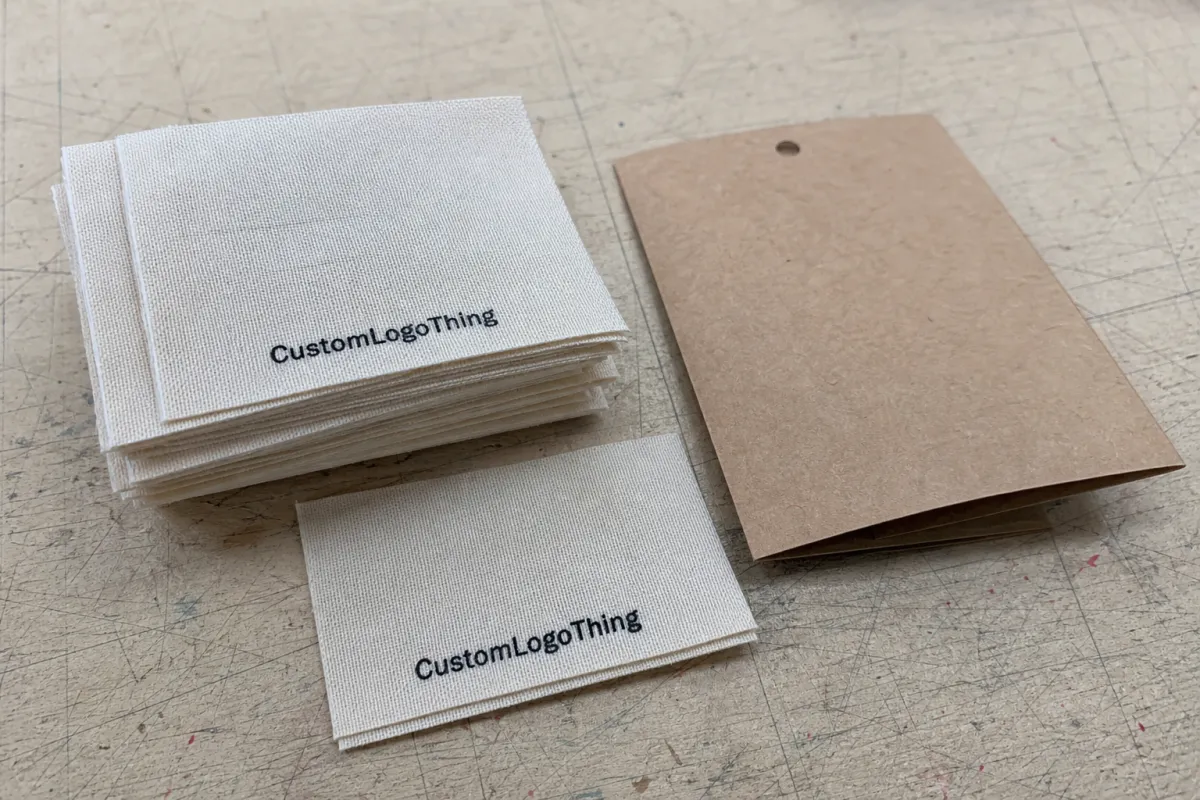
A handmade mug may sell for $38, $48, or $72 depending on clay body, glaze, firing method, scale, and reputation. Yet the packaging around it can still feel improvised: a plain cotton pouch, a kraft box, a strip of tissue, a care card, maybe a sticker. That mismatch is one reason more studio buyers price woven labels before they finalize retail packaging.
From a packaging buyer’s perspective, the logic is practical. A studio selling mugs, bowls, incense holders, workshops, or wholesale gift sets wants the customer experience to stay consistent across pouches, tea towels, aprons, retail shelves, and shipping inserts. Printed stickers and paper tags can look good on day one. They also scuff, curl, tear, absorb moisture, and get discarded quickly.
Woven labels behave differently. They survive folding, storage dust, repeated handling, washing, and the slightly rough life of a working studio. Thread has memory. Paper does not.
A good label program also reduces design fragmentation. The same maker’s mark can appear on a linen drawstring bag, studio apron, canvas tote, and tool roll without redesigning every package component. That matters for small teams. Fewer decisions. Cleaner branding.
Here is the point many buyers underestimate: a quote is not just a price. It is a manufacturing map built from artwork, label size, fold style, thread count, yarn type, backing, quantity, and deadline. If one of those details is missing, the quote may still arrive, but it will be less reliable.
Ceramic studios also differ from fashion brands. They usually do not need five size runs or complex garment compliance labels. They need clear logos, earthy thread colors, soft textures, and compatibility with natural cotton, linen, jute, muslin, and canvas. That is a narrower brief. It can be cheaper and sharper if specified correctly.
Packaging reality: a woven label will not protect a fragile ceramic bowl from impact. Corrugated dividers, molded pulp, tissue, and void fill still do that job. The woven label adds brand continuity, perceived value, and reuse potential.
Where Woven Labels Fit in Ceramic Studio Packaging
Woven labels work best where ceramic packaging crosses into textiles. Common uses include labels for handmade pottery bags, branded canvas totes, apron neck labels, kiln cloths, gift wrap ribbons, clay tool pouches, workshop merchandise, and limited-edition product bundles. A 0.5 x 1 inch side tab can be enough. A 2 x 3 inch patch may be better for a workshop tote.
That small size is part of the commercial appeal. A studio does not have to rebuild its whole packaging system. A plain 8 oz cotton drawstring pouch can look more deliberate with one woven side-tab label sewn into the seam. A tea towel wrapped around a mug can carry the same logo as the apron worn during classes. The customer sees repetition. Repetition builds recognition.
Consider a studio selling a $48 mug. If the mug ships in a reusable cotton pouch with a woven side tab, the package feels closer to a boutique textile product than a commodity filler bag. The label does not need to shout. It needs to look intentional.
Placement controls the effect:
- Center-front patches: strong visibility on totes, aprons, and retail pouches.
- Side-seam tabs: subtle branding for drawstring bags and linen wraps.
- Hem labels: practical for tea towels, kiln cloths, and workshop textiles.
- Loop labels: useful for hanging products or decorative packaging ties.
- End-fold labels: clean for clay tool rolls and flat-sewn textile packaging.
The customer journey matters. At point of sale, a front patch helps the package read as branded inventory. During shipping unboxing, a side tab feels quieter and more premium. In workshops, apron labels turn staff uniforms and student merch into brand reminders. For wholesale or gallery collaborations, the label helps connect a ceramic object to the studio after it leaves the shelf.
There is also a cross-selling advantage. One label design can often be used across aprons, tote bags, retail textile packaging, and workshop merchandise. That lowers setup friction because artwork proofing, thread selection, and logo simplification happen once instead of four separate times.
For studios building a packaging system, Custom Logo Things’ Custom Labels & Tags category is the logical starting point because the label decision affects sewing, pouch sourcing, product photography, and retail presentation.
Product Details: Damask, Satin, Cotton-Look, and Recycled Options
Material choice changes the label’s appearance more than many buyers expect. A Woven Labels Supplier Quote for ceramic studios should identify the construction, not just the size and quantity. “Woven label” is a category. Damask, satin, taffeta, cotton-look polyester, and recycled yarn labels each behave differently.
Damask woven labels are usually the default recommendation for ceramic studios with detailed logos, small lettering, maker’s marks, line-art icons, or stamp-inspired artwork. Damask uses finer yarns than basic utility labels, so it can hold cleaner detail. If a logo includes a tiny potter’s wheel, a hand-drawn bowl, or a small serif wordmark, damask deserves serious consideration.
Satin woven labels have a smoother, more reflective finish. They can suit gallery packaging, gift lines, or higher-polish retail sets. The tradeoff is aesthetic: satin may feel too glossy beside raw stoneware, unbleached cotton, or kraft packaging.
Taffeta labels are more economical and often used for care or utility tags. For a studio, they may work for internal workshop aprons or simple tool pouches, but they usually do not deliver the same tactile value as damask.
Cotton-look polyester labels are worth considering for organic, handmade positioning. They deliver a matte, softer visual texture while retaining the production consistency of synthetic yarn. They pair well with linen pouches, jute bags, raw canvas, stoneware glazes, and minimal black-on-natural branding.
Recycled yarn options may fit brands with sustainability messaging. Claims should be handled carefully. If a studio is making environmental claims on packaging, align those claims with broader guidance from credible sources such as the EPA’s sustainable materials management resources. For paper-based components, FSC-certified board or tags may also be relevant; the Forest Stewardship Council provides useful certification context.
Thread is not ink. That is the key technical point. Gradients, watercolor marks, glaze-like color shifts, and very fine punctuation need translation. A logo that looks soft and expressive on a website may become muddy at 0.75 inches wide in thread.
Practical fixes are simple: reduce colors from six to three, thicken fine lines, remove tiny punctuation, avoid low-contrast beige-on-cream combinations, and test the mark at actual label size. If the studio name cannot be read from 18 inches away on a paper proof, it probably will not improve once woven.
| Label Type | Best Fit for Ceramic Studios | Typical Strength | Watch Point |
|---|---|---|---|
| Damask woven | Maker’s marks, detailed logos, small type | High detail and clean edges | Costs more than basic taffeta |
| Satin woven | Gift sets, gallery packaging, polished retail lines | Smooth reflective finish | May look too glossy for rustic packaging |
| Taffeta woven | Utility tags, workshop textiles, simple marks | Economical and functional | Less refined detail |
| Cotton-look polyester | Linen pouches, canvas bags, natural packaging | Matte handmade appearance | Thread color range may be narrower |
| Recycled yarn | Sustainability-focused product bundles | Supports material responsibility goals | Confirm availability, claims, and color limits |
Finishing options include straight cut, heat cut, end fold, center fold, Manhattan fold, mitre fold, adhesive backing, iron-on backing, sew-on backing, and merrowed-edge patches. Durability depends on yarn density, edge treatment, backing, colorfast threads, and the abrasion the label will face during studio storage or washing.
Specifications Buyers Should Prepare Before Requesting a Quote
The fastest route to an accurate quote is a tight spec. Not a perfect spec. A usable one.
Prepare these details before contacting a supplier:
- Logo file: AI, EPS, SVG, or high-resolution PDF is preferred.
- Label size: width and height in inches or millimeters.
- Fold type: end fold, center fold, straight cut, loop fold, or patch.
- Background color: natural, black, cream, clay red, charcoal, green, or another thread shade.
- Thread colors: Pantone reference if available, or closest visual target.
- Quantity: include current order and expected reorder volume.
- Application method: sew-on, adhesive, iron-on, or supplied loose for a sewing contractor.
- Destination country: needed for freight and landed cost planning.
- Required delivery date: market date, pottery drop, workshop launch, wholesale ship date, or gallery opening.
Vector files reduce friction. A PNG or JPG may be acceptable for rough pricing, especially if the design is simple, but it can slow proofing because the supplier may need to redraw or simplify the art. For tiny maker’s marks, this matters. One extra line in a stamp-style logo can change readability at 0.75 inches wide.
Size is another quote driver. Ceramic studio labels commonly fall into four bands: 0.5 x 1 inch for small side tabs, 1 x 2 inches for standard logo labels, 2 x 3 inches for larger patches, and custom dimensions for aprons, totes, or tool rolls. Bigger labels use more yarn and loom time. They may also need stronger edge finishing.
Fold choice should follow the application. End-fold labels sew flat onto pouches. Center-fold labels insert into seams. Straight-cut labels work for patches. Loop-fold labels can hang from products or create a decorative textile accent. A fold that looks nice in a mockup can fail during sewing if the seam allowance is wrong.
Color decisions affect cost and clarity. Most quotes are based partly on the number of thread colors. Simplifying a logo from six colors to three can improve both price and legibility. For natural ceramic brands, two-color labels often outperform complex art: charcoal on cream, clay red on natural, black on oat, or off-white on dark green.
Backing deserves scrutiny. Sew-on labels are the safest choice for durability. Adhesive labels can work for temporary presentation, product staging, or non-wash applications, but adhesion varies by fabric texture. Iron-on backing may be useful if sewing is not practical, provided the textile can tolerate heat and pressure.
Confirm scratchiness, wash needs, edge finish, orientation, exact or closest Pantone match, and border requirements before approval. A thin border can help sewing alignment. It can also crowd the logo if the label is too small.
Woven Labels Supplier Quote for Ceramic Studios: Pricing, MOQ, and Unit Cost Factors
A credible Woven Labels Supplier Quote for ceramic studios should explain the cost structure, not hide it behind a single number. Woven label pricing is usually driven by quantity, label size, thread count, number of colors, fold type, backing, edge finish, artwork complexity, and shipping method.
MOQ varies by supplier and construction. Some small-label programs may start around 100 pieces, while more complex patches or specialty yarn options may require higher minimums. This depends on loom setup, finishing labor, and whether the supplier is grouping production with similar orders. Unit cost usually drops as quantity rises because setup, proofing, loom preparation, and planning are spread across more labels.
A two-color side tab is not priced like a large multi-color merrowed patch with adhesive backing. The side tab uses less material, less loom time, and simpler finishing. The patch needs more yarn, edge work, inspection time, and packing care.
| Quote Scenario | Typical Specification | Likely Cost Behavior | Best Use |
|---|---|---|---|
| Economy side tab | 0.5 x 1 inch, 2 colors, center fold, sew-in | Lowest unit cost at volume; simple finishing | Linen pouches, drawstring bags, muslin wraps |
| Standard logo label | 1 x 2 inches, 2-4 colors, end fold, sew-on | Moderate cost; strong branding area | Canvas totes, aprons, tea towels |
| Premium patch | 2 x 3 inches, 3-6 colors, merrowed edge | Higher cost due to size and edge work | Workshop merch, retail bundles, branded tool rolls |
| Adhesive-backed label | Custom size, woven face, pressure-sensitive backing | Higher finishing cost; adhesion testing needed | Temporary presentation, flat packaging, displays |
Ask for tiered pricing at 100, 300, 500, 1,000, and 2,500 pieces. The breakpoints can be revealing. A label that feels expensive at 100 pieces may become sensible at 500 or 1,000. For studios running seasonal drops, a slightly larger order can cover pouches, aprons, and wholesale packaging in one production cycle.
Hidden variables deserve attention. Rush production, color matching, physical sample proofs, international freight, split shipments, and post-approval art changes can move the final cost. So can the delivery date. A label needed before a holiday ceramic drop has a different risk profile than a label ordered for general inventory.
Calculate total landed cost, not just unit price. Include setup fees, sampling, shipping, duties where applicable, and the cost of delays if packaging assembly depends on label arrival. If a sewing contractor is waiting on labels, one late component can stall the whole textile program.
For buyers ready to price a real order, Contact Us with the size, quantity, fold style, and artwork. A useful quote should name the label type, dimensions, colors, fold, backing, quantity, production time, shipping method, proof process, and revision policy.
Process and Timeline From Artwork Review to Delivery
The process is straightforward, but the handoffs matter. A typical woven label order moves through inquiry, specification review, artwork check, price quote, digital proof, optional physical sample, approval, weaving, cutting and folding, quality inspection, packing, and shipment.
The fastest delays often happen before production starts. Missing vector artwork. Uncertain dimensions. Thread colors chosen by description alone. A fold style changed after the proof. These do not sound dramatic, but they can add days because the supplier cannot confidently set up the loom or finishing path.
A digital proof should show the label size, thread colors, fold lines, front and back orientation, edge type, and any limitations where small artwork details may be simplified. If the proof only shows the logo floating on a rectangle, ask for more detail. The fold line is not decorative. It tells the sewing team where the visible art will land.
Physical samples are useful for premium packaging, retail collaborations, or labels being sewn onto expensive aprons. They add time, but they reduce risk. For a studio preparing a wholesale line or gallery bundle, a sample can prevent a 1,000-piece mistake.
Lead time depends on complexity, quantity, sampling, production queue, finishing, and shipping destination. A simple repeat order with locked artwork can move faster than a first order with a detailed mark and physical sample. Rush options may be available if specifications are complete early, but rush production should not be used to rescue unclear art.
Do not order labels after ceramic packaging is already in production. If pouches, wraps, totes, or aprons are being sourced, the label quote should happen at the same time. Label dimensions affect seam allowances. Backing affects application. Fold choice affects sewing labor.
- Finalize the logo or maker’s mark before requesting final pricing.
- Request tiered pricing across practical quantities.
- Approve the digital proof only after checking size, fold, and colors.
- Confirm shipping address and required delivery date.
- Schedule sewing or packaging assembly after label production dates are confirmed.
ISTA guidance is often discussed for transport packaging, especially fragile goods testing. Woven labels are not transport protection, but ceramic studios shipping breakable products should still understand the broader packaging system. The International Safe Transit Association is a useful reference point for transit testing principles.
Quality Checks That Prevent Costly Label Mistakes
The common failures are predictable: logo too small, thread color not matching expectations, label too stiff for lightweight linen, fold type incompatible with the sewing method, or adhesive backing used on the wrong fabric. None of these are glamorous problems. All of them cost money.
Start with legibility. Print the proof at actual size and view it from normal customer distance. If the maker’s mark disappears on paper, it will likely struggle in thread. This is especially true for pottery stamp marks, delicate line drawings, and serif lettering under 6 points in visual scale.
Test against the real substrate. A label that looks crisp on a white PDF may lose contrast on oat linen, tan jute, or undyed canvas. Fabric texture changes perceived color. So does the surrounding ceramic palette. A warm beige thread beside a speckled clay body can look elegant; the same beige on raw muslin may vanish.
Thread cannot reproduce every printed gradient or glaze tone. Buyers should approve closest thread matches rather than expecting ink-like reproduction. If a glaze-inspired logo uses blue fading into green, the woven version may need two or three discrete thread colors, not a smooth transition.
The ceramics comparison is useful. Glaze tests prevent surprises in a kiln. Label proofs prevent surprises on the loom. Both are small controls that protect the final presentation.
Check sewing margins and fold allowances before bulk approval. The logo should not sit so close to the edge that stitching eats it. For an end-fold label, allow enough blank area at each end for sewing. For a center-fold tab, confirm which half is visible and whether the logo orientation is correct after folding.
Finished label inspection should cover consistent dimensions, clean cuts, accurate folds, readable text, color consistency, correct quantity, proper packing, and no excessive fraying or loose threads. For washable textiles such as aprons and towels, ask about wash tolerance and colorfastness. For display-only pouches, softness and appearance may matter more than wash performance.
Next Steps to Get an Accurate Studio Label Order Started
Getting a production-ready quote is mostly about giving the supplier the same facts a production planner needs. Choose the product application. Measure the available label area. Select a fold style. Prepare artwork. Pick approximate colors. Estimate quantity. Decide whether samples are required.
Photograph the textile or package where the label will be placed. This is underrated. A supplier can often spot scale, sewing, backing, and placement issues faster from one clear product image than from five vague descriptions. Include a ruler in the photo if possible.
Ask for two or three quote scenarios: economical, standard premium, and highest-detail. For example, compare a 0.5 x 1 inch two-color side tab, a 1 x 2 inch damask end-fold label, and a 2 x 3 inch merrowed patch. That gives the buyer real tradeoffs without restarting the conversation.
Deadline context matters too. A market date, wholesale shipment, gallery opening, pottery drop, workshop launch, or retail collaboration changes the risk calculation. If labels must arrive before pouches go to a sewing contractor, say that clearly.
Custom Logo Things should be able to respond with specification confirmation, artwork guidance, tiered pricing, MOQ, estimated production schedule, proofing steps, and shipping options. The cleaner the intake, the faster the answer.
If you want a Woven Labels Supplier Quote for ceramic studios, send logo artwork, target size, quantity, application photos, fold preference, backing needs, shipping destination, and delivery deadline. Better details reduce guesswork. Fewer guesses mean fewer production surprises.
FAQs
What details are needed for a woven label quote for a ceramic studio?
Send logo artwork, preferred label size, quantity, fold type, thread color preferences, backing choice, application photos, shipping destination, and deadline. Vector artwork such as AI, EPS, SVG, or high-resolution PDF is best, but a high-resolution image can usually be reviewed for initial pricing.
What is the usual MOQ for custom woven labels for pottery packaging?
MOQ depends on label type, size, finishing, and supplier setup requirements. Some simple labels may be practical at lower quantities, while larger patches or specialty finishes may need higher minimums. Request tiered pricing at 100, 300, 500, 1,000, and 2,500 pieces because unit cost often drops as volume increases.
Are woven labels better than printed labels for ceramic studio pouches and totes?
Woven labels are generally more durable on reusable textile packaging and create a more tactile, premium finish. Printed labels can work for complex gradients or short-term use, but woven labels are stronger for repeated handling, washing, folding, and storage.
How long does production take after approving a woven label proof?
Timeline depends on quantity, artwork complexity, sampling needs, finishing, production queue, and shipping method. The quickest way to avoid delay is to approve artwork, size, fold, colors, and delivery details before production begins.
Can a ceramic studio use the same woven label on aprons, bags, and gift packaging?
Yes, if the size, fold, and backing work across all applications. For multi-use labels, choose a versatile design with strong contrast, readable text, and enough sewing margin for different fabrics. A woven labels supplier quote for ceramic studios should confirm whether one label specification can cover all planned uses.


