Acrylic Beanies Reorder Planning Guide for Bulk Buyers
Acrylic Beanies Reorder Planning guide sounds administrative, but that is exactly why it matters. The first purchase usually gets attention. The second one decides whether your margin survives the year.
That pattern shows up across retail replenishment, school programs, teams, private label lines, and promotional campaigns. The initial run is often managed like a project. The repeat order is treated like a shortcut. Then the buyer opens the cartons and finds a different yarn hand, a looser cuff, a changed label, or a quote that suddenly includes “extra” charges nobody saw on the first PO.
The problem is rarely one dramatic mistake. More often it is a stack of small assumptions: a sample that was approved by eye, a spec sheet with missing measurements, a reorder request that names the style but not the construction, and a factory that fills in the blanks differently than last time. Acrylic is forgiving enough to hide minor drift, which is why the drift keeps happening.
The cheapest reorder is the one that does not need rework.
This guide focuses on the parts that actually move cost, quality, and timing. The goal is not a prettier sales pitch. It is a cleaner repeat order with fewer surprises.
Why the second order is where costs creep in
The first order often gets approved from a sample, a mockup, and a few rounds of email. That is workable. The second order should be easier, but only if the original build was documented well enough to repeat. If not, the factory may substitute yarn lots, alter knit tension, update trim suppliers, or interpret the packaging spec differently. The product still looks close. It just does not match.
That matters more with acrylic beanies than some buyers expect. The fabric is structured enough to hide small changes, yet those changes affect fit, handfeel, and appearance. A half-centimeter difference in cuff depth, a slightly tighter crown, or a warmer-looking shade can be enough to trigger a complaint from a retailer or brand manager who compares the new run to the old one under daylight.
Repeat orders also invite quote drift. If the supplier has to reconstruct the spec from memory, the price may include extra caution, extra sampling, or a wider allowance for unknowns. That is not greed every time. It is usually the cost of uncertainty. Good buyers reduce that uncertainty before asking for pricing.
Use the old PO, approved sample, and production notes as the baseline. If any one of those is missing, the reorder is no longer a reorder. It is a new build pretending to be a repeat.
For buyers using Custom Logo Things or another supplier relationship, the right approach is the same: insist on the historical record before the next quote starts. The less the factory has to guess, the less your order changes in transit between approval and shipment.
Specs to lock before you approve the next run
Begin with the construction. Confirm fiber content, yarn thickness, gauge, cuff style, crown shape, and finished size. Acrylic beanies commonly sit in the 6- to 9-gauge range. Finer knit typically gives a cleaner face and better logo definition. Heavier knit usually feels denser and warmer. Both change yarn usage, production time, and cost.
Fit deserves more attention than most buyers give it. A one-size beanie can still fit differently depending on stretch, blocking, and the factory’s finishing method. Ask for finished width and length, plus the relaxed and stretched measurements if the item is going into a program that cares about uniformity. If there is a youth size or oversize version, write that down separately instead of assuming the same pattern will scale neatly.
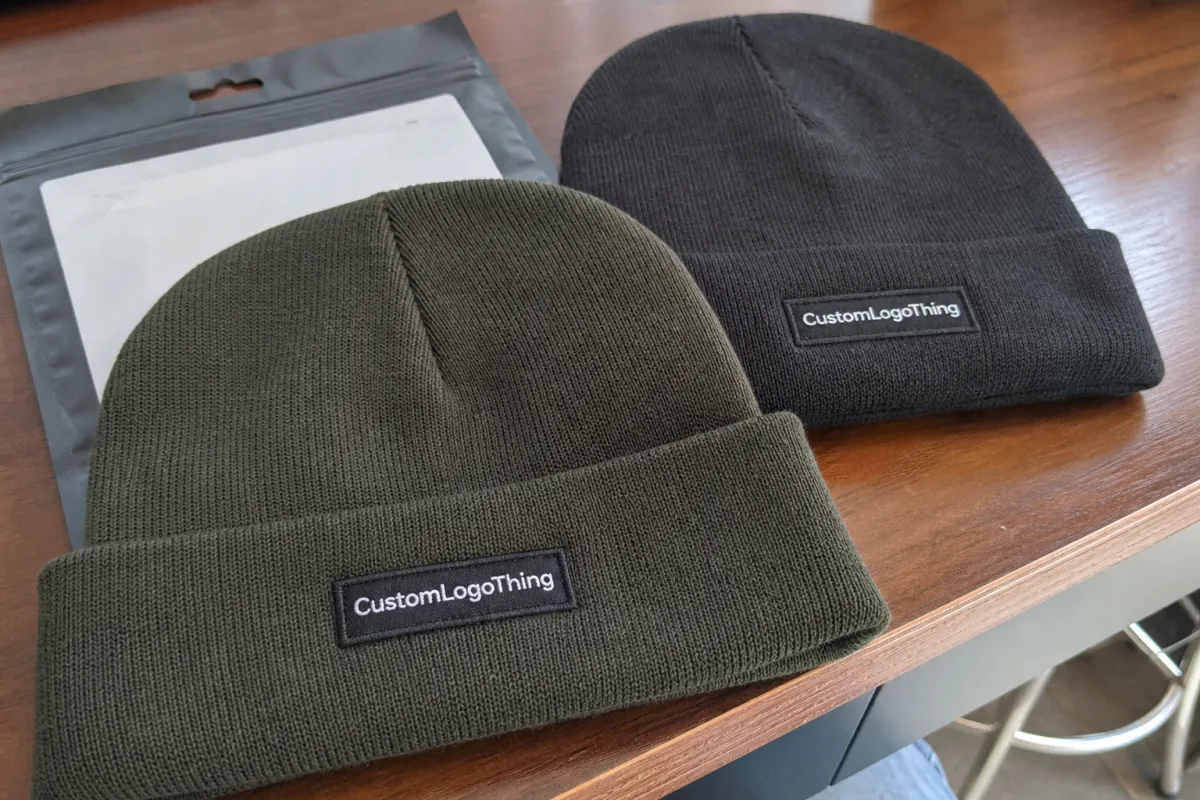
Decoration is another fault line. Embroidery, woven patch, print label, woven label, and sewn-in care tag all affect both price and lead time. A simple chest-style logo placement on the cuff is not the same as a dense front panel patch with edge stitching and backing. Lock the placement, dimensions, thread colors, stitch count, and backing method. If you skip those details, the supplier will make reasonable guesses. Reasonable guesses are expensive when the order is multiplied by thousands.
Color should be defined with more than a name. Pantone is useful, but it should be paired with a yarn card, a physical swatch, and the approved sample from the first run. Screen images can be misleading because knitted acrylic absorbs and reflects light differently than a flat digital file. If the business depends on exact shade continuity across batches, a physical reference is non-negotiable.
Packaging can change the economics more than expected. Fold method, polybag count, barcode label, insert card, carton count, and master carton marks all affect handling. If the goods are going into retail distribution, confirm case pack and pallet pattern too. Freight and warehouse receiving may be influenced by carton size and count as much as by the beanie itself.
- Core build: fiber content, gauge, cuff depth, finished dimensions
- Decoration: method, size, placement, stitch count, thread colors
- Color reference: Pantone, swatch, photo, and approved sample
- Packaging: fold, bagging, labels, carton count, inserts
Cost, MOQ, and quote inputs that move unit cost
Repeat order pricing is shaped by more than quantity. Yarn availability, decoration complexity, packaging, labor, and freight terms can move the final number more than a modest volume increase. The same beanie can land at very different price points depending on whether the factory is simply repeating the build or reworking it with fresh assumptions.
For a standard acrylic beanie with basic embroidery and unchanged construction, a repeat order often falls in the $1.80-$3.20 per unit range at moderate volumes. Heavier decoration, custom patchwork, retail packaging, or specialty finishing can push the price higher. Very large runs can lower unit cost, but not in a straight line. The first break often appears around 500-1,000 pieces, then again at 3,000+ if materials are available and the line is set up for the job.
MOQ usually depends on color count, trim method, and whether the supplier has matching yarn in stock. One color with existing materials is simpler than three custom shades with separate label variations. If the supplier offers a lower MOQ for a revised version, check whether the lower threshold is offset by a higher unit price. That trade-off is common.
Watch the line items that hide in plain sight. Sample rebuilds, artwork revisions, proofing, rush fees, split shipments, carton changes, and packing updates can turn a decent quote into an awkward one. Ask for the quote to mirror the prior approved spec and identify every change in writing. If the supplier says something is “same as before,” ask them to point to the exact build record that proves it.
| Repeat scenario | Typical MOQ | Unit price range | Lead time | Best use case |
|---|---|---|---|---|
| Exact repeat, same yarn, same decoration | 300-500 pcs | $1.80-$3.20 | 12-15 business days after approval | Fast replenishment with minimal change risk |
| Repeat with stock yarn and same art | 500-1,000 pcs | $1.65-$2.95 | 10-14 business days after approval | Best if the factory already has the right materials |
| Repeat with new patch or label method | 1,000+ pcs | $1.95-$3.60 | 15-20 business days | Brand refresh without changing the core hat |
| Repeat with retail packaging upgrade | 500-2,000 pcs | +$0.10-$0.45 per unit | 13-18 business days | Retail shelves, e-commerce, or seasonal gifting |
If the shipment is going into a warehouse, distribution center, or retail chain, ask about carton performance. ISTA test standards are a practical reference if cartons will be stacked, knocked around, or handled by parcel networks that do not care whether the logo lines up.
For buyers managing recurring branded programs, the Wholesale Programs page can help frame repeat pricing discussions because a supplier is usually more consistent when they can see a pattern of orders rather than a single one-off run.
Process, production steps, and lead time for repeat orders
A repeat order should start with record verification. The supplier needs to confirm the previous style code, retrieve archived approvals, and compare the requested reorder against the last approved spec. If that step gets skipped, the production team may start knitting before the details are locked. Errors found after packing are far more expensive than errors found on paper.
The usual production sequence is yarn sourcing, knitting, shaping, trim attachment, decoration, finishing, inspection, packing, and shipment. Leave out one step and the job stops being repeatable. It becomes a new build with a familiar logo.
Lead time depends on stock yarn, decoration type, quantity, and whether the factory needs a new approval cycle for color or trim. If all materials are on hand and nothing changes, a repeat run can often ship in roughly 10-15 business days after proof approval. Add custom packaging, a new patch, or yarn sourcing, and the calendar stretches. Peak season adds real delay, not theoretical delay, so seasonal orders need more cushion than the factory’s fastest estimate suggests.
Separate the production finish date from the ship-ready date. They are not the same thing. A finished order still needs inspection, packing, carton labeling, booking, and pickup. If the delivery date is fixed, build time around those steps instead of assuming the goods move the moment knitting ends.
Also confirm the quotation basis. EXW, FOB, and delivered pricing can all produce a different landed cost. A low factory price is not useful if the freight, pickup, or export handling makes the final number look less friendly than the first quote implied.
Retail buyers should ask for carton dimensions, master carton count, barcode placement, and case-pack consistency. Warehouses dislike improvisation. A clean carton plan saves time at receiving and reduces the odds of a rejected pallet or a delayed intake.
What changes between batches and how to prevent rework
The most common batch-to-batch changes are color shade, knit density, stretch recovery, label placement, and packaging consistency. None of those sounds dramatic on its own. Put them together and the reorder may look “similar” while failing the buyer’s comparison standard.
Keep one approved physical sample and one documented photo record with notes. Label them with the style code, approval date, decoration method, and any exceptions that were accepted on the first run. That gives both sides a clear reference if the next batch starts drifting. Memory is unreliable, especially when several people touched the approval chain.
Define tolerances before production. Set acceptable ranges for size, color, logo position, and carton counts. Vague phrases like “same quality” or “close enough” do not help anyone once a batch lands and the deviation is visible. Buyers who define tolerances early spend less time negotiating after the fact.
Ask the factory to flag substitutions before bulk work begins. That includes a yarn source change, a different label supplier, a packaging swap, or a trim update. Silence is not a quality system. It is simply a late surprise.
- Color drift: confirm shade with a physical swatch, not a screenshot
- Fit drift: lock finished width, length, and cuff depth
- Logo drift: record size, placement, and stitch count
- Packout drift: confirm bag count, labels, and carton counts
If paper inserts or carton text carry recycled-content or forestry claims, check FSC requirements before printing. A claim on the box should be supportable with records. That is not an optional detail.
What a reliable reorder partner should document
A reliable supplier keeps style codes, artwork files, bill of materials, and approval history attached to each order. If that record cannot be found quickly, the repeat order will probably be slower and less exact than it should be. The best partners do more than answer yes. They can show the build history.
They should also track lot numbers, inspection checkpoints, and packing specs. That matters because a sample can look perfect while the bulk run shifts in shade, trim, or fit. Sample approval alone is not enough if the production record is thin. Buyers who have been disappointed once tend to insist on the paper trail. That instinct is healthy.
Communication matters because small changes ripple outward. A strong partner explains what stayed the same, what changed, and what needs approval before the next step. If the response is vague, the risk usually shows up later in the cartons.
One phrase deserves skepticism: “same as last time.” That can mean the same style code, or it can mean the supplier believes the difference will not be noticed. Those are not the same thing. If there is any doubt, ask for the archived spec and the approved sample reference before you authorize production.
Use this acrylic beanies reorder planning guide as a check on your supplier process. If the factory can pull the original build record within a day, the relationship is probably in decent shape. If it takes multiple emails to locate the previous PO, expect the repeat order to absorb more time than it should.
What to send now for a faster reorder quote
Send the old PO, approved sample photos, logo files, quantity by color, target delivery date, shipping address, and any change notes. That is the minimum packet for a useful quote. Without it, the supplier has to ask basic questions before they can price the job, and that slows the process immediately.
Ask the quote to show unit cost, MOQ, Lead Time, and assumptions. If assumptions are hidden, the reorder will probably produce a surprise later. A quote that looks cheap at first can become less attractive once packing, decoration, or freight details are clarified.
Request written confirmation for any detail that could change the result: yarn availability, decoration method, packaging, carton count, and approval deadline. If speed matters, send one clean file set and one clear physical reference. The cleaner the packet, the less back-and-forth the supplier needs before they can commit.
For teams that reorder often, a standard intake form pays for itself quickly. It reduces follow-up questions, gives purchasing a cleaner comparison across vendors, and makes it easier to tell which supplier can reproduce the same beanie without rebuilding the project from scratch.
If there is one practical rule to keep, it is this: the repeat order should be easier than the first order. If it is not, the records are incomplete somewhere.
How far ahead should I place an acrylic beanies reorder?
Earlier than the factory’s lead time if the order has a fixed launch date or seasonal deadline. Add buffer for proof approval, color confirmation, and freight movement. If yarn or labels are not already in stock, start sooner. Seasonal orders rarely forgive a tight schedule.
What should I confirm if the supplier says it is the same as last time?
Ask for the style code, bill of materials, decoration method, packaging spec, and approved sample reference. Confirm whether yarn lot, trim supplier, label construction, or carton count changed. A verbal answer is not enough for a reorder that affects margin.
Does MOQ usually change on repeat acrylic beanie orders?
It can, especially if the color, decoration, or packaging changes. A repeat order may qualify for a lower MOQ if the factory already has the materials, but that does not happen automatically. Ask for the exact repeat version and any revised version so the cost difference is clear.
Why did my reorder cost more than the first order?
The price may have moved because of material cost, labor, freight terms, or a different packing method. Sometimes the first order was priced as a sample build or a promotional quote that did not include every production step. Compare the old PO and the new quote line by line before assuming the factory simply raised prices.
What files or details speed up an acrylic beanies reorder the most?
Old PO, approved sample photos, logo file, color reference, quantity split, and delivery deadline are the big ones. Packing instructions, barcode labels, and compliance notes help too. The more complete the reference packet, the faster the supplier can confirm price and lead time without guessing, which is the point of an acrylic beanies reorder planning guide.