A Nylon Camp Hats private label order looks simple on paper. A soft crown, a short brim, a logo patch, and a brand name on the inside label. Then the details start shifting the price, the fit, and the shipment date. That is usually where a good idea becomes either a repeatable program or a one-off sample that never leaves the warehouse.
The style sells because it is easy to understand and easy to wear. Nylon packs flat, dries quickly, and holds a cleaner technical look than most cotton caps. That combination works for outdoor retail, travel, fishing, golf, surf, and casual uniform programs. It also works because the buyer can explain it in one sentence without stretching the story.
The catch is that simple products still have hard manufacturing rules. A camp hat that ships well and reorders cleanly depends on fabric choice, brim recovery, crown depth, stitch control, and labeling discipline. Miss one of those, and the finished hat can feel generic even if the artwork looks strong.
Nylon camp hats private label order: why this style sells fast
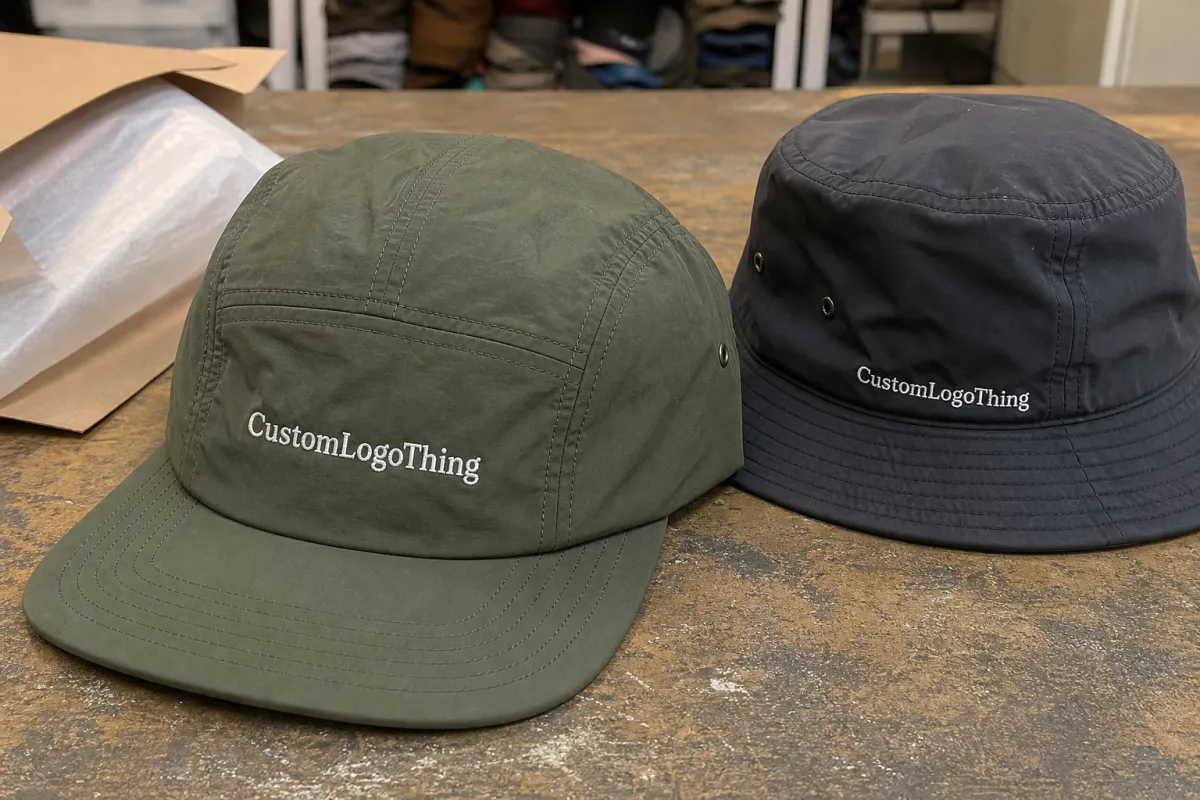
Camp hats sit in a useful middle ground. They are less rigid than a trucker, less formal than a baseball cap, and less intimidating than a performance hat with too many panels and vents. Buyers like that balance because it broadens the customer base without flattening the design.
Nylon helps the economics as well as the look. It is light, it ships efficiently, and it usually behaves better in packing than bulkier fabrics. A carton of Nylon Camp Hats can take up less freight weight than a heavier structured style, which matters once a program moves beyond a small test order. Even a difference of a few ounces per unit adds up across several hundred pieces.
For private label, the style also gives you room to brand without clutter. A clean woven patch, a low-profile embroidery hit, or a simple rubber badge can carry the logo without overpowering the shape. That matters because customers often judge this category from a distance. If the hat reads as polished on a shelf and still feels comfortable in hand, it usually has a better chance of repeat sell-through.
The demand story is less about fashion cycles than about utility. People buy camp hats when they want something that can move from trail to commute to weekend errands without looking out of place. Nylon supports that use case, but only if the finish is chosen deliberately. A shiny shell can read too synthetic for retail. A matte or lightly textured face usually lands better.
There is also a practical buyer advantage: this style tolerates small brand experiments. A seasonal color, a limited patch program, or a regional drop can be tested without redesigning the entire headwear line. That flexibility is one reason a nylon camp hat often becomes the first private label cap a brand can scale.
What to choose in a nylon camp hat before you quote
Before asking for pricing, decide on the shape of the hat itself. Start with panel count. A 5-panel camp hat usually gives a cleaner front for graphics. A 6-panel version can fit more like a standard cap and sometimes feels more familiar to end customers. Neither is automatically better. The right choice depends on logo size, target channel, and how much structure you want in the crown.
Crown height changes the whole personality of the product. A low crown feels sharper and more fashion-forward. A mid crown is safer for broad retail distribution because it tends to suit more head shapes. A shallow crown can look great in lifestyle photography and awkward in real life if the pattern is too aggressive. Many bad sample rounds come from ignoring that difference and approving the first hat that seems close enough.
The brim deserves equal attention. A flat brim gives a sharper profile. A slightly curved brim feels more familiar to mainstream buyers. A soft, packable brim is useful for travel or outdoor use, but it should still recover after being folded or stuffed into a bag. If the brim collapses too easily, the hat may look tired on arrival even if the sewing is clean.
Fit hardware should match the market. A plastic side-release buckle is practical and durable. A nylon strap with a metal clasp can look a bit more premium, though it may cost more and add a small amount of assembly time. Hook-and-loop closures are fast and cheap, but they can feel less refined on retail product. For a first run, the simplest answer is often the best one.
Decoration should stay proportionate to the hat. A woven patch gives a neat retail look and keeps the surface tidy. Embroidery adds texture and works well for a short wordmark or small emblem. Direct embroidery is fine when the logo is uncomplicated and the hat body can handle needle penetration without puckering. Rubber badges suit technical or outdoor branding, but they can look heavy if the rest of the hat is too soft.
Also decide whether the order needs hidden comfort details. A soft sweatband can improve wearability more than an extra logo does. Eyelets or mesh vents can help in hot climates, although they also change the look. One size fits most is common, but if the buyer expects a tighter retail fit or a more athletic lane, ask for actual measurement data instead of relying on the phrase alone.
Fabric, trim, and label specifications that prevent rework
This is where the order either becomes repeatable or starts drifting. The shell fabric should be described in a way a factory can use without interpretation: nylon type, denier, weave, finish, and any coating or treatment. Common builds include 70D, 210D, and 300D nylon. Lower denier usually feels lighter and more supple. Higher denier can add body and improve abrasion resistance, though it may also make the hat feel less packable.
Ripstop nylon brings visible texture and is often chosen for outdoor positioning. Plain weave reads smoother and cleaner. A coated nylon can resist light moisture better, but coating should not be presented as waterproof unless the product has been tested and specified that way. That distinction matters. Buyers often use terms like “water resistant” loosely, then discover the claim does not match the fabric behavior.
Trim details need the same precision. Spell out buckle type, strap width, seam allowance, reinforcement points, thread color, stitch count, and whether the crown is lined. If the supplier has to decide those details on the fly, the result may be functional but not brand-right. Most production mistakes are not dramatic. They are a stack of small assumptions that slowly become expensive.
Labeling should be defined before sample approval. A woven main label, care label, sizing mark, swing tag, and carton marking all affect the final workflow. If the label package is still in flux, start with Custom Labels & Tags so the hat and the packaging speak the same design language. That also helps the receiving team, which will care about barcodes and carton counts long after the photo shoot is over.
Color management deserves more discipline than many buyers expect. Black can skew warm or cool. Navy can shift toward royal or toward charcoal. Olive often changes under different lighting. Pantone references help, but they are not a magic shield. Ask for a lab dip or strike-off whenever the color matters to the brand story. Warehouse light, daylight, and camera flash do not tell the same truth.
One sample approval is not enough if the product has multiple moving parts. Check crown depth, brim shape, logo placement, stitch density, hardware finish, and label position. If the sample misses one of those in a way that affects the final look, do not assume bulk production will magically improve it. Bulk usually reproduces the approved version more faithfully than the buyer remembers approving it.
Private label pricing, MOQ, and unit cost tradeoffs
Pricing is driven by more than fabric cost. Decoration method, trim count, label package, packaging type, and colorway count all affect the quote. Buyers often compare only the base hat price, which is a useful way to get misled. Two quotes can differ by a dollar or more per unit simply because one includes patch work, labeling, and retail packaging while the other leaves those items out.
MOQ usually rises as the build gets more specific. A basic camp hat with one patch and standard labeling may be available at a few hundred pieces per style. Add multiple colorways, custom hardware, or more involved packaging, and the minimum can climb quickly. That is not a penalty. It is the factory trying to buy materials and schedule labor without creating inefficiency across several tiny batches.
Here is a realistic pricing frame for a nylon camp hat program:
| Order Qty | Typical Build | Approx. Unit Cost | What Usually Changes |
|---|---|---|---|
| 300-500 pcs | Nylon shell, one patch, basic woven label, standard closure | $4.80-$6.20 | Setup costs and smaller material buys raise the per-unit price |
| 1,000 pcs | Same build with tighter label package and more efficient packing | $3.10-$4.10 | Material purchasing improves and setup cost spreads out |
| 3,000+ pcs | Custom trim, refined packing, repeatable decoration | $2.20-$3.20 | Labor and tooling are absorbed across a larger run |
These numbers are directional, not a quote. A patch can add setup charges. Special trims can add sourcing time. Retail folding cards, individual polybags, barcode stickers, and carton inserts can shift the landed cost even if the hat itself looks unchanged. That is why the first order should be priced as a full package, not as a blank hat with optimism attached.
Ask for tiered pricing at 300, 1,000, and 3,000 pieces. That reveals the actual break point where unit cost starts to move in your favor. If the price barely improves at higher volumes, the program may still be too small for the chosen decoration method. Better to learn that before production starts than after inventory is already committed.
A practical buyer rule: if the first run cannot support margin at the smallest tier, the design is probably too complicated. Simpler branding often performs better anyway. Camp hats are rarely won by excess.
Production steps, lead time, and approval checkpoints
A reliable run follows a predictable sequence: brief, artwork review, spec confirmation, sample development, pre-production approval, cutting and sewing, decoration, inspection, packing, and shipment. If a supplier changes the order of those steps, ask why. Fast is fine. Unstructured usually costs more than it saves.
Timeline is shaped by response time as much as factory capacity. Clean logo files move faster than a low-resolution screenshot. Clear color references move faster than “close to this shade.” A late change to label placement or closure type can force a restart on materials already in motion. The calendar does not care that the change felt small.
For a straightforward private label hat, sampling often takes 7 to 14 business days. Bulk production typically adds another 12 to 20 business days after sample approval. More complex decoration, larger quantities, or peak seasonal demand can extend that window. Freight sits on top of that, and sea freight behaves very differently from air. If the launch date is fixed, plan backward from arrival, not from the factory completion date.
Inspection should happen before packing whenever possible. Stitch quality, patch placement, measurement tolerances, and hardware finish are easier to correct before the units are boxed. Packing also deserves a check. A nylon camp hat may be soft enough to compress, but too much compression can leave the brim misshaped or the crown dented. Carton strength, fold method, and stacking pattern all matter if the product is shipping retail-ready.
For distribution planning, basic transit standards help. A reference to ISTA can guide packaging tests when cartons need to survive long shipping lanes or multiple handoffs. If hang tags, carton inserts, or exterior packaging materials are included, responsible sourcing through FSC is a sensible check for paper-based components. None of that replaces common sense, but it reduces surprises.
A useful rule for the schedule: the cleaner the spec sheet, the fewer approval loops you need. That sounds plain because it is plain. Production is usually delayed by incomplete decisions, not by mysterious factory behavior.
How to vet a supplier before you place the run
Good suppliers tend to explain tradeoffs before they become problems. They can tell you which brim style holds shape best, which fabric finish shows fewer wrinkles, and which label method will survive washing or rough handling. That kind of clarity matters more than polished sales language. A sample is useful; repeatability is more useful.
Ask for a written spec sheet, sample photos, and a realistic MOQ. Then ask whether the same build can be reordered without changing the crown shape or color tone. That question exposes a lot. Some suppliers can make a strong one-off sample but struggle to reproduce it across multiple lots. Others may not have the patience to document the build properly. Either way, the answer tells you something important.
Quality control should be visible in the process. Stitch alignment, logo centering, color checks, label placement, and carton counts are not optional on a retail or wholesale order. If the supplier treats inspection as a casual extra, the product usually shows it. The invoice may not reveal the gap, but the customer eventually will.
"Show me the spec sheet, the sample, and the packing method. If those three things match, the order is usually fine."
That is not a slogan. It is a shorthand for how most clean orders stay clean. Ask who approves artwork before decoration starts. Ask how measurement tolerances are handled. Ask what happens if the sample misses the target. A supplier worth using will answer directly and without drama.
If the order is meant to support future restocks, look for a partner that can handle repeatable programs, not just one-time custom work. A factory that understands reorder continuity is more valuable than one that only knows how to quote a first sample. Retail buyers feel that difference quickly.
You can also compare how the supplier supports packaging, labeling, and reorder documentation through Wholesale Programs. That matters more than people expect. A hat that is easy to reorder is far more useful than one that only photographed well the first time.
Common mistakes that inflate cost or delay launch
The most common mistake is overbuilding the first run. Too many colorways. Too many logo placements. Too many trim options. Variety feels safer, but it usually makes the production line less efficient and the inventory harder to read. One strong style teaches more than five diluted versions.
Vague label instructions create avoidable revisions. So do fuzzy size approvals. If the crown was supposed to be low and the sample comes back mid-depth, do not approve it because the difference seems small in a photo. That kind of compromise is exactly how dead inventory starts.
Mixing fabric types in one launch can also muddy the line. Ripstop, coated nylon, and standard woven nylon all behave differently, and they look different under light. If you do not already know the market will absorb that variation, keep the first order tight and consistent.
Another trap is comparing only the headline quote. A low base price can hide setup charges, missing packaging, or freight assumptions that change the landed cost later. The cheapest number on the page is not the cheapest order if the missing pieces return as add-ons at the end.
There is also the timing trap. Brands sometimes approve a sample late in the season and still expect a broad launch window. Hat production does not bend to that wish. If the program depends on a seasonal sell-through, the sample needs to be approved early enough for cutting, sewing, decoration, inspection, and freight. Otherwise the product arrives after the moment passed.
The best first-order strategy is boring: prove the style, sell the style, and scale only the winners. That keeps cash available for the next reorder instead of tying it up in variations that never had a clear buyer.
Next steps for a clean private label order
If the order is moving forward, keep the brief short but complete. Include the logo file, target quantity, fabric preference, decoration method, color references, label requirements, packaging needs, and launch date. Ask for a quote that separates the hat body, decoration, packaging, and setup charges. That is the only way to compare suppliers without guessing what is hidden inside the total.
Then request the spec sheet and sample photos before final approval. If the sample misses the target, stop and fix the issue. Small errors tend to multiply across a bulk run. They are never exciting. They are just expensive.
For brands thinking beyond the first buy, treat the hat as a program rather than a one-time purchase. Reorder planning, label continuity, and carton discipline matter more than they seem at the quoting stage. A good first run should make the second run easier, not more chaotic.
A well-managed Nylon Camp Hats private label order depends on early decisions and disciplined approvals. Lock the spec, check the sample carefully, and compare the quote against the full build instead of the headline price. That approach protects margin, reduces rework, and gives the product a better chance of earning a reorder.
FAQ
What is the usual MOQ for a nylon camp hats private label order?
MOQ depends on decoration, trim, and the number of colorways. A basic build may start at a few hundred pieces per style, while custom hardware or more complex packaging can push the minimum higher. Smaller quantities usually carry a higher unit cost because setup and sampling are spread across fewer hats.
Which decoration method works best for nylon camp hats private label runs?
Woven patches and embroidered patches usually give the best balance of durability, brand clarity, and cost control. Direct embroidery works well for simple graphics. Rubber badges fit technical or outdoor positioning, but they should be sized carefully so the hat does not feel overbuilt.
How long does a nylon camp hats private label order take from sample to shipment?
Sampling often takes 7 to 14 business days. Bulk production usually adds 12 to 20 business days after sample approval, though larger runs or complex decoration can stretch the timeline. Freight is separate, so the full schedule should include transit time.
What should be confirmed before approving a private label hat sample?
Check crown shape, brim profile, logo placement, color match, label position, strap hardware, and stitch quality. If the sample does not match the spec sheet, correct the issue before bulk production starts. Approval should be based on measurement and finish, not on a general impression that the hat looks close enough.
How can I keep unit cost down on a nylon camp hats private label order?
Keep the first design simple, limit colorways, and choose one decoration method instead of stacking several branding elements. Ask for tiered pricing so you can see where the unit cost drops at higher quantities. The cleanest budget usually comes from a build that is easy to repeat.


