Acrylic Beanies Unit Cost Breakdown for Bulk Buyers
The acrylic Beanies Unit Cost Breakdown looks straightforward until one extra color, a larger patch, or a late artwork change turns a clean quote into a moving target. The yarn is only part of the bill. Setup, decoration, finishing, and packing usually decide whether the price stays disciplined or starts drifting.
That matters because a beanie quote is only useful if every supplier is pricing the same product. A low number on a vague request is not a bargain; it is an omission. Once sampling fees, setup charges, and freight appear, the cheap quote can stop looking cheap very quickly.
Why pricing settles after the spec is fixed
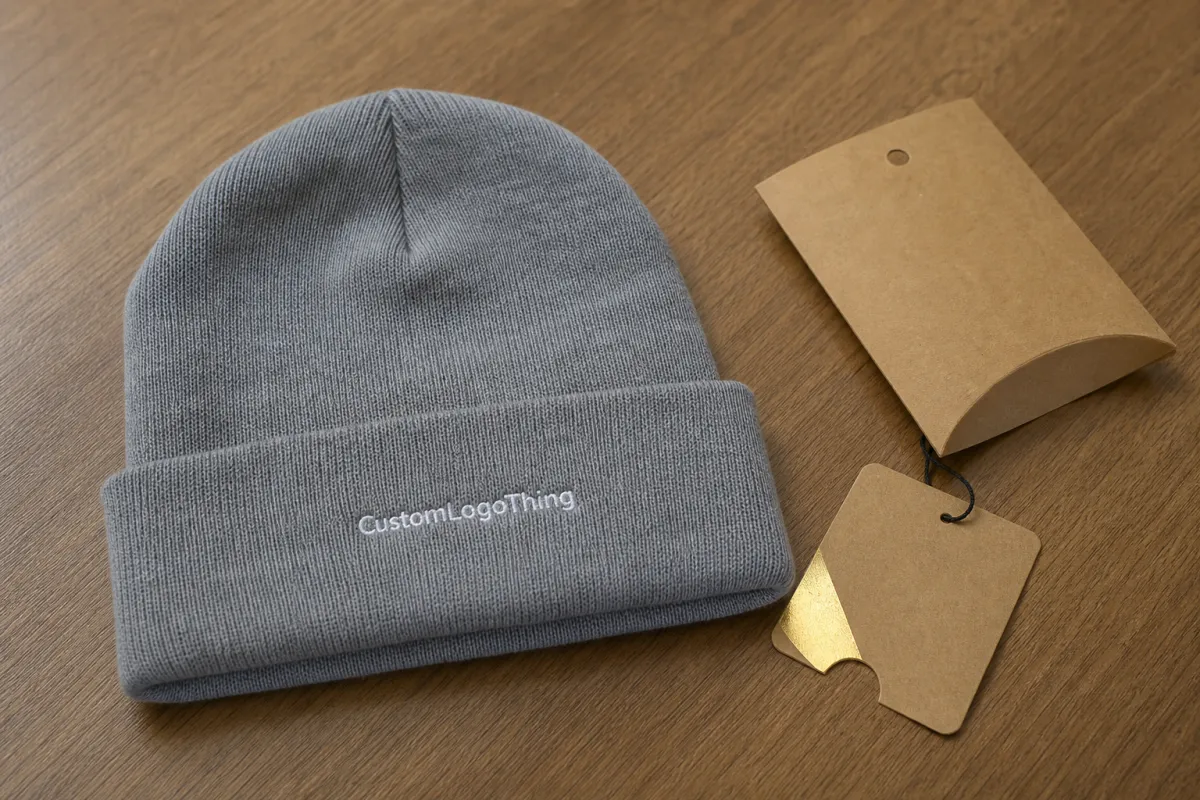
Acrylic beanie pricing falls into place once the build is locked. That is the part many buyers underestimate. Knit density, cuff height, decoration method, and finishing work all require machine time or manual labor. If those details are still changing, the factory is not quoting one product; it is pricing a range of possibilities.
Small orders feel this most sharply. A 150-piece run can absorb nearly the same setup effort as a 1,500-piece order, which is why the unit cost at low MOQ often looks stubborn. A few hours of programming or stitching spread across a tiny batch does real damage to the per-piece figure.
Late revisions are another common trap. One more thread color, one adjusted patch size, one new care tag, and the quote has to be rebuilt. Factories are not inventing charges out of nowhere. They are adding labor that now has to be repeated or rechecked.
"A stable spec is the difference between a real quote and a moving target."
That is why an accurate acrylic Beanies Unit Cost Breakdown starts with definition, not negotiation. Once the specification stops changing, the numbers become far easier to compare.
What a useful acrylic beanie spec needs
A strong spec sheet does not need to be long. It needs to be specific enough that two factories cannot interpret it two different ways. If you want quotes that can be compared line by line, the request has to cover the construction, decoration, and packing assumptions.
At minimum, a useful spec should list:
- Yarn blend - 100% acrylic, acrylic-wool blend, or recycled acrylic if the buyer wants a lower-impact option
- Knit structure - single-layer, double-layer, rib knit, or jacquard pattern
- Cuff style - folded cuff, tall cuff, short cuff, or no cuff
- Decoration - embroidery, woven patch, woven label, silicone patch, or jacquard logo
- Finishing - care tag, size label, hang tag, polybag, retail folding, carton label
Those details are basic for a reason. They are the variables that actually move the quote. If one supplier is pricing a plain knit beanie and another is pricing a retail-ready piece with tags and bagging, the comparison is already broken.
Ask for the stitch gauge, patch dimensions, label placement, and packing format. "As sample" sounds convenient, but samples drift. A spec sheet stays put, which is exactly why buyers use it.
Which choices move the unit price
Gauge changes cost because it changes knit time and machine control. Finer gauges usually take longer and require tighter consistency, so they tend to raise labor cost. Mid-gauge acrylic beanies usually sit in the most practical range for bulk buying because they balance warmth, appearance, and production speed.
Cuff height matters too. A taller cuff uses more yarn and more knit time, especially if the logo sits on the fold. Double-layer construction adds another step in handling. The difference sounds minor on paper and becomes obvious in a quote.
Decoration is where many estimates split apart. Embroidery is often the easiest to understand, but heavy stitch counts can raise cost fast. Woven patches look clean on detailed artwork, though they add attachment labor. Jacquard logos build the design into the knit itself, which can look sharp but needs more programming before production starts.
- Embroidery - lower setup burden, but dense stitching can raise the price
- Woven patch - good for fine detail, usually adds patch setup and sewing labor
- Jacquard pattern - integrated into the knit, often more setup-heavy
- Woven label - low material cost, but still requires attachment work
- Care tags and hang tags - inexpensive individually, yet they add handling time
There is no hard-tooling mold like there would be in molded goods, but suppliers still talk about setup fees for embroidery digitizing, patch dies, or knit program preparation. That charge is not imaginary. It is usually one-time, but only if you ask. If the same setup appears again on the next colorway, you need to know why.
A simpler finish can save margin without making the beanie look stripped down. In practice, a clean cuff, one sharp decoration method, and consistent label placement usually beat a crowded spec with too many extras. Buyers are paying for the final product, not for a long line item list.
MOQ, price tiers, and what they really mean
This is where the acrylic Beanies Unit Cost Breakdown becomes useful in a practical sense. MOQ changes the economics. At low volume, setup charges are spread across fewer pieces, so the per-unit price rises. At higher volume, the same setup is diluted across more units, and the cost drops.
Typical bulk pricing bands look roughly like this. Decoration, packaging, and market conditions can move any order above or below the range.
| Order volume | MOQ pressure | Indicative cost per piece | Main cost drivers |
|---|---|---|---|
| 100-300 pcs | High | $3.50-$6.50 | Setup charges, small-run labor, sample handling |
| 500-1,000 pcs | Moderate | $2.20-$4.20 | Decoration method, cuff height, label work |
| 3,000+ pcs | Low | $1.35-$2.80 | Base knit efficiency, packaging, freight weight |
Those numbers are not fixed rules. They are a practical guide to how labor and setup behave across different order sizes. A plain acrylic beanie with a woven label will often sit near the lower end of the range. A jacquard beanie with a patch, custom tags, and retail folding will move upward fast.
Ask for three volume breakpoints instead of one. A quote at 300 pieces, 1,000 pieces, and 3,000 pieces shows where the real savings begin. Sometimes the jump from 300 to 500 pieces barely changes the unit cost. Sometimes the jump to 3,000 pieces makes the larger order worth the storage risk. The only way to know is to see the tiers.
A useful quote should separate:
- Base unit price
- Sample fee
- Setup charges
- Decoration cost
- Packaging and carton cost
- Freight or shipping estimate
That is the actual buying math. Anything else is a single figure trying to hide several different costs.
Sampling, production, and lead time
Sampling and bulk production do not share the same timeline, even when the product looks simple. Buyers often compress them into one expectation, then wonder why the ship date slips. A sample may take 5-10 business days depending on yarn sourcing and decoration complexity. Bulk production often takes 12-20 business days after approval, before transit is added.
The sequence is usually predictable:
- Artwork review and quote confirmation
- Yarn matching and knit programming
- Sample development
- Buyer approval or revision
- Bulk knitting and decoration
- Finishing, inspection, and packing
- Carton labeling and shipment booking
Delays usually show up at approval. Slow logo feedback, new color changes, and sample revisions can erase the schedule advantage of a good price. Rush freight can shorten the calendar, but it rarely improves the budget.
Ask suppliers to separate sample time from production time in writing. A vague "3-4 weeks" is less helpful than a schedule that shows each step. If a supplier cannot explain the sequence, it usually means the job has not been planned closely enough.
For orders moving through retail or distribution channels, carton strength and transit testing are worth checking early. Standards from ISTA are relevant if the beanies need to survive more handling than a direct-to-customer shipment. If your packaging uses recycled paper claims, chain-of-custody rules from FSC may matter as well. Buyers do not need every standard. They do need the parts that prevent expensive surprises.
Freight, packaging, and landed cost
The cheapest factory quote is often not the cheapest landed price. That sounds obvious until the beanies are packed with individual polybags, barcode labels, retail folds, and carton inserts. Soft goods are light, but packaging still adds cost. So does the time needed to assemble it.
The landed cost question is simple: what does each piece cost once it reaches your warehouse or distribution point? That number is what matters when the production quote looks attractive but freight and packing make the final total less friendly.
- Custom hang tags add print and assembly cost
- Polybags add material cost and packing labor
- Barcode labels add setup and accuracy checks
- Retail folding adds time even when the beanie itself is simple
- Carton format affects freight charge and warehouse handling
Ask for a quote in landed terms whenever possible. Product, packaging, transit, and any rework risk should be visible before the order is placed. The Packaging School and trade groups like packaging.org are useful references if you need better terminology for pack formats and carton assumptions. Half the problem in sourcing is just making sure everyone is talking about the same package.
Rework risk deserves attention too. A supplier that saves a few cents by skipping inspection can be more expensive if labels are misapplied or folding is inconsistent. That is not a savings strategy. It is a delayed expense with a shipping label on it.
How to judge suppliers without getting lost in surface price
A good supplier makes the decision clearer, not foggier. Clear specs, transparent pricing tiers, believable lead times, and consistent samples are not extras. They are the baseline for a bulk order that needs to land on time and look the same across every carton.
When reviewing a quote, look for these signs:
- Yarn type and knit gauge are confirmed without hedging
- Sample fees, setup charges, and unit price are separated
- MOQ and volume breakpoints are stated clearly
- Decoration limits are explained before production starts
- Lead time sounds realistic, not optimistic
Good vendors also point out where a design creates risk. A dense jacquard pattern may look excellent, but it can reduce stretch, affect hand feel, and increase reject risk if the artwork is too detailed. That kind of warning saves money later. A seller who agrees to everything usually plans to protect the job after the fact.
"The lowest quote is not the lowest cost if control is weak."
The best acrylic beanies Unit Cost Breakdown is one that makes tradeoffs visible. It shows where the money goes, which details are optional, and what changes the price most sharply. That is better buying information than a single attractive number.
FAQ
What is the typical acrylic beanie unit cost for bulk orders?
It depends on quantity, knit density, and decoration, but bulk pricing often falls around $3.50-$6.50 at low MOQ, $2.20-$4.20 at mid volumes, and $1.35-$2.80 at larger runs. The exact number depends on how many setup and finishing steps the order requires.
How does MOQ affect acrylic beanie pricing?
Lower MOQ orders usually carry more setup cost per piece, so the unit price rises. As quantity increases, those fixed costs spread out, and the per-piece price drops. The savings only make sense if the extra stock fits your plan.
Which spec changes move acrylic beanie pricing the most?
Decoration method, knit gauge, and custom finishing usually move pricing the fastest. Extra colors, woven labels, patching, and retail packaging can raise the quote quickly, especially on smaller runs.
How long does acrylic beanie production usually take?
A sample may take 5-10 business days. Bulk production often takes 12-20 business days after approval, plus transit time. Artwork delays and revision rounds can stretch both timelines.
What should I ask for in a supplier quote?
Request a breakdown of unit price, sample fees, setup charges, packaging, and freight. Also ask for MOQ, lead time, and decoration limits so you can compare quotes on the same basis.
Start with a fixed spec, then compare tiered pricing, sample timing, and landed cost. That sequence keeps the numbers honest and makes the buying decision easier to defend.

