For bakery teams ordering winter merch, staff gear, or seasonal giveaways, a bakery cuffed knit beanies unit cost review should begin with the spec, not the first number in the inbox. The line item that looks cheapest often hides the real variables: cuff height, yarn composition, stitch density, decoration method, packing, freight, and the amount of pre-production work needed to make the logo sit cleanly on knitwear.
That matters because a beanie is not a generic blank. It is a small product with a lot of failure points. If the cuff rolls, the embroidery sinks into the knit, or the color shifts between sample and bulk run, the order can still arrive on time and still miss the mark. The difference between a useful branded hat and an awkward one is usually found in the details buyers forget to compare.
A low quote only means something if the yarn, decoration, packing, and delivery assumptions are identical.
Why a bakery cuffed knit beanies unit cost review changes the buying decision
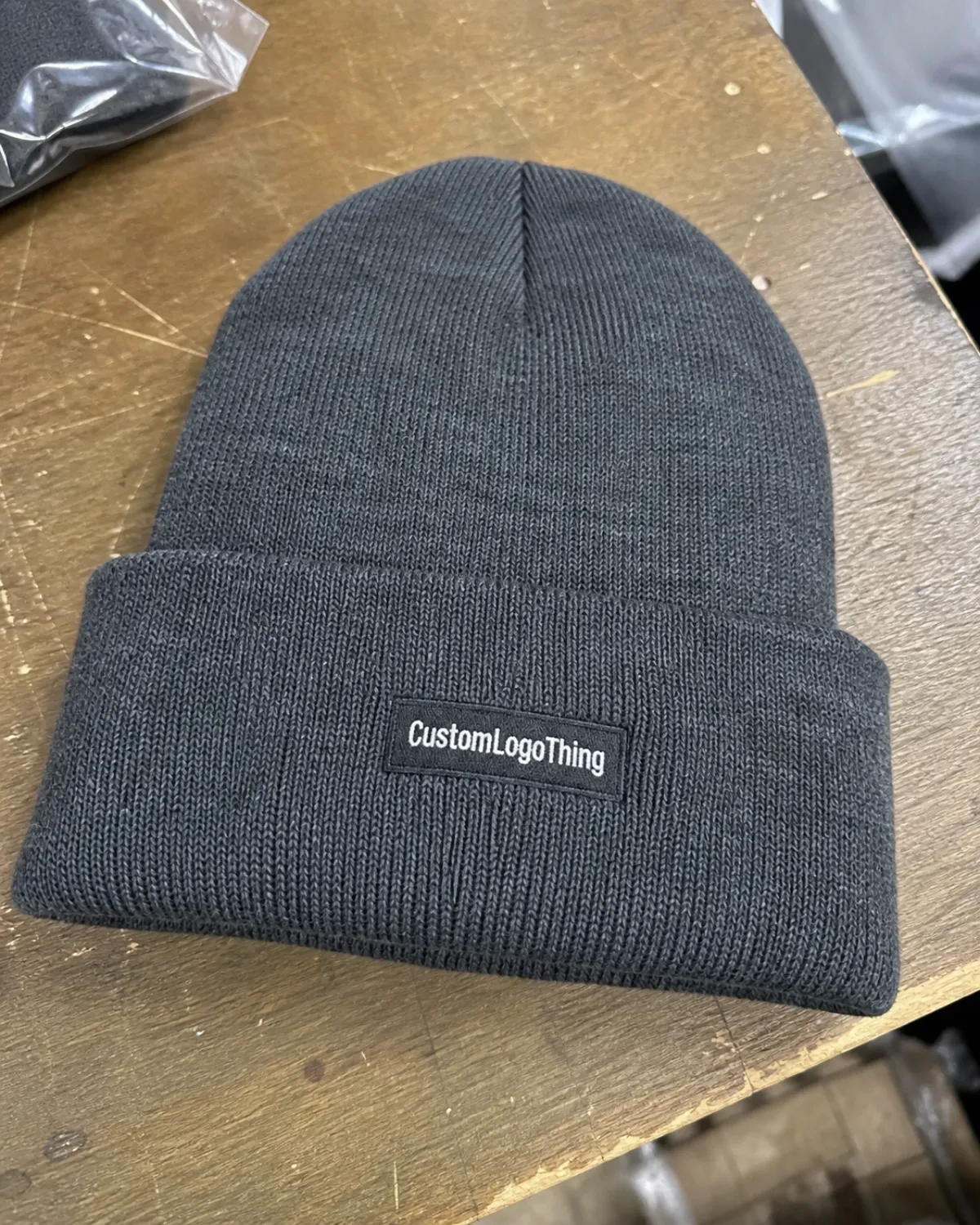
The common mistake is to treat knit headwear like a simple promotional item. It is closer to a small manufactured product with several moving parts. The unit price might look clean on paper, but a taller cuff, denser knit, custom color, or more complex logo treatment can change the quote faster than most buyers expect.
For bakery teams, the use case is usually mixed. The same beanie may be worn by staff in cold prep areas, handed out as winter merch, tucked into customer gift bundles, or sold as a seasonal retail item. Those jobs do not demand the same level of finish. Staff gear needs comfort and repeat wear. Retail pieces need better presentation. Promo stock needs enough structure to feel like a real product rather than a throwaway.
That is why the unit review should compare more than price. Buyers should look at the fabric hand feel, logo clarity, color consistency, and how the hat behaves after a shift, a wash, or a long day in a hot kitchen moving into cold morning air. A beanie that saves ten or twenty cents but comes back sloppy after a few uses is not a lower-cost option. It is a lower-quality one.
The strongest buying decisions usually come from a simple question: what does the hat cost per piece, what does it look like when worn, and what hidden work sits behind the quote? If the answer is unclear, the number is too.
There is also a practical timing issue. Bakery merch tends to be seasonal. Orders for late fall and winter are often placed under time pressure, which makes rushed approvals more expensive. If the spec is loose, the supplier has room to fill in the blanks in ways that may not suit the buyer. A tighter review reduces that risk before production starts.
Material, knit density, and cuff construction details that affect fit
The yarn choice shapes nearly everything else. Acrylic remains the most common base because it is inexpensive, holds color well, and is easy to produce in volume. It also gives suppliers a wider pricing range, which makes it a practical benchmark for comparing quotes. Acrylic-wool blends feel warmer and often look more substantial, but they usually raise the unit cost and can introduce slight variation in hand feel between lots. Recycled yarns can support a sustainability story, although buyers should ask for clarity on softness, stretch recovery, and any limitations in color matching.
Knit density is the next variable that changes the product more than people expect. A tighter knit usually gives the beanie a firmer shape, improves cuff stability, and creates a cleaner surface for embroidery. A looser knit may feel softer and more casual, but it can relax after wear and make small logos look less controlled. On knitwear, that matters because branding is often viewed from a distance, quickly, and in poor light. There is not much time for a complicated logo to announce itself.
The cuff is doing a lot of work. A fold-over cuff around 7 to 9 cm usually gives enough room for a legible logo without crowding the edge. Shorter cuffs can work, but they reduce the usable decoration area and can make the front feel cramped. If the cuff height varies too much from sample to sample, the beanie may still function, but the brand presentation starts to look inconsistent.
Fit is not just about circumference. Buyers should ask how much stretch the beanie has, whether the crown has a relaxed or fitted profile, and whether the edge keeps its shape after folding. One batch may feel fine on a sample table and still look less polished on actual heads, especially if the knit relaxes too much at the cuff. A reliable supplier should be able to describe the fit profile in plain terms, not just call it “standard.”
Color also deserves early attention. Bakery buyers often lean toward warm neutrals, charcoal, deep red, cream, forest green, or muted seasonal tones that feel natural in front-of-house environments. A bright color can work, but only if the logo, yarn, and packaging are all aligned. Once production starts, changing color is rarely a small adjustment. It can affect dye lots, lead time, and the minimum order quantity.
Comfort is another real constraint. Staff may wear these hats for long shifts or during early-morning prep, so scratchy yarn or unstable sizing becomes a daily annoyance. If the order includes retail packaging, hang tags, or carton labeling, the product spec should account for that from the start. Packaging is part of the buyer experience, not an afterthought.
Decoration specs: embroidery, patches, labels, and color matching
Decoration is where a plain winter hat becomes a branded product. Embroidery is usually the default because it is durable, familiar to suppliers, and strong enough for repeated wear. It works especially well when the logo is simple, the stitch count is reasonable, and the knit surface is dense enough to support the design. Woven patches are better when the logo includes fine lettering or sharper detail. Sewn labels and faux leather patches can also elevate the look without changing the knit base very much.
Placement affects both appearance and cost. A logo centered on the cuff usually gives the clearest read and the easiest approval process. Crown placement can work when the design is minimal, but it leaves less room for adjustment and can look less intentional if the artwork is busy. On knitwear, tiny elements disappear quickly. Thin lines, small type, and detailed icons may need to be simplified before the proof stage, because a design that looks perfect on screen can become muddy in stitches.
It helps to ask for an art package that includes the exact logo size in millimeters, placement dimensions, thread colors, and a digitized proof. A solid supplier should also state the stitch density, patch backing, or label construction if those details affect the final build. These are not cosmetic extras. They are part of the price structure and the quality outcome.
Color matching deserves a separate discussion. Yarn and thread do not always behave the same way under different lighting, and knit surfaces absorb color differently than flat fabric. A bakery logo in cream on forest green may look crisp on a digital proof and slightly softer in hand. That is normal, but the supplier should show a realistic expectation before production begins. If Pantone references are available, use them. If not, describe the colors in practical terms and ask for the closest production match.
One useful rule: the more detailed the art, the more carefully the buyer should watch the proof. Small text on a cuffed beanie can become unreadable very quickly. In many cases, a cleaner one-color mark performs better than a complicated badge that tries to say too much. For bakery promotions, subtle usually beats loud. The product should feel wearable first and branded second.
A concise decoration checklist helps keep the spec tight:
- Logo size in millimeters
- Cuff or crown placement
- Thread colors, patch material, or label type
- Stitch density or backing method
- Written approval before bulk production
Unit cost, pricing tiers, MOQ, and quote assumptions to compare
Any bakery cuffed knit beanies Unit Cost Review should compare like with like. The first headline price is rarely enough. Quantity changes the economics, but so do yarn type, decoration complexity, packaging, and shipping terms. A quote that looks lower at 1,000 pieces can become more expensive than a higher-looking quote at 300 pieces if the first one adds digitizing, packaging, or freight later.
For a standard acrylic cuffed beanie with one-location decoration, the pricing ranges below are realistic buying bands rather than promises. Exact pricing will move with lead time, color selection, decoration method, and whether the supplier is working from stock materials or custom production.
| Quantity | Typical unit cost | What it usually includes | Notes |
|---|---|---|---|
| 100 pieces | $5.20-$8.50 | Stock yarn, single-color embroidery, standard packing | Setup fees matter more at this level, and MOQ can be tight |
| 300 pieces | $3.80-$6.20 | Better bulk pricing, one decoration location, simple spec | A common range for bakery staff runs and short seasonal drops |
| 1,000 pieces | $2.60-$4.20 | Strongest price efficiency on a standard build | Often the best tier for multi-site campaigns or retail programs |
The important part is not the table itself. It is the assumption list behind it. Ask for a breakdown of sample cost, digitizing or tooling, production cost per piece, packaging, freight, duty if applicable, and any relabeling or bagging charges. If the supplier cannot separate those items, the quote is not transparent enough for a serious comparison.
MOQ changes with the spec. A stock-color beanie with a simple embroidered mark may have a relatively accessible minimum order. Custom yarn, multi-color patches, woven labels, or special packaging will usually raise the bar. That is not a red flag by itself. It is just how production gets balanced when a build requires more setup.
If the goal is to reduce cost without weakening the product, the most reliable levers are straightforward: use a standard yarn base, reduce thread colors, and simplify decoration without losing legibility. Buyers sometimes overdesign a beanie and then pay for it in setup and production complexity. The sweet spot is a hat that reads clearly at a glance and still feels worth wearing.
It also helps to request three quote scenarios at the same spec: a minimum order, a mid-sized run, and a bulk tier. That shows where the breakpoints are and whether a slightly larger order creates better value over the season. In practice, those jumps are more informative than a single price per piece.
Process, lead time, and production steps from proof to shipment
A reliable supplier should be able to map the order in a way that makes sense without translation. The usual path is inquiry, artwork review, digital proof, sample or pre-production approval, bulk production, quality check, packing, and shipment. That sounds ordinary because it is ordinary. The problems show up when the sequence gets interrupted by vague approvals or missing spec details.
Lead time depends on the build. A stock-color beanie with a single embroidered mark often lands around 12 to 18 business days after proof approval. A more custom order with special yarn, woven patches, or layered decoration can drift toward 18 to 30 business days. Shipping is separate. Ocean freight, customs, and domestic transit can add more time, especially if the order is tied to a seasonal launch. Rush work is possible in some cases, but the cost usually rises and the room for correction gets smaller.
The best proofs are boring in the right way. The logo size should be measured, not guessed. The cuff placement should be marked clearly. The color should be referenced with a code or a clear description. Packing should be defined by carton count, folding method, labeling, and whether the hats are bagged or loose-packed. When these details are left open, the production team has to interpret them, and interpretation is where avoidable variation starts.
Quality control should happen before the goods leave the factory. For knit headwear, that means checking dimensions, stitch consistency, color match, cuff stability, embroidery placement, and loose threads or snagging. A buyer does not need a laboratory report for every order, but they do need proof that the supplier is checking the run against the approved sample.
Milestone dates are more useful than a vague delivery estimate. Ask for the proof approval date, production start date, inspection date, and ship date. Those checkpoints help when a bakery is lining up a winter launch, holiday kit, or staff rollout. They also make it easier to spot schedule slippage before it becomes expensive.
The safest planning habit is simple: order earlier than the internal deadline suggests. That gives room for sample revisions, freight booking, and sign-off delays without forcing the buyer into air shipping or rushed production. In this category, time is part of cost.
How to judge supplier reliability for bakery promotional headwear
Good suppliers talk in specifications, not slogans. They should be able to explain what is included, what can change the quote, how the beanie is measured, and what happens if the sample differs from the proof. If they cannot state cuff height, yarn type, logo size, and packing method in one clear response, the buyer is already doing too much of the supplier’s job.
Consistency controls matter more than buyers sometimes expect. A serious partner will offer a pre-production sample when needed, provide run photos, and ask for written approval before full production. That is especially useful with knitwear because tension, yarn lot, and backing method can alter the final look. Small variation is normal. Random variation is not.
Repeat orders are a useful test. Ask whether the supplier can hold the same artwork file, patch spec, and color references without rebuilding the order from scratch. If a bakery needs 50 extra pieces later, can the supplier reproduce the original build quickly, or does everything start over with a fresh quote and fresh confusion? The answer reveals how stable the operation really is.
Communication style matters too. A reliable supplier will point out limits instead of saying yes to everything. If a logo is too detailed for embroidery, they should say so. If a color request is likely to shift the price or timeline, they should explain why. That kind of honesty is especially useful for bakery buyers, because these are practical branded items, not collector pieces. They need to look good, wear well, and arrive on time.
Packaging is another quiet sign of competence. A team that can manage hang tags, insert cards, carton labels, and folding instructions without drifting off spec usually has a stronger process overall. If the packaging details are messy, the rest of the order often is too.
Next steps for comparing quotes and placing the right order
Start with a clean checklist: logo file, color reference, target quantity, delivery window, decoration choice, and the intended use case. Staff wear, customer gifts, and retail promotions do not need the same build. Once the purpose is fixed, request two or three quote scenarios at the same spec so the comparison shows real breakpoints rather than a collection of unrelated numbers.
Confirm the sample requirement before production starts. If the logo contains small text, multiple colors, or an exact cuff position, proofing is not optional. The sample is the place to catch the problems that become expensive after bulk production. Buyers often save money by approving a clearer, simpler design rather than forcing every design detail into a knit structure that does not support it well.
Internal decision-making should also be aligned before the order is placed. One person may care most about unit cost, another about lead time, and another about presentation. Those priorities are not interchangeable. A bakery that wants staff to wear the hats daily should weight comfort and washability more heavily. A seasonal retail item needs stronger visual appeal. A promotional handout needs enough durability to survive real use without looking cheap.
In the end, the most useful bakery cuffed knit beanies Unit Cost Review is the one that compares the quote against the exact spec, the actual lead time, and the real use case. If the yarn, decoration, packing, and delivery assumptions are aligned, the numbers mean something. If they are not, the lowest quote is often the least useful one.
What drives bakery cuffed knit beanies unit cost the most?
Yarn type, decoration method, and quantity usually have the biggest impact. Setup work, custom colors, and packaging changes can raise the price even when the beanie itself looks simple.
What MOQ should I expect for custom bakery cuffed knit beanies?
MOQ depends on the supplier and the build. Stock yarn and basic embroidery usually allow smaller runs than custom yarn, patches, or special packaging, so it helps to request several tiers before comparing vendors.
Which decoration is best for bakery branded cuffed knit beanies?
Embroidery is the most common choice because it wears well and looks clean. Woven patches or sewn labels can work better when the logo has fine detail or when the product needs a more polished finish.
How long does production usually take after proof approval?
Many stock builds fall around 12 to 18 business days, while more custom orders can take 18 to 30 business days or longer. Freight and customs are separate, so the full delivery window should be confirmed in writing.
Can I reduce unit cost without hurting the final look?
Yes. The safest ways are to simplify thread colors, use a standard yarn base, and avoid decoration that is too detailed for knitwear. The logo still needs to read clearly and the cuff still needs to hold its shape.


