Two Frosted Zipper Bags can look nearly identical on a shelf and fail in completely different ways once they’re filled, sealed, stacked, and shipped. That is why the retail frosted zipper bags material thickness guide matters more than most buyers expect. The wrong film gauge shows up fast: split seams, zipper tracks that feel loose, corners that puncture under pressure, and a package that reads as cheap before the customer has even touched the product.
Thickness in plastic packaging is usually discussed in microns or millimeters, but the number alone does not tell the full story. Real performance depends on the body film, zipper area, side seals, product shape, and how the bag is handled through the supply chain. A frosted zipper bag is not just decorative plastic. It has to present well, protect the product, and survive enough open-close cycles to justify its place in retail packaging.
The tradeoff is straightforward and a little unforgiving. Too thin, and failure is only a matter of time. Too thick, and the bag becomes stiff, heavier in freight, and more expensive than the product actually needs. Good spec work is usually about restraint, not excess.
Why frosted zipper bag thickness changes everything
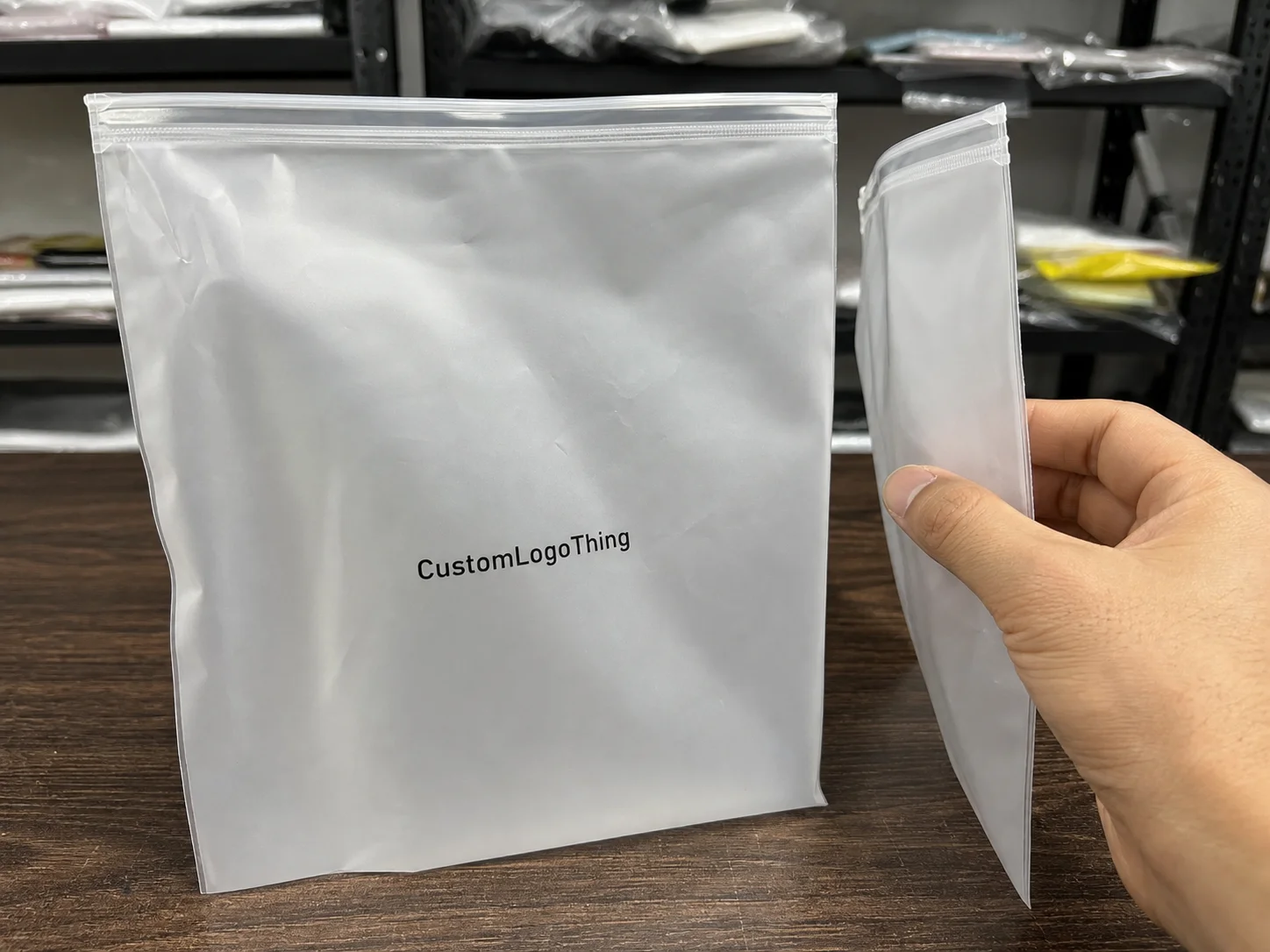
On paper, a 0.08 mm bag and a 0.12 mm bag do not look dramatically different. In practice, they can behave like two separate packaging formats. The lighter bag may work for flat apparel inserts, paper goods, or soft accessories. The heavier one handles denser products, sharper edges, and repeated customer use with less distortion. That gap is exactly why thickness deserves attention instead of guesswork.
Thickness affects more than durability. It also changes perceived quality. Frosted film diffuses light and hides fingerprints better than clear film, which is one reason retailers like it for display packaging. But if the film is too thin, the bag wrinkles easily and feels flimsy in the hand. Too thick, and it may feel rigid or overbuilt, which can work for premium kits but feels awkward for small, flexible retail items.
The buyer usually runs into one of two problems:
- Too thin: split seams, zipper failure, pinholes, or a bag that looks tired before it reaches the shelf.
- Too thick: higher unit cost, more material weight, harder folding, and a budget that gets consumed by packaging instead of product value.
So thickness changes everything because it influences performance, appearance, and logistics all at once. That is a lot of consequences for one specification line.
How frosted film thickness affects performance
Film thickness has a direct effect on puncture resistance, tensile strength, and seal integrity. Thicker film generally handles sharp edges better and gives the zipper zone more support. That matters because the closure is often where weak construction becomes visible first. If the film around the track is too soft, the zipper can distort after repeated use or under product pressure.
The frosted finish itself does not make the bag stronger. It changes the visual effect and the surface feel. A matte finish often reads as more premium than glossy film, even when the base resin is similar. The downside is that poor frosting quality can make a bag look cloudy, streaked, or uneven. That tends to signal weak process control, not just a bad design choice.
For practical selection, buyers usually encounter these ranges:
| Approx. film thickness | Typical use | Strength profile | Tradeoff |
|---|---|---|---|
| 0.05–0.07 mm | Light retail items, inserts, flat accessories | Good for gentle handling, lower puncture resistance | Lower cost, but easier to overfill or damage |
| 0.08–0.10 mm | General retail packaging, mixed handling | Balanced strength and flexibility | Often the best compromise for many buyers |
| 0.11–0.14 mm | Heavier goods, sharper edges, premium kits | Better puncture resistance and shape retention | Higher cost and more stiffness |
Thickness alone does not decide performance. Resin blend, zipper profile, seal width, and side-gusset design can matter just as much. A well-made 0.09 mm bag can outperform a poorly made 0.12 mm bag if the closure and seals are executed properly. Factory consistency still matters more than a marketing-friendly number.
For buyers who need to validate packaging performance, testing should go beyond visual inspection. Drop tests, compression checks, and zipper-cycle testing are more useful than judging a sample in your hand for thirty seconds. Standards and shipment simulation methods from organizations such as the International Safe Transit Association (ISTA) can help frame those tests, while the Institute of Packaging Professionals offers broader packaging references. The point is simple: test the bag under use conditions, not just under showroom lighting.
Key factors that determine the right thickness
The right thickness depends on how the bag will actually be used. Not in a product photo. In a real supply chain, where it gets filled, stacked, handled, reopened, and occasionally overstuffed because somebody is trying to move faster than the packaging was designed for.
Product weight and shape are the first filters. Flat apparel inserts, socks, and paper goods behave differently than cosmetics, small electronics, or hardware. Soft products are forgiving. Hard corners are not. If the product can press through the film or stress the zipper line, thicker material usually earns its keep.
Use case changes the target too. Display-only retail packaging can run lighter than bags used for ecommerce shipping or repeated customer access. If a shopper will open and close the bag many times, zipper fatigue matters. If the bag is only a one-time presentation sleeve inside a gift set, the spec can be lighter and more cost-conscious.
Surface sensitivity is another quiet factor. If the product has a soft-touch label, foil finish, printed coating, or delicate surface treatment, the bag should avoid unnecessary abrasion. A smoother interior and a thickness that reduces sharp folding lines can help protect premium cosmetic, stationery, and accessory sets.
Brand presentation matters more than buyers often admit. Thicker film can look premium, but only if the frosting is even and the bag holds its shape. If the film becomes cloudy, wavy, or too rigid, the visual effect works against the product. Thickness should support the brand story, not dominate it.
Storage and handling also influence the spec. Bags stacked in cartons face compression. Bags hung on retail hooks get pulled. Bags shipped in bulk may rub against each other and the carton contents. If the outer pack uses recyclable corrugated cardboard or FSC certified cartons, the inner bag still has to survive the abuse. Sustainable outer packaging does not excuse a weak inner structure.
Regulatory and sustainability constraints can narrow the material options. If a buyer wants post-Consumer Recycled Content, a recyclable structure, or a resin with environmental documentation, not every thickness will be available in every blend. Some biodegradable claims are technically narrow or poorly explained, so material verification matters more than slogans. Ask for the actual resin, the actual spec, and the actual test results.
Retail frosted zipper bags material thickness guide: choosing by product type
Here is the buyer-friendly version of the retail Frosted Zipper Bags material thickness guide: start with product category, then adjust for handling and presentation. That sounds basic because it is. Many packaging mistakes happen when teams skip the basic fit check and chase a sample that feels good in hand but fails once the actual product goes inside.
Lightweight retail items
For apparel accessories, small stationery bundles, cards, patches, and similar low-risk items, lighter film often performs well. A bag in the 0.05–0.08 mm range can be enough if the product is smooth and not sharp-edged. In this category, visual presentation matters more than brute strength. The goal is enough body to look intentional, not a soft sleeve that collapses when a customer picks it up.
Mixed-use products
For items that sit on a shelf and also ship in small cartons, a mid-range film around 0.08–0.10 mm is usually the most practical choice. That range balances clarity, flexibility, and durability without pushing freight or material cost too hard. It also gives the zipper area enough support for repeated handling. For many retail programs, this is the range that survives both merchandising and distribution.
Heavier or sharper retail goods
For dense products, premium kits, small electronics, or items with clips, corners, and edges, thicker structures around 0.11–0.14 mm make more sense. The extra film helps resist puncture and supports the zipper track. If the product can press into the side wall under load, a thin bag will become a problem quickly. Saving a few cents on the bag rarely justifies the replacement cost later.
“If the bag feels almost too thick in hand, that may be acceptable for shelf presentation. It may also create freight cost you did not plan for. Test it with the product, not with intuition.”
The simplest test is almost embarrassingly direct:
- Fill the bag with the actual product.
- Seal it fully.
- Shake it, stack it, and compress it in a carton.
- Open and close it several times.
- Look for whitening at the fold, zipper drag, seam stress, or corner puncture.
If it fails there, the spec is wrong. If it passes but still looks overbuilt, compare the next thinner option. The target is the thinnest bag that still looks premium and survives the handling the product will actually face.
For sustainability-led projects, the bag has to be evaluated as part of a system. A kraft paper carton or FSC certified paper insert may reduce the plastic footprint of the outer pack, but that does not mean the zipper bag can be flimsy. Packaging components need to work together. A good-looking materials chart does not protect a damaged product.
Cost, pricing, and MOQ tradeoffs
Thickness affects cost in a direct way. More film means more material cost and often more freight weight. It can also change production efficiency because thicker film may require different sealing parameters or slower handling. That is why the lowest-looking spec is not always the cheapest finished order.
MOQ matters because higher quantities usually reduce the unit price, but only when the thickness spec stays stable and the factory can run it efficiently. If the buyer keeps changing the gauge, zipper style, or print coverage, the quote starts drifting. A lot of packaging comparisons fall apart here. One quote includes custom printing, another uses recycled content, and a third quietly removes the upgraded zipper structure.
For custom orders with basic printing, these ranges are a useful reference:
| Thickness range | Typical unit price at 5,000 pcs | Common buyer reason |
|---|---|---|
| 0.05–0.07 mm | $0.10–$0.18 | Low-cost display packaging |
| 0.08–0.10 mm | $0.14–$0.24 | Balanced retail use |
| 0.11–0.14 mm | $0.20–$0.34 | Premium or heavy-duty use |
These are working ranges, not universal quotes. Size, print coverage, zipper style, and finish can move price more than a small change in thickness. Full-color printing on both sides may matter more than a jump from 0.09 mm to 0.11 mm. Larger sizes do the same. If a quote looks off, check the full spec sheet before assuming the material is the issue.
Overspending usually happens when teams choose a premium thickness for a product that never sees rough handling. Underspending happens when they shave film thickness to save pennies and then pay for replacements, complaints, or rework. Packaging budgets tend to be very patient until the first failure report lands.
If sustainability is part of the brief, ask whether the bag can be produced with post-consumer waste content or a recyclable structure. Do not assume that “green” means cheaper or more durable. It may mean neither. Clarity is better than vague eco-language.
Production steps, testing, and lead time
A normal custom bag workflow starts with size confirmation, then a thickness recommendation, sample approval, production, quality check, and shipping. If you are ordering custom logo zipper bags, that sequence matters because thickness affects sealing behavior and the finished hand feel. A factory may need to adjust heat, pressure, or dwell time when moving from lighter film to a thicker structure.
Lead time usually stretches if the supplier needs to source a different film grade or tune the process. For standard specs, roughly 12–15 business days after proof approval is a common range. Custom thickness requests, special finishes, or dense print coverage can push that longer. Buyers often underestimate this and assume “just thicker” means no timeline impact. It usually does.
Sample testing should not be skipped. Check zipper cycle performance, seal strength, drop handling, and how the bag looks under retail lighting. A bag can look clean on a desk and odd under bright store lights because the frost level or print density changes the visual effect. Retail packaging lives or dies by what the customer sees in the aisle.
If sustainability goals are part of the project, verify whether the outer packaging and shipping cartons are specified in recyclable materials and whether the paperboard components are FSC certified. The FSC site is a useful reference if the brief includes certified paper sourcing. The important part is documentation, not assumptions.
One more practical detail: thicker film can require tighter process control, not looser. The seal area may need different settings to prevent distortion or weak bonding. If the first sample feels too stiff, too cloudy, or hard to close, ask for a revision and build that into the schedule. First-round perfection is nice; reliable approval is better.
Common thickness mistakes buyers make
The most common mistake is choosing thickness based on appearance alone. A bag can look premium and still fail under load. Another common error is copying a competitor’s spec without knowing their product weight, fill level, or shipping method. That is like copying someone else’s shoe size because you like the color.
Buyers also assume thicker film automatically fixes a weak zipper. It does not. If the zipper track is poor, thicker walls just create a more expensive bag with the same closure problem. The film and the closure system need to be matched together.
- Over-specifying: making the bag so thick that packaging cost exceeds the value it adds.
- Under-specifying: saving a penny and then dealing with splits, returns, and complaints.
- Skipping samples: trusting a spec sheet as if it has field experience.
- Ignoring real handling: not testing stacking, shipping, or repeated opening.
There is also a quieter mistake: forgetting that the bag is part of a larger pack system. If the inner packaging is a frosted zipper bag but the product ships in a heavy corrugated cardboard mailer, the bag may only need moderate strength. If the product travels loose in a carton, it needs more protection. Packaging does not exist in isolation, even though buyers often try to spec it that way.
Next steps for specifying the right bag
Start with a short packaging brief. Include product weight, dimensions, retail use case, shipping method, expected handling, and whether the bag will be opened repeatedly. That single page will save more money than a string of vague emails asking for “good quality.”
Then request two or three thickness samples around the target range. Compare them side by side with the actual product inside. Judge feel, clarity, zipper action, and durability. Not just the thickness number. If possible, test shelf display and carton stacking too. Real use beats assumptions every time.
Ask for quotes that show unit price at each thickness option, plus MOQ and estimated lead time. If the supplier cannot quote clearly, that is a warning sign. A good answer explains why 0.09 mm fits better than 0.07 mm for a specific product, not just that “this one is better.”
Choose the thinnest bag that passes the abuse test and still looks premium. Then lock the final spec in writing so nobody “interprets” your thickness request into something else during production. That happens more often than it should. A clear spec sheet is cheaper than a remake.
Used properly, the retail Frosted Zipper Bags material thickness guide is not about choosing the thickest bag or the cheapest one. It is about buying the bag that does the job cleanly, holds up in the real world, and avoids wasting money on unnecessary material.
FAQs
What thickness is best for retail frosted zipper bags for light products?
For lightweight retail items, a mid-light film usually works if the product is smooth and not sharp-edged. Zipper quality and seal consistency matter as much as thickness. Test with the actual product, because empty-bag specs rarely tell the whole story.
How do I compare frosted zipper bag thickness without getting confused by numbers?
Ask the supplier what thickness range is recommended for your product weight and handling. Compare samples side by side after filling them. Judge puncture resistance, closure feel, and shelf appearance.
Does thicker material always mean a better retail frosted zipper bag?
No. Thicker can mean stronger, but it can also mean stiffer, pricier, and heavier. The best bag is the one that survives use without pushing cost beyond the value it adds.
How does thickness affect pricing and MOQ?
Thicker film usually increases material cost and can raise freight cost. MOQ can lower unit cost, but only if the thickness spec stays stable and production is efficient. Ask for quotes at multiple thickness options to see the real difference.
What should I ask a supplier before ordering frosted zipper bags?
Ask for the recommended thickness, sample options, unit price, MOQ, and lead time. Also ask how the bag performs with your actual product weight and shape. Request samples before committing to full production.


