Beauty Logo Patch Beanies Unit Cost review sounds specific until the first quote lands and the numbers start moving around. The patch is one line item. The knit is another. Packaging has opinions too. A beanie that looks simple on the shelf can hide a lot of cost behind the scenes, which is why the cheapest-looking option on paper is often the one with the most surprises.
For salons, skincare labels, and promo teams, patch beanies are a practical middle ground. They give you visible branding without forcing a full jacquard knit, which means less artwork complexity, fewer sample revisions, and less risk if you are still testing demand. That matters. A lot. You are not buying a fashion essay. You are buying something people will wear, photograph, and hopefully reorder.
The best runs usually do three things at once: they keep the logo legible, they stay inside the target margin, and they do not turn production into a scavenger hunt. If a beanie looks clean from a distance and the landed unit cost leaves room for resale, it has done its job. Fancy jargon does not help here. Clear specs do.
Why Beauty Brands Use Patch Beanies to Sell Faster
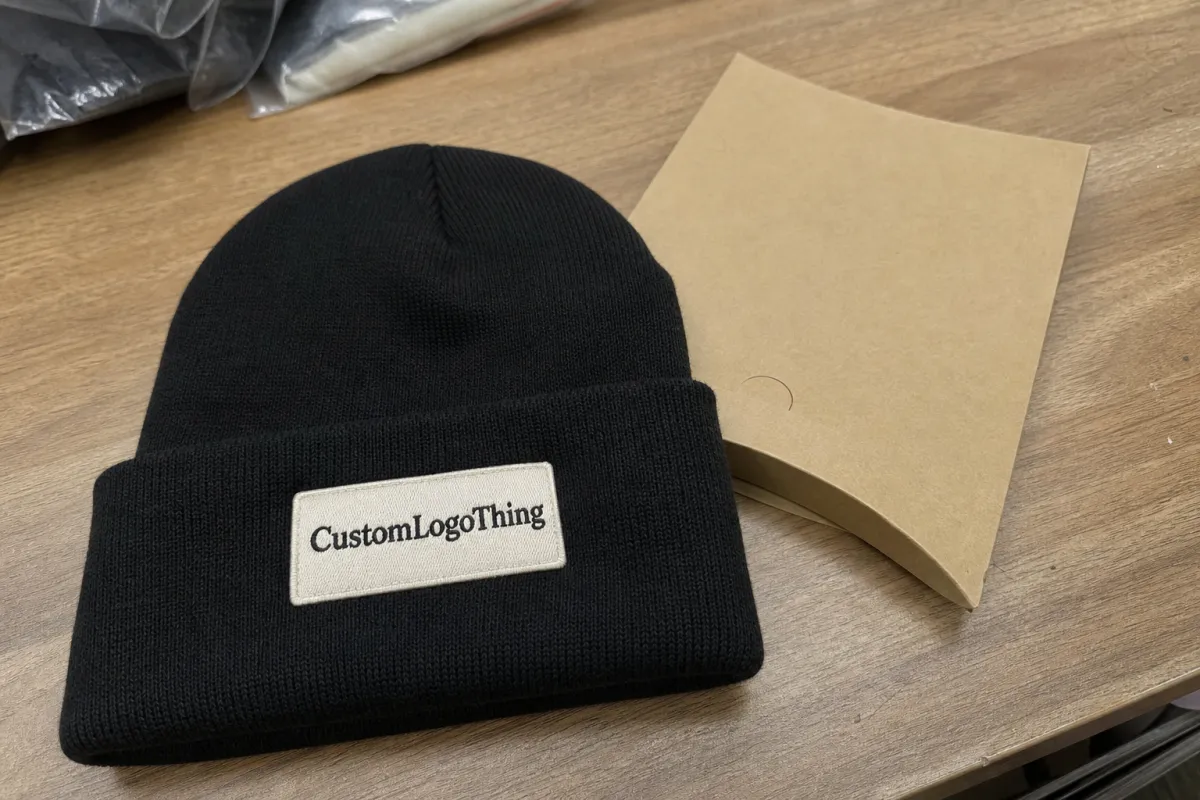
Patch beanies work because they solve three practical problems. They create fast branding, they simplify production, and they fit into a beauty merch line without looking like a random add-on. A small logo patch on a cuff gives enough visual presence for retail, but it avoids the approval headaches that come with full-color knit artwork.
That small patch also gives buyers more control. A woven or embroidered logo can preserve clean typography without requiring every letter to be knit into the garment itself. For beauty brands, that is useful because marks are often minimal, understated, and built around spacing more than decoration. A patch handles that nicely. A giant knit graphic usually does not.
The margin story matters just as much as the design. If the beanie costs a few dollars to make and the retail price sits in a normal winter-accessory range, the product can support a decent margin without feeling inflated. That is why these sell. They are easy to photograph, easy to display near checkout, and easy to bundle with other merch or gift sets. Simple products tend to move faster when the presentation is clean.
Buyer rule: choose the beanie and patch combination that protects the logo first, then pressure-test the unit cost. It is easy to overpay for a material that sounds premium and still end up with a less convincing product. The market does not care about the adjective on the quote. It cares about how the thing looks in hand.
Common buyers include:
- Skincare brands building seasonal bundles, staff gifts, or loyalty drops.
- Salons and med spas that want retail add-ons or team wear with a cleaner finish.
- Promo teams looking for a winter item that avoids apparel sizing drama.
- Wholesale merch brands testing a logo line before placing a deeper inventory bet.
“If the logo reads from six feet away and the knit still feels decent in hand, the product is doing real work.”
Patch beanies also move faster through revision than fully custom knit styles. If the logo needs a size tweak or the placement shifts a few millimeters, that is usually easier to correct on a patch than on a garment knit file. Less rework means fewer delays and fewer people pretending a small change is “no problem” when it clearly is.
Patch Styles, Placement, and Finish Choices
The patch type does most of the visual heavy lifting. Woven, embroidered, PU leather, silicone, and TPU all produce different looks, and each comes with a different cost and risk profile. The right pick depends on how detailed the logo is, how polished the brand needs to feel, and how much contrast you want against the beanie body.
Woven patches are usually the safest choice for small text and fine lines. They hold detail better than embroidery and usually quote well for buyers who want a clean, controlled look. Embroidered patches add texture and a more traditional retail feel, but tiny type can get mushy fast. If the logo is bold and simple, embroidery works. If it relies on a thin serif or tiny spacing, be careful.
PU leather patches look polished and photograph well on neutral knits. Silicone patches feel more technical and dimensional, which can work for athletic or modern beauty branding. TPU patches land somewhere between graphic and glossy, but they are not a free win. If the logo does not need that effect, the extra shine can just make the product look louder than intended. The point is fit, not novelty.
| Patch Type | Best For | Typical Cost Impact | Notes |
|---|---|---|---|
| Woven | Small text, fine lines, clean logos | Usually the most economical | Strong detail and a good default for tighter budgets |
| Embroidered | Bold marks, texture, classic retail feel | Low to moderate | Can blur small lettering; best for simple shapes |
| PU leather | Minimal branding, premium presentation | Moderate | Debossing looks clean on uncomplicated logos |
| Silicone | Sporty, modern, dimensional branding | Moderate to higher | Useful when a tactile, technical finish matters |
| TPU | Glossy graphics, contemporary branding | Moderate | Works best with solid shapes and simple artwork |
Placement changes both the look and the labor. A cuff patch is the most common because it is visible, stable, and easy to align. A crown patch can look more integrated, but it demands tighter placement control and a more careful inspection process. Fold-over or side placements feel more casual and can work if the brand wants something closer to streetwear than conventional beauty merch.
Finish matters more than buyers expect. Matte usually photographs better and hides small surface flaws. Gloss can work, but it also draws attention to every edge and every alignment issue. Stitched edges are dependable. Heat-sealed edges can look cleaner at first glance, but only if the factory cuts and seals them correctly. A sloppy edge is exactly the kind of detail that makes a “premium” item feel rushed.
The practical filter is simple: pick the patch that supports the logo detail, then choose the finish that matches the brand lane. Do not pay extra just because a material sounds expensive. That is how a quote gets padded without improving the product.
Beanie Specs That Change Fit, Warmth, and Order Risk
The beanie base can make or break the whole order. A good logo on a flimsy knit still looks like a flimsy knit. Yarn content, gauge, cuff depth, and stretch recovery all affect comfort, shelf appeal, and cost. If two quotes look wildly different, these are usually the reasons.
Acrylic is the usual budget-friendly choice. It is easy to source, holds color well, and gives consistent results across batches. Acrylic-wool blends usually cost more, but they feel warmer and can look a bit more substantial. Recycled blends help if the brand wants a sustainability story, but the buyer still needs to check actual fiber content, not just a recycled claim printed in big letters and explained poorly later.
Fit is controlled by silhouette. A cuffed beanie is the safest commercial option because it gives you a stable branding zone and broad appeal. A slouch beanie is looser and more fashion-forward. A fisherman beanie sits shorter and usually feels trend-driven. Rib knits stretch and recover better than looser constructions, which matters if the customer base is broad and the item is meant for repeated wear.
Gauge deserves more attention than it gets. A tighter knit often looks cleaner, blocks wind better, and makes the patch feel more integrated. A looser knit can feel softer, but it also shows irregularity faster. Two beanies can both be labeled one size and still fit very differently. That is not a typo. It is the reason fit samples exist.
There are a few spec choices that quietly push cost and risk:
- Color count increases approval complexity and can slow sample confirmation.
- Contrast stitching adds visual interest, but it adds one more thing to inspect.
- Woven interior labels improve branding and usually add setup charges.
- Hang tags and insert cards improve presentation, but they touch labor and packing cost.
If you are testing the market, keep the first run simple. One body color, one patch, standard packing, no extra ornaments. That gives you a clean read on demand and keeps the order from becoming a mini project with five opinions and a deadline. Once the design proves itself, then you can add labels, custom tags, or a heavier yarn blend.
Order risk is real. A rare yarn shade, a specialty patch finish, and custom packaging all raise the chance of delay. Simpler specs make quotes easier to compare and production easier to control. Boring is useful here. Boring ships.
Beauty Logo Patch Beanies Unit Cost Review: MOQ and Quote Ranges
Here is the part buyers usually want first: the unit cost. A quote for patch beanies typically includes the blank beanie, the patch, application labor, basic packaging, and sometimes local freight to a consolidation point. Anything beyond that, like rush service, special cartons, or retail inserts, can show up later unless the quote is careful.
Bulk pricing is rarely a straight line. The first meaningful drop usually comes from spreading setup charges, tooling, and sample work across more units. That is why a 100-unit run can feel awkwardly expensive while a 500-unit run starts to look more sane. The math is not mysterious. It just dislikes small orders.
Here is a realistic frame for a straightforward custom beanie program. These are range estimates, not promises, because yarn, patch finish, and packaging can move the number quickly:
| MOQ | Typical Unit Cost Range | Best Use Case | Notes |
|---|---|---|---|
| 100 units | $4.50-$8.50 | Test launch, event merch, small local run | Setup burden is heavier; useful if you need low exposure |
| 300 units | $3.50-$6.50 | Small retail drop or salon promo program | Often the sweet spot for a first serious order |
| 500 units | $2.75-$5.25 | Real launch with better margin control | Usually better if the logo, color, and placement are already settled |
| 1,000 units | $2.10-$4.25 | Established product line or wholesale order | Best unit economics, but only if inventory risk is acceptable |
Patch type can move the number more than some buyers expect. Woven and simple embroidered patches usually sit toward the lower end. PU leather, silicone, and TPU often push cost higher, especially if the patch is large, uses multiple colors, or needs a more precise finish. Premium yarn blends, custom dyeing, and upgraded packaging can shift the number again. Small changes add up fast.
Hidden cost drivers are where quotes get messy. Pantone matching can slow things down and sometimes trigger a surcharge. Sample revisions can add cost if the artwork keeps changing after the first proof. Split shipments, custom cartons, and retail-ready packing all affect the landed unit cost. If a supplier does not separate those items, the quote is incomplete.
If you want a real comparison, ask for three versions of the same order:
- Economy - stock blank, standard patch, basic packaging.
- Balanced - better yarn, cleaner patch finish, branded presentation.
- Premium - upgraded fiber content, custom labels, refined packaging.
That side-by-side view usually shows where the money actually goes. Sometimes the premium version is only a small step above balanced because the factory is already set up for it. Other times the finish choice adds real labor and pushes lead time. You do not know until the same brief is priced three ways.
The lowest quote is not automatically the best one. If freight, packing, trimming, or revision fees are missing, the landed number can end up worse than the quote that looked more expensive at first glance. Ask for line-item clarity and confirm whether the price includes sewing, trimming, carton packing, and standard polybags. If it is not spelled out, assume it is not included.
For buyers planning retail or distribution, basic documentation matters too. Standards from groups like ISTA help frame shipping and transit expectations, and any packaging claim tied to certified fiber or wood content should be checked against FSC guidance. Not every beanie order needs formal certification, but once the product moves beyond a small promo run, paperwork stops being optional.
Production Steps, Approval, and Turnaround Expectations
The production path is simple on paper. Artwork review comes first. Then the supplier creates patch mockups or digital proofs. After approval, the beanie body is sourced or knitted, the patch is produced, the patch is sewn or heat-applied, and the order moves through inspection and packing. Straightforward. In practice, the delays usually start at approval, not in the sewing room.
The approval stage matters because changes after sign-off affect both price and lead time. A small logo shift can require a new patch file, a new mold, or a revised embroidery setup. That is not the supplier being difficult. That is how production works when multiple parts are already in motion. The fastest way to slow a run down is to keep adjusting artwork after it has been approved.
Turnaround depends on what is already in stock and how custom the order is. A simple run using stock blanks and a standard woven patch can move faster than a fully custom build. Add custom yarn colors, special labels, or unusual patch materials, and the schedule stretches. For a straightforward order, a realistic window is often around 12-18 business days after sample approval. More customized jobs usually need more time, especially during peak season.
Where delays usually show up:
- Missing vector files or low-resolution logos.
- Placement changes after the first proof.
- Sample revisions that keep moving the target.
- Holiday freight congestion or carrier cutoff dates.
- Last-minute requests for retail packing or split delivery.
One habit saves a lot of trouble: confirm the delivery date before final design approval. Not after. If the target event date is clear from the start, the supplier can tell you whether the schedule is realistic or wishful thinking. That single conversation prevents the usual “we thought it would still be fine” email chain.
Practical standard: ask for proof images, sample photos, and a written approval deadline. That creates a paper trail and keeps timing honest on both sides. A supplier who cannot explain the schedule clearly is not really selling production. They are selling optimism.
What a Reliable Custom Beanie Supplier Should Prove
A reliable supplier does not hide behind vague language. They show specs, line-item pricing, sample references, and approval milestones. If the quote is clear, the order usually runs better. If the quote is fuzzy, the production often follows the same pattern. Strange how that works.
The difference between a supplier and a salesperson is simple. A supplier explains tradeoffs. A salesperson says everything is easy and hopes the missing details do not show up until after approval. For beauty Logo Patch Beanies, the tradeoffs usually sit in patch detail, yarn feel, and packaging cost. You want someone who can explain why one version costs more and what that buys you.
Quality checks should be concrete. Ask how they verify patch alignment, whether they inspect edge cleanup, how they handle color consistency across the batch, and whether they trim loose threads before packing. If the patch sits crooked or the logo drifts off-center, the beanie looks wrong immediately. Nobody buys “close enough” and calls it premium.
Good documentation matters too. Request a tech pack, proof images, carton count, and packing details. That way the shipment matches the order instead of whatever the conversation sounded like that day. If the supplier can also confirm whether the order ships in one lot or multiple cartons, receiving gets easier and the warehouse does not have to guess.
Strong suppliers usually do four things well:
- They answer with measurements instead of adjectives.
- They separate the beanie, patch, labor, and freight in the quote.
- They show sample references before bulk production starts.
- They give a realistic schedule and stick to approval deadlines.
That is the standard worth expecting. You are buying consistency and speed, not slogans. If a supplier cannot prove both, the price is not the real problem.
Next Steps to Order the Right Run Without Surprises
If you want a clean quote, send everything in one message: logo file, target quantity, preferred patch style, beanie color, packing requirement, and hard delivery date. A complete brief usually gets a tighter number and fewer follow-up questions. Every missing detail creates room for guesswork, and guesswork is expensive.
Start with the purpose of the order. A resale item needs a different margin target than staff uniforms or giveaway merch. If the product is going into retail, visual appeal and unit economics need to work together. If it is for an event, speed and reliability may matter more than squeezing the last few cents out of the order. The spec should match the job. Wild concept, I know.
Compare quotes using the same assumptions. Patch size, yarn type, packaging, and shipping method should match across suppliers or the comparison is useless. Buyers get burned when one supplier prices a bare-bones version and another prices a more complete package. That is not comparison shopping. That is playing spreadsheets against each other and pretending the numbers mean the same thing.
Before production starts, check this list:
- Approve the sample or proof in writing.
- Confirm the MOQ and reorder range.
- Confirm turnaround after sample approval.
- Confirm packing style and freight terms.
- Confirm whether setup charges or tooling fees are already included.
Used properly, beauty Logo Patch Beanies Unit Cost review is not just a pricing exercise. It is the filter that helps you choose the cheapest quote that still matches the brief. That is the real win: not the lowest number on paper, but the best order for the money.
What is included in beauty logo patch beanies unit cost?
Usually the blank beanie, the patch, application labor, and basic packaging are included. Sample fees, rush charges, or freight may be separate depending on the quote. Ask for a line-item quote so the lowest number is not hiding extra charges.
What MOQ makes sense for beauty logo patch beanies?
Around 100 units works for a small test or local campaign. 300 to 500 units is usually the better range for a real launch. 1,000 units or more often improves unit cost if the design is locked.
Which patch type keeps the price lowest on custom beanies?
Simple woven or embroidered patches usually keep tooling and setup lighter. Leather and silicone patches add texture and shelf appeal, but they can raise cost. Choose the patch type that fits the logo detail first, then optimize price.
How long does turnaround usually take for patch beanies?
Stock blanks with a simple patch can move faster than fully custom builds. Custom colors, sample revisions, and peak season can slow the schedule down. Get the timeline confirmed after sample approval, not before.
What artwork do I need for an accurate quote?
Send a vector logo, patch size, placement, target quantity, and color references. Include packing and shipping needs so the factory prices the whole job correctly. The clearer the brief, the tighter and more useful the quote will be.


