A vitamin Logo Patch Beanies unit cost review usually starts with the wrong line item. Buyers fixate on the blank beanie. That is understandable, but the shell is rarely what decides the final economics. Patch material, application method, artwork complexity, and setup spread tend to move the number far more than the knit itself.
That is why patch beanies keep showing up in bulk programs. A small, well-made logo patch changes how the hat is perceived. It reads like branding, not decoration. A clean patch on a simple cuff beanie can look retail-ready even when the underlying construction stays economical.
The practical question is not whether a patch looks nicer than a plain knit cap. It does. The real question is whether the build supports the budget, deadline, and quantity you actually need. For giveaways, the goal is controlled spend. For resale, the goal is margin. For staff uniforms, durability matters more than a flashy finish. The right spec depends on which of those jobs the beanie has to do.
The cheapest quote is often the one with the most missing details. On patch beanies, vague specs create rework fast.
The Margin Test: Why Patch Beanies Outsell Plain Knit Hats
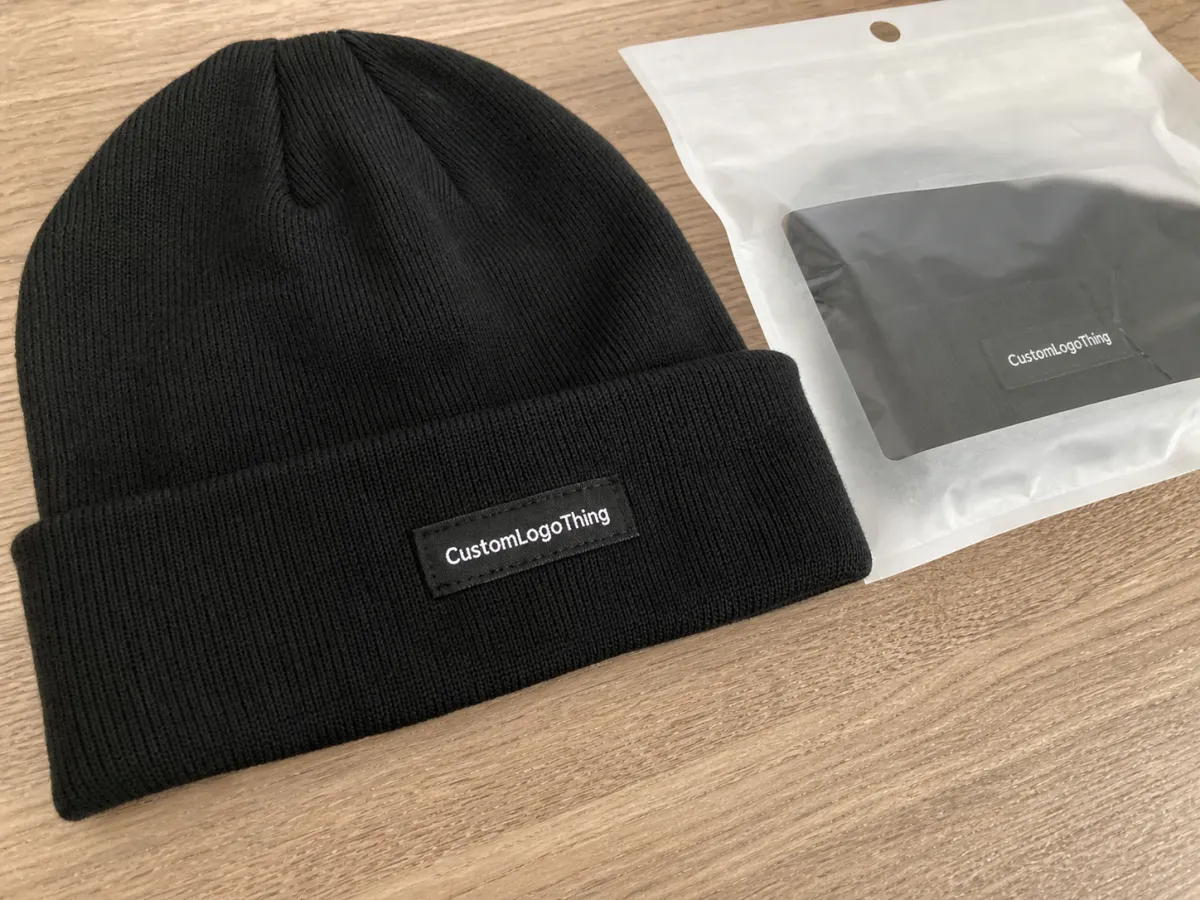
Plain knit hats are easy to source and easy to ignore. A patch changes that in a hurry. Customers read the patch as a badge, and badges sell better than empty surfaces. That is especially true for cuff beanies, where the logo sits in the one place people expect to look first.
There is also a packaging effect. A plain knit beanie can be functional and still feel generic. Add a well-proportioned patch and the same hat starts to feel designed. It looks like something that went through a process instead of something that was simply pulled from inventory.
That shift matters because perceived value is part of the economics. A beanie that costs a little more to make can still be the better purchase if it supports a higher resale price or a stronger brand presentation. The opposite is true too. If the program is a low-cost handout, extra decoration can waste money without improving the outcome.
Three common buying situations drive the decision:
- Event giveaways: keep the decoration simple, protect the budget, and avoid overbuilding the product.
- Team or staff wear: focus on fit, repeatable color, and a patch that stays readable after use.
- Retail or resale: spend more attention on patch finish, packaging, and overall presentation.
The economics change with quantity too. A 100-piece run is a different animal from a 1,000-piece run. On the smaller order, setup charges are loud. On the larger order, those charges disappear into the background and material choice becomes more visible. That is why a quote can look expensive at first and still be reasonable once the math is spread across the full lot.
Patch Styles, Knit Base, and Decoration Choices That Change the Buy
Patches are not interchangeable. Woven patches are usually the best choice for tight details, fine lettering, and clean edges. Embroidered patches bring more texture and a traditional look, but dense stitching can push cost up fast when the art has several colors or heavy fill. Rubber and silicone patches give a dimensional finish and often read as more premium on shelf. Leather patches sit in a quieter lane and work well for brands that want something understated rather than loud.
The knit base matters just as much. A standard acrylic cuff beanie is usually the lowest-cost route and the easiest to quote. Heavier gauge knits, wool blends, and recycled yarns raise material cost, but they also improve handfeel and structure. That tradeoff is not subtle. A thicker beanie generally holds shape better and gives the patch a cleaner frame.
Fit is mostly about proportions. If the cuff is too shallow, the patch looks cramped. If the knit is too loose, the hat loses shape and starts to feel promotional instead of retail. Buyers often assume the logo is the problem when the real issue is proportion. A patch can be well made and still look off if the cuff height or crown depth is wrong.
Placement also affects both labor and visual balance. Centered cuff placement is the simplest and safest. Side placement can look more design-led, but it adds a little more risk during application and approval. Mixed decoration, such as a patch plus a woven label, can look polished if it is controlled. It can also become clutter fast.
Here is the short version: more visual impact usually means more production complexity. More complexity usually means more cost. That does not make the premium option wrong. It just means the buyer should know what they are paying for.
Specs That Affect Fit, Color Match, and Perceived Quality
The fastest way to improve a quote is to tighten the spec sheet. A useful brief should include yarn content, knit gauge, cuff size, patch dimensions, patch type, and a clear color reference. If the brand uses exact colors, send Pantone values. If the patch will be sewn, heat-applied, or otherwise fixed to the cuff, say so up front. Guessing late in the process is where delays usually begin.
Color is not cosmetic. On a clean beanie, a slight mismatch can stand out more than the artwork itself. Black, navy, heather gray, and olive are popular because they hide small knit variation, but they also make border mismatches easier to spot if the patch is off. A warm black next to a cool black looks fine in a file preview and wrong in hand. That gap is common.
Fit and recovery matter too. Adult beanies are usually designed for broad head sizes, but stretch behavior varies by yarn and gauge. Too much stretch and the beanie sags. Too little and it rides up or feels tight. Buyers sometimes call this a comfort issue, but it is really a construction issue. A better knit base makes the logo look better because the hat sits better.
Before sign-off, check for these items:
- Patch edge finish: no loose threads, bubbling, burrs, or ragged corners.
- Alignment tolerance: the logo should sit straight on the cuff from unit to unit.
- Sample match: the pre-production sample should match the approved build, not just the artwork.
- Labeling: size, fiber content, and any care info should be locked before bulk starts.
QC on beanies is not about chasing perfection. It is about removing avoidable variation. If the patch is consistent, the cuff height is consistent, and the color stays within a sensible tolerance, the finished order reads as intentional. That is enough for most programs. Inconsistent orders are the ones that create returns, complaints, and awkward photos in circulation later.
Vitamin Logo Patch Beanies Unit Cost Review for Bulk Orders
Here is the core of the vitamin logo patch beanies Unit Cost Review: the final number comes from the blank shell, the patch material, the application method, the quantity, and how the setup charges are spread. On a short run, fixed costs are heavy. On a larger run, the same charges become much easier to absorb.
The most common quoting mistake is comparing only the base hat price. That is not enough. A clean quote should break out the beanie shell, patch cost, any tooling or mold fee, artwork prep, application labor, and optional extras such as labels or packaging. If freight is included, it should be identified clearly. If it is not, that needs to be obvious too. Otherwise the buyer is comparing half-answers.
Typical starting ranges look like this, though the exact number depends on yarn source, patch style, country of origin, and current factory load:
| Build | Typical MOQ | Approx. Cost Per Piece | Tooling / Setup Notes |
|---|---|---|---|
| Woven patch on acrylic cuff beanie | 300-500 pcs | $2.10-$3.80 | Usually the lowest setup burden; patch art often needs only standard proofing |
| Embroidered patch on midweight knit | 500 pcs+ | $2.45-$4.60 | Digitizing and sample prep can add $25-$75 upfront |
| Rubber or silicone patch on premium beanie | 500-1000 pcs | $3.10-$5.80 | Mold or tooling fees can run $60-$180 depending on shape and detail |
| Leather patch on heavy-gauge knit | 300-500 pcs | $2.80-$5.20 | Setup is usually moderate, but material quality affects the final look |
Those ranges only help if the specs match. A low quote on a thinner knit, smaller patch, or stripped-down package is not comparable to a quote on a heavier beanie with more finishing. The number may look better on paper and worse in use. That happens often enough to be annoying.
The useful formula is simple: base knit + patch + application + packaging + freight allocation + setup spread. If one supplier includes labels and another does not, the lower price is not automatically the better deal. If one supplier quotes air freight and another quotes ocean freight, the comparison is even messier. This is where a lot of buyers get burned by false savings.
Quantity also changes the math. A 100-piece order may carry a unit cost that is 20%-40% higher than a 1,000-piece order because sampling, art handling, and machine time are divided across fewer units. That is normal. If a supplier cannot explain why the price changes with scale, the quote probably has other weak spots too.
One more practical point: cheap is not the same as efficient. A slightly higher unit cost can still be the better answer if it cuts rework, improves approval speed, and lowers the chance of a late shipment. That tradeoff is usually invisible until something goes wrong. Then it becomes very visible.
Production Steps, Sampling, and Timeline Expectations
The production sequence is usually straightforward if the brief is tight. A typical order moves through artwork review, patch proofing, sample making, bulk knitting, patch application, inspection, and packing. The sequence sounds simple. The delays usually happen in the handoffs between those steps.
- Brief review: confirm quantity, fit, patch style, delivery point, and required date.
- Artwork prep: clean vector files make it much easier to lock the patch size and detail level.
- Sample approval: one solid approval round is better than several rounds of partial comments.
- Bulk production: knitting and decoration move in sequence, not all at once.
- Final pack-out: count, label, carton mark, and book freight only after the order passes inspection.
Lead times vary with complexity. A straightforward woven-patch beanie may sample in about 7-10 business days and finish bulk production in roughly 12-18 business days after approval. More complex builds take longer. New molds, unusual yarn shades, and custom packaging all add time. Holiday congestion adds more. A rushed freight plan can hide the schedule problem, but it will not fix it.
Speed improves when the buyer reduces uncertainty. Send vector artwork instead of a screenshot. Confirm the Pantone references instead of saying “close to navy.” Name one approval contact. Lock the patch size before proofing. These are small decisions, but they prevent the project from bouncing between people who all need the same answer.
There is a difference between an aggressive timeline and an unrealistic one. The latter shows up as a late delivery, a resubmitted proof, or a sample that suddenly needs another round. For seasonal merchandise, that matters more than buyers sometimes admit. A good beanie delivered after the campaign window is just inventory with a story attached.
Why Factory-Direct Patch Execution Reduces Rework
Factory-direct control reduces rework because fewer handoffs mean fewer chances to misread the spec. If one vendor sells the beanie, another sources the patch, and a third applies it, the chance of a shifted color note or a crooked placement goes up. Every extra transfer adds noise.
Direct production also helps with consistency. The same team can control knit tension, patch placement, packing, and inspection. That matters because the finished piece is judged as one product, not a bundle of separate components. End customers do not care which step went wrong. They only see that the logo sits crooked or the hat feels off.
Quality control is stronger when the same line owns the full build. The sample process is faster. The proof is easier to interpret. If a patch needs adjustment, the production team can change the spec without relaying instructions through three middle layers that each interpret things a little differently.
Reliability is part of cost. A low quote that creates rework, delayed replenishment, or a rejected sample is not really low.
For pack-out and transit checks, some buyers use the testing references published by ISTA as a practical benchmark. If the order includes paper inserts or hang tags, sourcing through FSC-certified paper can also keep procurement clean without changing the product design. Those details do not make the hat prettier, but they do lower friction later.
The main advantage of factory-direct execution is simple: fewer surprises. That means fewer sample loops, fewer mixed messages, and fewer chances for a decent quote to turn into a rescue job. Buyers tend to notice the savings only after the second or third order, when the process becomes repeatable instead of improvisational.
What To Send for a Faster Quote and Cleaner Proof
A better quote starts with better input. A logo file and a rough quantity are not enough if the goal is an accurate price. The more the supplier has to guess, the more likely the quote is to be padded or incomplete. Neither outcome helps.
- Quantity: exact count plus any tiered volume you want priced.
- Delivery location: country, state, or port if freight will affect landed cost.
- Target date: the actual need-by date, not just “ASAP”.
- Logo file: vector format preferred, with notes on any issues or missing elements.
- Patch size and placement: center cuff, side, woven label, or mixed decoration.
- Color count: knit color, logo colors, and any contrast trim or border.
- Packaging: polybag, hang tag, belly band, gift box, or master carton only.
Once the quote arrives, read it like a buyer, not like a hopeful spreadsheet. Confirm what is included. Ask whether sample revisions are free or charged. Ask whether the patch price includes tooling or whether that sits outside the line item. Ask whether freight assumes air or ocean. Ask whether labeling is part of the bulk order or a separate add-on. The questions are boring. The saved money is not.
For a vitamin Logo Patch Beanies Unit Cost review that actually helps the purchase, compare the same spec across every supplier. If one factory offers a thicker knit and another quotes a thinner one, the lower number is not a clean win. If one includes packaging and another does not, the comparison is already distorted. The fastest path to a usable quote is a brief that removes as much guesswork as possible.
That is the point of the review: not to make beanies sound complicated, but to make the quote honest. The right spec gives the buyer a fair read on cost, lead time, and finish quality before the order is locked. That is the part that saves the most time later.
Frequently Asked Questions
What drives the unit cost of logo patch beanies the most?
Patch material and application method usually matter more than the base beanie alone. Quantity, packaging, and artwork revisions can also move the price, especially on smaller runs. A useful quote should separate the shell, patch, and any add-on services so the cost per piece is easy to verify.
What MOQ should I expect for vitamin logo patch beanies?
MOQ depends on patch style, knit color count, and whether the order needs custom packaging or special finishing. Simple woven-patch builds can often support lower minimums than rubber, silicone, or multi-color constructions. Ask for MOQ by exact spec instead of by product name alone, because those details change the threshold quickly.
How long does production usually take after sample approval?
A straightforward order may sample in about 7-10 business days and complete bulk production in roughly 12-18 business days after approval. More complex builds take longer, especially if the patch needs tooling or the yarn needs to be sourced in a specific shade. Rush schedules are possible, but they often raise unit cost or narrow the finishing options.
Can I lower the price without making the beanies look cheap?
Yes. Simplify patch construction, reduce color count, choose a cleaner knit base, or keep packaging minimal. The best savings usually come from removing unnecessary complexity, not from cutting quality so far that the product feels flimsy. A good beanie still looks intentional even when the build stays efficient.
What artwork is needed for an accurate quote review?
Vector files give the cleanest starting point for patch size, edge detail, and placement. Pantone references or clear brand color notes help avoid mismatch between proof and production. If the artwork is still changing, send the closest version available and mark the open questions clearly so the supplier can price the real scope.


