Small retailers rarely struggle with branding ideas. They struggle with cash tied up in packaging, limited storage, and uneven demand. That is why interest in Bookshop Frosted Zipper Bags low moq order options keeps growing among independent bookstores, museum shops, stationery stores, and gift-led retail concepts.
For paper goods and small merchandise, Frosted Zipper Bags offer a cleaner presentation than plain clear poly bags, better dust and moisture protection than open sleeves, and far less storage demand than rigid boxes. Lower minimums also let shops test a new journal line, event merch set, or seasonal bundle without overbuying packaging.
The buying risk is usually in the details: a size that is slightly too tight, film that is too thin for the packed product, or a quote that hides setup charges. A few millimeters, one extra print color, or an unspecified gusset can change both cost and usability.
Why bookshop frosted zipper bags low MOQ orders fit specialty retail
Independent bookshops buy differently from chain retail. They run narrower assortments, smaller back rooms, more event-driven products, and shorter promotional cycles. A large packaging run may reduce unit cost, but it also absorbs working capital and limits flexibility.
That is the main advantage of a low-MOQ order. A first run of 500 to 2,000 units is often enough for a branded notebook launch, reading accessory set, author event giveaway pack, or holiday stationery bundle. Ordering 10,000 only makes sense when sell-through is proven or the same bag can serve multiple SKUs.
Typical bookshop uses include:
- Single journals and notebooks
- Bookmark sets and reading accessories
- Pens, washi tape, and stationery kits
- Art prints and postcard bundles
- Small branded gifts and merchandise
- Book-club packs and event gift sets
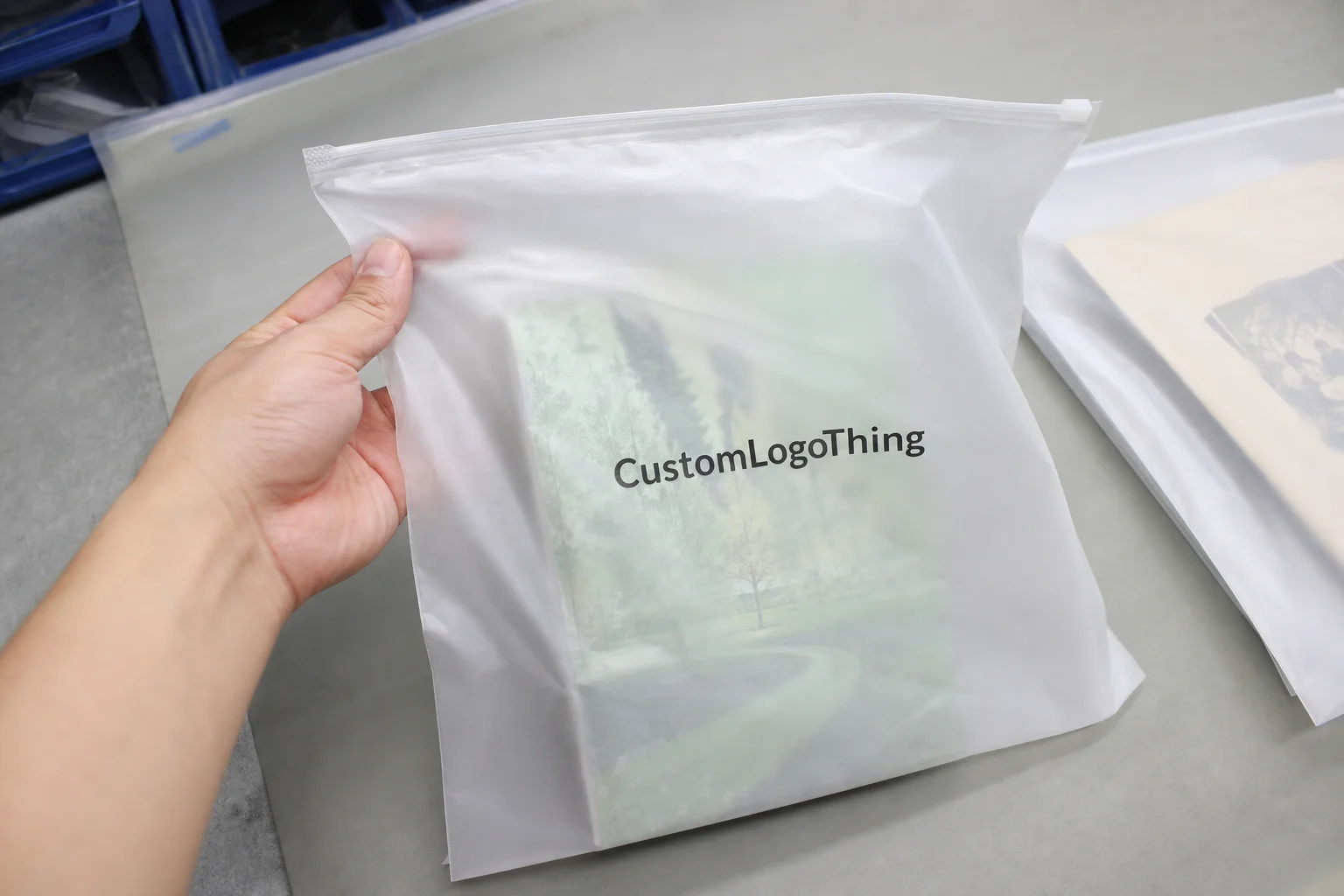
Frosted Zipper Bags sit in a practical middle ground. They reveal enough product for retail display, but the frosted surface cuts glare and fingerprints better than fully clear film. They are also lightweight and flat-packed, which helps on inbound freight and stockroom space.
Most buyers compare suppliers on four things: print quality, MOQ flexibility, lead time, and landed cost. That is more useful than comparing ex-factory price alone. A low unit price means little if freight is inflated, print registration drifts, or artwork changes trigger new setup charges.
What frosted zipper bags are and where bookshops use them
A frosted zipper bag is a flexible package made from semi-opaque film, usually PE, EVA, or a PE-based blend, with a press-to-close zipper. It can be plain, lightly branded, or fully printed. Some bags are flat pouches; others include a bottom gusset for depth, a hang hole for peg display, or a tear notch above the zipper.
Common structural options include:
- Hang hole or euro hole for peg display
- Bottom gusset for thicker bundled products
- Tear notch for a cleaner first opening
- Vent hole if trapped air is an issue
- Custom dimensions for unusual formats or kits
The frosted finish is not only aesthetic. It softens glare under store lighting, hides minor scuffs better than glossy clear film, and gives mixed products a more consistent shelf appearance. For paper goods, where bent corners and small defects show easily, that matters.
There are trade-offs. Frosted zipper bags are more protective and reusable than paper sleeves, but they are not ideal for every premium gift product. If the presentation needs rigid structure, a box still wins. If the goal is a basic dust cover, clear poly may be cheaper.
| Packaging type | Visibility | Moisture resistance | Reusability | Packing efficiency | Typical use in bookshops |
|---|---|---|---|---|---|
| Frosted zipper bag | Medium-high | High | High | High | Journals, stationery sets, gifts, merchandise |
| Paper bag or sleeve | Low | Low | Low-medium | Medium | Basic wraps, short promotions |
| Clear poly bag | High | High | Low-medium | High | Budget packaging, backstock protection |
| Rigid box | Low unless windowed | Medium | High | Low | Premium gift sets |
A resealable bag can also reduce packing labor. If staff assemble kits in store, the zipper may remove the need for extra stickers or closure labels.
Key specifications to confirm before placing an order
Most packaging problems start with vague specifications. A supplier needs the actual structure, dimensions, fill style, and print expectations. If the product will hang, say so. If it needs to fit a notebook plus pen, that must be part of the brief.
Main technical details
- Width x height, in millimeters or inches
- Bottom gusset depth, if needed
- Zipper position, especially with a hang hole above
- Film thickness, usually in microns or mil
- Print area and print sides
- Frost level and opacity
Thickness should match the product. For flat bookmarks, postcard packs, or slim paper inserts, roughly 120 to 160 microns total thickness may work depending on bag size and handling. For notebook bundles, pen-and-journal sets, or products with sharper corners, 180 to 250 microns usually gives better body and puncture resistance.
Print choices matter as much as structure. A simple one-color front logo is often the safest low-MOQ option because it controls setup cost and reduces print risk. Dense artwork, fine text, and large flood areas on frosted film are harder to reproduce cleanly.
Sizing should be based on the packed product:
- Bookmarks: allow room for a backing card if used
- Single A5 journal: include insertion clearance and zipper closing space
- Notebook plus pen: account for clip or loop depth
- Stationery kit: measure the assembled pack, not loose pieces
- Gift set: include tissue, inserts, promo cards, or belly bands
Buyers often measure the product flat and request almost identical bag dimensions. That leads to awkward filling, strained zippers, or corner pressure on the seals. In practice, an extra 5 to 15 mm often makes the bag usable.
Before approving production, ask for a sample check covering:
- Fit and ease of packing
- Opacity and shelf appearance
- Print legibility, especially white ink
- Side seal strength
- Zipper alignment and opening feel
If the bags will ship to multiple locations, carton data matters too. Ask for inner pack count, master carton quantity, carton dimensions, and gross weight. If handling will be rough, it is reasonable to ask whether the outer case has been assessed against standards such as ISTA protocols.
Pricing, MOQ, and unit cost for custom frosted zipper bags
Pricing is driven by a short list of variables: size, thickness, print complexity, quantity, and whether the bag uses a stock size or a fully custom dimension.
Suppliers usually quote based on:
- Bag width, height, and gusset
- Film material and thickness
- Print colors and coverage
- Front-only or double-side printing
- Stock size versus custom dimensions
- Total quantity
- Packing requirements and destination
Low MOQ nearly always means a higher unit cost. Short runs still require artwork setup, machine calibration, material waste allowance, and inspection time. Some projects also carry plate or setup charges, especially if the size is custom.
Typical market ranges often look like this:
| Order scenario | Typical MOQ | Estimated cost per piece | Notes |
|---|---|---|---|
| Standard size, 1-color front logo | 500-1,000 pcs | $0.18-$0.34 | Common entry point for testing |
| Standard size, 2-3 color print | 1,000-3,000 pcs | $0.24-$0.42 | Higher print setup and coverage cost |
| Custom size with gusset | 1,000-3,000 pcs | $0.30-$0.55 | Structure complexity pushes pricing |
| Repeat run, approved prior spec | 1,000+ pcs | Often 5%-12% lower | Depends on material and freight conditions |
These figures are directional, not fixed. Material costs move, freight moves more, and large white ink areas, double-sided printing, or thick film can push quotes above the range.
For many retailers, stock-size customization is the best balance. Using an existing size with custom print can reduce setup cost and keep MOQ manageable. Fully custom dimensions make sense when the product has an awkward footprint or fit strongly affects shelf presentation.
To get a useful quote, send:
- Dimensions in W x H x gusset format
- Target quantity
- Artwork files in vector format
- Pantone or color references
- Intended product use
- Delivery country and postal code
Also ask whether mixed artwork versions are priced as one pooled quantity or as separate runs. Many buyers assume three designs totaling 3,000 units unlock one price tier; sometimes they do, sometimes they do not.
Compare landed cost, not just ex-factory cost. A cheap unit price can lose its advantage once rush production, air freight, or poor carton utilization is added back.
Production process, timeline, and delivery planning
The workflow is usually straightforward. Delays tend to come from missing specs, slow approvals, or artwork that has to be rebuilt before production starts.
- Inquiry and specification review
- Quotation
- Artwork check and proof preparation
- Sampling if required
- Final approval
- Production
- Inspection
- Packing and carton labeling
- Shipment
A digital proof confirms artwork placement and approximate scale. It does not confirm fit, zipper performance, film feel, or actual opacity. A physical sample does that.
For first-time low-MOQ custom orders, production often takes about 12 to 20 business days after proof approval, depending on print complexity, sample needs, and factory load. Repeat orders on an unchanged specification often move in 10 to 15 business days. Shipping time is separate.
Common causes of delay include:
- Missing dimensions or unclear structure
- Artwork supplied only as low-resolution images
- Repeated logo, color, or text revisions
- Slow sample approval
- Heavy white ink or full-coverage print requirements
If timing matters, send vector artwork early, state the in-hand date up front, and confirm whether you need a hang hole, barcode panel, warning text, or compliance wording. If associated paper inserts require chain-of-custody claims, the FSC site is the right place to verify current guidance.
Delivery planning deserves more attention than it usually gets. Confirm how many bags are packed per inner bundle and master carton. Ask for carton dimensions and gross weight. If your receiving location has labeling or handling requirements, state them before shipment.
Simple rule: reorder based on sales velocity plus lead-time buffer, not when the stock room looks almost empty.
How to evaluate a supplier for smaller custom packaging runs
Small custom runs expose supplier discipline quickly. A capable supplier should question vague specifications, recommend appropriate film thickness, and warn you if the artwork is too fine or too dense for frosted film.
Experience usually shows up in the problems they prevent:
- Unreadable logos caused by weak contrast
- Side seals splitting under corner pressure
- Zippers misaligned with the bag mouth
- Bags that are technically sized right but hard to fill
- Print placement drifting from proof to production
For smaller packaging programs, flexibility matters almost as much as price. Many retailers begin with one SKU, test sales, then add matching sizes or new artwork versions. A supplier that supports a low opening run and a cleaner repeat-order process saves time.
Repeat-order consistency should be judged on measurable points: color match, seal integrity, zipper feel, dimension tolerance, print registration, and carton labeling accuracy. Ask whether pre-shipment photos or inspection summaries are available, and ask about overrun or underrun policy. A 1% to 3% variance is not unusual, but it should not be a surprise.
Clear communication is another filter. Good suppliers answer directly on MOQ, setup fees, lead time, replacement policy, and freight assumptions. If the quote is vague before the order, it will stay vague after payment.
If you are comparing vendors across broader custom packaging needs, reviewing available Wholesale Programs can help clarify service scope and repeat-order support.
How to request the right quote and avoid reorder mistakes
The fastest quote requests are specific. “Need custom bag for bookstore products” is not enough to price accurately.
Buyer checklist
- Measure the packed product, not the loose item
- Choose the fit: snug, standard, or roomy
- Confirm finish details: frost level, zipper color, hang hole if needed
- Decide print color count and print sides
- Estimate quantity by SKU and by artwork version
For a faster quote, send:
- Dimensions
- Artwork file format
- Use case and product type
- Delivery address
- Target timeline or in-hand date
Request samples for unusual shapes, boxed bundles, or products with sharp corners. It is also worth confirming carton quantity, spare percentage, production photos, and replacement policy before approval.
Reorders should be based on sales velocity and replenishment time, not guesswork. If a journal set sells 300 units a month and packaging takes six weeks door to door, the reorder point must cover that lead-time demand plus a safety buffer. Waiting too long usually leads to rush freight.
There is already useful baseline information in the site FAQ, but custom bag projects still need a proper specification sheet. “Same as last time” only works when the previous order was documented clearly.
If the goal is a polished retail package without bloated inventory, keep the request grounded in real dimensions, realistic volume, and actual shelf use. That is how a Bookshop Frosted Zipper Bags low moq order works in practice, not just on a quote sheet.
FAQ
What is the typical MOQ for a bookshop frosted zipper bags low MOQ order?
MOQ depends on bag size, film structure, print method, and whether the supplier can use a stock dimension. For simple logo printing on a standard size, 500 to 1,000 pieces is common. Custom sizes, gussets, or more complex artwork often push the minimum higher. Always ask whether MOQ applies per size, per artwork version, or per total order.
Can bookstores print a custom logo on frosted zipper bags?
Yes. One-color and multi-color logo printing are both common, although low-volume orders are usually most cost-efficient with front-only printing and limited coverage. Vector artwork and Pantone references improve print consistency.
How do I choose the right size for books, journals, and stationery sets?
Measure the packed item at its widest, tallest, and deepest points. Include backing cards, inserts, tissue, belly bands, or bundled accessories if they will be inside the final pack. For irregular kits or products with protruding parts, ask for a fit sample before mass production.
What has the biggest impact on custom frosted zipper bag pricing?
Size, thickness, print colors, artwork coverage, and quantity are the main drivers. Freight method, delivery destination, and rush timing can change landed cost just as much as the unit price. Lower MOQ reduces inventory risk, but the per-piece cost is usually higher.
How long does production take for low MOQ custom orders?
First-time custom runs often take around 12 to 20 business days after artwork approval, depending on complexity and whether a sample is required. Repeat orders are generally faster if the approved specification stays unchanged. Complete artwork and clear dimensions at the start will cut avoidable delays.
Are frosted zipper bags suitable for retail display in bookshops?
Yes, especially for journals, stationery bundles, accessories, and gift packs. They work well for shelf display and can also be configured for hanging display with a euro hole or hang hole. The frosted finish looks tidier than clear packaging while still showing enough of the contents to support retail presentation.