Most packaging overspending in book retail starts before the first quote arrives. A solid Bookshop Frosted Zipper Bags unit cost plan starts with one question: is the bag meant to protect the product, help sell it, or act as a reusable takeaway pouch? Buyers often expect one bag to do all three, and the price rises accordingly.
Frosted Zipper Bags sit in a useful middle ground. They look more finished than plain poly bags, hold loose paper goods together, and cost far less than rigid boxes or premium gift packaging. For notebooks, bookmarks, postcard sets, pens, reading kits, event bundles, and membership packs, that balance is often the reason to use them.
The main cost drivers are usually material, thickness, zipper construction, size, gusset, and print coverage, not the logo alone. A one-color print on thick EVA can cost more than a two-color design on thinner PE. If the zipper fails, seams split, or staff struggle to load the contents, any savings disappear in repacking time, returns, and rushed reorders.
This guide focuses on what helps a buyer decide: where these bags fit, which specs affect performance, what to lock before quoting, how MOQ and pricing behave, what lead times look like, and how to compare suppliers without being misled by a low number.
Bookshop Frosted Zipper Bags Unit Cost Plan Starts With One Simple Reality
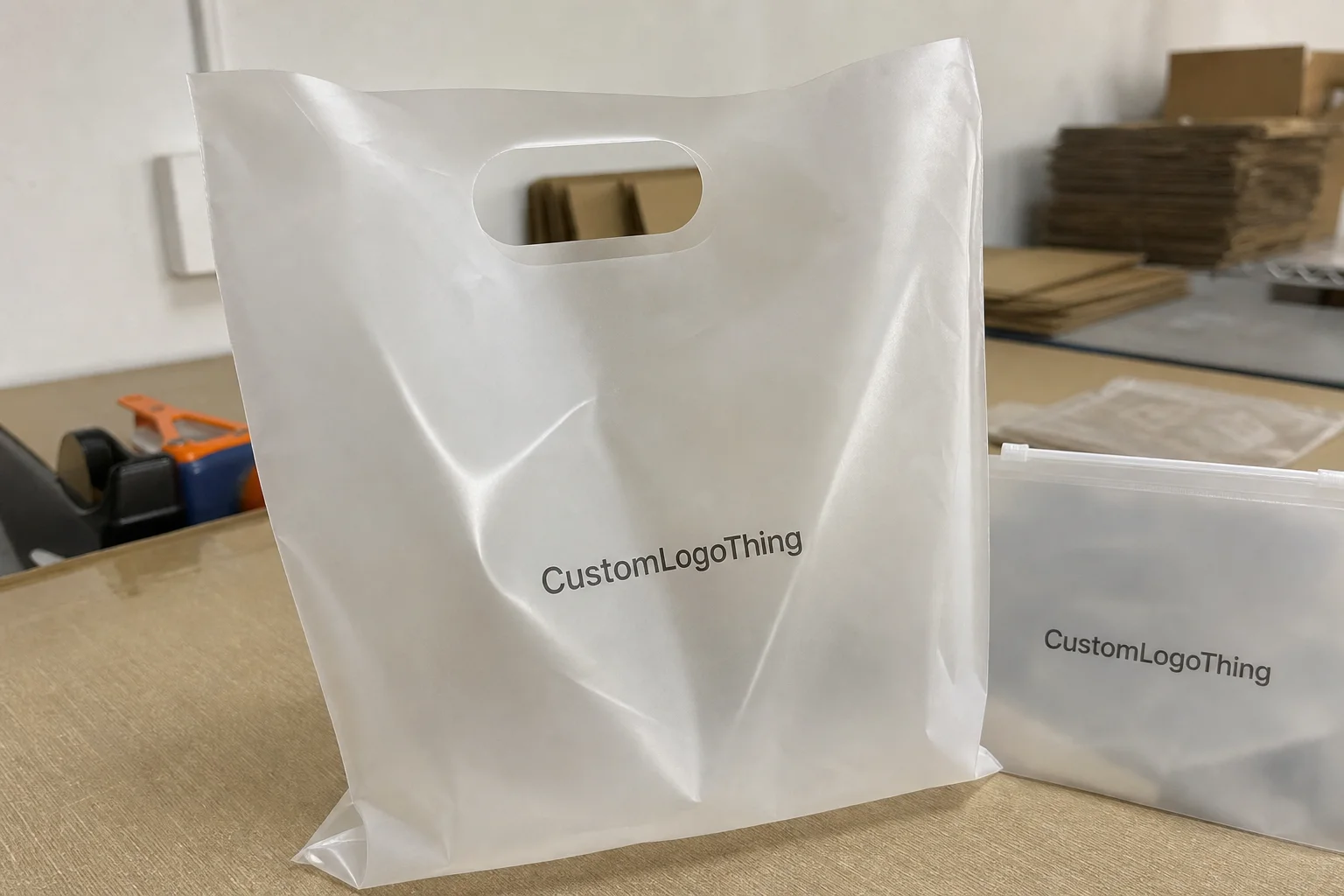
A bookstore bag is rarely just a bag. It is usually part display packaging, part protection, and part customer carry packaging. That is why planning should start with use case, not decoration.
For a slim bookmark set, the bag mostly keeps small pieces together and presentable. For a journal bundle, it also needs enough body to load cleanly and survive handling. For a museum shop or campus bookstore gift kit, it may need to feel reusable enough That Customers Keep it.
Small spec changes can move unit cost quickly:
- Moving from 0.16mm to 0.20mm thickness often adds roughly 10% to 18%
- Switching from a flat bag to a bottom gusset commonly adds 6% to 14%
- Upgrading from press-to-close to slider zipper can add 15% to 35%
- Broad print coverage raises ink use, setup, and registration demands
Budget planning needs to balance appearance, durability, packing speed, and reorder simplicity. For repeat orders, standardizing one or two core sizes and consistent print placement usually gives better long-term pricing than redesigning the bag for every seasonal bundle.
Where Frosted Zipper Bags Add Real Value in a Bookshop Setting
These bags make sense when the product needs a step up from commodity packaging but not a full luxury box. Common uses include membership welcome kits, journaling sets, children’s reading packs, stationery bundles, event merchandise, signed-edition extras, and small museum or campus retail assortments.
Compared with rigid boxes, Frosted Zipper Bags are lighter, flatter to store, and easier to ship in volume. Custom frosted zipper bags for mid-volume orders often land around $0.18 to $0.75 per unit depending on size, thickness, material, and print. Premium slider or EVA versions can run higher. Rigid boxes for similar presentation often start around $0.90 to $2.50+ before freight.
The frosted finish is visually useful because it shows the outline and color cues of the contents while hiding backing card clutter, barcode noise, and light scuffs better than fully clear film. That can improve shelf presentation without heavy print coverage.
Reusability can add value too. Customers may keep pouches for pens, tickets, cables, receipts, or art tools. If that matters, spec for it with appropriate material and thickness. If not, there is no reason to pay for a softer premium film just because it sounds better.
The zipper is functional, not decorative. It keeps postcard sets, note cards, sticker sheets, bookmarks, inserts, and other small pieces from scattering during browsing and checkout.
These bags make less sense for heavy hardcover bundles, sharp-edged stacks, or ultra-low-cost giveaways. Those either need stronger material and seals or a simpler packaging format.
Product Details That Actually Change Performance, Not Just Appearance
Material choice is the starting point for performance. For most bookstore applications, the main options are PE and EVA.
Material options
- PE: lower cost, widely available, suitable for most standard retail packaging and simple print jobs
- EVA: softer feel, generally lower odor, more premium hand feel, usually higher in cost
- PVC alternatives: sometimes used for structure or clarity, though many buyers avoid them for compliance or brand reasons
For many bookshop orders, PE is enough. EVA makes more sense when the pouch is intended to be reused, gifted, or treated as part of the product.
The frosted look comes from the film finish, not from printing. It cuts glare, hides light scratches, and softens the appearance of logos. The tradeoff is that very fine text and pale colors can lose clarity unless white underprint or thicker line weights are used.
Zipper choices
Press-to-close zippers are the default because they cost less and are usually sufficient for notebooks, cards, pens, and stationery sets. Slider zippers look more premium and may be easier to use, but they add cost and complexity.
Zipper placement also matters. If it sits too low, usable inner height shrinks. If it sits too high with weak sealing, the top can distort after repeated opening.
Bag shape and expansion
Flat bags suit slim products such as postcard sets, bookmark assortments, sticker packs, and thinner notebooks. Bottom gussets work better for thicker journal bundles, pen sets, or mixed kits. Side gussets can help bulky packs but are less common for smaller-format bookstore packaging.
Handles and finishing details
Many zipper bags do not need handles. No-handle styles usually look cleaner for stationery and giftable paper goods, and they save money. Die-cut handles make sense if the pouch also serves as the takeaway bag.
Other details that affect real-world performance include:
- Rounded corners to reduce snagging and corner stress
- Reinforced seals for thicker or heavier bundles
- Hang holes for peg displays
- White underprint for colored logos on frosted film
- Vent holes only if packing behavior actually requires them
For printing, screen printing is common for simpler artwork and small to medium runs. Gravure can make more sense at higher volumes or with larger print coverage, but it may require cylinder or tooling costs. Digital samples are useful for review, but they are not proof of final production print quality.
Specifications Buyers Should Lock Before Requesting a Quote
A usable quote depends on usable specs. “Need frosted zipper bags for books” is not enough.
At minimum, include:
- Finished size: width x height x gusset
- Usable inner dimensions
- Material type: PE, EVA, or approved alternative
- Film thickness, such as 0.12mm, 0.16mm, or 0.20mm
- Zipper style: press-to-close or slider
- Handle option: none, die-cut, or other
- Print method if known
- Number of print colors
- Front-only or front-and-back printing
- Estimated quantities by order tier
Thickness should match the contents. Around 0.12mm to 0.14mm can work for lightweight paper goods such as bookmarks, postcards, or sticker sets. 0.16mm to 0.18mm is a common middle range for notebook and journal bundles. 0.20mm and above is better for reusable pouches, gift kits, or heavier mixed packs.
Dimensions need insertion tolerance. For many stationery bundles, adding about 8 to 15mm in width and 10 to 20mm in height beyond the packed product size makes filling much easier. Bags spec'd too tightly create slow packing and bent corners.
Artwork details matter more on frosted film than many buyers expect. Suppliers need color references, preferred print area, whether white ink is required, and whether front/back registration needs to align tightly. Fine lines and pale inks often need adjustment.
Ask for empty-bag packing data too: carton count, carton dimensions, gross weight, and net weight. These bags are light but bulky, and freight can rise quickly if carton packing is inefficient.
If the order matters, request a real sample and test fit, zipper feel, opacity, seal quality, and print legibility with the actual products inside.
Unit Cost, Pricing, and MOQ: What Moves the Quote Up or Down
The main cost drivers are size, material, thickness, zipper type, print colors, print coverage, gusset construction, and total volume.
MOQ exists because custom bags carry material purchasing, setup, print prep, line changeover, and packing costs. Small runs spread those fixed costs over fewer pieces, so the per-unit price rises quickly.
| Bag Type | Typical MOQ | Estimated Unit Cost | Best Use |
|---|---|---|---|
| Flat PE frosted bag, 1-color print, 0.12-0.14mm | 3,000-5,000 pcs | $0.18-$0.32 | Bookmarks, postcard sets, slim stationery packs |
| Flat or small gusset PE bag, 1-2 colors, 0.16mm | 3,000-5,000 pcs | $0.28-$0.48 | Notebook bundles, journals, membership kits |
| EVA frosted bag, 0.18-0.20mm | 5,000-10,000 pcs | $0.45-$0.75 | Premium gift sets, museum shop or campus retail |
| Slider zipper custom bag with gusset | 5,000-10,000 pcs | $0.60-$1.10 | Higher-value curated packs with repeat-use appeal |
These ranges are directional. Final pricing changes with dimensions, resin costs, print complexity, and freight timing.
If you need to reduce cost without hurting function, try these first:
- Reduce print coverage before cutting material quality
- Standardize one or two sizes across multiple SKUs
- Use press-to-close instead of slider zipper
- Order at a more efficient quantity break
- Keep artwork consistent to limit extra setup or tooling charges
Cost-cutting usually backfires when buyers go too thin, oversize the print area, choose weak zipper tracks, or force a tight fit that slows packing. Landed cost matters more than ex-works price because these bags are low weight but high cube. For planning, it helps to build three pricing tiers: trial quantity, standard reorder quantity, and peak-season quantity.
Production Process and Lead Time From Artwork Approval to Delivery
The production flow is usually straightforward once specs are locked:
- Inquiry
- Specification confirmation
- Quotation
- Artwork review
- Sample or mockup approval
- Deposit or order confirmation
- Mass production
- Quality control
- Packing
- Shipping
Sampling often takes 3 to 7 business days for a basic mockup and 7 to 12 business days for a more production-style sample. Mass production commonly takes 12 to 20 business days after final approval for standard jobs. Larger quantities, material shortages, holiday congestion, or gravure work can take longer.
Do not confuse a digital mockup with a physical sample. One shows layout; the other shows fit, zipper smoothness, opacity, and print behavior on the actual film.
Common delays usually come from missing vector files, unclear color references, dimension changes after signoff, or late artwork edits.
Quality checks worth watching include:
- Seal strength and seam consistency
- Zipper alignment and closure feel
- Print placement, legibility, and color consistency
- Film opacity consistency across the batch
- Carton counts and packing accuracy
For shipments moving through rough distribution channels, decent outer carton strength matters. If transport testing is relevant, standards from ISTA can help frame transit expectations.
How to Compare Suppliers Without Getting Distracted by Cheap Quotes
Two quotes can look similar while describing very different bags. One supplier may lower the film thickness, reduce the print area, simplify seals, or swap materials. The low price only helps if the spec is still right.
Use a comparison checklist:
- Material type and feel
- Actual thickness tolerance
- Zipper track quality
- Print sharpness on frosted film
- Sample accuracy versus approved artwork
- Written size and print-placement tolerances
- Carton packing details
- Defect handling or remake terms
- Communication speed and clarity
A useful supplier does more than agree to everything. They flag fit problems, warn when fine text may fill in, and tell you when your quantity sits in an inefficient bracket. That kind of pushback is usually a good sign.
If the bag will be reordered, ask how repeatability is handled. Can prior specs be repeated exactly? Are plates or cylinders retained? How is color consistency managed across runs?
Practical rule: if the quote is suspiciously low, something is probably missing: material, thickness, print coverage, packing, tolerance, or freight assumptions.
Next Steps to Build a Smarter Order Plan and Request the Right Sample
For cleaner pricing and fewer delays, keep the first brief simple and complete. Start with the use case: journal bundle, event kit, children’s pack, stationery set, gift-with-purchase, or premium add-on.
Then work through this checklist:
- Measure the fully packed product set, not just the main item
- Choose material and thickness based on weight, handling, and reuse goals
- Decide between flat and gusseted construction
- Lock zipper style
- Confirm print colors and coverage
- Estimate quantity in tiers: test run, core reorder, peak season
- Provide delivery destination and target in-store date
- State whether artwork is final, in revision, or not started
Request one or two sensible samples, not a wide spread of random variations. Compare landed cost, not only bag price. Ask suppliers to separate unit price, setup charges, and shipping assumptions clearly.
Before approval, run a real packing test. Insert the journals, add the bookmarks, and open and close the zipper repeatedly. Check whether staff can fill the bag quickly without bending product corners or fighting the opening.
For reorders, document approved dimensions, material, thickness, zipper construction, print placement, carton count, shipping marks, and final artwork files. A good Bookshop Frosted Zipper Bags unit cost plan is not just a price check. It is a repeatable buying system built around actual retail use, realistic order tiers, and specs that hold up in production.
FAQ
How do I build a bookshop frosted zipper bags unit cost plan for multiple order sizes?
Price the same bag across at least three quantity tiers: a trial batch, a standard reorder batch, and a seasonal peak batch. Keep the specs identical so the comparison is meaningful. Separate bag price, setup cost, and freight to see the real landed cost at each level.
What MOQ is typical for custom frosted zipper bags for bookshop packaging?
Many custom printed orders start around 3,000 to 5,000 pieces for simpler PE bags and move closer to 5,000 to 10,000 pieces for EVA, slider zipper, or more customized structures. Exact MOQ depends on size, print method, and customization level.
Which specs affect the unit cost of bookshop frosted zipper bags the most?
The biggest cost levers are size, material, thickness, zipper style, print colors, print coverage, gusset construction, and total quantity. Large bags, white underprint, slider closures, and heavier film usually add faster than buyers expect.
How long is the lead time for custom frosted zipper bags for a bookstore order?
Simple jobs may be ready in roughly 2 to 4 weeks before transit after artwork approval, while more complex orders can take longer. Sampling, print preparation, production, and shipping all need time. The fastest way to avoid delay is sending final specs and usable artwork from the start.
Are frosted zipper bags good for books, journals, and stationery bundles?
They work especially well for journals, notebooks, postcards, bookmarks, pens, and mixed stationery sets. For heavy hardcovers or sharp-edged bundles, use thicker material, stronger seals, or a different packaging format. A physical fit test with the actual products is still the safest check.


