Buyer Fit Snapshot
| Best fit | Branded Kraft Paper Bags Wholesale projects where brand print, material claims, artwork control, MOQ, and repeat-order consistency need to be specified before quoting. |
|---|---|
| Quote inputs | Share finished size, material target, print colors, finish, packing count, annual reorder estimate, ship-to region, and any compliance wording. |
| Proofing check | Approve dieline scale, logo placement, barcode or warning zones, color tolerance, closure strength, and carton packing before bulk production. |
| Main risk | Vague material claims, crowded artwork, missing packing details, or unclear freight terms can make a low unit price expensive after revisions. |
Fast answer: Branded Kraft Paper Bags Wholesale: Specs, Pricing & More should be specified like a repeatable production item. The safest quote records material, print method, finish, artwork proof, packing count, and reorder notes in one written spec.
Production checks before approval
Compare the actual filled-product size with the drawing, then confirm tolerance on folds, seals, hang holes, label areas, and retail display edges. Reserve space for logos, QR codes, warning copy, and material claims before decorative graphics fill the panel.
Quote comparison points
Review material grade, print process, finish, sampling route, tooling charges, carton quantity, and freight assumptions side by side. A quote is only useful when the supplier can repeat the same color, closure quality, and packing count on the next order.
Branded Kraft Paper Bags Wholesale: Specs, Pricing & More
Branded Kraft Paper Bags wholesale sounds simple until the first round of quotes lands in your inbox. Then the details start doing their little dance. Paper weight. Handle type. Print coverage. Minimum order quantity. Freight. Suddenly the “just order a bag” plan looks less simple and more like procurement with a side of pain.
That is also why this category keeps winning. Branded kraft Paper Bags Wholesale sits in a useful middle ground. It feels polished enough for boutiques, salons, gift shops, wellness brands, and specialty food retailers, but it is still easier to spec, print, and reorder than laminated packaging. Generic bags do the job. Branded Kraft Bags do the job and make the brand look like it has its act together. Which, frankly, helps.
Branded Kraft Paper Bags Wholesale: Why Buyers Switch Fast
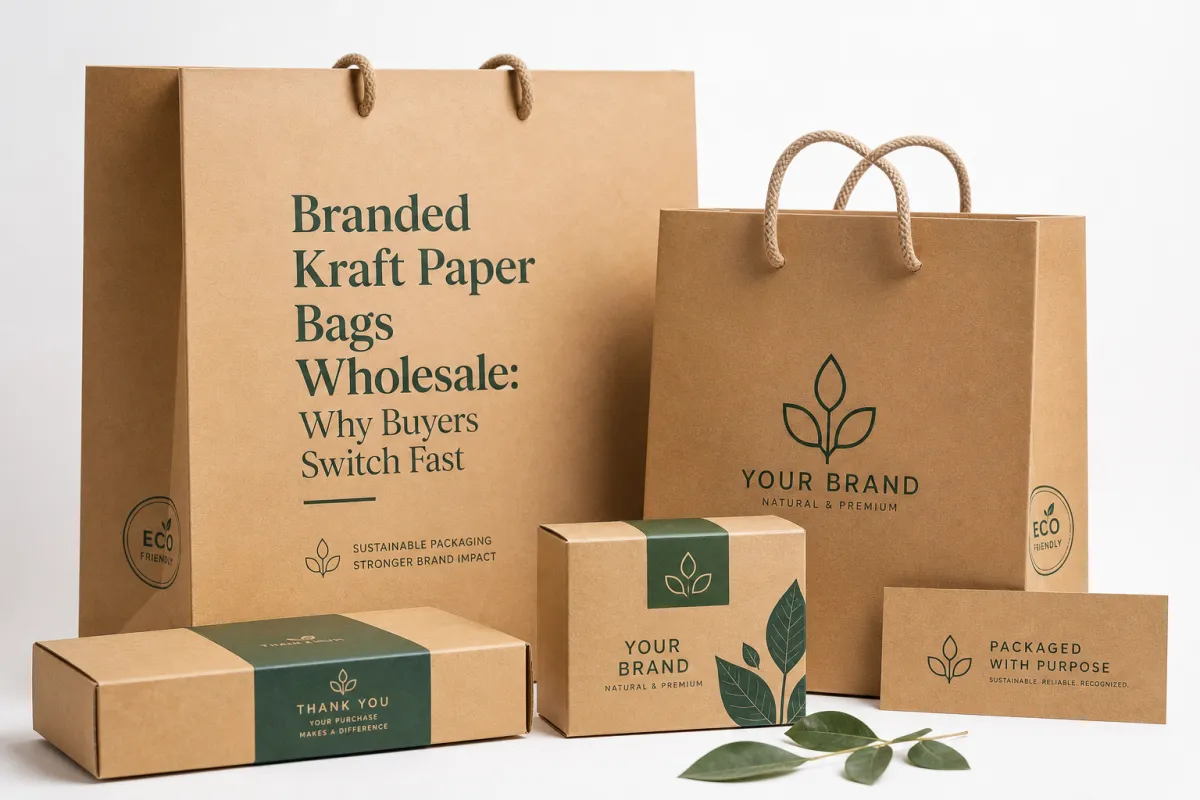
Most buyers move to branded Kraft Paper Bags wholesale for one very practical reason: the bag earns its keep. A customer leaves with a clean branded bag, carries it through a mall or onto a train, and the logo keeps showing up in public. That is not some fuzzy marketing slogan. It is a moving billboard with real street time.
Kraft often wins against packaging that looks more “finished” on a sample table. Some buyers assume laminated or coated bags will feel more upscale. Sometimes they do. Sometimes they just feel heavy and try a little too hard. Kraft brings a different tone. It can read as honest, modern, restrained, and yes, a little less desperate to impress. For indie retailers, wellness brands, gift shops, and specialty food stores, that tone works.
Branded kraft paper bags wholesale also makes operations cleaner. One core bag can cover daily retail, seasonal launches, pop-ups, and insert packaging for ecommerce orders. That cuts down on decision fatigue. It also keeps the stockroom from turning into a graveyard of random packaging SKUs that nobody remembers ordering.
Presentation matters more than people admit out loud. A plain shopping bag carries the product. A branded one changes how that product feels. It makes the item inside seem more deliberate, more finished, and a little more worth the ticket price. That effect shows up fast in apparel, cosmetics, candles, stationery, and gift items, where the bag is part of the purchase experience instead of just dead weight.
"A bag is small. The impact is not. If the carryout piece feels right, the whole transaction feels more considered before the customer even gets home."
That is the real value of branded kraft paper bags wholesale: stronger presentation, easier branding, and a packaging setup that can hold steady across stores and events. The goal is not to chase the prettiest sample in the room. It is to match structure, print style, and order size to the way the bag will actually be used, whether that is a boutique counter, a market stall, or an ecommerce insert pack that still needs a branded touch.
There is also a budget angle that gets ignored too often. This category usually sits below rigid boxes and laminated gift packaging in both cost and complexity. That makes branded kraft paper bags wholesale a practical option for brands that want polished packaging without locking up cash in oversized inventory. A little boring? Maybe. But boring is nice when the numbers work.
Branded Kraft Paper Bags Wholesale Options and Construction
The first thing to sort out in branded kraft paper bags wholesale is construction. A lot of buyers compare print price first and bag type second. That order is backwards. Two bags can look nearly identical in a mockup and behave very differently once weight, handle stress, and checkout use are involved.
The common formats include SOS paper bags, gusseted shopping bags, twisted-handle retail bags, flat-handle carry bags, and premium reinforced versions. SOS bags are the simple self-opening square-bottom style. They show up a lot in foodservice and light retail because they are straightforward and efficient. Gusseted shopping bags give more side expansion, which helps when products need width or the load changes from one sale to the next. Twisted-handle bags are a staple for boutiques and apparel because they balance appearance and cost well. Flat-handle bags keep costs down and work nicely for lighter items or fast-moving stores. Reinforced styles use heavier board or patching near the handle area, which helps when the bags need to take abuse.
Handle construction changes both how the bag feels and what it costs. Paper twist handles are common because they carry moderate weight well and still look clean. Flat paper handles are simple and efficient. Rope handles push the bag toward a more premium retail look, but they raise unit cost and can extend lead time. Die-cut handles remove the separate handle component, which keeps the look cleaner and cuts part complexity. That setup can work well, though the body of the bag may need extra reinforcement if the contents are heavy.
Color choice matters more than many buyers expect. Natural brown kraft gives off a recycled, earthy, no-nonsense feel. White kraft usually delivers sharper logo contrast and better photo results, which helps brands with dark artwork, thin type, or detail-heavy marks. Coated or lined finishes can improve print sharpness, but they also push the bag away from the raw kraft look many retailers actually want.
Structural details are where quote comparisons often fall apart. In branded kraft paper bags wholesale orders, buyers should confirm side gussets, bottom reinforcement, fold quality, glue strength, and whether the bag stands up neatly at checkout. That last point sounds small until staff are trying to pack orders during a rush. A bag that collapses on the counter slows the line and irritates everyone in earshot.
Add-ons can matter too. Some buyers want inside printing for a subtle brand message, insert cards for promotions, or coordinated stickers and tissue paper to round out the packaging system. Window cutouts can work for food or gift items, but they should be checked against both strength and privacy. If the packaging program includes multiple formats, it helps to treat the bag as one piece of a larger system instead of an isolated item.
For brands comparing packaging families, it is worth reviewing Wholesale Programs alongside the bag spec. That keeps the order tied to volume planning instead of a one-off purchase. If you want a clearer view of how other buyers structure packaging decisions, the Case Studies page is a useful reference point.
Well-chosen branded kraft paper bags wholesale specs do more than improve appearance. They cut waste, reduce bag failures, and make reorders easier to repeat. That is the part people only notice after the first replenishment cycle, which is usually when they stop pretending all paper bags are the same.
Sizes, Paper Weights, and Print Specifications
Size selection is where branded kraft paper bags wholesale orders are won or wasted. Buyers often start with what looks right in a mockup and then discover the bag is too narrow for folded apparel or too tall for a small gift box. The fix is simple: match the bag to the product envelope, not the logo file.
Small bags usually fit jewelry, cosmetics, accessories, candles, and compact gift items. Medium bags work for apparel, books, bakery boxes, and mixed retail purchases. Large bags handle bulkier purchases, multiple items, or heavier products that need more room and stronger handles. If a store sells a wide range of goods, two core sizes are usually smarter than one oversized bag that gets dragged into every situation.
Paper weight should be discussed in useful terms, not vague quality language. Lighter stocks work for low-load items and short carry distances. Thicker kraft handles repeated use, denser products, and bags that need to survive a longer walk home. Buyers often ask for gsm or thickness without describing the load. That is where mistakes begin. A 120gsm stock may be fine for apparel, while a heavier order could need 150gsm or more depending on the structure and handle style. The right answer depends on the bag design and what it actually carries.
Print method is another practical call. One-color flexographic print often gives the cleanest cost control for large quantities and simple logos. Multi-color branding makes sense for retail chains or brands that need stronger shelf presence, though it adds setup complexity. Premium finishes like foil stamping, embossing, or spot coating can lift perceived value, but they should be used with restraint. Kraft already brings texture and visual character. Piling on finish after finish can work against the natural look that made the bag appealing in the first place.
Good branded kraft paper bags wholesale production depends on technical precision. Buyers should confirm exact width, gusset, and height; handle length; artwork bleed; Pantone match; safe print area; and whether the logo sits high enough to stay visible when the bag is carried. If a supplier only asks for “bag size” and “logo file,” that is not enough information for repeatable work.
Compliance matters too. If the bag touches food packaging, food-safe inks or food-contact-adjacent specifications may be required. If the bag carries dense or sharp-edged items, tear resistance and load testing should be on the table before approval. Standards such as ASTM methods for material performance, ISTA packaging test protocols, and chain-of-custody requirements tied to FSC certification standards can all matter depending on the product category. For buyers who need more context on testing, ISTA packaging test protocols are a useful benchmark.
That is why smart buyers treat branded kraft paper bags wholesale as a specification exercise, not just a print order. A good bag should look right, hold up under real use, and be realistic to reorder. Miss one of those pieces and the savings disappear fast.
| Bag style | Typical use | Common spec range | Wholesale value point |
|---|---|---|---|
| SOS paper bag | Food service, light retail | 30-80 gsm, square bottom | Low print complexity and efficient unit cost |
| Twisted-handle kraft bag | Boutiques, apparel, gifts | 120-150 gsm, reinforced handles | Good balance of presentation and durability |
| Flat-handle kraft bag | Budget retail, events | 100-130 gsm, paper handles | Lower cost for high-volume replenishment |
| Rope-handle premium bag | Luxury retail, special launches | 140 gsm+, reinforced top | More premium feel, higher unit price |
Those ranges are not universal. That is the point. A packaging buyer should use them as a starting frame, then ask the supplier to confirm load expectations, print coverage, and handling conditions. Branded kraft paper bags wholesale works best when the spec sheet reflects the real product, not the polished mockup someone made at 10 p.m. and hoped nobody would question.
Branded Kraft Paper Bags Wholesale Pricing, MOQ, and Value
Pricing for branded kraft paper bags wholesale comes down to a few variables buyers can actually control. Bag size, paper weight, handle type, number of ink colors, print coverage, and whether the order uses a stock format or a fully custom shape all affect the quote. If two suppliers are both “competitive” but one includes heavier board, better handles, and tighter print registration, then the comparison is not equal. It just looks neat on a spreadsheet.
MOQ needs a straight answer. Minimum order quantity usually reflects setup efficiency, not a random number pulled out of nowhere. Bigger runs lower unit cost because press setup, plates, packing, and labor get spread across more pieces. Smaller runs still make sense for new stores, seasonal collections, pilot launches, or a limited-edition refresh. The right MOQ is the one that matches sell-through speed without leaving dead stock in the back room.
For simple branded kraft paper bags wholesale jobs, buyers often see lower pricing at higher quantities, while more complex print layouts or premium handles push the unit cost upward. A range such as $0.18-$0.28 per unit at 5,000 pieces for a straightforward one-color retail bag is common, though that changes with paper weight, print coverage, and freight origin. A three-color bag with reinforced handles will usually cost more. That is normal. It is not a warning sign.
What matters more than headline price is the quote structure. A useful quote should break out unit price, plate or setup fees, proof charges, freight, duties, and any packaging or warehousing costs. If those items are buried inside one number, the buyer loses the ability to compare value properly. A lower unit price can turn expensive once shipping and extras get added. That is why total landed cost is the better metric. It shows what the bags actually cost to get to the dock, not just what they cost to make.
Here is the buying rule that saves headaches: match MOQ to realistic sell-through, then scale up only after the bag proves itself in-store. If a chain location uses 1,200 bags a month, a 10,000-piece run may make sense. If a seasonal pop-up only needs 1,500 bags, smaller branded kraft paper bags wholesale runs can be smarter even when the per-unit price is a little higher. Cash flow, warehouse space, and reorder rhythm all matter. Yes, even the boring stuff.
Buyers should also watch for hidden costs in artwork and logistics. Some suppliers charge for extra proofs, revisions, or special packaging. Others offer lower base prices but higher freight. A good procurement team does not chase the lowest quote. It compares the cost of ownership. That approach works especially well in packaging because the cheapest option on paper often gets beaten by reprint risk or freight surprises.
If you are comparing branded kraft paper bags wholesale offers from multiple vendors, ask each one to quote the same size, same handle, same paper weight, same print colors, and same delivery terms. Otherwise, the comparison gets distorted before it starts. Once the specs are aligned, value is much easier to see.
The strongest result usually comes from balancing three things: a bag that looks right, a price that supports margin, and an MOQ that matches actual demand. That is the sweet spot for branded kraft paper bags wholesale, and it is the point where packaging stops acting like a loose expense and starts behaving like a controlled part of the brand experience.
From Artwork Approval to Delivery: Process and Timeline
The ordering process for branded kraft paper bags wholesale is usually simple, but only if the buyer brings final information early. The cleanest flow is quote request, spec confirmation, artwork review, digital proof, sample approval if needed, production, packing, and shipment. Each step can move quickly. The delays tend to happen at the handoff points, right where people assume someone else already answered the question.
Proofing usually moves faster than production. If the artwork is ready and the bag size is locked, a digital proof may come back quickly for review. Manufacturing takes longer because it depends on print complexity, material sourcing, handle availability, and current factory load. Simple one-color kraft orders move faster than multi-color jobs with special finishes or custom reinforcements. That is not mystery meat. It is production reality.
What speeds the job up? Final artwork in vector format, clear dimensions, confirmed Pantone colors, and fast approval on proofs or samples. What slows it down? Blurry logo files, shifting dimensions, changes after proofing, and late freight decisions. A buyer can save days by dealing with those items before the order enters production. In many packaging programs, the difference between a smooth run and a frustrating one is whether the supplier had to chase basic decisions.
Campaign-based buyers need a buffer. Do not plan delivery for the date you hope to launch. Plan for the date you need to receive, inspect, and distribute the bags. Transit time can shift because of port congestion, seasonal shipping pressure, customs checks, and carrier schedules. A production timeline that looks fine in a quote can still turn tight if revisions stretch out by a week.
Experienced buyers use an internal calendar that leaves room for reality. For branded kraft paper bags wholesale, a normal sequence might look like two to four business days for proofing if artwork is clean, one to three weeks for production depending on complexity and volume, then transit on top of that. If the order is urgent, ask whether an expedited path exists. Some suppliers can do it. Some cannot. The answer should depend on capacity, not optimism.
Supply chain planning gets easier if the bag program is treated as repeatable instead of one-off. Once the size and print style are approved, reorder cycles become far less painful. Many brands underestimate how much time disappears when the spec stays stable. A consistent branded kraft paper bags wholesale program gives a buyer better forecasting and fewer surprises than a packaging lineup that changes every quarter because someone got bored.
From a quality-control perspective, ask for a sample or at least a pre-production proof before a large run. A sample shows hand feel, handle strength, ink contrast, and overall presentation in a way a PDF never can. If you need a deeper look at how supply programs are structured, the information on Wholesale Programs can help frame the next purchase more clearly.
In plain terms, the best branded kraft paper bags wholesale timeline is the one that protects the launch date. If the bags arrive early, the brand keeps control. If they arrive late, the cost shows up in lost presentation and rush fees. Good timing is not glamorous, but it is one of the most profitable parts of the order.
Why Choose Us for Custom Packaging Supply
Plenty of packaging suppliers can print a logo. Far fewer can deliver branded kraft paper bags wholesale with consistent materials, repeatable print quality, and clear communication. That distinction matters more than polished promises. A buyer does not need poetry. A buyer needs bags that show up on spec, on time, and at the agreed quality level.
Good packaging partners trim hidden costs. Fewer artwork errors mean fewer reprints. Clearer quotations mean fewer freight surprises. Faster answers mean fewer internal delays while a store, buyer, or marketing team waits for approval. Those savings do not always show up on the first invoice. They show up in the full buying cycle, which is where the real bill lives.
Dependable suppliers also help buyers make better decisions. They should be able to explain the difference between white kraft and natural kraft, point out where handle reinforcement matters, and give a realistic view of what print detail will and will not hold on paper. That kind of guidance matters because not every artwork file was made with packaging in mind. Thin fonts, tiny reverse text, and crowded logos can cause trouble if the paper surface is too rough or the print area is too small.
A strong vendor should also be comfortable talking about sample support, realistic timelines, and replenishment planning. That matters for brands with uneven sell-through. Some months are flat. Some months jump because of a promotion or seasonal display. The supplier should help plan branded kraft paper bags wholesale orders around that variability instead of forcing a rigid ordering pattern that looks neat in a spreadsheet and annoying in real life.
What should a buyer look for first? Quotation clarity. If the quote lists bag specs, handle type, paper weight, print colors, and delivery terms in plain language, that is a good sign. Then check sample quality. Then compare response time. A supplier that answers questions quickly and precisely usually handles production questions the same way. That is not a law of nature, but it is a useful procurement signal.
For brands that want a supplier relationship instead of a one-time transaction, the best packaging partner is usually the one that balances price, consistency, and responsiveness. Not the cheapest. Not the loudest. The one that can repeat the same result across multiple runs without drama. That is exactly what matters in branded kraft paper bags wholesale, because packaging quality is only useful if it holds steady from the first order to the fifth.
It also helps when the supplier understands the broader role of packaging in brand presentation. Kraft bags are often the first physical item a customer touches after checkout. They sit beside receipts, tissue, stickers, and insert cards. If that system is coordinated, the whole brand looks more intentional. If it is not, the bag stands out for the wrong reason.
That is why we treat branded kraft paper bags wholesale as a supply program, not just a print job. The right supplier should make the process easier, the specifications clearer, and the reorders more predictable. That is the standard buyers should use.
Next Steps for Ordering the Right Bag Mix
If you are ready to move forward with branded kraft paper bags wholesale, start with a short checklist. Confirm the product weight, target bag size, preferred handle type, print colors, and estimated monthly usage. Those five inputs remove a lot of guesswork from the quote stage and help suppliers recommend a realistic spec instead of a generic one.
Ordering a sample or reviewing a detailed spec sheet is smart whenever bag strength, color accuracy, or retail presentation matters. A small sample can reveal whether the paper feels too thin, whether the logo sits in the right place, and whether the handles hold up under a real load. That matters even more for brands moving from plain bags into a branded kraft paper bags wholesale program for the first time.
The easiest decision path is often the best one: start with the most common store size, test it in real use, and expand into a full branded program once you know the bag works. That approach keeps inventory risk low and gives you better data on reorder pace. In packaging, good decisions usually come from actual handling, not from the cleanest mockup.
To speed up your quote, send artwork files, the delivery location, the target arrival date, and your MOQ requirement at the same time. If the order must land inside a tight window, say so early. If the bag needs to work with other packaging materials such as tissue, stickers, or corrugated cardboard shipping boxes, mention that too. The more complete the brief, the better the result.
Buyers should also think about long-term consistency. A successful order is not the finish line. It is the start of a repeatable packaging standard. If the first run performs well, document the spec, the print colors, the handle type, and the reorder quantity. That makes the next purchase faster and more accurate, especially when the bag becomes part of a wider branded packaging system built around recycled materials, FSC certified sourcing, or biodegradable packaging goals.
For a commercial brand, the best outcome is simple: the bag looks right, carries well, arrives on time, and can be reordered without headaches. That is the real purpose of branded kraft paper bags wholesale. If you want a quote that reflects size, print, and volume rather than a vague package number, request one with your exact specs and volume target. The more specific the brief, the better the pricing and the more predictable the result.
Here is the practical takeaway: choose the construction first, lock the paper weight second, then compare quotes using the same size, handle, print colors, and delivery terms. Do that, and branded kraft paper bags wholesale stops being a messy guessing game and becomes a repeatable packaging standard.
FAQ
What is the usual MOQ for branded kraft paper bags wholesale orders?
MOQ usually depends on bag size, print colors, and whether the style is stock or fully custom. Lower-MOQ options often exist for simple one-color designs and standard sizes. Higher-volume runs usually reduce unit cost, so it makes sense to compare MOQ against your monthly sell-through before you commit.
How long does wholesale branded kraft paper bag production take?
Proofing is usually the shortest stage if artwork is ready and specifications are clear. Production time depends on print complexity, material selection, and current factory scheduling. Add transit time separately so your bags arrive before the campaign or store launch, not after it.
Which paper weight is best for wholesale kraft shopping bags?
Lighter paper works for apparel, cosmetics, and small gifts. Thicker stock is better for heavier purchases, multiple items, or repeated handling. Ask for load guidance or sample testing if the bag will carry dense products, because paper weight alone does not tell the whole story.
Can I print on both sides of custom kraft paper bags?
Yes, most suppliers can print on one or both sides. Double-sided printing usually increases cost and may affect turnaround time. If budget matters, a strong one-side logo placement is often the most efficient option and still gives good shelf and street visibility.
How do I compare quotes for branded kraft paper bags wholesale?
Compare unit price, setup fees, freight, duties, and any sample or proof charges. Check whether the quote includes handle type, paper weight, and print coverage. The lowest quote is not always the best value if shipping or reprint risk is higher.

