Buyer Fit Snapshot
| Best fit | Kraft Paper Bags Supplier MOQ projects where brand print, material claims, artwork control, MOQ, and repeat-order consistency need to be specified before quoting. |
|---|---|
| Quote inputs | Share finished size, material target, print colors, finish, packing count, annual reorder estimate, ship-to region, and any compliance wording. |
| Proofing check | Approve dieline scale, logo placement, barcode or warning zones, color tolerance, closure strength, and carton packing before bulk production. |
| Main risk | Vague material claims, crowded artwork, missing packing details, or unclear freight terms can make a low unit price expensive after revisions. |
Fast answer: Kraft Paper Bags Supplier MOQ: Film, Print, MOQ, and Carton Packing should be specified like a repeatable production item. The safest quote records material, print method, finish, artwork proof, packing count, and reorder notes in one written spec.
Production checks before approval
Compare the actual filled-product size with the drawing, then confirm tolerance on folds, seals, hang holes, label areas, and retail display edges. Reserve space for logos, QR codes, warning copy, and material claims before decorative graphics fill the panel.
Quote comparison points
Review material grade, print process, finish, sampling route, tooling charges, carton quantity, and freight assumptions side by side. A quote is only useful when the supplier can repeat the same color, closure quality, and packing count on the next order.
A Kraft Paper Bags supplier moq can look like a single line on a quotation, yet the number usually reflects a much larger set of decisions. Size. Handle style. Paper grade. Print method. Packing method. Shipment method. One design may stay affordable in a plain format and climb quickly in price once the order calls for reinforced handles, heavier paper, or a multi-color logo. Buyers get better answers when the bag is defined first and the kraft paper bags supplier moq is requested after the specification is real, not hypothetical.
That distinction matters because the smallest order is not always the safest order. A low run can work for a launch, a seasonal promotion, or a test with a new retail layout, yet the per-unit cost can rise when the press needs a changeover, the waste allowance grows, or the printer has to spend extra time on setup. Custom Logo Things works with buyers who want a usable number rather than a polite estimate, and the cleanest quotes usually begin with a precise spec and a realistic delivery window. For Custom Kraft Paper Bags, that discipline matters even more because small changes in structure can move the price in a big way.
A useful kraft paper bags supplier moq is not the lowest number a factory can say out loud; it is the smallest run that still protects quality, keeps unit cost under control, and fits the buyer's calendar.
What Is the Right Kraft Paper Bags Supplier MOQ?
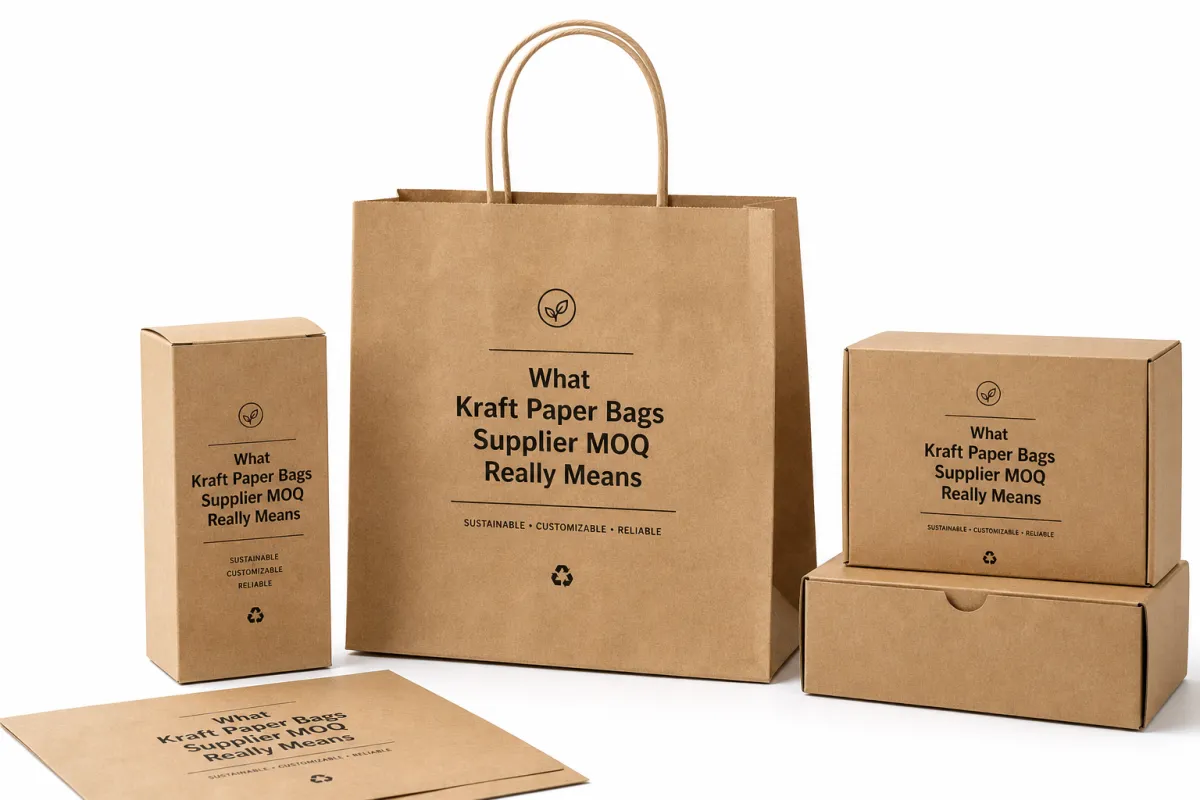
In practical terms, a Kraft Paper Bags supplier moq is the minimum production run that makes an order workable for both sides. Machine setup, die-cut tooling, plate making, carton packing, and raw-material waste all feed into that threshold. A supplier may be willing to accept a lower count, but if the job requires special handles, custom ink matching, or a nonstandard gusset, the cost per bag rises because the setup effort stays fixed while the volume shrinks. That is why a kraft paper bags supplier moq should be read as a production threshold, not a sales line.
The same bag can shift from economical to expensive without any change in paper grade. A plain kraft paper bag with no print and standard dimensions usually moves through a line quickly. Add twisted handles, a white exterior, a full-front logo, and a reinforcement patch, and the order now carries more material handling, more inspection points, and more chances for waste. At that point, the kraft paper bags supplier moq reflects factory economics rather than an abstract minimum.
Buyers get cleaner numbers when they settle the bag size, print count, and handle style before asking for MOQ. Otherwise the quotation often describes a generic bag that does not match the final requirement. I see this pattern often: one supplier quotes a low number for stock-style bags, another quotes a higher number for the branded version, and the buyer assumes the second factory is overpriced. The issue is simpler than that. The two quotes are not for the same product. Fair comparison starts with the same dimensions, the same paper weight, the same artwork, and the same packing method. That is the starting point for any paper bag MOQ that deserves to be compared across suppliers.
A low-MOQ promise can still be useful, but buyers should ask what was sacrificed to reach it. Sometimes the supplier accepts a smaller run by using standard paper stock, a single-color print, and the most common handle style in the plant. That is a sensible trade. Other times the lower count arrives with a higher unit price, a longer lead time, or less freedom on artwork placement. A strong kraft paper bags supplier moq balances pricing, quality, and delivery in one answer.
From a procurement viewpoint, MOQ also reveals process discipline. A supplier that knows setup times, waste allowance, and packing logic can quote with confidence. A supplier that cannot explain those details may be guessing. That is a problem when the order supports a retail launch, a food-service rollout, or a branded promotion with a fixed ship date. The sharper question is not only “What is your MOQ?” but also “What specification gives me the best kraft paper bags supplier moq for my budget?”
I have seen a five-millimeter change in gusset depth matter more than a buyer expected. On paper, it looked tiny. On the floor, it altered carton count, stack height, and even the way the bag sat on the filling table. Packaging is like that sometimes. A detail that feels minor at the quoting stage can become the thing that makes production easy, or annoyingly fiddly.
Product Details Buyers Expect From a Kraft Paper Bags Supplier
Most buyers begin by asking for bags, then the conversation becomes more useful once the product family is narrowed. A supplier should be able to discuss flat paper bags, SOS grocery bags, square-bottom retail bags, twisted-handle shopping bags, and heavier takeaway bags without making the customer guess the differences. Flat bags suit lightweight goods and simple takeout needs. SOS grocery styles stand upright better and are common in fast-moving retail and food use. Square-bottom retail bags create a cleaner shelf presentation. Twisted-handle bags carry a stronger retail signal. For repeat ordering, the most practical kraft paper bags supplier moq often comes from a style the factory already runs efficiently.
Paper selection matters just as much. Natural brown kraft gives a plain, honest look that many brands use for recycled or eco-conscious positioning. Bleached white kraft offers a cleaner surface for logos, while recycled-content paper can support sustainability claims when the source is documented properly. Buyers who need a more premium feel often ask for heavier stock, especially when the bag must hold boxed products, bottles, or multiple items that will be carried more than once. A practical kraft paper bags supplier moq often depends on whether the supplier is working with standard kraft sheets or a more customized material blend. For wholesale paper bags, standard sizes often give the best starting point because they reduce tooling complexity.
Handle choice is another point where the order can change direction. Twisted paper handles remain popular because they are durable, cost-effective, and straightforward to produce in volume. Flat paper handles can work for lighter loads and a simpler appearance. Die-cut handles give a neat opening and appear often on promotional bags. Rope handles, while less common in basic kraft paper bags, can push the bag into a more premium retail space and may increase the kraft paper bags supplier moq because they add assembly steps. Handle style changes both the look and the structure, so it should be settled before pricing starts.
Printing changes the buying path too. A one-color logo on a standard bag is easy to run and often keeps the order accessible. Multi-color branding, wide coverage, metallic inks, and heavy solids add setup time and raise the risk of registration issues. Some brands only need an unprinted stock bag, which can move faster and reduce unit cost. Others need the bag to carry the brand at the counter, which means the supplier should see the artwork early. Once the branding becomes more elaborate, the kraft paper bags supplier moq usually rises because the run must absorb more production overhead. Custom Printed Paper bags almost always need a clearer brief than stock packaging.
Different buyers care about different outcomes. A retail store may care most about appearance and handle strength. A food-service brand may focus on fast packing, grease resistance, and dimensions that fit carryout containers. Event teams often want a simple, lightweight option that still looks polished in photos. Promotional buyers usually care about visual impact and consistent print quality across a large giveaway. The right kraft paper bags supplier moq depends on those priorities, because a bag that works beautifully in one setting can be oversized, overbuilt, or overpriced in another.
- Flat paper bags: useful for lightweight items, inserts, and simple food service.
- SOS grocery bags: practical for upright packing and quick checkout use.
- Twisted-handle shopping bags: common for retail branding and everyday carry.
- Square-bottom bags: better shelf stability and a more structured look.
- Takeaway bags: suitable for heavier carryout orders and boxed meals.
If the order will be reused in a retail setting, the surface finish deserves a second look. A smoother sheet can sharpen logo edges, while a rough natural kraft texture supports a more authentic recycled message. Both choices are valid. The real question is which texture fits the brand experience, because the right kraft paper bags supplier moq should support the packaging story rather than weaken it.
Sample sheets and photo references rarely waste time. They show handle attachment, gusset shape, and print placement more clearly than a quotation ever can. That matters even more when the bags will sit beside other packaging, such as corrugated cardboard cartons or ecommerce mailers, where visual consistency becomes part of the customer experience.
One thing I always ask for is a picture of the bag next to a familiar object: a soda can, a pastry box, a folded shirt, something ordinary. The comparison strips away the marketing gloss. A bag can sound “premium” on a spec sheet and still feel awkward in the hand. Real-world scale is a brutally honest editor.
Specifications That Change Strength and Shelf Appeal
The fastest way to narrow a quote is to lock down the core dimensions: bag width, gusset depth, height, paper GSM, handle reinforcement, and bottom construction. Those measurements decide whether the bag feels compact and economical or sturdy and retail-ready. A small bag with a narrow gusset may look tidy at checkout but struggle with wider products. A deeper gusset adds capacity, yet it can also affect stacking, folding, and carton packing. The kraft paper bags supplier moq does not sit apart from the spec sheet; the spec sheet gives the MOQ meaning.
Paper weight changes performance in a direct way. Lighter stocks suit dry goods, bakery items, inserts, and products that do not need repeated handling. Heavier paper makes more sense for bottles, boxed goods, and anything that may be carried across a parking lot, placed in a car, and handled again at home. The wrong choice shows up quickly in the field: handles pull, bottoms open, or the bag bows at the gusset. That is a difficult discovery after shipment, especially when the order was supposed to support a branded retail launch and the kraft paper bags supplier moq was based on a spec that was too light.
The base structure matters as much as the top. A square-bottom bag stands more securely on a counter and packs more evenly into cartons. A folded base can reduce material use, but it may not offer the same stability. Handle reinforcement changes the feel of the bag as well. If the handles are attached with a patch or a strong internal fold, the bag can carry more weight and survive repeated use more effectively. That usually nudges the kraft paper bags supplier moq upward, yet it can also prevent a weak bag from being replaced or complained about later.
Finish and branding details are not decorative extras; they change both perception and production. Matte surfaces usually feel more natural and less reflective. A smoother sheet can help keep ink coverage even, especially on logos with fine type. High-coverage artwork or flood prints need more careful drying and inspection. Some buyers want a natural craft look that signals recycled materials and biodegradable packaging. Others want a cleaner retail finish that makes the logo stand out on the shelf. Either can work, but the supplier should know the goal before setting the kraft paper bags supplier moq.
Food-contact use deserves its own check. If the bag will hold bakery goods, deli items, or takeaway packaging that may touch food directly, buyers should ask which papers and inks are appropriate. A supplier should be able to explain whether the bag construction fits direct food handling, secondary packing, or simple carryout use. For broader compliance questions, buyers can review standards and guidance through groups such as ISTA for shipping performance and FSC for responsible fiber sourcing. The best kraft paper bags supplier moq is the one that keeps the product credible and usable, not just cheap on paper.
The environmental side also needs a practical view. Buyers who need recycled materials, FSC certified paper, or content with post-consumer waste should say so early. Those requirements can affect availability and lead time, but they also keep the packaging aligned with the brand story. Not every order needs the same sustainability profile, and not every claim is equally easy to support. Honest sourcing matters more than decorative green language. In eco-friendly packaging, the paper spec should support the claim, not merely decorate it.
There is a quiet industry truth here: paper claims travel fast, but documentation travels slowly. If a certificate cannot be matched to the exact paper batch, the claim is shaky. That is not a theoretical problem. It is the sort of mismatch that creates awkward conversations after the order lands, and nobody enjoys those.
Kraft Paper Bags Supplier MOQ and Pricing Factors
The quote for a kraft paper bags supplier moq usually comes down to five variables: paper grade, bag size, print complexity, handle type, and whether the order uses standard production or custom tooling. Once those are known, a supplier can estimate raw material use, labor, waste, and packing. Leave any one of those fields open and the quote often becomes broad or misleading. A well-structured brief is worth more than a short email that simply says “send price.”
Small runs nearly always carry a higher unit cost because the setup burden is spread across fewer bags. The plates still need to be made, the machine still needs adjustment, and the team still needs to check registration, handle alignment, and fold consistency. If the first bag is wrong, the correction cost still exists. Larger runs can reduce unit price, but only if the buyer can use the volume without building excess inventory. A careful kraft paper bags supplier moq helps the buyer find the point where the price curve starts to make sense.
It helps to separate product price from landed cost. The displayed unit price may look attractive, yet freight, cartons, sample charges, taxes, and local receiving fees can change the real number. That becomes more visible with imported packaging, where transport can make up a meaningful share of the budget. Buyers often compare two offers that look close on the line item and later discover that one quote used heavier outer cartons, different packing counts, or a more expensive shipping lane. A real comparison measures the kraft paper bags supplier moq against the full landed cost, not the bag price alone.
| Order Type | Typical Features | Relative Unit Cost | Best Fit |
|---|---|---|---|
| Standard stock-style bag | Common size, one-color logo or no print, standard handles | Lowest | Simple retail, food service, fast replenishment |
| Low-MOQ custom bag | Custom dimensions, light branding, standard kraft paper | Moderate to high | Launch orders, test programs, seasonal runs |
| Fully branded custom bag | Multi-color artwork, reinforced handles, custom finish | Highest | Premium retail, brand-heavy campaigns, repeat programs |
Several choices can reduce cost without weakening the product. Standard dimensions keep tooling simple. Fewer print colors lower setup time. Cleaner artwork with less ink coverage usually prints more predictably. A common handle type, rather than a specialty one, can also help. If the buyer has flexibility on delivery consolidation, combining cartons or aligning shipping schedules may reduce freight expense. These moves do not always lower the kraft paper bags supplier moq itself, but they often improve the economics around it.
Compare like with like, then ask what the quote leaves out. A fair supplier should explain the assumptions behind the number, including whether the order uses recycled materials, whether the paper is FSC certified, and whether the cartons are packed for standard warehouse handling or for more protective shipping. If the packaging needs to travel alongside corrugated cardboard shippers, carton style may matter more than expected. Good quoting is detailed because real production is detailed.
A practical buyer may ask for two scenarios. One should match the target kraft paper bags supplier moq exactly. The other should show the next volume tier, because that often reveals the price break that justifies a slightly larger order. That simple comparison makes the pricing curve easier to read and shows whether the larger buy is worth the extra inventory. It is a small step, yet it cuts through a lot of guesswork.
Sample requests deserve attention. A printed sample, or even a plain physical sample, can show whether the size is right, whether the handle sits comfortably in the hand, and whether the paper feels strong enough for the final load. A quotation may say the kraft paper bags supplier moq is acceptable, but the sample shows whether the order is acceptable in actual use.
If you have ever watched a buyer approve a quotation and then reject the first sample, you know how expensive assumptions can be. The order did not fail because the supplier was mysterious. It failed because the bag had been described too loosely. That is fixable, and much cheaper to fix before production starts.
How Ordering, Proofing, and Lead Times Work
The usual workflow starts with specification review, then pricing, artwork checking, proof approval, production, packing, and shipment. A buyer who sends a complete brief gets a more accurate quote and a more reliable schedule. A buyer who sends only a logo and a rough size usually gets slower back-and-forth and more room for mistakes. That matters because the kraft paper bags supplier moq is only one part of the order; the proofing stage can be just as decisive to the final result.
Artwork approval is one of the easiest ways to save time. If the supplier has the logo in a clean file format, knows the color count, and understands where the mark should sit on the bag, the proof can move quickly. Problems usually appear when the artwork is low resolution, the dimensions are unclear, or the buyer changes the layout after the quote. Experienced packaging buyers send exact files early and keep the design stable once the kraft paper bags supplier moq is agreed.
Lead time works better when it is broken into pieces. Sample turnaround is not the same as production time, and production time is not the same as freight time. A factory may need several business days to prepare a sample, a couple of weeks for production depending on quantity and finish, and then the shipping time on top of that. A simple order with an open line may allow rush work. A job that needs new tooling, special inks, or a tight color match becomes less flexible. A good kraft paper bags supplier moq is one that fits the calendar as well as the budget.
Buyers should share the delivery target early, even when the spec is still being refined. That gives the supplier a chance to state the limits before anyone commits to a date that cannot be met. I would rather see a buyer simplify the print or trim the quantity slightly than miss a launch because the schedule was assumed instead of confirmed. The value is not in promising the fastest answer. The value is in confirming the right answer.
For buyers working with sustainable packaging goals, timing may also depend on paper source. Recycled-content kraft paper, FSC certified materials, or stock with a post-consumer waste claim can require a different inventory position than standard paper. That is normal. It simply means the supply chain should be checked before the order is approved. A dependable kraft paper bags supplier moq should never hide those details.
One habit helps more than it looks like it should: keep a short pre-flight checklist before issuing the order.
- Confirm final dimensions and gusset depth.
- Lock the paper GSM and handle style.
- Approve the print count and artwork placement.
- Check carton counts and shipping destination.
- Set a delivery date with freight included.
With those five points in place, the quote becomes sharper and the lead time becomes easier to trust. That usually separates a smooth order from a chain of revisions that slows everything down.
Why Choose Us as Your Kraft Paper Bags Supplier
Custom Logo Things focuses on practical packaging decisions rather than decorative promises. For buyers who need a kraft paper bags supplier moq that fits a real business model, the value comes from matching bag construction to load, branding, and budget. That means starting with the actual use case. Is the bag carrying a pastry box, a bottle set, apparel, or a retail gift? Is it being handed out at checkout, packed in a warehouse, or used as part of a premium customer experience? Those answers shape the bag spec, and the bag spec shapes the kraft paper bags supplier moq.
Production control matters because repeat orders depend on consistency. The paper should feel the same from run to run, the print registration should stay aligned, and the handle attachment should hold under normal carrying loads. Buyers who reorder every month do not want to requalify the bag each time. A supplier that tracks specs carefully can make the second order easier than the first, which is exactly how a packaging program should mature.
Quality checks are not abstract here; they show up in the hand. Glue strength affects whether the bottom stays closed. Handle attachment affects whether the shopper trusts the bag after it is filled. Cut accuracy affects whether the bag stacks neatly in the carton and presents well at the counter. Ink clarity affects whether the logo reads as intended, especially on natural kraft paper where texture can soften fine details. Those are the small things buyers only notice after a bag has already left the building, so they are worth checking before the order is released.
Quote clarity is another benefit of a careful supplier. Buyers should see the assumptions behind the number, including whether the order uses standard kraft paper, recycled materials, or a specified eco profile such as FSC certified stock. If the quote includes sample support, proof review, or packing guidance, that should be stated plainly. Hidden tradeoffs become expensive later. Clear tradeoffs are manageable now.
A strong packaging partner also helps a buyer move from a test order to a repeat program. Maybe the first run is small because the brand is still learning the right bag size. Maybe the paper weight needs one more step up after field use. Maybe the handle style needs adjustment because customers carry the bag farther than expected. A supplier that understands those realities can refine the order without starting over, and that is often the real value behind a reliable kraft paper bags supplier moq.
For buyers who want broader ordering support, our FAQ page covers common questions about specs, proofs, and production timing. It is a useful place to clear early concerns before a quote request turns into a long back-and-forth thread.
In a good supplier relationship, the tone stays calm and specific. The buyer knows what the bag needs to do. The supplier knows how to build it. The quote reflects the real job. That is the kind of setup where a kraft paper bags supplier moq becomes a planning tool rather than a problem.
Next Steps to Confirm Your Kraft Paper Bags Supplier MOQ
Useful quotes begin with useful inputs. Before reaching out, prepare bag dimensions, paper GSM, handle style, artwork files, quantity target, and delivery location. Those six items let the supplier judge whether the order can be built as requested or whether a small adjustment would improve pricing. The more exact the brief, the more useful the kraft paper bags supplier moq will be.
Two scenarios help more than one. Ask for the quantity you expect to buy, then ask for a slightly higher volume so you can see the price break. In many cases, the second quote reveals the real economics. The difference may be small enough that the larger run is worth it, or large enough that the lower order is clearly the safer move. Either way, you get a better view of the kraft paper bags supplier moq before committing.
If the bag is new, or if it will carry heavier goods, request sample photos or a physical sample. That is especially useful for retail-facing branding, because a logo can look strong on screen and still feel too faint or too busy on paper. A sample also helps confirm whether the handles feel right, whether the gusset opens cleanly, and whether the bag stands the way it should on a shelf or counter. A useful kraft paper bags supplier moq always sits beside a usable physical product.
Do not treat sustainability claims casually. If you need FSC certified paper, recycled materials, or a post-consumer waste content statement, ask for the documentation at the same time as the quote. That keeps the commercial conversation honest and avoids late surprises. The same logic applies if the bags are part of a broader biodegradable packaging program. Buyers should know what the claim means and what the supplier can support.
For many procurement teams, the cleanest path is simple: approve the spec, review the proof, lock the quantity, and schedule production. That sequence keeps the order moving and cuts the chance of expensive revisions. It also gives the supplier enough information to honor the kraft paper bags supplier moq without padding the quote for uncertainty.
So if you are planning a retail bag, a takeaway program, or a branded giveaway, start with the exact use case and let the production details do the rest. A precise brief makes the kraft paper bags supplier moq easier to understand, easier to compare, and easier to buy with confidence. The practical takeaway is straightforward: pin down the dimensions, material, handle, print count, and delivery date before you ask for price. That five-part check is usually the difference between a number that looks good and a number That Actually Works.
What is a typical kraft paper bags supplier MOQ?
It depends on bag size, print method, handle style, and whether the supplier is using standard materials or a custom setup. Smaller, simpler bags often have lower MOQs than large printed shopping bags with reinforced handles. The fastest way to get a realistic number is to send exact dimensions, paper weight, and artwork details. That gives the supplier enough detail to calculate a real kraft paper bags supplier moq instead of a rough estimate.
How does printing affect kraft paper bags supplier MOQ?
Each extra color or special finish can add setup time, so MOQ often rises when printing becomes more complex. One-color logos on standard bags usually keep ordering easier than full-surface branding or multi-panel artwork. If you want a lower MOQ, keep the design simple and confirm whether the supplier can run it on stock materials.
Can I lower MOQ by changing the bag spec?
Yes, standard sizes, lighter print coverage, and simpler handles usually make smaller orders more feasible. Avoid custom shapes and unusual coatings if your goal is to keep the first order modest. A supplier can often suggest a near-match spec that preserves branding while reducing setup burden.
What should I send for an accurate quote?
Send bag dimensions, paper GSM, handle type, print colors, quantity, destination, and target delivery date. Include artwork files or even a rough logo layout so the supplier can judge print setup correctly. If the bag will hold food, bottles, or heavy retail items, state that clearly because it affects construction and pricing.
How long does production usually take after MOQ is confirmed?
Time depends on proof approval, material availability, and how busy the production schedule is. Standard orders move faster when artwork is final and the spec is already approved. Add shipping time on top of production time so the delivery plan reflects the full timeline, not just the factory run.

