Buyer Fit Snapshot
| Best fit | Branded Packaging Inserts Wholesale projects where brand print, material claims, artwork control, MOQ, and repeat-order consistency need to be specified before quoting. |
|---|---|
| Quote inputs | Share finished size, material target, print colors, finish, packing count, annual reorder estimate, ship-to region, and any compliance wording. |
| Proofing check | Approve dieline scale, logo placement, barcode or warning zones, color tolerance, closure strength, and carton packing before bulk production. |
| Main risk | Vague material claims, crowded artwork, missing packing details, or unclear freight terms can make a low unit price expensive after revisions. |
Fast answer: Branded Packaging Inserts Wholesale: Costs, Specs, MOQ should be specified like a repeatable production item. The safest quote records material, print method, finish, artwork proof, packing count, and reorder notes in one written spec.
Production checks before approval
Compare the actual filled-product size with the drawing, then confirm tolerance on folds, seals, hang holes, label areas, and retail display edges. Reserve space for logos, QR codes, warning copy, and material claims before decorative graphics fill the panel.
Quote comparison points
Review material grade, print process, finish, sampling route, tooling charges, carton quantity, and freight assumptions side by side. A quote is only useful when the supplier can repeat the same color, closure quality, and packing count on the next order.
One crushed shipment can wreck the margin on an entire run. That is the part people tend to ignore until returns start stacking up, replacements start shipping, and the customer photos make the box look like it got kicked down a staircase. A cheap insert looks optional right up until it is the reason your product arrives rattling around like spare change. A good one does more than fill space. It locks the product in place, cuts down movement, and makes the package feel considered instead of improvised.
Buyers usually spot the value in the boring places first: fewer returns, fewer support emails, fewer damage claims. That matters whether you ship cosmetics, electronics, supplements, candles, gift sets, or anything fragile enough to get cranky in transit. Branded Packaging Inserts wholesale is not decorative fluff. It is protection, presentation, and brand control sitting in the same piece of packaging. Ignore it, and the bill shows up somewhere else on the P&L.
Picking the right insert starts with the product, the shipping risk, and the reorder volume. Everything else is material, print spec, and a little common sense. That is what this breakdown covers before you request a quote for branded packaging inserts wholesale.
Why Branded Packaging Inserts Wholesale Pays Off Fast
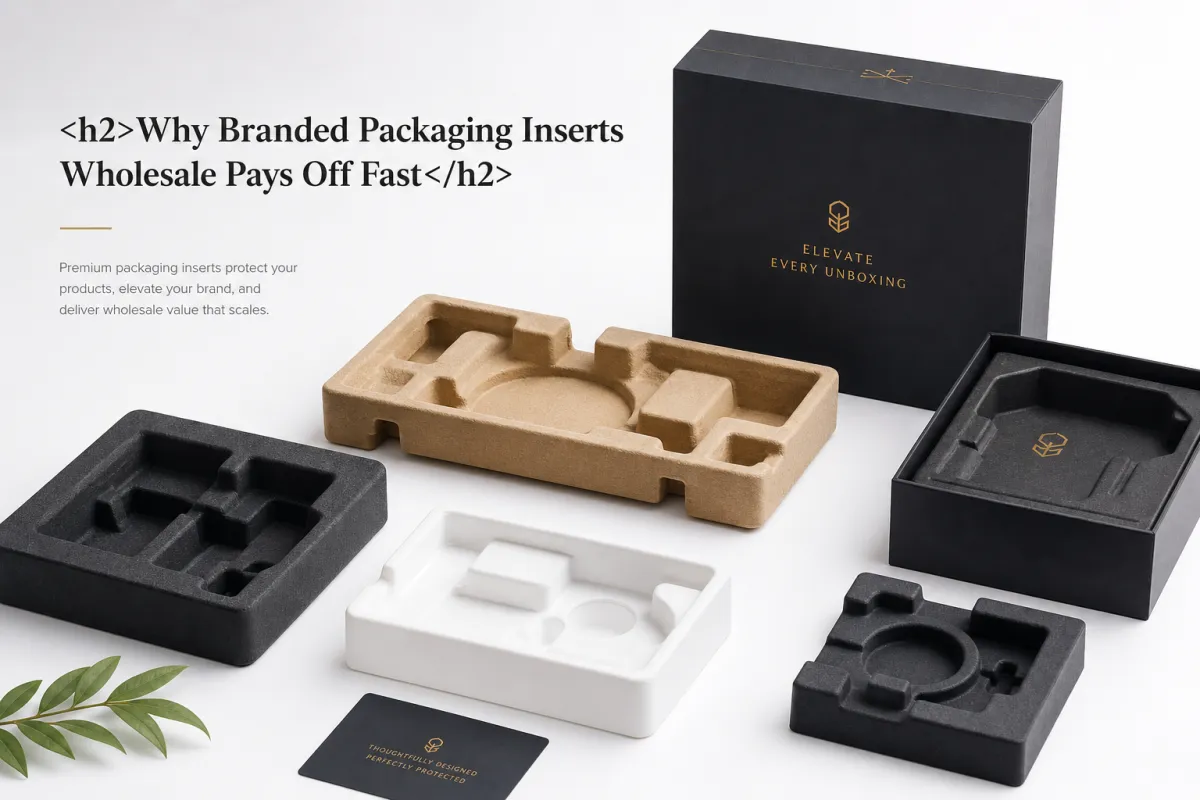
One bad shipment is usually enough to make the case. A cracked jar. A scuffed device. A lid that pops loose because the product had room to bounce around. That single failure can cost more than a basic branded packaging inserts wholesale order once you add refunds, replacement freight, lost time, and the customer who quietly decides not to reorder. People call that a “small issue” until it starts eating margin.
The job of an insert is simple on paper. Keep the product in position. Add protection. Make the opening feel clean and intentional. In branded packaging, those jobs happen at the same time. A solid insert says someone thought through the shipper, the product, and the customer experience. A weak insert says the opposite, usually without needing a logo to spell it out.
The Best Use Cases are the ones where movement creates damage. Glass skincare bottles. Tech accessories rattling inside a mailer. Gift boxes with multiple pieces that need separation. Apparel brands use branded packaging inserts wholesale too, usually for thank-you cards, care sheets, and fold-out inserts that keep the presentation tidy. The insert can protect, guide, and sell if the structure supports the job.
“If the product shifts, the customer notices before they notice the branding.”
Wholesale matters because the economics only work when setup costs get spread across enough units. At low volume, almost every custom insert looks expensive. At higher volume, the unit cost drops fast, especially when the dieline stays fixed and the same spec can be reordered without new tooling. That repeatability is the real advantage of branded packaging inserts wholesale. No drama. No starting over every time a launch gets rescheduled.
Consistency is the other piece buyers underestimate. Once the insert spec is locked, the box packs the same way every time, the line moves faster, and the customer gets the same experience on every order. That matters in product packaging, retail packaging, and subscription programs where a sloppy batch can make the entire brand feel a little off.
The math is usually dull and obvious. A $0.18 insert that trims returns by even a small percentage often beats “saving” $0.05 on a cheaper piece that protects nothing. I have seen teams argue over pennies here and then lose dollars later. Funny how that works.
There is also a practical trust factor. When the packaging feels dialed in, customers assume the product inside was handled with the same care. That assumption matters more than some brands admit. It is not magic. It is packaging doing its actual job.
What Branded Packaging Inserts Wholesale Includes
Branded packaging inserts wholesale is a category, not a single item. Buyers often ask for “an insert” and mean five different things. A thank-you card is an insert. A divider tray is an insert. A molded pulp cradle is also an insert. They do not solve the same problem, and they should not be priced like they do.
The most common formats are easy enough to recognize:
- Thank-you cards and promo cards for brand messaging, QR codes, and discount offers.
- Belly bands that wrap around a product bundle or flat pack to hold pieces together.
- Fold-out instruction sheets for assembly steps, care guidance, or warranty notes.
- Chipboard dividers that separate jars, bottles, or small components.
- Corrugated supports that add structure and reduce crush risk in transit.
- Foam inserts for tighter fit and stronger impact control.
- Molded pulp trays for brands that want a more sustainable presentation.
- Branded sleeve packs that wrap the product or tray with printed graphics.
Decorative inserts and structural inserts are not the same thing. A postcard can improve the unboxing moment, but it will do nothing for a glass bottle sliding around in the box. That is why branded packaging inserts wholesale needs to match the actual shipping risk. Pretty is not protection. Packaging buyers usually learn that the expensive way if nobody stops them first.
For apparel and light goods, a printed card or sleeve may be enough. For heavier jars, chargers, skincare sets, or gift boxes with multiple compartments, structure matters. That might mean a die-cut board, a corrugated insert, or a molded pulp tray with a specific cavity depth. In custom printed boxes and branded packaging programs, the insert has to fit the outer package, not just the product.
There is a communication angle too. An insert can carry setup instructions, QR codes, reorder prompts, care tips, cross-sell offers, and warranty details. That cuts support tickets later. A good insert answers the obvious question before the customer sends your team an email about it.
That is why branded packaging inserts wholesale is more than a print order. It is a packaging decision, a shipping decision, and a marketing decision sitting inside the same spec sheet. Brands that understand that usually choose better materials and get fewer surprises. Brands that do not usually spend more cleaning up the mess.
For buyers comparing bundled solutions, it can help to review related options in Custom Packaging Products and see how inserts fit into the rest of the system. If the outer carton and insert are designed together, the full pack works harder.
Branded Packaging Inserts Wholesale: Materials and Specs
Material choice shapes the feel, the protection level, and the cost. That sounds obvious, but buyers still pick the cheapest sheet stock for a job that needs stiffness. Then they wonder why the package arrives crushed. For branded packaging inserts wholesale, the material has to match the product weight, the shipping route, and the brand look.
Chipboard is the workhorse for rigid printed inserts. It gives decent stiffness, clean cutting, and a smooth surface for print. Paperboard or SBS works well when the insert is more about presentation than load bearing. Corrugated board adds cushioning and crush resistance, which is why it shows up in heavier ecommerce orders. Kraft board gives a natural look and suits brands that want less gloss and more recycled texture. Molded pulp is often the better answer for sustainability-led programs because it supports the product without looking like overbuilt plastic packaging.
Thickness matters just as much as material. A thin 14pt card is fine for a mailer note or promo insert. A 16pt to 24pt board works better for layered presentation pieces. Structural inserts often need heavier stock, sometimes in the 18pt to 32pt range depending on shape and product load. If the item is fragile or heavy, think in terms of fit and support, not just print surface. A pretty insert that collapses under pressure is just a fancy failure.
One more practical detail: tolerances matter. If your bottle neck, cap height, or accessory bundle varies from batch to batch, the insert should give you a little breathing room. Too tight and you slow packing or scuff the product. Too loose and the item starts wandering inside the box. That extra millimeter or two can save a headache later.
| Insert Type | Best Use | Typical Spec | Typical Wholesale Unit Range | MOQ Notes |
|---|---|---|---|---|
| Thank-you card | Brand message, QR code, promo offer | 14pt-16pt paperboard, one or two sides | $0.03-$0.10 | Often lower MOQ, especially for digital print |
| Chipboard divider | Separate bottles, jars, or accessories | 18pt-32pt chipboard, die-cut slots | $0.12-$0.35 | Usually needs a custom die and setup charge |
| Corrugated support | Crush control, box stabilization | E-flute or B-flute, branded print optional | $0.18-$0.60 | Better for mid to higher volumes |
| Molded pulp tray | Product cradle, sustainable protection | Formed to product cavity, uncoated or light finish | $0.20-$0.75 | Tooling and cavity design can raise the entry point |
| Branded sleeve pack | Presentation wrap, bundle hold, retail packaging | 250gsm-350gsm board, fold and lock tabs | $0.08-$0.22 | Works well for repeat runs and standard dimensions |
For print specs, confirm the basics before you approve anything. Color count, one-sided or two-sided print, matte or gloss coating, foil, embossing, spot UV, barcode or QR placement, and bleed size all change the job. If the insert has to live inside branded packaging with a tight fit, the dieline matters more than the mockup. A file that looks clean on a screen can turn into a press headache if the folds are off.
Prepress is where a lot of jobs get delayed. Send vector artwork when you can. Use print-ready files at the correct resolution. Ask for the dieline before final art so your team is not guessing where the folds land. If the insert touches food-contact items or makes a recyclability claim, the material and inks need to support that claim. That is not paperwork for fun; it is how you avoid misleading packaging.
For shipping performance, testing matters. If the insert is protecting a product through parcel transit, I would rather see an order checked against relevant ISTA test protocols than hear a supplier say, “It should be fine.” I have heard that line before. It usually shows up right before a replacement order.
When sustainability is part of the brief, look for FSC-certified paperboard or documented recycled content. The FSC program is one of the clearer signals that the paper source has been tracked properly. If a supplier cannot explain board grade, coating, or certification chain without wandering into marketing fluff, keep asking questions. Clear answers beat polished nonsense every time.
Branded Packaging Inserts Wholesale Pricing, MOQ, and Unit Economics
Pricing is where the truth shows up. A pretty mockup means nothing if the landed cost wrecks your margin. For branded packaging inserts wholesale, the final number depends on size, material, print coverage, finishing, assembly complexity, and quantity ordered. That is the boring answer, and it is also the right one.
Here is the part buyers need to hear: a quote at 500 units and a quote at 5,000 units are not competing offers. They are different economies. Setup and waste get spread across more pieces at higher volumes, which is why unit cost falls as volume rises. That is the real benefit of wholesale, not just the word sitting in the headline.
Typical MOQ logic looks like this. Simple printed cards can sometimes start in the low hundreds, especially with digital printing. Custom structural inserts usually need a larger run, often 1,000 to 3,000 pieces, because the die, setup, and production waste have to be absorbed somewhere. Molded pulp and more complex formed pieces may sit higher depending on tooling. If a supplier offers a tiny MOQ on a complex job, ask where the missing cost is hiding. It has to be somewhere.
Do not forget the extras. Buyers regularly miss die cutting, tooling, sample charges, proofing, freight, import duties, warehouse storage, and kitting labor. Those are not optional costs. They are part of the job. That is why branded packaging inserts wholesale should always be compared on landed cost, not just the factory line item. A cheap unit price can get ugly once the boxes hit your dock.
Here is a practical way to read a quote:
- Base material tells you what the insert is made from.
- Print setup tells you whether artwork needs plates, digital setup, or both.
- Die and tooling tells you if the shape is custom and reusable.
- Finishing tells you whether coating, foil, embossing, or laminating adds cost.
- Packing method tells you whether the inserts arrive flat, nested, or pre-assembled.
For a simple branded card run, you might see something like $0.05 to $0.12 per unit at moderate quantities. For die-cut board supports, $0.15 to $0.35 is more realistic. For more specialized molded or rigid structures, the range can climb further, especially if the piece is complex or the order is small. That is normal. What is not normal is pretending every insert should cost the same just because it came from a printer.
Comparing suppliers inside Wholesale Programs can help you separate a real factory quote from a broker quote padded with handoffs. If the pricing changes every time the file changes hands, the project is not stable yet.
Ask for three options too: standard, better, and premium. That gives you room to compare margin against protection instead of guessing in the dark. Most teams make better decisions when they can see a $0.08 version next to a $0.19 version and understand exactly what changes.
And yes, sometimes the cheapest route is enough. If the insert is just a branded card tucked into a rigid box, there is no reason to turn it into a science project. The mistake is paying for structure when all you needed was a message, or skipping structure when the product really needs support. That part is on the buyer, not the supplier.
Branded Packaging Inserts Wholesale: Process and Timeline
The order flow is straightforward, but only if the buyer shows up prepared. A proper branded packaging inserts wholesale project moves through brief, quote, material selection, dieline setup, artwork submission, proofing, production, quality check, packing, and delivery. Delays usually happen because someone skipped one of those steps and decided the schedule would somehow absorb the mistake. It does not.
Simple print-only inserts can move quickly if the artwork is ready and the spec is locked. Custom structural inserts take longer because the design has to be cut, tested, and sometimes adjusted after the first proof. Shipping time is separate from production time, which sounds obvious until someone promises inventory to a sales team and forgets the freight leg.
Most delays come from the same few problems: vague dimensions, missing artwork, too many revisions, special finishes added late, and approvals that sit in a manager’s inbox because nobody wants to make a call. I have seen beautiful jobs stall because the team could not decide whether the logo should be foil or flat print. That is not a supply chain problem. That is a decision problem.
If you want the schedule to stay tight, lock the dimensions early and send print-ready files in vector format when possible. Ask for a proof, review it quickly, and make sure the delivery method is set before production starts. Branded packaging inserts wholesale should not require detective work from the supplier. Give clear instructions and the job usually moves just fine.
One small thing that saves a lot of grief: verify the outer box dimensions before final approval. Teams sometimes build the insert around a sample carton that later changes by a few millimeters. That tiny shift can throw off the fit and force a rework. It is the kind of detail nobody remembers until they are standing in the warehouse wondering why the trays are not seating properly.
Here are the questions worth asking before you place the order:
- What is the lead time for production only?
- How many proof rounds are included?
- Is there a rush option, and what does it cost?
- Will the supplier check dimensions against the outer box?
- What happens if artwork fails prepress?
- Is freight included or separate?
That last question matters more than people think. If the insert is part of a larger packaging system, the box, tray, and shipper all need to work together. That is where a weak design chain gets expensive. Good packaging design saves time later. Bad design creates rework that nobody budgets for.
For buyers who want to see how inserts fit into wider packaging programs, it helps to review a few Case Studies. Real examples show how outer carton size, insert thickness, and packing method affect the final result. Theory is nice. Shipping damage costs more.
In practice, a clean timeline for branded packaging inserts wholesale looks like this: 1 to 3 business days for quote and concept alignment, 2 to 5 days for proofing if artwork is ready, 7 to 15 business days for production on simpler runs, and longer for structural or molded work. Then add transit time based on the shipping method. That is the honest version. Anything much faster needs a very careful second look.
Why Choose Us for Branded Packaging Inserts Wholesale
Buyers do not want mystery. They want the insert to fit, the print to match, the price to make sense, and the delivery to show up before the launch date turns into a problem. That is the value of working with a supplier who actually understands branded packaging inserts wholesale instead of just forwarding files and hoping nobody asks technical questions.
Our advantage is simple: tighter control over print, die cutting, and quality checks means fewer surprises. Color stays more consistent. Dimensions stay more stable. Reorders stay cleaner because the spec is already saved. That matters if your packaging program includes custom printed boxes, coordinated inserts, and repeat launches that need the same look every time.
Quote clarity matters too. A good supplier should tell you the MOQ, the lead time, the included proof rounds, and the extras that are not included. No vague “starting at” language that falls apart the moment you add finishing. Buyers do not need cheerleading. They need a usable number. That is especially true with branded packaging inserts wholesale, where setup and freight can move the landed cost fast.
Technical support matters just as much. If the dieline needs adjusting, the file should be checked before production starts. If the insert is meant to hold a bottle or device, the dimensions should be reviewed against the product weight and the outer box. That prevents the usual wasteful back-and-forth. Nobody likes paying to discover the cavity is 3 mm too loose after the run is printed.
Reorders are where a good program pays off. Saved artwork, archived specs, and repeatable dimensions make the next batch easier to quote and faster to produce. If your product starts moving faster, a stable branded packaging inserts wholesale setup keeps you from rebuilding the whole package every time sales pick up. That is the part teams appreciate after the first successful run.
If you are building a larger packaging system, our Custom Packaging Products page is a useful place to compare insert formats with cartons, sleeves, and other structural parts. The goal is not just a branded object. The goal is a package that works in transit and still looks deliberate in the customer’s hands.
We also keep the process practical: no inflated promises, no extra revisions that burn time, and no pretending every order can move at the speed of a digital mockup. Branded packaging should support the product and the margin. If it does not, it is decoration with a freight bill. That is a bad deal dressed up as marketing.
Next Steps to Order Branded Packaging Inserts Wholesale
If you are ready to quote branded packaging inserts wholesale, gather the basics before you send the brief. Product dimensions. Insert purpose. Target quantity. Print needs. Coating preference. Budget range. Delivery deadline. That list alone can save a full round of clarification emails and a lot of wasted time.
Ask for three options if possible: value, standard, and premium. That gives you room to see whether the main difference is material, finish, or structure. It also makes the tradeoff obvious. If the premium version only adds a nicer coating but the standard version already protects the product, you may not need the upgrade. If the premium version cuts damage risk in half, the answer changes fast.
Always request a sample or at least a digital proof before the full run, especially if the insert has a tight fit. A cavity that is too loose can turn into product movement. A cavity that is too tight can slow packing and damage the item. Both are annoying. One is more expensive.
Set a reorder point based on sales velocity, not hope. If a batch takes two weeks to produce and another week to ship, you do not wait until the last carton is gone. That is how businesses end up doing emergency orders at ugly prices. Good branded packaging inserts wholesale planning should keep you ahead of the shortage, not chasing it.
One more thing: make sure the insert matches the rest of the package. The outer carton, the product wrap, the tray, and the printed message should all feel like the same system. That is what makes branded packaging look intentional instead of patched together. It is also what keeps Product Packaging Costs under control over time.
To move forward, send the specs, the quantity, and the product dimensions. If you want help narrowing the format, start with the outer box size and the protection goal. From there, the right branded packaging inserts wholesale option usually becomes obvious pretty quickly. And if it does not, that is usually a sign the brief needs one more pass before the quote.
The cleanest takeaway is simple: choose the insert around the product, not around the mockup. Measure the shipping risk, lock the dieline, and compare landed cost instead of chasing the cheapest unit price. Do that, and branded packaging inserts wholesale stops being a line item that causes headaches and starts doing the job it was supposed to do in the first place.
FAQ
What is the minimum order for branded packaging inserts wholesale?
The MOQ depends on material and print method, but simple printed inserts usually start lower than custom structural pieces. Digital or short-run options can work for smaller test orders, while offset and die-cut jobs usually need a bigger run to make sense. If a supplier offers a very low MOQ, check whether setup, tool costs, or freight are hiding the real price.
How much do branded packaging inserts wholesale orders usually cost?
A simple paper insert can be low cost per unit, while rigid, die-cut, or fully customized inserts cost more because of setup and materials. The biggest price drivers are size, print coverage, finishing, and quantity ordered. Always compare landed cost, not just the base unit price, because freight and tooling can change the real number fast.
Which material works best for wholesale branded inserts?
Chipboard and paperboard work well for printed presentation pieces and lightweight support. Corrugated or molded pulp is better when the priority is protection and product stability. Kraft or recycled boards make sense when the brand wants a natural look and recyclability matters.
How long does branded packaging inserts wholesale production take?
Quote and proof stages can move in a few business days if the artwork is ready and the specs are clear. Production time usually ranges from about two to four weeks for custom orders, depending on complexity and quantity. Shipping is separate, so buyers should plan for transit time before promising delivery to customers.
Can I add QR codes, promo codes, or care instructions to inserts?
Yes, and those are some of the most useful things to print on an insert because they keep the package doing work after unboxing. Make sure QR codes are tested on the proof and sized large enough to scan reliably. Use the insert to reduce support questions, drive repeat purchases, or send customers to a product page, not just to fill space.
If you are comparing options for branded packaging inserts wholesale, the right answer usually comes down to fit, protection, and landed cost. Get the dimensions right, choose the material based on the real shipping risk, and keep the order spec stable enough to reorder without rebuilding the whole thing. That is how branded packaging inserts wholesale protects the product, improves the unboxing, and keeps costs from wandering off into nonsense.


