Buyer Fit Snapshot
| Best fit | Branded Packaging Inserts with Logo projects where brand print, material claims, artwork control, MOQ, and repeat-order consistency need to be specified before quoting. |
|---|---|
| Quote inputs | Share finished size, material target, print colors, finish, packing count, annual reorder estimate, ship-to region, and any compliance wording. |
| Proofing check | Approve dieline scale, logo placement, barcode or warning zones, color tolerance, closure strength, and carton packing before bulk production. |
| Main risk | Vague material claims, crowded artwork, missing packing details, or unclear freight terms can make a low unit price expensive after revisions. |
Fast answer: Branded Packaging Inserts with Logo: What Actually Works should be specified like a repeatable production item. The safest quote records material, print method, finish, artwork proof, packing count, and reorder notes in one written spec.
Production checks before approval
Compare the actual filled-product size with the drawing, then confirm tolerance on folds, seals, hang holes, label areas, and retail display edges. Reserve space for logos, QR codes, warning copy, and material claims before decorative graphics fill the panel.
Quote comparison points
Review material grade, print process, finish, sampling route, tooling charges, carton quantity, and freight assumptions side by side. A quote is only useful when the supplier can repeat the same color, closure quality, and packing count on the next order.
Branded Packaging Inserts With Logo: What Actually Works
Most brands obsess over the outer box and treat the inside like it does not matter. It does. Branded Packaging Inserts with logo are often the first thing a customer sees after the lid opens, and that first look sets the tone fast. A good insert holds the product, protects it, and makes the packaging feel finished instead of improvised. It has a job. The logo is just the part people remember.
From a packaging buyer’s side, the best inserts do three things at once: they reduce movement, improve the reveal, and support package branding without yelling about it. That is why branded packaging inserts with logo show up in ecommerce shipments, retail packaging, subscription boxes, PR kits, fragile goods, and gift sets. The outer carton gets the shelf appeal. The insert handles the moment that actually lands in the customer’s hands.
If you are comparing options for Custom Packaging Products, the real question is not whether to add a logo. It is what needs to happen inside the box for the logo to matter. That answer changes the structure, the material, the print method, and the budget. Skip that part, and you end up paying for ink on a surface nobody sees. Cute, but not smart.
What Branded Packaging Inserts with Logo Actually Do
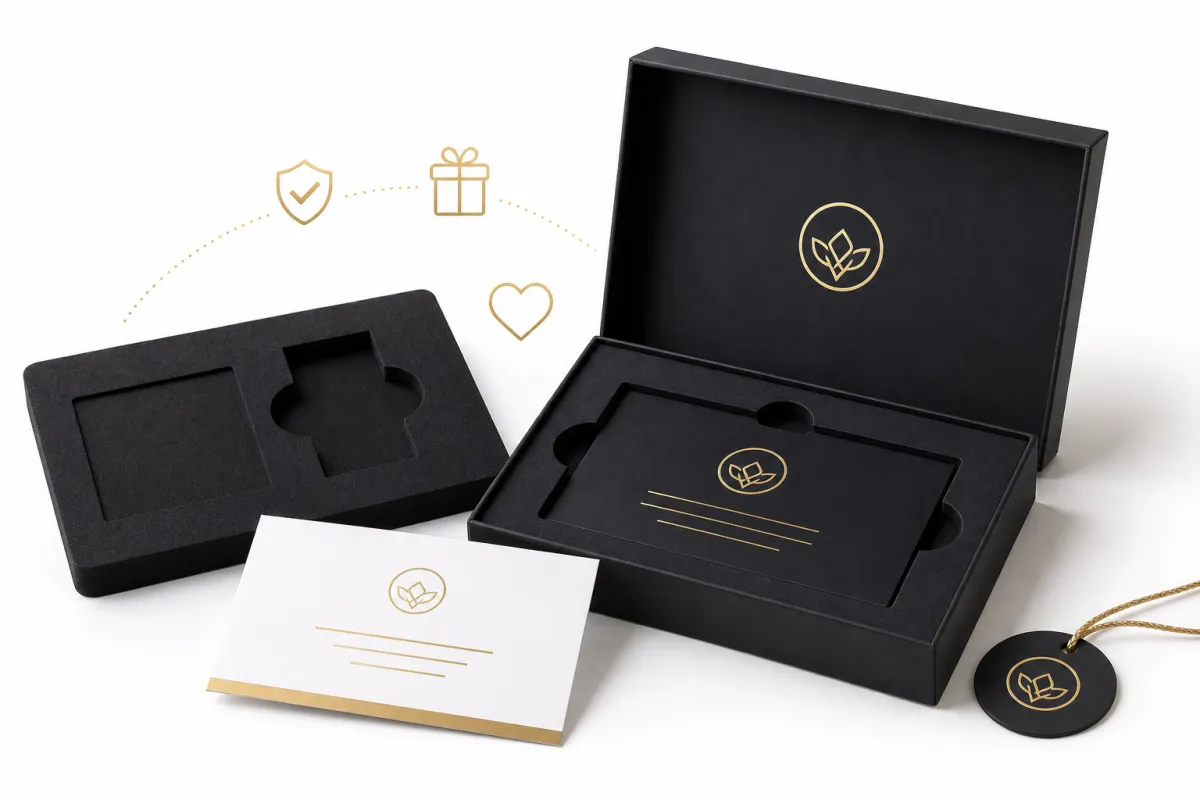
A packaging insert is the internal structure that holds, protects, and presents the product. It can be a paperboard cradle, a corrugated divider, a molded pulp tray, a rigid board frame, or a foam insert. The job stays the same: keep the product where it belongs and make the box feel deliberate. Branded packaging inserts with logo add a visible brand cue right when the customer opens the package.
The difference between a plain filler and a true branded insert is easy to spot. Plain filler just occupies space. A branded insert is sized to the product, matched to the box, and built so the logo lands where the eye naturally goes. Fit matters. Print placement matters. Reveal timing matters. If the product covers the logo the second the lid lifts, the branding is wasted. That is not premium. That is just bad planning with extra steps.
In practice, branded packaging inserts with logo work best when they improve both protection and presentation. A good insert can reduce scuffing, prevent corner damage, keep bottles upright, stop accessories from rattling, and make a kit look organized instead of dumped into a carton. That is useful for custom printed boxes, retail packaging, and Shipping Boxes That need to survive parcel handling without showing up beat up.
Brands use them in a few common ways:
- Ecommerce shipments: keep the product centered and stop movement during transit.
- Subscription boxes: create a repeatable unboxing structure that feels tidy and premium.
- PR kits: give media or creators a cleaner reveal and better camera-ready presentation.
- Gift sets: separate items so the set looks curated instead of crowded.
- Fragile products: add protection without overstuffing the box with loose filler.
The business case is simple. Better fit means fewer damages. Better presentation means stronger first impressions. Better structure means your branded packaging does not need to carry the entire brand story by itself. That matters when the box size is fixed, the product shape is awkward, or the launch budget will not support a full packaging redesign.
There is another piece people miss: inserts change perception. A product sitting in a centered cavity looks more expensive than the same product tossed into a deep mailer with tissue paper. I have seen vendors send a gorgeous flat sample that fell apart the second a bottle was dropped into it. Pretty on a table. Useless in a box. Packaging has a way of humbling people.
A pretty insert that fails a drop test is just expensive confetti. The best branded packaging inserts with logo look clean, fit tightly, and survive real shipping conditions.
How Branded Packaging Inserts with Logo Work Inside the Box
Structurally, the insert uses cutouts, folds, cavities, or molded pockets to lock the product in place and stop movement. The exact shape depends on the item. A bottle needs a different cavity than a cosmetics set. A cable bundle needs a different solution than a ceramic mug. That is why the dieline comes first and the graphics come second. The structure has to solve the movement problem before anyone starts talking about decoration.
Branded packaging inserts with logo also depend on face selection. The logo should not land wherever there is room. It needs to sit on the face the customer sees first, or on a reveal panel that appears as the lid lifts or the product comes out. In some builds, the logo sits on a flap, a top panel, or a secondary reveal card. That gives the brand control over the opening moment instead of leaving it to chance.
Logo application can happen in several ways. Basic options include spot color printing and one-color flexo or offset on paperboard. More premium builds may use foil stamping, embossing, debossing, spot UV, or a die-cut reveal window. Each method changes the cost and the feel. Foil reads luxe. Embossing adds a tactile cue. A clean one-color print usually looks smarter than loading the insert with every finish available like it is trying to win a trophy.
There is also the user experience side. When the insert guides the eye, the customer understands the product faster. When the structure is orderly, the package feels more considered. That matters in ecommerce and retail packaging because people judge the product before they ever touch it. Branded packaging inserts with logo turn that inside surface into a controlled moment instead of a blank afterthought.
Compatibility is where many projects fall apart. Inserts have to match the box style, the product shape, and the packing process. A mailer box with a tuck flap behaves differently than a rigid setup box. A narrow bottle cavity behaves differently than a flat accessory tray. If the logo lands on a face that gets hidden by the product, or the cavity makes workers fight the part during packing, the design failed before production started.
That is why packaging design teams start with the product, not the artwork. Measure the item. Check the weight. Note the fragility. Decide whether the insert needs to protect, present, or do both. Then build the structure around those realities. Fancy renderings are cheap. A working insert is where the money goes.
Branded Packaging Inserts with Logo: Cost, Materials, and Print Choices
Price depends more on structure than on the logo itself. Material type, insert size, complexity, print method, tooling, and quantity all affect the quote. A simple insert with one logo color can stay under control. Add multiple cavities, specialty finishes, tighter tolerances, and low order quantities, and the price climbs fast. Packaging has a charming habit of turning small decisions into annoying expenses.
For branded packaging inserts with logo, the most common material choices fall into a few tiers. Paperboard and corrugate are usually the most budget-friendly. Molded pulp can be competitive at volume, especially for protective use cases. Rigid board and foam sit higher because they add structure, density, or cushioning. The best choice is not the one that looks most impressive in a pitch. It is the one that fits the product, the shipping method, and the brand position.
Typical Material Tiers
Here is a practical way to think about the tradeoffs:
| Material | Typical Use | Approx. Unit Price at 5,000 pcs | Main Tradeoff |
|---|---|---|---|
| Paperboard | Light to medium products, retail packaging, inserts with simple print | $0.18-$0.45 | Good cost control, lighter protection |
| Corrugate | Shipping-heavy products, divider systems, stronger protection | $0.22-$0.60 | Bulkier than paperboard, less refined surface |
| Molded pulp | Snug product support, eco-focused programs, transport protection | $0.20-$0.55 | Tooling and lead times can be higher |
| Rigid board | Luxury sets, premium presentation, high-touch unboxing | $0.60-$1.80+ | Higher cost, better perceived value |
| Foam | Fragile items, precision fit, impact protection | $0.70-$2.00+ | Protection is strong, sustainability questions may arise |
Those ranges are not fixed. They move with size, coverage, tooling, and order size. A small run of 500 pieces can land well above those estimates, while a larger production run may reduce the unit price enough to change the plan entirely. With branded packaging inserts with logo, setup costs matter just as much as unit costs. Die charges, sample fees, plate charges, and print setup should be listed separately so you can compare quotes fairly.
Print choices affect both look and economics. One-color print is usually the simplest path. Full-color print adds flexibility but may not be necessary if the insert is mostly hidden. Foil stamping and embossing improve perceived value, but they should have a reason to exist. If the insert goes into a shipping carton and the customer sees it for three seconds, a restrained design often beats a crowded one. Big surprise, I know.
For buyers comparing options, think in three budget bands:
- Protection-first: simple paperboard or corrugate, minimal print, solid fit, lowest cost.
- Balanced branding: moderate structure, one or two brand cues, better reveal, mid-range spend.
- Premium presentation: rigid board, specialty finishes, precise fit, higher cost, stronger unboxing impact.
That framework keeps branded packaging inserts with logo from becoming a vanity project. The goal is to spend where customers will notice it and skip the rest.
Two standards are worth keeping in mind. If the package ships by parcel, ask whether the structure has been checked against ISTA testing guidance. If sustainability is part of the brief, confirm whether fiber-based components are certified through FSC. A vendor may also reference ASTM methods for material properties, which helps when you need repeatable performance across production runs.
For brands balancing budget and presentation, the smartest move is often not a fancier material. It is the right material, clean print, and fewer mistakes. That is where branded packaging inserts with logo save money without looking cheap.
Step-by-Step Process for Ordering Branded Packaging Inserts with Logo
Start with the product, not the artwork. Measure the item in its actual shipping state, including accessories, closures, sleeves, or protective caps. Record weight, fragility, and whether the item can shift during transit. If the product is sold in sets, note the full arrangement. A lot of quote problems start because someone guessed the size from a product photo and hoped the factory would figure it out later. That is not a workflow. That is a mess with a purchase order attached.
Branded packaging inserts with logo usually move through a predictable workflow: brief, dieline, sample, revisions, final proof, production, and packing. Good vendors will ask for the box size, the product dimensions, the target shipping method, and the expected order quantity. If they do not, pause. A fit-first process saves more money than any clever logo placement ever will.
What the Timeline Usually Looks Like
Timelines depend on complexity, but a practical schedule often looks like this:
- Simple paperboard insert: 7-12 business days for sample and approval, then 10-15 business days for production.
- Molded pulp or custom tooling: 2-4 weeks for sample development, then 15-25 business days after approval.
- Premium rigid build with specialty print: 2-3 sample rounds is not unusual, followed by a longer production window.
Those ranges assume responsive approvals. If your team takes a week to review every proof, the calendar stretches. Fastest path? One logo location, one structure, one clear sign-off chain. Branded packaging inserts with logo get delayed when too many people try to improve the layout after the first sample is already built.
Reviewing prototypes properly is where the real value sits. Do not just hold the sample and say it feels nice. Shake it. Drop it. Close the box. Open it again. Check whether the product moves, whether the corners rub, whether the logo is visible from the first opening angle, and whether the part loads efficiently on the packing line. A beautiful insert that slows the line is a problem, not a win.
If you want a cleaner approval path, ask for both a blank sample and a printed sample. The blank version tells you whether the geometry works. The printed version tells you whether the branding helps or just adds clutter. That comparison is especially useful for Case Studies, where you can see how different packaging design decisions affect the final customer experience.
Here is a simple approval checklist that keeps things honest:
- Does the product sit tightly without force?
- Does the insert survive shake and tilt tests?
- Does the logo show at the right moment?
- Can the pack line load it without slowing down?
- Does the finish match the brand position?
Once those boxes are checked, the final run gets much less risky. That is the whole point of branded packaging inserts with logo: make the final order predictable before you commit to volume.
Common Mistakes With Branded Packaging Inserts with Logo
The most common failure is basic: the brand designs before measuring the product. That usually leads to loose fits, crushed edges, or a logo that ends up hidden by the product itself. A cavity that is two millimeters too generous may not sound like much, but in a box that gets handled, shaken, and stacked, it can mean scuffing, movement, and a weak first impression.
Another mistake is over-designing the insert. Too many cutouts. Too many colors. Too many finishes. The piece starts to look busy, and the quote jumps for no good reason. With branded packaging inserts with logo, restraint usually feels more premium than decoration overload. Clean structure beats visual noise almost every time.
Material choice can also go sideways. A buyer picks a sleek-looking stock because it looks good on a sample table, then finds out it buckles in humid storage or collapses under shipping pressure. That is why the use case matters. For parcel-heavy product packaging, protection beats prettiness. For retail packaging, presentation can carry more weight. For subscription boxes, you often need a middle ground.
Another problem nobody likes talking about: packing efficiency. A beautiful insert that slows assembly is a hidden cost. If workers have to wrestle the insert into the box or spend extra seconds aligning every part, labor goes up. One slow insert on a 3,000-unit run can wipe out a lot of the value created by a nicer logo. This is where package branding and operations need to stop arguing and start agreeing.
Testing gets skipped more often than it should. A sample that looks good on a desk may fail in a real shipment. Test a small batch of 10 to 20 units and send them through your actual packing process. Then inspect the results after shipping. A rough trial is cheaper than a rework, and a rework is where budgets go to die quietly.
Common mistakes to avoid:
- Designing before confirming dimensions.
- Placing the logo where it gets covered.
- Using premium finishes that add cost without adding value.
- Ignoring humidity, stacking, or drop conditions.
- Skipping a real test shipment.
Honestly, the worst version of branded packaging inserts with logo is the one that looks great in a render but fails in real use. Packaging does not get graded on concept art. It gets judged by the customer who opens the box after it has spent two days in a carrier network.
Expert Tips for Better Branded Packaging Inserts with Logo
Use one strong brand cue instead of trying to cover every face with graphics. A well-placed logo, a clean color block, or a single reveal panel usually feels more deliberate than a crowded insert with too much happening at once. The eye likes order. Customers like order. Packing teams like order. Funny how that works.
Branded packaging inserts with logo should match the product story. Protective products need a secure fit. Luxury products need reveal timing. Kits need visual separation. Fragile items need impact control. The structure should reinforce the brand promise, not fight it. If the product is premium, the insert should feel precise. If the product is practical, the insert should feel efficient and clean.
Design for the camera angle customers actually use. On most boxes, that is the top-open reveal. If the logo lands in the wrong spot, it may look fine in a CAD drawing and disappear in real life. That matters more than people admit, especially for ecommerce and retail packaging where social sharing is part of the sales loop. A strong insert becomes part of the brand photo without trying too hard.
Ask for both blank and printed samples. If the printed version does not improve the opening moment, cut the decoration and keep the structure.
Utility details can help too, as long as they earn their place. A QR code, quick-start note, warranty card, or authenticity card can turn the insert into a useful touchpoint. That is especially smart for electronics, cosmetics, and high-value accessories. Do not add extras because they sound clever. Add them because they answer a real customer question.
Material choices should also match the rest of the package. If the outer carton is a simple mailer, a high-gloss insert may feel out of sync. If the outer box is a rigid setup, a flimsy internal tray will cheapen the experience. Package branding works best when the inside and outside speak the same visual language. That consistency is what customers remember, even if they cannot name it.
Here is the short version:
- Pick one main logo placement and make it visible.
- Choose a structure that protects the product first.
- Keep the finish consistent with the price point.
- Test how the box opens on camera and in hand.
- Use branded packaging inserts with logo to support the product, not compete with it.
That last point matters. The best branded packaging inserts with logo feel like part of the box architecture. They are not stickers on a tray. They are part of the experience.
Next Steps to Launch Branded Packaging Inserts with Logo
Start by auditing the product, box size, shipping method, and unboxing goal. Then decide whether the insert must protect, present, or do both. If the answer is both, good. Most strong inserts do both. If the answer is only “look pretty,” the structure probably needs more thought before anyone starts picking print finishes.
Request 2 to 3 material samples, one clean dieline, and a quote that separates setup, sample, tooling, and unit pricing. That makes comparisons easier. It also stops sales quotes from hiding the real cost in one vague number. For branded packaging inserts with logo, clarity is worth money. Confusing quotes cost more than they save.
Then test a small batch of 10 to 20 units. Check fit. Check damage rate. Check pack speed. Check whether the logo lands where customers actually see it. If the test fails, simplify the structure and cut any decoration that is not pulling its weight. The final version should balance cost, presentation, and production speed. Nothing glamorous. Just correct.
If you need a broader view of how an insert fits into your overall branded packaging plan, compare it against the rest of the system: outer box, tissue, label, product card, and shipping method. The insert should support that system, not compete with it. That is how you keep branded packaging inserts with logo from turning into an expensive side project instead of a useful packaging tool.
And yes, the final order should wait until the sample proves fit, finish, and timeline are all working. That is the boring part. It is also the part that keeps your launch from becoming a reprint.
For additional examples and structural options, review Case Studies and compare them with your own product requirements. If you are still deciding on materials or formats, browse Custom Packaging Products and match the insert to the box before you lock the artwork. Branded packaging inserts with logo only pay off when the structure, the print, and the shipping conditions all line up.
What are branded packaging inserts with logo used for?
They hold the product in place, reduce transit damage, and make the opening moment feel intentional instead of messy. They also give the brand a visible touchpoint inside the box, which is useful for ecommerce, gift sets, and PR mailers. In short, branded packaging inserts with logo make the inside of the package work harder.
How much do branded packaging inserts with logo usually cost?
Cost depends on material, size, print method, tooling, and quantity, so the unit price can swing a lot between a short run and a bulk order. Simple paperboard inserts are usually the cheapest starting point, while rigid, foam, or highly finished inserts cost more. Ask for setup and sample fees separately so you can compare real quotes instead of guessing from one unit price. That is the only sane way to shop for branded packaging inserts with logo.
What material is best for branded packaging inserts with logo?
Paperboard works well for light to medium products and keeps costs manageable. Corrugate gives more structure for shipping-heavy use cases. Molded pulp is a strong option when sustainability matters and the product needs a snug, protective fit. Rigid board or foam makes sense when presentation or cushioning matters more than material cost. The best material for branded packaging inserts with logo depends on the product and the shipping method.
How long does it take to make branded packaging inserts with logo?
Simple projects move faster, but custom structures, special finishes, and multiple sample rounds add time. A realistic schedule usually includes design, sampling, revisions, approval, production, and freight, not just the print run itself. If the launch date matters, build buffer time before final approval so one small change does not throw off the whole order. That buffer is often the difference between a clean rollout and a rushed one.
Can branded packaging inserts with logo be eco-friendly?
Yes, if you choose recyclable or fiber-based materials and keep the structure simple. The best eco option is usually the one that protects the product without overbuilding the insert or mixing unnecessary materials. Ask how the logo method affects recyclability before you approve foil, laminates, or coatings. A cleaner material choice can make branded packaging inserts with logo easier to justify both practically and environmentally.


