Buyer Fit Snapshot
| Best fit | Custom Product Packaging Cost Calculator for Brand Pricing projects where brand print, material claims, artwork control, MOQ, and repeat-order consistency need to be specified before quoting. |
|---|---|
| Quote inputs | Share finished size, material target, print colors, finish, packing count, annual reorder estimate, ship-to region, and any compliance wording. |
| Proofing check | Approve dieline scale, logo placement, barcode or warning zones, color tolerance, closure strength, and carton packing before bulk production. |
| Main risk | Vague material claims, crowded artwork, missing packing details, or unclear freight terms can make a low unit price expensive after revisions. |
Fast answer: Custom Product Packaging Cost Calculator for Brand Pricing should be specified like a repeatable production item. The safest quote records material, print method, finish, artwork proof, packing count, and reorder notes in one written spec.
Production checks before approval
Compare the actual filled-product size with the drawing, then confirm tolerance on folds, seals, hang holes, label areas, and retail display edges. Reserve space for logos, QR codes, warning copy, and material claims before decorative graphics fill the panel.
Quote comparison points
Review material grade, print process, finish, sampling route, tooling charges, carton quantity, and freight assumptions side by side. A quote is only useful when the supplier can repeat the same color, closure quality, and packing count on the next order.
Custom Product Packaging Cost Calculator for Brand Pricing
Buying product packaging without a price model is a fast way to lose control of a launch budget. A Custom Product Packaging cost calculator fixes that early, because it turns a rough idea into numbers you can compare before the quote stage. One detail surprises teams again and again: higher volume can cut unit cost once tooling, plate setup, and press preparation are spread across more pieces. That single fact can change a packaging plan overnight, and sometimes it should.
Brand teams, ecommerce sellers, and product managers do not need guesswork. They need a way to see MOQ pressure, setup fees, material trade-offs, and lead-time limits before the first sales call gets too far down the road. A Custom Product Packaging cost calculator does that job well. It also sharpens package branding choices. If foil stamping adds $0.12 to $0.25 per unit, the team can decide whether that finish helps margin or just makes the mockup look nicer on screen.
The point is simple. A Custom Product Packaging cost calculator does not replace a quote. It gives you a better question to ask. Buyers who use it well separate essential packaging features from nice-to-have extras, which matters when launch cash is tight or inventory is still being mapped. If you need a starting point for structure choices, the Custom Packaging Products catalog is a useful reference before you commit to custom engineering. I have seen teams save themselves from a bad order simply by comparing two structures side by side before art was finalized.
A calculator is not a promise. It is a decision screen that shows where money is going, where risk sits, and what happens if quantity, finish, or structure changes.
How does a custom product packaging cost calculator work?
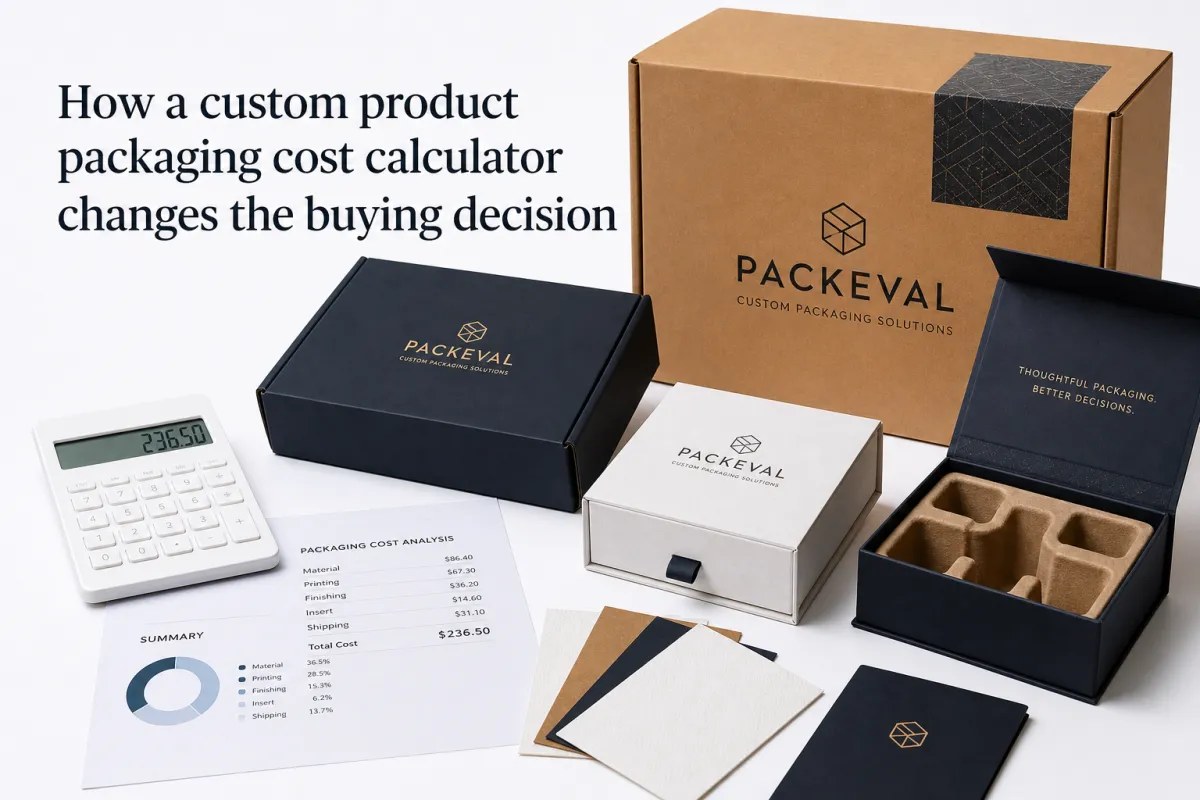
A custom product packaging cost calculator works by translating packaging inputs into a practical estimate. It takes dimensions, quantity, material, print method, finishing options, and shipping destination, then shows how each choice affects the overall cost. The output is usually a planning number, not a final invoice, but it is strong enough to guide early budgeting and supplier comparisons.
The best way to use a custom product packaging cost calculator is to treat it like a filter. Start with the package job, then test the variables that matter most: structure, board grade, print coverage, and finish. A simple folding carton can look very different from a rigid box once setup, labor, and tooling are added. The calculator shows those differences before a buyer commits to the wrong format, which is kinda the whole point.
That matters because packaging cost is rarely one number. It is a stack of decisions. A custom product packaging cost calculator helps separate the visible piece of the estimate from the invisible ones, such as die cutting, sample revisions, assembly labor, and freight. In other words, it gives the team a clearer map before they move into quotation and production. The more exact the inputs, the less the estimate has to guess.
Good calculators also flag where the estimate is still soft. Freight may change with destination. Board pricing may shift with supplier availability. A special finish can be affected by seasonal press capacity. A trustworthy custom product packaging cost calculator should make those limits visible instead of hiding them behind a neat-looking total.
How a custom product packaging cost calculator changes the buying decision
A custom product packaging cost calculator changes the buying process because it replaces vague terms like "premium" with measurable inputs. That matters to anyone responsible for margin. A box priced at $0.78 at 2,000 units and $0.41 at 10,000 units forces a different conversation. The first question is no longer "Which quote is cheapest?" The real question is whether the larger run lowers landed unit cost enough to improve margin and inventory efficiency.
The calculator also brings hidden cost drivers into view before the sales back-and-forth starts. Setup charges, die cutting, printing plates, blank inventory, and assembly labor all sit behind the per-unit figure. A custom product packaging cost calculator helps expose those layers early. That matters because the lowest quoted number often leaves out something expensive: a custom insert, a special coating, or a revision after dieline approval.
Many brands lose time right here. They ask for a quote too early, then spend days comparing apples to oranges. A custom product packaging cost calculator lets the team define the decision first. You can test whether a simple mailer, a retail-ready folding carton, or a rigid presentation box actually fits the budget. Once the numbers are visible, it becomes easier to rank features by value instead of arguing from taste.
Launch budgets benefit most. A clean calculator output gives ecommerce operators and product marketers a hard boundary. If decorative lamination pushes the package over target cost, the finish can be cut back while the structure stays intact. If a branded insert costs more than the product can support, the calculator gives a factual reason to remove it rather than guessing at the impact. That kind of discipline keeps a launch from drifting into budget creep one shiny option at a time.
For teams that buy custom printed boxes or manage retail packaging for several SKUs, the calculator also helps standardize decisions across the line. One size may work for three products if the insert changes. Another may need a different board grade entirely. A custom product packaging cost calculator turns those questions into a framework instead of a hunch.
Product details that move custom product packaging cost calculator results
The product itself drives a large share of the estimate. A custom product packaging cost calculator needs actual dimensions, not a rounded guess. A box for a 2.75-inch serum bottle behaves differently from a box for a flat accessory kit, even if both are called "small." Weight matters too. A heavier item may need stronger board, tighter fit, or a different ship-ready structure to keep the package from buckling in transit.
Fragility changes the math fast. Glass jars, ceramic pieces, battery-powered devices, and subscription kits with mixed contents usually need more internal support than a simple outer carton. A custom product packaging cost calculator reflects that through more board usage, more complex inserts, or extra assembly time. A snug fit can reduce void space and shipping cost, but it can also raise tooling precision and sample revisions. That trade-off shows up often in cosmetics, supplements, candles, and small electronics.
Item count matters just as much as size. One SKU in one box is simpler than a bundle of five components, each with its own fit requirement. A custom product packaging cost calculator should account for the pack-out method because labor changes with every added step. If the packing team has to orient inserts, fold nested trays, protect a fragile item, and add a printed card, line time rises. That affects unit economics and lead time at the same time.
There is also a clear difference between a protective carton and a presentation-focused branded package. A plain mailer can protect a product at low cost. A package built for shelf impact, unboxing, or retail compliance may need sharper printing, tighter folding accuracy, and more finishing detail. That is why a custom product packaging cost calculator is useful before the creative concept is locked. It tells the team whether a strong visual idea can be built within the target margin.
Category matters too. Cosmetics often depend on color accuracy and surface finish. Supplements may require compliance details, tamper evidence, or stronger carton walls. Electronics may need ESD-safe packaging design, anti-scratch inserts, or higher compression resistance. Candles and subscription kits often bring irregular shapes, mixed components, and variable fill heights. A custom product packaging cost calculator handles those details far better than a generic price chart ever can.
Packaging goals change the inputs
Before entering data into a custom product packaging cost calculator, define the job the package has to do. Shelf impact, shipping safety, visual unboxing, and retail compliance are not the same goal. If the box only needs to protect a product in transit, the spec can stay lean. If it has to sell the product on a crowded shelf, print and structure costs usually climb. If it must pass a retailer's pack test, the board grade may need to move up. The same product can produce very different estimates once the packaging brief changes.
Specifications that shape packaging cost, quality, and lead time
The biggest spec driver is the substrate. A custom product packaging cost calculator should ask whether the build uses SBS, C1S artboard, CCNB, corrugated board, kraft stock, or rigid chipboard. A 16pt folding carton and a 24pt rigid box do not behave the same in production. One converts quickly and ships flat. The other costs more, takes more assembly, and usually feels more premium in hand. Board grade affects weight, crush resistance, print sharpness, and yield.
Print process changes the estimate just as much. Digital print can make sense for low runs and quick proofing, while offset print usually becomes more efficient at higher quantities. A custom product packaging cost calculator should also ask for color count, because a one-color kraft box has a very different cost profile from a full-coverage CMYK job with spot colors and interior print. Add white ink, metallics, or strict registration demands, and setup becomes more demanding.
Finishes can move the price more than many buyers expect. Soft-touch lamination, spot UV, foil stamping, embossing, debossing, and matte varnish each affect labor, setup, and waste. A custom product packaging cost calculator is useful because it shows how those choices stack. A box with foil and embossing may look elegant, but if the product margin is thin, that finish package can become the most expensive part of the launch. The calculator helps you judge whether a simpler premium look will do the same job for less.
Structural style matters too. Tuck-end cartons, auto-lock bottoms, sleeve-and-tray systems, window boxes, rigid lift-off lids, and mailers all carry different build costs. A standard dieline usually keeps the estimate tighter. A custom-engineered structure pushes setup time up and raises the chance of revision. That is why a custom product packaging cost calculator often rewards buyers who choose familiar formats where possible. Known structures reduce surprises, and fewer surprises usually mean fewer surprises in the budget.
Sustainability choices can change both price and lead time, though not always in the same direction. FSC-certified paperboard, recycled content, and lighter structures may support a brand's environmental story, and they can also affect procurement timing if certain grades are less available. For buyers who need a third-party reference point, the FSC standard is a reliable place to start. A custom product packaging cost calculator should flag these options early so the team can balance certification, budget, and supply availability.
When packaging has to survive shipping stress or distribution testing, the structure should be checked against recognized methods rather than hope. The ISTA testing framework is widely used for transit simulation and packaging validation. A calculator cannot run the test itself, but it can show the cost impact of choosing a stronger shipper, a tighter insert, or a board upgrade that supports test performance. That is one reason the best custom product packaging cost calculator outputs feel practical instead of abstract.
Why standard dielines save time
Standard dielines cut down the number of variables that need to be checked. A custom product packaging cost calculator usually returns cleaner pricing when you use an established box format because the engineering work is lighter and the risk of dieline correction is lower. That matters for both the buyer and the production team. Every revision adds time, and every time a board line is redrawn, someone has to verify dimensions, glue tabs, folds, and artwork placement again.
Custom product packaging cost calculator pricing and MOQ
Pricing is easier to understand when it is broken into layers. A custom product packaging cost calculator should separate substrate cost, print setup, finishing, tooling, labor, packing, and freight. If you only see one number, you cannot tell what changed when the estimate moves. A clear quote structure usually makes supplier comparisons easier, because you can see whether one vendor is cheaper on print but higher on assembly, or lower on materials but weaker on freight efficiency.
MOQ exists for a reason. Press setup, die cutting, waste allowance, color calibration, and line preparation all cost the supplier money before the first saleable box comes off the line. A custom product packaging cost calculator makes the MOQ effect visible. Short runs usually carry a higher unit price because the fixed costs are divided over fewer pieces. Once quantity rises, those same fixed costs are spread more efficiently, and the unit number often drops faster than buyers expect.
Here is a practical comparison many packaging buyers find useful. It is not a quote. It is a decision aid based on typical production behavior. A custom product packaging cost calculator will usually land somewhere near these patterns once exact specs are entered.
| Packaging option | Typical MOQ | Indicative unit cost | Setup / tooling | Best for |
|---|---|---|---|---|
| Simple folding carton, 1-2 colors | 500-1,000 units | $0.28-$0.62 | $120-$350 | Small launches, lightweight products, tighter budgets |
| Full-color custom printed box with coating | 1,000-3,000 units | $0.34-$0.88 | $180-$600 | Branded packaging, ecommerce sets, retail shelf presence |
| Rigid presentation box with insert | 500-2,000 units | $1.20-$3.80 | $250-$900 | Premium product packaging, gifting, higher perceived value |
| Mailer with custom insert and premium finish | 1,000-5,000 units | $0.78-$2.10 | $200-$750 | Subscription kits, direct-to-consumer shipping, unboxing focus |
The table shows what many buyers miss at first glance: the cheapest-looking unit price may not be the best total buy. A custom product packaging cost calculator helps you test whether a higher MOQ improves cash efficiency enough to justify the inventory commitment. A run of 5,000 pieces can sometimes beat a 1,000-piece order by a wide margin on unit cost, even though the total spend is higher. That is a trade-off between cash flow, storage, and margin, not just a raw price comparison.
There are clear ways to reduce cost without weakening the brand. Remove unnecessary interior print. Limit the number of foil elements. Use a standard size instead of a custom footprint. Choose a widely stocked board. Reduce the number of inserts. Keep the color count tight. A custom product packaging cost calculator makes those choices concrete instead of abstract. If you can save $0.09 per unit by simplifying the finish and still protect the product, the calculator helps you prove it.
Price can still shift after the first estimate. Artwork that needs extra trapping, a finish that adds more labor than expected, a tighter structural tolerance, or a freight route that changes after the destination is confirmed can all move the final number. That is normal. A good custom product packaging cost calculator is honest about that fact and tells you where the quote is firm and where it is still provisional. That kind of clarity saves time on both sides.
If you are comparing options across a product line, the most useful test is often three scenarios side by side: bare-bones functional, balanced branded, and premium shelf-ready. A custom product packaging cost calculator can show which version supports the margin target while keeping the package on brand. For a quick structural shortlist, the Custom Packaging Products page can help narrow the format before engineering begins.
Process and timeline: from estimate to approved sample
A custom product packaging cost calculator works best when the process is clean from the start. The usual sequence is straightforward: submit specs, receive an estimate, review revisions, approve the dieline, confirm artwork, sample if required, then move into production. Each step depends on the one before it. If the dimensions are off, the dieline changes. If the dieline changes, the artwork moves. If the artwork moves, timing shifts. Accurate input matters because the whole chain depends on it.
The fastest projects are the ones with exact numbers. Send the product dimensions, quantity, material preference, finish requirements, destination, and deadline at the same time. A custom product packaging cost calculator can only be as useful as the data behind it. If a team sends "about 6 inches by 4 inches" for a product that actually measures 6.35 by 4.18 by 1.9, the estimate can drift enough to affect the final order. Small errors in packaging become large errors in conversion and freight.
Delays usually come from internal indecision rather than production itself. Teams keep debating the lamination, changing copy, or waiting on sign-off from someone who was not part of the original discussion. A custom product packaging cost calculator helps because it narrows the dispute. If the premium finish adds two cents per unit, that number becomes part of the approval conversation. If a custom insert adds three days of sampling, the launch calendar can absorb that before it turns into a problem.
Timelines should be treated as ranges, not promises. Simple digital short runs may move through proofing and production faster than offset work with custom tooling. More complex packaging can take longer if materials need to be sourced, dies must be built, or samples require adjustment. In practice, a straightforward run can often move in roughly 7-10 business days after proof approval, while more involved packaging projects may need 12-18 business days or more once artwork, sampling, and freight are included. A custom product packaging cost calculator should help you plan for that range instead of assuming the shortest case. That keeps the schedule honest, which is rare and useful.
Planning matters because packaging is tied to launch timing, reorder windows, and safety stock. If the first run lands late, the product may sit ready but unsold. If the reorder window is too tight, the brand can run out during a sales spike. A custom product packaging cost calculator is useful because it gives procurement and operations one shared estimate to work from before inventory commitments are made. That is a practical benefit, not a marketing line.
What slows a sample approval
Sample approval often slows when teams are still choosing materials or changing artwork after the dieline is already built. A custom product packaging cost calculator cannot remove that friction, but it can expose it early. If the team knows that a foil finish adds cost and time, it can decide whether the visual payoff is worth the delay. If the product needs a tighter fit, the sample should be requested sooner rather than later. That discipline keeps the project moving.
Why choose our team for custom product packaging
Buyers do not just need a number. They need a supplier that can explain the number. A custom product packaging cost calculator tied to a production-minded team becomes useful because transparency shows up in the details. You can see where the estimate comes from, what raises the price, and what can be trimmed without weakening the package. That is a better buying experience than a vague range and a long delay.
Production-minded support matters because packaging has to be buildable, printable, and shippable. A creative concept that looks strong on screen may fail once the board is chosen or the fold sequence is tested. A custom product packaging cost calculator should be paired with people who understand the difference between a design that looks expensive and a package that performs well on the line. That kind of guidance is especially useful for branded packaging and custom printed boxes that need both presence and consistency.
There is also a practical advantage in working with a team that treats sampling and fit checks seriously. Material verification, print accuracy, glue quality, and closure performance all affect the end result. A custom product packaging cost calculator is only one part of the decision; inspection and sampling close the loop. If the carton does not hold its shape, if the insert shifts, or if the artwork lands off by a few millimeters, the quote was never the real issue. The build was.
Generic brokers and template shops often struggle with those details. They may quote quickly, but the estimate can lack the context needed for a final buying decision. A custom product packaging cost calculator linked to a responsive supplier shortens that gap. The buyer gets clearer MOQ guidance, better lead-time expectations, and fewer surprises once the order is locked. That is useful for transactional buyers who need facts, not hand-waving.
If you are building out a line, it also helps to have a supplier who can handle different product packaging formats without forcing every job into one template. A folded carton for one SKU, a mailer for another, and a rigid set box for a gift bundle should all be possible without reworking the buying process from zero. That is where the Custom Packaging Products range becomes useful as a working reference. The goal is not more options for their own sake. The goal is a clearer path to the right structure.
Next steps after using a custom product packaging cost calculator
Once you have a custom product packaging cost calculator estimate, gather the exact inputs before you request a formal quote. That means product dimensions, target quantity, product weight, branding files, finish preferences, and destination zip code or country. If you already have a dieline, include it. If you have a sample photo or a reference package, include that too. The cleaner the brief, the more reliable the next quote will be.
It also helps to make a short priority list. Mark what is required and what is optional. Maybe the box must have a matte finish, but foil is optional. Maybe the insert must protect the product, but printed interior artwork is optional. A custom product packaging cost calculator makes those trade-offs easier to see because each feature can be mapped to a cost impact. Once the team agrees on the essentials, the supplier can optimize the rest.
A smart comparison is usually two or three scenarios, not one. Test a standard finish against a premium finish. Test a standard board against a heavier board. Test two quantities to see where the unit cost drops enough to justify the increase in inventory. A custom product packaging cost calculator is strongest when it is used for comparison, not just for a single number. That comparison tells you which package fits the margin target and which one only fits the mood board.
After that, request a detailed quote with the same specs used in the calculator. Consistency matters. If the estimate was built on 3,000 units, 350gsm board, full-color print, and soft-touch lamination, the quote should match those inputs. A custom product packaging cost calculator loses value if the briefing changes halfway through. Keep the inputs aligned, and the numbers stay meaningful.
The best next move is straightforward: use the calculator as the first step in a purchase decision, then move directly into sourcing with the same data set. That is how brands avoid guessing, protect margin, and keep launch schedules realistic. If you need a starting point for the structure itself, review Custom Packaging Products, then feed the exact dimensions and quantities into the custom product packaging cost calculator so the estimate reflects the package you actually plan to buy. No fancy theory needed; just clean inputs and a fair comparison.
Frequently Asked Questions
How accurate is a custom product packaging cost calculator?
A custom product packaging cost calculator is usually accurate enough for early budget planning when dimensions, quantity, and material specs are correct. Final pricing can still shift after artwork review, finish selection, freight routing, or tooling checks. Accuracy improves a lot when you submit exact measurements instead of estimates or placeholder numbers. A calculator is strongest as a planning tool, not a substitute for a formal production quote.
What information do I need for a custom packaging cost calculator?
Use the product dimensions, target quantity, material preference, print method, and finish requirements as your base inputs. Add shipping destination and timeline so freight and rush factors can be considered. If possible, include a dieline, sample photo, or reference package. A custom product packaging cost calculator works best when the brief is specific. Guessing on size or stock grade usually muddies the result.
Why does MOQ affect custom product packaging pricing so much?
MOQ matters because setup, tooling, and press preparation costs have to be spread across the run. Small runs usually have a higher unit price because fixed costs are divided over fewer pieces. A slightly higher order volume can sometimes lower the cost per unit enough to improve total margin, which is why a custom product packaging cost calculator is valuable before you commit. The math is not magic; it is just fixed costs being divided a different way.
What packaging choices lower cost the fastest?
The fastest savings usually come from standard sizes, simpler structures, and fewer print colors. Removing premium finishes, specialty inserts, and custom engineering can also lower spend if those features are not solving a real product need. Choose materials that are widely stocked to help control sourcing delays and price swings. A custom product packaging cost calculator makes those savings visible, which is a lot better than relying on a gut feeling.
Can the calculator estimate packaging for multiple SKUs?
Yes, but each SKU should have its own dimensions and quantity so the estimate stays reliable. Shared structures or common inserts can sometimes reduce setup costs across a product line. Mixed-SKU projects may need separate MOQs or staged production schedules, and a custom product packaging cost calculator is most useful when each item is entered clearly. The cleaner the SKU data, the better the comparison.

