Buyer Fit Snapshot
| Best fit | Branded Pallet Boxes Manufacturer projects where brand print, material claims, artwork control, MOQ, and repeat-order consistency need to be specified before quoting. |
|---|---|
| Quote inputs | Share finished size, material target, print colors, finish, packing count, annual reorder estimate, ship-to region, and any compliance wording. |
| Proofing check | Approve dieline scale, logo placement, barcode or warning zones, color tolerance, closure strength, and carton packing before bulk production. |
| Main risk | Vague material claims, crowded artwork, missing packing details, or unclear freight terms can make a low unit price expensive after revisions. |
Fast answer: Branded Pallet Boxes Manufacturer: Board, Finish, Dieline, and Unit Cost should be specified like a repeatable production item. The safest quote records material, print method, finish, artwork proof, packing count, and reorder notes in one written spec.
Production checks before approval
Compare the actual filled-product size with the drawing, then confirm tolerance on folds, seals, hang holes, label areas, and retail display edges. Reserve space for logos, QR codes, warning copy, and material claims before decorative graphics fill the panel.
Quote comparison points
Review material grade, print process, finish, sampling route, tooling charges, carton quantity, and freight assumptions side by side. A quote is only useful when the supplier can repeat the same color, closure quality, and packing count on the next order.
A branded Pallet Boxes Manufacturer does more than put a logo on a large shipping container. The right partner turns pallet packaging into something that feels considered the moment it rolls into a warehouse, a distribution center, or a wholesale receiving dock. For brands that need protection and presentation to work together, the outer box becomes part of the product journey, not just a shell of corrugated board, plywood, or a hybrid build wrapped around the goods.
That matters because pallet packaging lives in a very practical corner of the supply chain. Forklifts pick it up, stacks press against it, cold storage affects it, stretch wrap tightens around it, labels get scanned on it, and the whole unit may be opened, resealed, or reused more than once. If the structure is weak, branding is the least of your problems. If the structure is right, a branded pallet boxes manufacturer can help the shipment read clearly from across a warehouse aisle while still standing up to the trip. If you want a broader view of how that approach fits into packaging decisions, the team at Custom Packaging Products is a practical place to start.
Buyer psychology matters too, even in B2B settings. A pallet box is often the first branded surface a distributor sees and, in some cases, the last branded surface before the product is opened. That moment is small, but it carries weight. People notice whether a shipment looks planned or improvised, and they notice it fast. A thoughtful branded pallet boxes manufacturer helps keep that impression on the right side of the line.
Why a Branded Pallet Boxes Manufacturer Matters
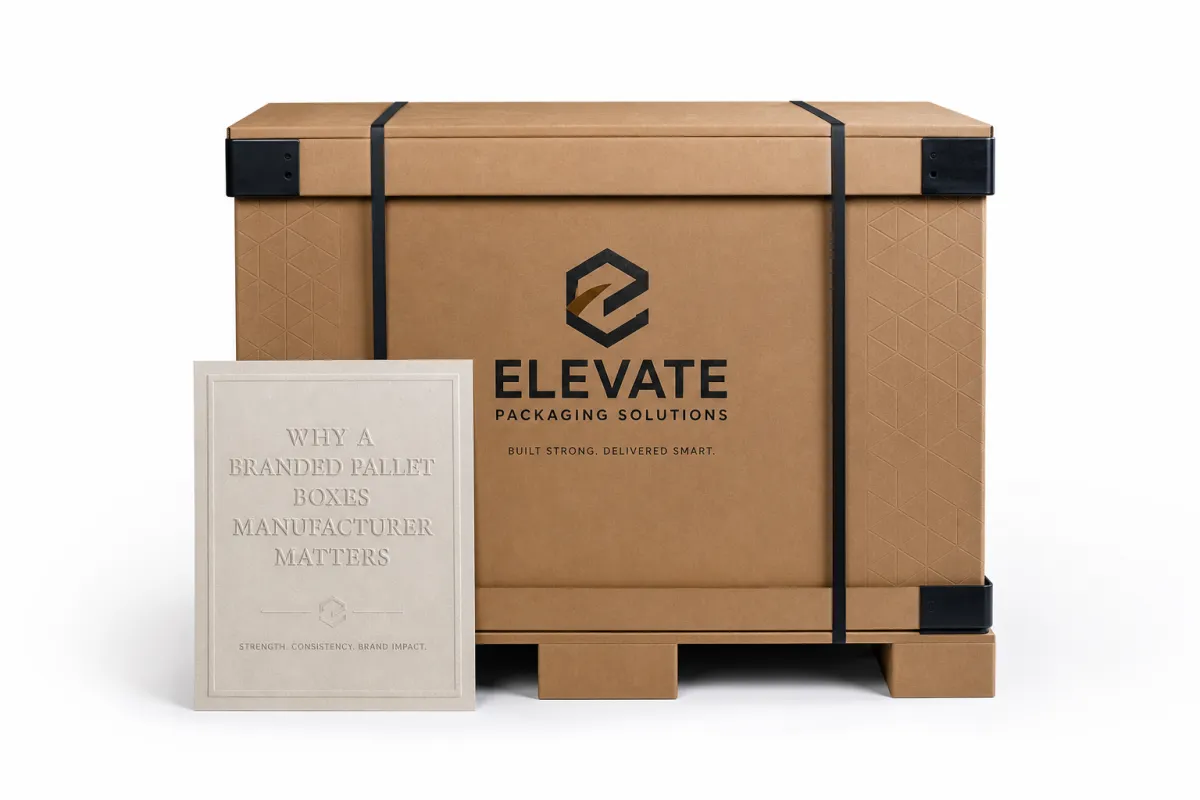
Walk through a busy receiving area and the pattern shows up pretty quickly: plain freight, handwritten notes, temporary labels, and the occasional shipment that looks like somebody actually cared about how it arrived. That last group is where a branded pallet boxes manufacturer proves its value. The box is carrying product, but it is also carrying expectation. A clean branded pallet box can signal quality before the seal is broken, which helps with distributor shipments, trade channels, and large-format retail replenishment.
From a packaging buyer's point of view, the value starts with control. Branding matters, yes, but the more practical gain is consistency. A well-built pallet box can reduce handling damage, improve stacking behavior, and make warehouse identification simpler. It can carry product family names, handling notes, barcodes, orientation marks, and compliance details without turning the outer package into visual clutter. That is the balance a branded pallet boxes manufacturer should understand without needing a long explanation.
There is also a quiet advantage for brands that move product through several stops. If a unit goes from plant to 3PL to distributor to regional warehouse, the outer packaging may pass through multiple teams before it reaches the end user. Every handoff creates room for confusion. Good pallet packaging narrows that risk. In that sense, a branded pallet boxes manufacturer is part production partner, part logistics partner, and part brand translator.
I have seen companies underestimate pallet packaging more than once. They spend months refining the retail carton and forget that the bulk shipping format often does the heavy lifting in terms of first impression, product protection, and receiving efficiency. Once a load starts moving, the pallet box is the piece everyone sees. A good branded pallet boxes manufacturer does not stop at, "What logo do you want?" The better question is, "How will this load move, sit, stack, and be opened?"
A pallet box that looks good but fails in transit is not branded packaging; it is an expensive lesson.
For buyers who want proof that packaging choices affect more than appearance, the wider packaging industry has long focused on transit testing, material selection, and fiber recovery. Resources from groups such as ISTA are useful when you are comparing how a package performs under real shipping conditions rather than in a photo sample.
That is also why the strongest projects usually begin with structure and use case, then move into print. A branded pallet boxes manufacturer should be able to explain when a simple one-color mark is enough, when a printed sleeve makes more sense, and when the outer case needs to do much more than carry a logo. The right answer depends on the load, the route, and the level of visibility the shipment needs in the field.
How a Branded Pallet Boxes Manufacturer Builds the Box
The build starts with the structure, and that part matters more than the decoration. A capable branded pallet boxes manufacturer usually begins by matching the box to the load, the pallet footprint, and the handling environment. Corrugated fiberboard is common for lighter to moderate loads because it prints well, recycles easily, and converts cleanly in different wall strengths. Plywood brings another kind of rigidity, especially for heavier loads or harsher transit conditions. Honeycomb board can provide a lighter structure with respectable compression performance, and hybrid builds often combine materials to reach a practical balance.
The pallet itself is part of the design, not an afterthought. If the footprint is off by even a small amount, the whole system becomes harder to secure. A good branded pallet boxes manufacturer will ask about pallet size, load height, stacking requirements, fork access, and whether the shipment will be stretch wrapped, banded, or both. Those details shape wall height, panel layout, opening style, and how the base locks to the pallet.
Print comes next, but it is not only about making the box look polished. Flexographic printing works well for repeat runs and simpler graphics. Digital printing can help with short runs, variable content, and faster setup. Labels and sleeves offer another path if the structure needs to stay plain or if the artwork changes often. Spot graphics can reduce ink coverage while still giving the box a branded presence. Each option changes Cost, Lead Time, and durability, so a branded pallet boxes manufacturer should show the tradeoffs instead of pretending one method fits every job.
Print also has a performance side. Heavy ink coverage on corrugated can look rich in a sample and then behave differently on production stock, especially if board porosity varies. Large solid areas may show scuffing sooner in warehouse use. Fine type can disappear if the print method does not match the board grade. A seasoned branded pallet boxes manufacturer will often recommend larger type, stronger contrast, and a layout that respects shipping wear.
When teams compare material options, a table like this usually helps more than vague sales language:
| Material / Build | Best For | Branding Strength | Practical Notes |
|---|---|---|---|
| Single-wall corrugated | Lighter pallet loads, short-to-medium transit | Good for direct print and labels | Lower weight, easier recycling, less crush resistance than heavier builds |
| Double-wall corrugated | Heavier loads, stacking, mixed distribution routes | Very good for large graphics and handling marks | Better compression strength, slightly higher cost, more board bulk |
| Plywood | Rough handling, heavier products, reuse cycles | Moderate unless paired with labels or panels | Strong rigidity, durable, but print options are more limited |
| Honeycomb or hybrid | Weight-sensitive shipments that still need structure | Good with applied graphics or sleeves | Can reduce material weight while keeping a stable form |
That table is only the starting point, because real packaging decisions depend on product density, moisture exposure, temperature swings, and how the box is opened. A branded pallet boxes manufacturer should be able to explain compression strength, corner protection, and the stress points around pallet entry, strap pressure, and warehouse scuffs. If you want a wider look at how packaging work is handled on the brand side, the company profile at About Custom Logo Things can offer useful context.
One detail gets missed often: the outer package has to support the product and the workflow. If warehouse staff need quick access, the opening style matters. If the shipment will be reused, the closure system matters. If the box will be displayed or staged, the print placement matters. Good design is not about adding more graphics; it is about making the package easier to trust and easier to use. That is the real mark of a strong branded pallet boxes manufacturer.
Branded Pallet Boxes Manufacturer: Cost, Pricing, and MOQ
Price gets discussed early and often, and usually too vaguely. A branded pallet boxes manufacturer can only give a useful quote once the basic spec is clear: footprint, height, board grade, print coverage, quantity, and any special finishing. Those details matter because material cost is only one piece of the total. Tooling, setup, artwork preparation, sampling, and freight all shape the final landed cost.
The biggest drivers are usually easy to identify. Larger dimensions use more board. Heavier board grades cost more but may reduce damage risk. Full coverage print takes more ink and often more press time. Extra structural complexity, such as internal partitions, reinforced corners, or custom access panels, raises fabrication time. If a design needs moisture resistance, coatings or liners can add cost quickly. A careful branded pallet boxes manufacturer should break out those variables instead of tucking them into a single number with no explanation.
MOQ, or minimum order quantity, changes the conversation too. Larger runs usually lower the unit price because setup is spread across more pieces. Smaller runs can still make sense, but they may require more flexible production methods or stock materials. In practical terms, a run of 500 branded pallet boxes will not scale the same way as 5,000 pieces, especially if the artwork is complex or the structure is custom. That is why a branded pallet boxes manufacturer should help you think in terms of total value, not only the sticker Price Per Unit.
Here is a useful way to compare pricing logic without pretending there is one universal rate:
| Pricing Factor | Typical Impact | What to Ask |
|---|---|---|
| Material grade | Can shift cost noticeably as board weight and durability increase | What load and stacking target does the grade support? |
| Print coverage | More coverage usually means more ink, setup, and quality control | Can the design use spot panels or lower coverage instead of full bleed? |
| Quantity | Larger orders usually reduce unit cost | What quantity breaks improve pricing without creating excess inventory? |
| Freight and pallet count | Can change the landed cost more than expected | How many pallets ship, and what are the delivery terms? |
| Special finishes | Moisture protection, coatings, or inserts raise total cost | Are those features necessary for transit, storage, or brand presentation? |
That is where quote comparison gets serious. Do not compare one supplier's price against another supplier's price unless the spec sheet is identical. The same-looking box can hide different board grades, different print assumptions, different pallet counts, or different delivery terms. A reliable branded pallet boxes manufacturer should be willing to quote from the same assumptions you send to everyone else, because fair comparison depends on consistency.
In many projects, the real savings come from simplification. Reducing print colors, shortening the box height, removing unnecessary internal parts, or standardizing pallet footprints can make a larger difference than chasing a tiny per-unit reduction. A smart branded pallet boxes manufacturer will point that out even if it means a lower-margin order for them. That kind of honesty is valuable.
For sustainability-minded projects, the final cost conversation should include end-of-life and material recovery. Recyclable fiber structures can make sense when the shipment needs good print and straightforward disposal. FSC-certified board is often worth considering if sourcing policy matters to your customers or your procurement team; the FSC site is a useful reference for certification basics. The best branded pallet boxes manufacturer will not treat sustainability as a label-only discussion. It should connect to material choice, weight, and how the pack performs in the field.
Branded Pallet Boxes Manufacturer: Process, Timeline, and Lead Time
A clean production run usually follows a predictable path, and a dependable branded pallet boxes manufacturer makes that path visible from the start. The process often begins with discovery: product dimensions, weight, pallet footprint, shipping route, handling method, and branding goals. That stage sounds simple, but it is where a lot of future trouble gets avoided. If the supplier knows the product is headed into cold storage, for example, moisture and adhesive performance become part of the conversation immediately.
Next comes structure and artwork setup. The manufacturer may create or refine a dieline, adjust panel sizes, and mark print-safe areas. If the artwork is already built for a retail carton, it often needs rethinking for a pallet-scale package, because viewing distance, fold lines, seams, and tape zones all change the design. A good branded pallet boxes manufacturer should be comfortable saying, "This layout looks fine on screen, but not on a box this size." That kind of restraint saves time later.
Sampling is where the project becomes real. A structural sample checks fit, stack behavior, closure, and handling. A printed sample checks color, contrast, logo placement, and whether the artwork survives the fold pattern. Depending on complexity, a pre-production sample or mockup may take a few days to a couple of weeks. If a project needs drop or compression testing, the timeline extends further. For transit testing language and procedure references, many teams look at methods associated with ISTA, especially when the shipment needs a documented performance target.
Lead time then depends on three things: quantity, complexity, and approval speed. A simple corrugated pallet box with a modest print run may move quickly once files are approved. A custom hybrid structure with specialty print and inserts will move more slowly. Most delays come from preventable issues: incomplete artwork, missing dimensions, slow sign-off, late changes, or material shortages. A serious branded pallet boxes manufacturer will tell you that the calendar is often controlled by approvals more than machines.
Here is a realistic way to think about a project timeline:
- Brief and scoping: 1 to 3 business days if the information is complete.
- Structural design and dieline setup: 2 to 5 business days for straightforward builds, longer for custom engineering.
- Sample or prototype: several business days to a couple of weeks, depending on print and construction.
- Approval and revisions: varies widely, and this is often the biggest wildcard.
- Production: commonly 12 to 15 business days after proof approval for many standard runs, but more complex jobs take longer.
- Freight and delivery: depends on shipping mode, pallet count, and destination.
Those are planning ranges, not promises. A branded pallet boxes manufacturer should always clarify whether the quote includes sample time, freight, and delivery to dock, because those details affect the project date as much as the print schedule does. A short project can become a late project if the sample is skipped or approved too quickly.
One practical habit helps a lot: build in buffer time before the first outbound order. If the shipment date is tied to a customer launch or a warehouse relocation, the box should be approved before the pressure starts. That buffer gives the team room to correct a panel size, shift a logo position, or test a closing method without risking the live order. In good packaging work, the schedule is part of the design brief, not a separate issue.
That is why the most dependable branded pallet boxes manufacturer is usually the one that asks the annoying questions early. What is the stack height? What is the target gross weight? Will the load travel by truck only, or will it sit in a humid facility first? Will the pallet be reused? Those questions are not red tape. They are the difference between a package that looks fine in a mockup and a package that holds up in the supply chain.
Key Factors to Compare Before You Choose a Manufacturer
Choosing a branded pallet boxes manufacturer is not only a purchasing decision; it is a technical and operational decision. The first thing I would compare is structural support. Some suppliers can print well but offer very little engineering help. Others can build a strong structure but struggle with artwork or assembly guidance. You want both. The ideal partner can size the box to the product, the pallet, and the route without making the brand team feel like they are speaking two different languages.
Print control is the second filter. Large-format packaging magnifies inconsistency. A small shift in color, placement, or registration may not matter on a carton that fits in your hand, but it becomes obvious on a pallet box. Ask how the supplier handles color matching, proof approval, and repeat-run consistency. A professional branded pallet boxes manufacturer should be able to explain what is controlled in-house, what is checked on press, and how they reduce variation between batches.
Sustainability support matters too, but only if it is tied to material truth. Recyclable board, lighter structures, reduced ink coverage, and FSC-certified materials are useful options when they fit the application. They are not substitutes for a package that holds up. If the box fails early, any sustainability gain disappears in waste and rework. A thoughtful branded pallet boxes manufacturer will discuss source reduction, recoverability, and performance in the same sentence.
Communication quality is the fourth filter, and in practice it may be the most important. The best packaging design in the world cannot survive a supplier that answers slowly, misses details, or leaves you guessing about revision status. Sample speed, response clarity, and freight coordination all matter. When something goes wrong, you want a branded pallet boxes manufacturer that tells you the problem early and proposes a fix instead of hiding the issue until the last minute.
It also helps to review recent project examples. Not as a beauty contest, but as evidence that the supplier understands structural work, pallet-scale print, and production discipline. If you need a useful reference point, the team’s Case Studies page can show how packaging decisions move from concept to real-world use.
Before you make the final call, ask these questions:
- Can the supplier help with both structure and print, or only one side of the job?
- What testing or sample process is included before mass production?
- How does the supplier handle artwork revisions and proof approvals?
- What are the freight terms, pallet counts, and delivery expectations?
- Can they support repeat orders without changing the spec silently?
Those questions tell you more than a polished sales pitch ever will. A strong branded pallet boxes manufacturer should answer them clearly, with numbers, not fluff.
Common Mistakes Brands Make With Branded Pallet Boxes
The most common mistake is treating the pallet box like a billboard and forgetting it is a shipping container first. That usually shows up as oversized artwork on a weak structure, or a box that fits the product poorly because the team spent more time on graphics than on dimensions. A good branded pallet boxes manufacturer will try to correct that early, because the freight damage that follows is expensive and hard to explain.
Another mistake is overcomplicated artwork. Large packaging can hold more visual information, but that does not mean it should. Too many colors, tiny type, heavy gradients, and low-contrast details can all turn muddy once the box is printed and handled. Scuffs, fold lines, and straps also change the appearance. If the design cannot survive a warehouse environment, it should be simplified. A practical branded pallet boxes manufacturer knows that clean, high-contrast design often performs better than a crowded layout.
Warehouse handling is another blind spot. Forklift entry, banding pressure, moisture exposure, and cold storage can all affect the final package. If the box will sit near a dock door, the outer surfaces may see more abrasion than the design team expects. If the shipment is stored in a damp environment, board choice and coatings matter. If the load is likely to be reused, closing methods and reinforcement matter. A branded pallet boxes manufacturer that asks about those details is not being difficult; they are protecting the shipment.
Skipping samples is probably the most expensive shortcut of all. The first production run is not the place to discover a seam issue, a print shift, or a poor pallet fit. Even a simple mockup can reveal whether the logo sits too close to a fold, whether the access opening is awkward, or whether the box is harder to assemble than planned. A cautious branded pallet boxes manufacturer will encourage sample review because it prevents rework later.
There is one more issue worth calling out: inconsistent specs between suppliers. One quote may use a different board thickness, another may assume a different pallet footprint, and another may leave freight out of the number entirely. Comparing those quotes side by side creates false savings. A better method is to send one complete brief and ask each branded pallet boxes manufacturer to price the exact same job.
Expert Tips for Better Branding and Better Performance
If you want the package to do its job well, start with hierarchy. The logo should not fight with handling marks, product family names, or regulatory information. Each element needs a place on the box. A strong branded pallet boxes manufacturer can help map those zones so the pallet box looks deliberate from a distance and remains readable up close.
High contrast matters more than many people expect. In a warehouse, someone may only glance at a pallet for a second. Deep color on a light board, or a dark logo panel with clear white type, is often more effective than a busy graphic treatment. The box should read fast. It should also survive the real environment, which means the most visible surfaces may need extra attention because those are the ones that will see straps, scuffs, or warehouse dust first. A careful branded pallet boxes manufacturer will keep those wear points in mind during design.
Think in terms of touch points. Corners, edges, access flaps, and lift zones wear faster than broad flat panels. If the design places critical branding there, it may look rough before the shipment ever reaches its destination. The better move is to protect those areas with structure and let the broader panels carry the graphic identity. That is a small design choice, but it often separates a polished result from a tired-looking one.
Use practical information to make the box easier to work with. Orientation arrows, product family codes, lot information, and short handling cues often help more than decorative flourishes. A branded pallet boxes manufacturer that understands operations will encourage this kind of useful labeling because it reduces warehouse friction.
Do not skip the sample stage. Ask for a pre-production mockup or sample so you can review structure, print placement, and assembly before the full run begins. Even if the box looks simple, the assembled form can behave differently than the flat artwork file suggests. The sample is where you see whether the finish feels right and whether the box is easy for staff to handle. That step is one of the best ways a branded pallet boxes manufacturer can help reduce risk.
Branding and performance do not compete if the design is handled well. A pallet box can be strong, legible, and cost-aware at the same time. The trick is discipline. Use enough graphics to make the load recognizable, but not so much that the construction is compromised. A good branded pallet boxes manufacturer knows where that line sits.
Next Steps With a Branded Pallet Boxes Manufacturer
If you are preparing to source a branded pallet boxes manufacturer, the first step is gathering the right information. Start with product dimensions, target load weight, pallet footprint, shipping method, storage environment, and the branding elements that must appear on the box. If the load has special handling needs, say so upfront. The more complete the brief, the cleaner the quote and the faster the sample process.
It also helps to put your request into one simple document. Include artwork files, quantity expectations, delivery location, and any deadlines tied to a launch or warehouse move. A branded pallet boxes manufacturer can move much faster when the technical and commercial details sit in one place instead of being scattered across emails and calls.
From there, ask for two or three quotes using the exact same specification. That comparison should cover material choice, print method, lead time, sample support, and landed cost. If one quote looks much cheaper, find out whether it is using a different board grade, a lighter print assumption, or different freight terms. A trustworthy branded pallet boxes manufacturer will not mind that level of comparison; it is the right way to buy.
Once you have a strong candidate, approve the sample, review the details, and move into a pilot run before scaling up. A pilot run gives you a chance to confirm assembly speed, warehouse handling, and print consistency under real conditions. That small step often prevents larger trouble later, especially when the shipment volume is tied to a customer commitment or a seasonal demand spike.
If you want to explore broader packaging options after you define the pallet format, the product range at Custom Packaging Products can help you see how pallet-scale packaging fits into the rest of the packaging system. For a team that values structure, branding, and supply-chain realism, that context matters.
The practical truth is simple: the right branded pallet boxes manufacturer makes the box feel like part of the operation instead of an extra complication. That is the kind of packaging that protects the goods, supports the brand, and keeps the receiving dock moving.
FAQ
What does a branded pallet boxes manufacturer actually do?
They combine structural packaging design, print production, and logistics planning for pallet-sized shipping boxes. A good branded pallet boxes manufacturer helps match the box to product weight, warehouse handling, and branding goals, then guides sampling, artwork setup, and production so the final package performs well in transit.
How do I choose between corrugated and plywood pallet boxes?
Choose corrugated when you want lower weight, easier recycling, and strong print options for branding. Choose plywood or hybrid builds when the shipment is heavier, needs more rigidity, or will face rough handling. The best choice depends on load, travel distance, storage conditions, and whether the box will be reused, which is why a branded pallet boxes manufacturer should ask about the full route.
What affects branded pallet box pricing the most?
Material thickness, box dimensions, print coverage, and structural complexity are usually the biggest cost drivers. MOQ matters because larger runs often lower the unit cost, while small runs may need more flexible production methods. Freight, pallet count, and special finishing can also change the total landed cost, so a branded pallet boxes manufacturer should quote from a complete spec sheet.
How long is a typical production timeline for custom pallet boxes?
Simple projects can move quickly once artwork and specs are approved, but samples still add time. Complex structures, larger quantities, or specialty print needs usually extend the timeline. A realistic plan should include sample approval, production, and shipping buffer time before the first outbound order, especially if the branded pallet boxes manufacturer needs to test fit or print placement.
What files should I send to a branded pallet boxes manufacturer?
Send product dimensions, target quantity, pallet footprint, and any handling requirements first. For artwork, provide editable design files, brand colors, and any text that must stay readable on the final box. If possible, include reference photos or a simple sketch so the branded pallet boxes manufacturer can align structure and branding faster.
If you approach the project with clear dimensions, realistic expectations, and a sample-first mindset, a branded pallet boxes manufacturer can turn a plain freight container into packaging that protects the load, supports the brand, and holds up in the real conditions of shipping, storage, and handling. The best next move is to define the spec tightly, compare like for like, and approve a sample before the first full run. That is how you get a pallet box that earns its place in the supply chain.