Buyer Fit Snapshot
| Best fit | Branded Poly Mailers for Online Stores projects where brand print, material claims, artwork control, MOQ, and repeat-order consistency need to be specified before quoting. |
|---|---|
| Quote inputs | Share finished size, material target, print colors, finish, packing count, annual reorder estimate, ship-to region, and any compliance wording. |
| Proofing check | Approve dieline scale, logo placement, barcode or warning zones, color tolerance, closure strength, and carton packing before bulk production. |
| Main risk | Vague material claims, crowded artwork, missing packing details, or unclear freight terms can make a low unit price expensive after revisions. |
Fast answer: Branded Poly Mailers for Online Stores: Film, Print, MOQ, and Carton Packing should be specified like a repeatable production item. The safest quote records material, print method, finish, artwork proof, packing count, and reorder notes in one written spec.
Production checks before approval
Compare the actual filled-product size with the drawing, then confirm tolerance on folds, seals, hang holes, label areas, and retail display edges. Reserve space for logos, QR codes, warning copy, and material claims before decorative graphics fill the panel.
Quote comparison points
Review material grade, print process, finish, sampling route, tooling charges, carton quantity, and freight assumptions side by side. A quote is only useful when the supplier can repeat the same color, closure quality, and packing count on the next order.
Branded Poly Mailers for Online Stores: Practical Guide
Branded Poly Mailers for online stores usually meet the customer before anything else does. Not the product page. Not the thank-you email. The bag. That gives a shipping envelope more influence than a lot of brands want to admit. A clean mailer can make a small order feel considered. A weak one makes the whole shipment look cheap, even if the product inside is solid.
That is why the mailer should be treated like part of the fulfillment system, not a decorative afterthought. The right choice can protect the product, reduce pack time, and make the shipment feel like it belongs to the brand instead of a random warehouse drawer. Brands often compare Custom Poly Mailers with other Custom Packaging Products before deciding what fits their products, postage targets, and packing flow.
Branded Poly Mailers for online stores are lightweight shipping envelopes made from LDPE or a co-extruded film, usually printed with a logo, pattern, tagline, or short brand message. They are a strong fit for apparel, accessories, soft goods, and other items that do not need the protection of a rigid box.
The appeal is practical. Compared with cartons, Branded Poly Mailers for online stores can lower dimensional weight, move faster through a packing station, and keep out moisture without adding much bulk. They are not the right answer for every SKU, though. Pretending otherwise is how stores end up with crushed products and unhappy customers.
A mailer that looks polished but rips at the seal is not branding. It is a returns problem dressed up in print.
What Branded Poly Mailers Do for Online Stores
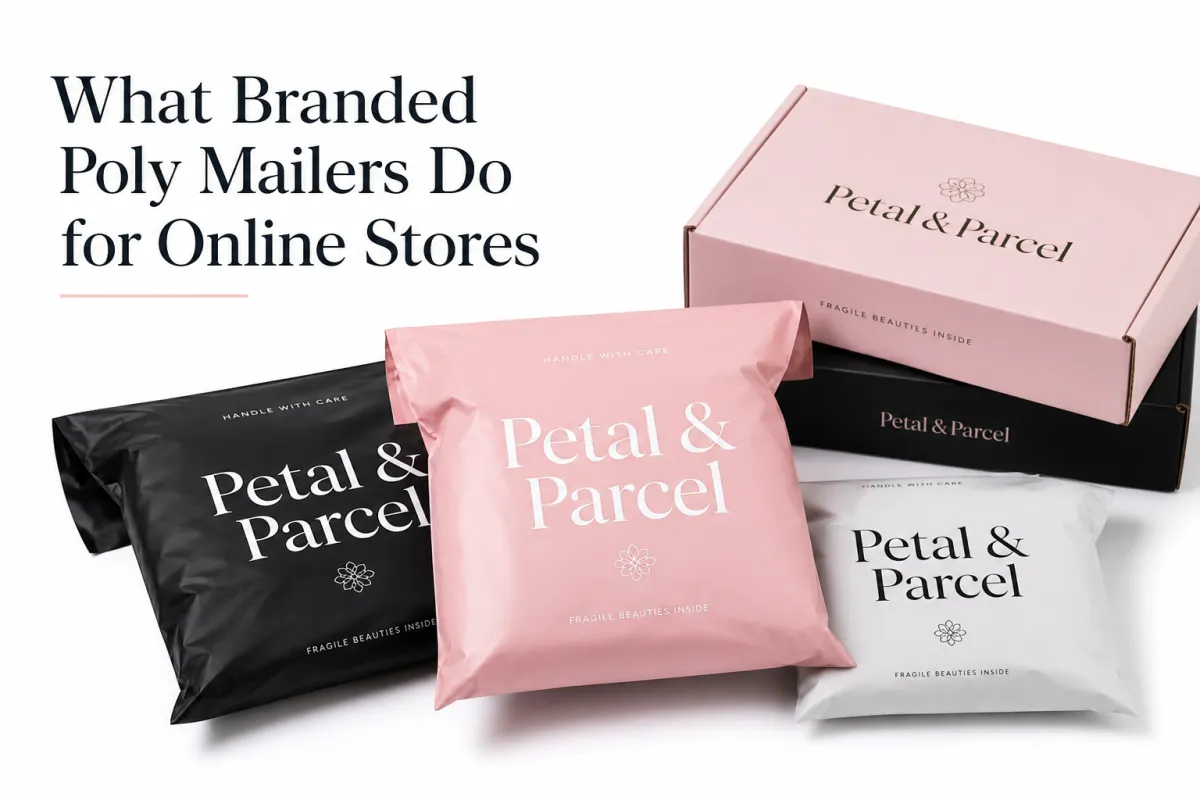
For most online sellers, branded poly mailers for online stores have three jobs: protect the order, communicate the brand, and keep fulfillment moving. Protection comes first. The bag has to survive conveyors, sorting, stacking, and whatever chaos the delivery route throws at it. Communication comes right after, because the outside of the package is often the first branded surface the customer sees in real life.
That outside surface matters. A plain mailer gets the package from A to B, sure. Branded poly mailers for online stores do more than that. They tell the customer someone cared enough to think about the delivery, not just the product listing. That can be a bold color, a repeating logo, a clean return address panel, or a message that does not sound like it was written by a committee trying to stay neutral.
The build is usually simple: film layers, a pressure-sensitive adhesive strip, and sometimes a tear strip or tamper-evident seal. Most branded poly mailers for online stores use LDPE or co-extruded film because those materials balance flexibility, seal performance, and puncture resistance. Heavier soft goods usually benefit from a thicker gauge, which helps the mailer keep its shape and lowers the chance of splitting in transit.
From a buyer's perspective, the operational upside is hard to miss. Boxes need tape, void fill, more storage room, and more handling. A mailer often needs a fold, maybe an insert, and one clean seal. That small difference adds up. Across hundreds or thousands of orders, branded poly mailers for online stores can shave minutes off a shift and reduce the number of little annoyances that slow a team down.
They also handle moisture better than paper-based options. That does not make them waterproof in every sense, but they do give useful protection against drizzle, damp loading docks, and wet sorting conditions. For apparel, socks, swimwear, towels, and similar items, that is usually enough.
Where stores get into trouble is assuming one packaging format can do everything. A ceramic item, a boxy accessory, or anything with sharp corners may need more structure than branded poly mailers for online stores can provide on their own. The smarter move is to use the mailer for the SKUs it actually fits and leave the rest to a different format.
The branding value is easy to underestimate. Outer packaging shows up in social posts, delivery photos, returns conversations, and sometimes even in wholesale buyer evaluations. Strong branded poly mailers for online stores create a visual thread from checkout to doorstep. That makes the brand feel more complete without forcing extra packaging layers into the order.
If you want to see how that plays out in real packaging programs, browsing Case Studies can help you compare print styles, order sizes, and product fits before you commit to a full run.
How Branded Poly Mailers for Online Stores Work
Most branded poly mailers for online stores are built from a co-extruded film structure. That just means the bag uses multiple layers, and each one does a different job. One layer may carry the print, another adds toughness, and another helps the seal hold properly and resist scuffing during transit. That layered setup is part of why the bags can stay light without feeling flimsy.
The closure matters just as much as the film. A good adhesive strip should grab cleanly, stay shut during handling, and not peel open because the package got bumped around. Some branded poly mailers for online stores also include a tear strip or tamper-evident feature, which gives the customer a better opening experience and keeps the package looking intentional when it lands on the doorstep.
Printing can happen in a few ways. Flexographic printing works well for repeat orders, medium-to-large runs, and designs that need efficient production. Gravure is often used for larger volumes and consistent color control. Digital printing can make sense for shorter runs, test programs, or artwork that needs flexibility. The method affects setup cost, turnaround, and how tightly the printer can control the look of branded poly mailers for online stores.
That print method affects the artwork too. Tiny type, thin rules, and low-contrast graphics may look fine on screen and then fall apart on film. A practical print file for branded poly mailers for online stores usually keeps the logo bold, the message short, and the spacing open enough that the design can print cleanly without turning into visual clutter.
The packout flow is straightforward, but it still has to work. The picker loads the product, folds it if needed, removes the liner, seals the adhesive, and applies the shipping label or uses a preprinted label zone. If the bag wrinkles badly, sticks to itself, or makes labeling awkward, the whole line feels it. Small friction points become big ones when they repeat hundreds of times a day.
That is why the best branded poly mailers for online stores are designed for branding and line speed at the same time. A pretty mockup is not enough. The bag has to run well on a bench, in a tote, and in a shipping lane while still looking sharp enough that the customer notices it before opening the package.
For testing, some suppliers reference film data like tensile strength or dart impact, often tied to methods such as ASTM D882 and ASTM D1709. You do not need to turn into a materials engineer, but it helps to ask for those numbers if the shipment is heavier, rougher, or more valuable than a standard apparel order.
Branded poly mailers for online stores are not just decorated envelopes. They combine structure, seal behavior, print discipline, and workflow design. When those pieces line up, the package feels easy to use and easy to trust.
For brands that want a broader packaging system instead of one SKU, it can make sense to review the rest of the assortment in Custom Packaging Products so the mailer fits cleanly beside inserts, labels, and other shipping components.
Branded Poly Mailers for Online Stores: Cost and Pricing Factors
Price is usually the first question. Fair enough. Branded poly mailers for online stores are not priced by one simple rule, though. Size, film thickness, number of printed colors, print coverage, total quantity, and setup method all change the number more than most store owners expect. A larger bag with full-bleed art will almost always cost more than a smaller one with a one-color logo and a limited print area.
Setup costs matter too. Plate charges, artwork prep, proofing, and sample work can show up as a one-time line item on the first order. On repeat runs, that cost spreads out, so the unit price looks a lot friendlier. That is one reason branded poly mailers for online stores can look pricey at first glance and much more sensible once the buyer looks at a full year of volume.
The cheapest unit price is not always the cheapest package. A well-sized mailer can cut dimensional weight, reduce labor, and lower the odds of an oversized shipping bill. That means branded poly mailers for online stores can save money even when the print itself costs a little more.
| Option | Typical build | Typical unit range | Best fit |
|---|---|---|---|
| Stock mailer with simple print | Standard white or gray LDPE, one-color logo, limited coverage | $0.16-$0.24 per unit at 5,000 pieces | Basic branding, predictable order volume, low artwork complexity |
| Custom mid-range mailer | 2.5-3 mil film, two-color print, custom size, adhesive seal | $0.22-$0.36 per unit at 5,000 pieces | Apparel brands, recurring promotions, balanced cost and appearance |
| Premium full-coverage mailer | Heavier film, full-bleed art, multiple print colors, special finish or custom tint | $0.32-$0.55 per unit at 5,000 pieces | Higher-end presentation, strong shelf-like branding, seasonal launches |
Those ranges are not a quote, and they move based on supplier, print method, freight, and order timing. Still, they give a realistic planning frame. A one-color run on branded poly mailers for online stores is usually simpler and cheaper than a full-coverage design with multiple screens or cylinders, and the artwork can affect setup cost almost as much as the film does.
If you are budgeting for a new program, estimate annual quantity, reorder frequency, and SKU mix before comparing quotes. A store shipping one hoodie size at steady volume has a very different buying pattern than a boutique with five product families and seasonal swings. Branded poly mailers for online stores reward planning because the format gets more efficient once the buyer understands how often the bag will be used.
Think beyond the printed bag too. If a mailer lets your team pack faster, protects the product well enough to reduce damage claims, and keeps the box size down, the savings can show up in labor and postage, not just in the unit price line. That is the part people miss when they only compare quotes on paper.
For brands that want to keep the packaging buy connected to actual results, reviewing Case Studies can make the pricing discussion more concrete because you can see how other packaging choices affected workflow and shipping outcomes.
How to Choose the Right Branded Poly Mailers for Online Stores
Size comes first, and size should be based on the packed product, not just the product itself. Measure the item as it ships, including tissue, inserts, folds, or any soft folding allowance. Branded poly mailers for online stores should fit with enough room to load comfortably, but not so much extra room that the product slides around and looks sloppy inside the bag.
Film strength comes next. Lightweight tees and flat soft goods may work fine in a standard-gauge mailer, while heavier sweatshirts, stacked garments, or mixed-item orders often need a thicker film with better puncture resistance. In practice, branded poly mailers for online stores around 2.5 to 3 mil often hit a useful middle ground, though the right choice still depends on the product weight and shipping lane.
Closure quality deserves more attention than it usually gets. A strong adhesive strip, a clean release liner, and a seal that closes consistently are worth paying for because fulfillment teams notice those details immediately. If the adhesive is unreliable, the bag slows the line or creates rework, and branded poly mailers for online stores stop feeling like an efficiency tool.
Sustainability claims need care. If you want recycled content, recyclable film, or a lighter-gauge structure, verify the material claims before you print them on the bag or advertise them on the site. Recycling rules vary by local program, so do not assume a plastic mailer is accepted everywhere. For general recycling guidance, the EPA recycling guidance is a useful reference point, and it is better to speak precisely than to make a broad claim you cannot support.
The same caution applies to paper inserts, thank-you cards, and instruction sheets. If those pieces matter to the brand, asking for FSC-certified paper stock is a practical way to support a better paper choice without making vague promises. A lot of buyers lump everything under "sustainable packaging." The details are what customers actually notice.
Design should support the packing reality, not fight it. A strong logo, a readable brand color, and one or two clear supporting messages are usually enough. Tiny type, overly subtle graphics, and weak contrast tend to disappear once branded poly mailers for online stores are printed at speed and handled by multiple people. The bag should look intentional on camera, but it also has to leave room for labels, barcodes, and handling marks.
If you are unsure where to start, I usually recommend a short checklist:
- Measure the packed item, not just the SKU.
- Confirm whether the product can tolerate flex and compression.
- Decide whether the customer sees the mailer or only the contents.
- Choose a print style that stays readable from one arm's length away.
- Verify seal strength on the actual packing bench.
That checklist sounds basic because it is. Basic is good. It prevents a lot of avoidable mistakes. Branded poly mailers for online stores work best when the buyer thinks through the product, the line, and the customer experience together instead of treating those as separate problems.
And yes, the warehouse team should have a say. They are the ones staring at the liner, the adhesive, and the bag shape all day. If they hate the mailer, you are gonna hear about it. Usually right when orders are piling up. Convenient, right?
Step-by-Step Timeline for Ordering Branded Poly Mailers
The cleanest ordering process starts with the product mix. Define the SKUs, the approximate order counts, the packing style, and the mailer size you think you need. When a supplier gets that information up front, branded poly mailers for online stores can be quoted more accurately, and the artwork can be built around the real shipment instead of a guessed package.
Next comes artwork review and proofing. A supplier will usually send a digital proof or mockup so the brand can check logo size, color placement, copy, and label zones. This is where a lot of useful corrections happen. A design that feels balanced on a screen may need more breathing room on the film, and branded poly mailers for online stores usually benefit from a bolder layout than the first mockup suggests.
A physical sample is worth asking for whenever possible. A real sample shows opacity, surface feel, seal behavior, and how the bag acts when it is folded, packed, and labeled. If the mailer will be used on a busy line, that sample test is one of the best ways to see whether branded poly mailers for online stores actually fit the workflow instead of only the mood board.
Production usually follows a familiar sequence: artwork approval, file preparation or plate making, print run, inspection, and shipment. The timing depends on quantity and print method. Smaller or simpler runs may move faster, while larger or highly customized orders take longer because more setup and quality control are involved. For many programs, a realistic window is often 12 to 15 business days after proof approval, though larger jobs can stretch to three to five weeks if the print method or freight plan is more complex.
That timing is why planning ahead matters. If you are launching a new product line, preparing for a seasonal spike, or coordinating a promotion, do not leave branded poly mailers for online stores until the last minute. Shipping bags are easy to overlook because they are not the glamorous part of the brand, but they become critical the moment orders start moving.
One practical habit helps a lot: keep a small buffer stock. Even if the reorder cycle is predictable, a few extra pallets or cartons can prevent a stockout if artwork needs revision or freight gets delayed. That buffer can be the difference between a smooth launch and a frantic scramble.
If you are still deciding how to structure the rollout, compare your packaging options first and then map the timeline backward from the ship date. That is usually the simplest way to introduce branded poly mailers for online stores without creating a bottleneck in the warehouse.
Common Mistakes When Ordering Branded Poly Mailers
The most common mistake is picking by appearance alone. A mockup can look fantastic, but if the mailer is too thin, too large, or poorly sealed, the package will create problems after it leaves the facility. Branded poly mailers for online stores have to be judged on real performance, not just a flat proof on a screen.
Artwork mistakes come next. Low-contrast logos, tiny type, thin rules, and crowded layouts often disappear once the bag is printed on film and handled in production. The fastest way to improve the result is to simplify. Strong branded poly mailers for online stores usually use a clear logo, a limited number of colors, and enough contrast to survive storage, packing, and transit.
Another frequent miss is skipping a packout test. The warehouse team is the best source of truth for whether a mailer actually works. They will notice if the bag catches on the product, if the adhesive grabs too early, if the label zone is awkward, or if the finished package sits strangely on the conveyor. That kind of friction is hard to catch from a design proof alone.
Timing mistakes are just as costly. Stores often underestimate lead time, forget to account for proof revisions, or fail to plan for reorders. The result is a stock gap right when order volume rises. Branded poly mailers for online stores should be treated like any other production-critical supply item: ordered early enough to absorb surprises.
There is also a compliance risk around sustainability language. If the bag includes recycled content, recyclable claims, or disposal instructions, those statements should be accurate and easy to support. Vague language sounds nice, but it can turn into a problem if customers or regulators ask for specifics. Strong brands stay careful here because branded poly mailers for online stores are part of the public promise, not just the internal supply chain.
A useful rule of thumb is to test, then refine. Order samples, run a few real packing sessions, compare shipping results, and only then commit to a larger order. That process takes a little longer up front, but it usually prevents the more expensive mistake of buying the wrong mailer in a hurry.
Honestly, the stores that get the best results are not the ones with the flashiest artwork. They are the ones that treat branded poly mailers for online stores as a packaging decision first and a graphic decision second.
Expert Tips and Next Steps for a Better Rollout
If you want a rollout that feels controlled instead of messy, start with the highest-volume SKU or the clearest product fit. That gives you real packing data quickly, and it keeps the first order focused. Branded poly mailers for online stores rarely need to launch across the entire catalog on day one. A staged rollout usually teaches you more, faster.
I also like to see a simple packaging audit before and after the switch. Track bag size, shipping cost, damage rate, and packing speed for a representative sample of orders. Those numbers tell the real story. If branded poly mailers for online stores cut labor by a few seconds per order and reduce carton use on soft goods, the value shows up fast.
Keep the design hierarchy clean. Put the logo first, the brand color second, and any secondary message only if it still prints sharply. A lot of brands try to fill the whole surface because they can. That does not mean they should. In many cases, branded poly mailers for online stores look more confident when the design is restrained and easy to read.
The people sealing the bags every day should have a voice in the process. They will notice whether the adhesive liner is easy to remove, whether the mailer sits flat on the bench, and whether the finished package stacks neatly in a tote. That practical feedback is priceless because branded poly mailers for online stores live or die in the warehouse before they ever reach the customer.
One more detail gets ignored a lot: the barcode and label zone. If the mailer is too glossy in the wrong place, or the label panel sits on a wrinkle-prone seam, scanning gets annoying fast. Nobody needs that kind of drama. Keep the label area flat, readable, and positioned for the way the team actually packs.
Here is a simple rollout sequence that works well:
- Measure the packed item and confirm the target mailer size.
- Request samples with the actual print style you plan to use.
- Run a small packout test with the warehouse team.
- Review shipping cost, packing speed, and customer feedback.
- Place the first production order with a modest buffer.
That kind of controlled launch is usually the difference between a smooth packaging upgrade and a rushed replacement order. If you want to keep the buying process grounded in real numbers, compare the mailer against your current format, then talk through the tradeoffs with the team that touches the order every day.
For brands that want to keep the decision anchored in proven packaging performance, the best next step is usually to gather measurements, request samples, compare quotes, approve artwork, and plan a small launch. Done that way, branded poly mailers for online stores become a reliable part of the fulfillment system instead of a last-minute branding add-on. That is the real win: the mailer does its job, the team moves faster, and the customer gets a package that looks deliberate from the moment it hits the doorstep.
What size branded poly mailers for online stores should I choose?
Measure the packed item, not just the product, and include room for inserts, folds, or soft packaging so the bag is not stretched tight. Most stores do better with a small set of core sizes rather than one oversized option, because that keeps postage and material waste under control. For many apparel programs, branded poly mailers for online stores work best when the size is based on the finished packed stack instead of the flat garment measurement.
Are branded poly mailers for online stores cheaper than boxes?
Usually yes for lightweight, non-fragile products because the material cost is lower and the package adds less dimensional weight. The real comparison should include labor, postage, and damage risk, since a slightly better mailer can reduce total fulfillment cost. In many cases, branded poly mailers for online stores also save time at the bench because they do not require tape or much extra assembly.
How long does it take to produce custom poly mailers?
The timeline depends on proof approval, sample review, print setup, and order size, so it is smart to plan ahead before a launch or sales event. If artwork is already finalized and the supplier has the right specs, production can move much faster than a fully custom first order. For many buyers, branded poly mailers for online stores are easier to keep on schedule when the reorder plan is set before inventory gets tight.
Can branded poly mailers for online stores be recycled?
It depends on the film structure and the local recycling program, so the brand should verify the material and not assume every mailer is accepted everywhere. If sustainability matters, ask for recyclable or recycled-content options and pair them with clear disposal guidance on the packaging or website. Branded poly mailers for online stores can support a better materials story, but the claim should always match the actual film and the local recycling reality.
Do branded poly mailers work for fragile products?
They are best for soft goods and durable items, not fragile products that can crack, bend, or shift under pressure during transit. For delicate items, combine the mailer with an inner box, protective wrap, or a different outer shipping format that offers more structure. Branded poly mailers for online stores are strongest when they are matched to the right product family instead of stretched into every use case.


