Buyer Fit Snapshot
| Best fit | Branded Poly Mailers with Inserts projects where brand print, material claims, artwork control, MOQ, and repeat-order consistency need to be specified before quoting. |
|---|---|
| Quote inputs | Share finished size, material target, print colors, finish, packing count, annual reorder estimate, ship-to region, and any compliance wording. |
| Proofing check | Approve dieline scale, logo placement, barcode or warning zones, color tolerance, closure strength, and carton packing before bulk production. |
| Main risk | Vague material claims, crowded artwork, missing packing details, or unclear freight terms can make a low unit price expensive after revisions. |
Fast answer: Branded Poly Mailers with Inserts: How They Work should be specified like a repeatable production item. The safest quote records material, print method, finish, artwork proof, packing count, and reorder notes in one written spec.
Production checks before approval
Compare the actual filled-product size with the drawing, then confirm tolerance on folds, seals, hang holes, label areas, and retail display edges. Reserve space for logos, QR codes, warning copy, and material claims before decorative graphics fill the panel.
Quote comparison points
Review material grade, print process, finish, sampling route, tooling charges, carton quantity, and freight assumptions side by side. A quote is only useful when the supplier can repeat the same color, closure quality, and packing count on the next order.
Branded Poly Mailers with inserts can look like a small packaging decision. They are not small in practice. They shape the first impression, affect damage rates, and can shave down the stream of “where is my order?” emails that pile up in support later. The outer mailer gets scanned first in transit. The insert is often the first thing the customer actually touches. That split matters more than people expect. Branded poly mailers with inserts are really about control. Control over the reveal. Control over protection. Control over the story the package tells before the product shows up.
Strip the setup down and it is pretty simple. The printed poly mailer carries the shipment and helps protect it from scuffs, moisture, and the usual beat-up treatment that happens in shipping. The insert adds structure, instructions, a thank-you note, a sizing guide, or a more polished branded moment. Put both together well and even a low-cost order can feel considered. Put them together badly and the package reads like two random things that happened to land in the same box. That difference is real. Buyers notice it. Customers definitely do.
For brands comparing Custom Poly Mailers, other Custom Packaging Products, or examples from Case Studies, the real question is not whether the setup looks nice in a mockup. The question is whether Branded Poly Mailers with inserts fit the product, the shipping lane, and the budget without creating extra waste or extra labor. I have seen teams fall in love with a render and then get surprised by packing time, curl, fit issues, or a reprint because the insert looked great on screen and useless in hand. The rest of this piece walks through how the format works, what it tends to cost, where orders get messy, and how to avoid paying for mistakes that should have been caught before proof approval.
Branded poly mailers with inserts: why the combo matters
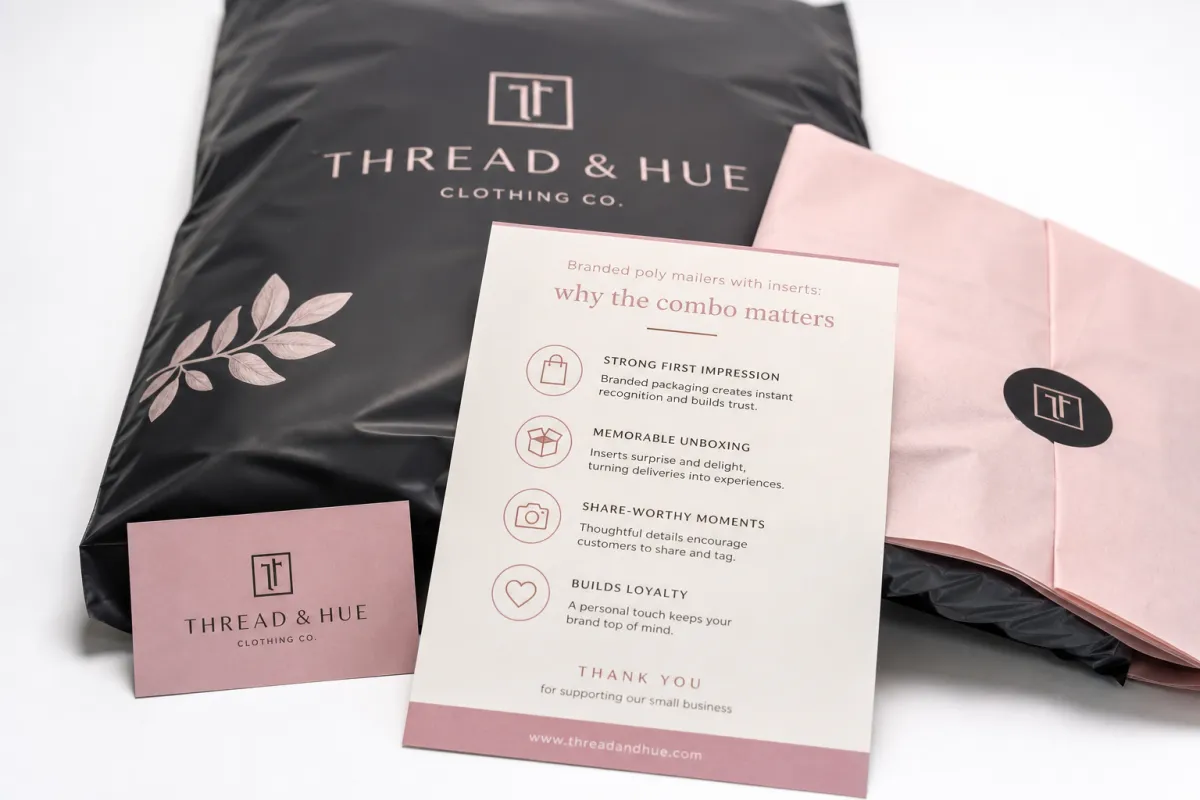
Here is the part buyers overlook: the outer mailer gets the first glance, but the insert often gets the first touch. That changes the branding moment. The customer may see the mailer on the porch, in the mailbox, or stacked with other packages. Once the order opens, the insert becomes the first deliberate contact. For Branded Poly Mailers with inserts, that is the point where shipping material stops being background noise and starts doing actual brand work.
A good mailer does the rough work. It resists abrasion. It handles moisture better than paper in a lot of shipping conditions. It signals tamper awareness because the seal is obvious and hard to ignore. The insert does the human work. It can organize the contents, explain how to use the product, point to a reorder path, or carry a message that feels more thoughtful than a shipping label ever could. That is why Branded Poly Mailers with inserts can pull more weight than plain packaging, even when the product itself is not luxury-priced.
The popularity makes sense. A plain poly mailer says “shipped.” A coordinated mailer plus insert says “planned.” That difference matters in apparel, beauty, subscription kits, and small accessories, where the first thirty seconds after delivery shape perceived value. I see teams miss this all the time. They spend money on the outer print, then treat the insert like an afterthought. The result is fine. Fine is not the goal. Fine is what people use when they do not want to admit they are underwhelmed.
There is a practical upside too. Branded poly mailers with inserts can cut confusion before customer service gets pulled into it. If the insert explains sizing, care, returns, or how to use a code, the package answers routine questions right away. That sounds small until you look at repetitive tickets month after month. A clear unboxing path often costs less than the support time it saves. Funny how that works.
The brand story matters just as much. A package that opens with the right color, texture, and message feels deliberate. A package that opens to loose product and no context feels cheaper, even if the item itself is perfectly fine. That is the odd thing about packaging. Branded poly mailers with inserts can influence perception without requiring a carton, a tray, or a pile of filler. A light system can send a stronger signal than a heavy one.
A package that answers the customer’s first questions before they ask them is doing more than shipping. It is reducing friction, and friction is usually where bad reviews and avoidable returns start.
For buyers, the value is not abstract. You are balancing material spend, labor, freight, and brand effect. If the setup helps the order arrive cleaner and feel more intentional, it earns its place. If it only adds print coverage and a nicer invoice moment, it starts drifting into decoration with a price tag. I do not love paying for decoration that pretends to be strategy.
How branded poly mailers with inserts work in shipping
The workflow looks simple on a spec sheet and a little less simple on a packed line. During fulfillment, the product goes into the mailer with the insert tucked behind it, laid on top, or folded around it depending on the category. In branded poly mailers with inserts, the mailer is the outer shell, but the insert often decides how neat the package looks when the customer opens it. Unboxing is a sequence, not a single action.
Start with the mailer. It handles abrasion resistance, moisture protection, and tamper awareness. A co-extruded poly mailer in the 2.5 mil to 3 mil range is common for many light to medium-weight shipments, though the right spec depends on weight, edge sharpness, and transit distance. Products with rougher edges or more abuse in the lane may need a thicker gauge. The insert does not replace that. It sits alongside it. That split is the core idea behind branded poly mailers with inserts.
Then comes the insert. It can be a thank-you card, care card, promo card, sizing guide, fold-over backing card, product literature sheet, or a lightweight stabilizer. The strongest insert is rarely the longest. It is the one that fits the job. A 4 x 6 in card can handle a short message and a QR code. A multi-panel insert makes more sense if the product needs steps, warnings, or reorder instructions. Branded poly mailers with inserts work best when the insert has one clear purpose and does not wander off into a little speech of its own.
Presentation matters more than a lot of teams want to admit. A mailer protects the order, but a well-designed insert can keep the contents aligned so the item does not slide, fold, or arrive looking rumpled. That matters for apparel, small soft goods, and subscription items with several pieces. If the packaging is doing its job, the customer should not need to “fix” the presentation after opening it.
Take a basic apparel order. A tee in a branded poly mailer may already arrive in decent shape, but a crisp insert can keep the shirt aligned, add a branded reveal, and include a care note or return reminder. The package feels more intentional. The product feels more complete. That is why branded poly mailers with inserts show up so often in categories that do not want the overhead of a carton but still want a polished customer moment.
Subscription kits follow the same logic with more moving parts. Inserts can organize components, explain the month’s theme, and reduce the “what is this for?” confusion that shows up after delivery. For accessories, they can carry SKU, barcode, or reorder information right where the customer is already looking. The insert becomes guide, brand sheet, and sales prompt all at once. Done well, branded poly mailers with inserts feel like one system instead of two unrelated pieces.
That system should be tested like a system. Durability is not just a visual question. If you want to evaluate mailer performance, look at transport tests used in the industry, such as those described by ISTA. If the insert is paper-based and sourcing matters, certification details from FSC may matter too. Standards do not replace judgment. They do give buyers a common language for comparing options.
Choosing the right size, material, and insert
Size is where people go wrong first. Too small, and the product gets forced into a curve, folded too tightly, or crushed at the corners. Too large, and the shipment slides around until the package loses its clean silhouette. With branded poly mailers with inserts, you need room for both the product and the insert, but not so much space that everything floats inside the envelope like loose inventory. Nobody wants a package that sounds like a handful of marbles.
A practical rule: size the mailer around the flat-folded product plus the insert, then allow a bit of tolerance for sealing and handling. That margin may be only a few millimeters on the insert or a quarter inch on the mailer, but it changes how the package behaves in the warehouse. When the fit is right, packers move faster. The contents stay aligned. The customer opens a package that feels deliberate instead of squeezed. A clean fit also helps the mailer seal flatter, which keeps the finished parcel looking less tired.
Material choice matters just as much. Standard poly works for many lightweight shipments. Co-extruded poly mailers are popular because they can balance strength and print surface pretty well. Recycled-content options may support sustainability goals, though the exact feel and print behavior depend on the formulation. Heavier gauges make sense when the item has sharp edges, more weight, or higher transit risk. For branded poly mailers with inserts, the outer layer should match the shipping burden, not just the mood board. The mood board does not have to survive the conveyor belt.
The insert should fit the job too. It should not just repeat the logo at the center of the page. A care card may need a clean front with a few short points and a QR code. A product literature sheet may need a grid, a diagram, or a folded panel. A sizing guide may work better as a compact postcard than a full flyer. The best branded poly mailers with inserts usually solve one specific problem or prompt one specific action.
There is a useful tradeoff here. If the goal is presentation, heavier card stock with a matte or soft-touch finish can feel more premium. If the goal is shipping efficiency, a lighter insert with focused content may be the better move. If the goal is protection, a fold-over backing card or stabilizer can keep the item upright and prevent wrinkles. The trick is matching function to job. Too little structure looks cheap. Too much structure burns money without adding much. That balance is the real design work behind branded poly mailers with inserts.
Brand tone matters too. A direct-to-consumer activewear label, a clean beauty brand, and a playful accessory shop will not use the same visual language. They still make the same mistake: nice mailer, lazy insert. The disconnect shows in the hand. The better move is to let the insert extend the same visual system, whether that means color blocking, short copy, strong typography, or one clear practical message.
- For apparel: use a mailer that protects the fold and an insert that reinforces fit, care, or return info.
- For beauty: use an insert that explains usage, ingredients, or product pairing without crowding the layout.
- For accessories: use a compact insert that clarifies sizing, warranty, or reordering.
- For subscription kits: use the insert to organize pieces and add context for the theme or contents.
Handling conditions deserve attention too. If products ship through humid lanes, wet-weather regions, or long distribution chains, the outer mailer choice becomes even more important. For paper-based inserts, think about curl, scuffing, and ink rub. For poly mailers, think about seal integrity and print quality. In both cases, branded poly mailers with inserts should be built around real conditions, not ideal studio lighting.
Costs and pricing for branded poly mailers with inserts
Pricing is where packaging turns from theory into a spreadsheet. A plain mailer and a plain insert are not expensive on their own. Once both pieces are customized, the cost stack can climb quickly. For branded poly mailers with inserts, the total usually includes the printed mailer, the insert print run, artwork setup, proofing, freight, and any labor needed to assemble the components together. The sneaky part is not the print price itself. It is everything around the print price.
Volume is the biggest lever. At 5,000 pieces, a simple printed poly mailer might land around $0.10 to $0.22 per unit depending on size, print coverage, and material. A basic insert card might run $0.03 to $0.10 per unit. Add a custom size, thicker gauge, specialty finish, or more print colors, and the numbers move up. That is normal. The useful part is knowing where the money goes when branded poly mailers with inserts are compared against plain stock packaging. I am intentionally treating those numbers as directional, because any honest supplier should be able to show exactly how their quote breaks out.
| Option | Typical unit cost at 5,000 pieces | Best fit | Main tradeoff |
|---|---|---|---|
| Plain poly mailer | $0.06-$0.12 | Low-cost shipping with minimal branding | Limited brand impact |
| Printed poly mailer only | $0.10-$0.22 | Brands that want a recognizable outer package | Less guidance inside the parcel |
| Plain mailer + simple insert | $0.12-$0.24 | Basic branding and customer instructions | Visual impact depends on insert design quality |
| Branded poly mailers with inserts | $0.18-$0.38 | More curated unboxing, support info, and premium feel | Higher setup and coordination effort |
The table is a framework, not a quote sheet. Final pricing depends on dimensions, color count, finishing, insert complexity, and whether the artwork is ready for print. For branded poly mailers with inserts, the most expensive surprises are usually not the headline unit cost. They are the extras: rush freight, file corrections, design revisions, or a reprint because the size was wrong and nobody caught it early enough. That is the kind of expense that makes everyone stare at the spreadsheet like it insulted their family.
Hidden labor costs matter too. If the mailers and inserts arrive separately, someone has to count, match, and pack them together. That sounds harmless until the schedule gets tight. On a clean line, it is manageable. In a crowded warehouse, it is another source of delay. The cheapest option on paper is not always the cheapest in real life. When buyers compare branded poly mailers with inserts to generic packaging, they should include labor and error rate in the math, not just print spend.
One quick way to think about volume:
- Low volume: higher unit cost, more setup pressure, less room for testing.
- Mid volume: usually the sweet spot for balancing design detail and spend.
- High volume: lower unit cost, but mistakes get expensive fast because they multiply across more pieces.
If spend needs to stay tight, simplify the insert before you simplify the mailer. A clean one-color insert with useful information can beat a crowded four-color card that does not help the customer. That is not a glamorous answer. It is a useful one. In branded poly mailers with inserts, simplicity is often the cheapest design choice that still does the job.
Production process and timeline for branded poly mailers with inserts
The production path starts with specs, not artwork. Product dimensions, mailer size, insert size, material preference, and print method all need to be settled before anyone can build a proper proof. That is true for nearly every order of branded poly mailers with inserts. If the specs are vague, everything downstream slows down and gets more expensive. A fuzzy brief is a great way to buy yourself three rounds of emails and one avoidable reprint.
After specs come dielines or templates. The mailer and insert may use different file setups, and that is where some teams stumble. A designer can build artwork that looks perfect on screen while ignoring bleed, folds, seal zones, or barcode placement. A good supplier will flag those problems, but cleaner files move faster. For branded poly mailers with inserts, proofing is often where the real work finally gets done.
Once artwork is set, the proof goes out. This is the moment to check color accuracy, copy, panel order, fold direction, and whether the insert still makes sense inside the final mailer. Do not rush it. A proof that feels “close enough” can still fail in production if the panel is off by a fraction or the insert lands in the wrong orientation. That kind of mistake is boring, predictable, and expensive.
Typical timelines vary. Simpler runs can move in roughly 7 to 12 business days after proof approval if the size is standard and the print is straightforward. More customized orders, special finishes, or larger volumes often need 12 to 18 business days or more. If the mailer and insert come from different vendors, coordination adds another layer of risk. That is one reason many buyers prefer a single source for branded poly mailers with inserts when the program allows it.
Physical samples help more than teams like to admit. A screen cannot tell you whether the insert feels too flimsy, whether the mailer looks too glossy under warehouse lighting, or whether the text is still readable once the package is in hand. A small pilot run goes further. It shows how the package behaves during packing, sealing, stacking, and opening. If anything is going to slip, wrinkle, or mismatch, the pilot is where you want to catch it. That is the safest way to scale branded poly mailers with inserts.
Mixed-vendor production creates one more issue. If one supplier prints the mailer and another prints the insert, the two pieces may look slightly different in color or tone. That may not matter for a black-and-white care card. It matters a lot if your brand depends on exact colors or a tight visual identity. The closer you want the components to feel, the more carefully you need to manage specs for branded poly mailers with inserts.
Common mistakes with branded poly mailers with inserts
Overdesign is the first trap. A team adds a glossy insert with several panels, heavier stock, and multiple messages, then realizes the customer only needed one or two clear details. That kind of packaging looks impressive in a mockup and inefficient in a warehouse. The point of branded poly mailers with inserts is not to prove that a brand can print more. It is to make the shipment more useful.
Size mismatch comes next. If the insert is too large, it buckles or curls. If it is too small, it disappears into the package and fails to create the premium reveal. If the mailer is too tight, the contents wrinkle. If it is too loose, the package shifts. None of that sounds dramatic. Customers feel it immediately. A wrinkled order in branded poly mailers with inserts can feel less thoughtful than a clean plain package.
Brand inconsistency creates another problem. The mailer may use one color family while the insert uses a different tone, copy style, or visual hierarchy. The customer may not be able to explain why the package feels off, but they know it does. A better result comes from treating the two parts as one system. When branded poly mailers with inserts are aligned, the package reads faster and stronger.
Missing operations details are easy to overlook and annoying to fix later. Return instructions. Care notes. SKU labels. Barcode placement. Support URLs. Promo codes. If the insert has space, it should carry the useful information, not just the prettiest message. A package that answers practical questions early is more effective than one that only looks polished. That is especially true for branded poly mailers with inserts, where the insert may be the only interior communication the customer ever sees.
A package that confuses the customer is not premium. It is just expensive.
Skipping a test batch is another mistake that shows up constantly. Screen proofs do not tell you how the finished package feels in hand. They do not show how a matte insert sits against a glossy mailer, or whether the product moves too much during packing. A small sample order can save a full reprint. For branded poly mailers with inserts, the pilot usually costs less than the fix.
There is one more trap worth calling out: choosing the insert before choosing the use case. Some brands start with the visual idea, then force the copy to fit later. That tends to create clutter. The better sequence is simpler. Define the job first, then shape the insert around it. Is it for education, promotion, protection, or brand story? Pick one primary role. Maybe two if the layout is disciplined. That clarity makes branded poly mailers with inserts easier to manage and better to use.
Expert tips and next steps for a smarter rollout
Start small. One product line. One shipping lane. One region, if you need to narrow it further. That is the cleanest way to learn whether branded poly mailers with inserts are paying off in lower damage, fewer questions, better repeat intent, or just nicer photos on social media. Roll everything out at once and the results get muddy fast. I have watched that happen. The data gets noisy, opinions get loud, and nobody can tell whether the packaging helped or the promotion did the heavy lifting.
Ask for a paired sample. Do not judge the mailer and insert separately. Put them together. Open them together. Pack them together. That combined view is what the customer sees, and it is the only view that matters. When the outer package and the insert share the same tone, the system feels deliberate. When they do not, the weakness shows up right away. That is why branded poly mailers with inserts deserve joint sampling.
Use the insert for one main job before it tries to do five jobs at once. A good insert can educate, promote, reassure, or guide. It should not try to be a catalog, a legal disclaimer, a loyalty program, and a style sheet all at once. Clarity usually wins. If your brand wants more information, use a QR code or a second panel instead of cramming everything into the first glance. In branded poly mailers with inserts, space is a design asset, not a challenge to fill.
A simple proof checklist helps. Review the exact outer size, inner size, copy, fold orientation, color, barcode placement, and order of reveal. Then ask one blunt question: what does the customer see first, second, and third? That sequence matters more than a lot of design teams realize. Good branded poly mailers with inserts guide the eye in a controlled order, which is part of why they feel better even when the material spend is modest.
- Measure the product in its packed form, not just its flat dimensions.
- Define the insert’s single most important job.
- Request a sample of the mailer and insert together.
- Compare the assembled package against your current shipment.
- Approve a pilot run before placing the full order.
If you want to compare sourcing routes, look at the packaging program as a whole instead of isolating one component. A supplier that can handle custom sizing, print alignment, and consistent reorders will usually be easier to manage than three different vendors. That is especially true for branded poly mailers with inserts, where small mismatches become visible very quickly. For teams building a broader packaging program, the range of Custom Packaging Products can help you compare mailers, inserts, and related items in one place.
Case examples also help. They show what changed after the packaging decision, not just what the packaging looked like in the mockup stage. If you are trying to judge whether branded poly mailers with inserts fit your product mix, reviewing Case Studies can make the choice less abstract and more operational.
One last detail: do not ignore sustainability language, but keep it practical. If you are specifying paper-based inserts, check whether FSC-certified stock makes sense. If you are trying to reduce material use, ask whether the insert can replace a larger enclosure card or a second component. Source reduction often beats adding another layer of packaging. That is the kind of grounded thinking that makes branded poly mailers with inserts work for both the brand and the shipping budget.
The best rollout is measured, not flashy. Measure the product. Define the insert’s job. Compare sample packs. Then approve a pilot batch of branded poly mailers with inserts and watch how the package performs in the real world, not just in the proof. If the packed sample feels clean, answers the customer’s obvious questions, and survives the line without drama, you are on the right track. If it does not, fix the spec before you spend on volume. That is the actionable part, and it is the part that saves money.
Frequently asked questions
How do branded poly mailers with inserts improve the unboxing experience?
They improve the unboxing experience by combining protection with a visible brand message and a more ordered reveal. The mailer does the shipping work, while the insert adds context, reassurance, or a small premium touch. Branded poly mailers with inserts feel more intentional when both parts share the same tone, color, and purpose.
What products are best for branded poly mailers with inserts?
Apparel, accessories, beauty items, and subscription products are strong fits because they benefit from both presentation and organization. Light to medium-weight goods work especially well when the insert also carries instructions or promotional content. Products with sharp edges or fragile finishes may need a sturdier mailer before branded poly mailers with inserts make sense.
Are branded poly mailers with inserts expensive to produce?
They usually cost more than plain mailers, but the price depends heavily on quantity, size, print complexity, and insert style. The added cost can stay modest if the insert is simple and the order volume is healthy. The real question is whether branded poly mailers with inserts improve repeat orders, perceived value, or support efficiency enough to justify the spend.
How long does it take to make branded poly mailers with inserts?
Lead time depends on proofing, print setup, quantity, and whether the mailer and insert are produced together. Simple orders can move in roughly 7 to 12 business days after proof approval, while more customized runs often need 12 to 18 business days or more. A sample or pilot run helps catch issues before branded poly mailers with inserts go into full production.
What should I include on the insert for branded poly mailers with inserts?
Use the insert for one clear purpose, such as care instructions, return details, sizing help, or a thank-you message. Keep the copy short and readable so it helps the customer instead of turning into clutter. If space allows, add a useful action like a QR code, reorder prompt, or support link to make branded poly mailers with inserts more functional.
For most brands, the smartest first step is a small pilot: one product, one mailer size, one insert purpose, and one real packing test under normal warehouse conditions. That is the quickest way to find out whether branded poly mailers with inserts are doing useful work or just looking good in a mockup.


