Buyer Fit Snapshot
| Best fit | Branded Product Pouches MOQ for Sustainable Packaging projects where brand print, material claims, artwork control, MOQ, and repeat-order consistency need to be specified before quoting. |
|---|---|
| Quote inputs | Share finished size, material target, print colors, finish, packing count, annual reorder estimate, ship-to region, and any compliance wording. |
| Proofing check | Approve dieline scale, logo placement, barcode or warning zones, color tolerance, closure strength, and carton packing before bulk production. |
| Main risk | Vague material claims, crowded artwork, missing packing details, or unclear freight terms can make a low unit price expensive after revisions. |
Fast answer: Branded Product Pouches MOQ for Sustainable Packaging should be specified like a repeatable production item. The safest quote records material, print method, finish, artwork proof, packing count, and reorder notes in one written spec.
Production checks before approval
Compare the actual filled-product size with the drawing, then confirm tolerance on folds, seals, hang holes, label areas, and retail display edges. Reserve space for logos, QR codes, warning copy, and material claims before decorative graphics fill the panel.
Quote comparison points
Review material grade, print process, finish, sampling route, tooling charges, carton quantity, and freight assumptions side by side. A quote is only useful when the supplier can repeat the same color, closure quality, and packing count on the next order.
Branded Product Pouches MOQ for Sustainable Packaging starts with a blunt truth: a pouch can look excellent in a mockup and still fail in production if the film, zipper, seal width, or barrier spec does not match the product. For a lot of buyers, branded product pouches moq is the first filter that turns a nice idea into something that can actually be filled, shipped, and sold without creating a mess.
The smartest buying process does not begin with decoration. It starts with product behavior, shelf life, seal performance, and the run size you can support without tying up too much cash in inventory. Branded product pouches moq should protect margin, cut scrap, and leave room to test the market before you scale. That sounds unglamorous because it is. It also saves people from bad decisions.
Brands that need shelf presence, lighter freight, and a clean printable surface for logos, claims, nutrition panels, or ingredient copy usually land on pouches for a reason. The real question is not whether branded product pouches moq can be low. The real question is whether the MOQ, structure, and finish all fit the product, the filling line, and the sustainability targets you actually need to hit.
This page covers the pouch formats, material choices, cost drivers, and timeline details that matter once the invoice lands on your desk. If you are comparing branded product pouches moq options for a launch, a seasonal program, or a packaging refresh, the point is simple: choose the structure that fits the product first, then line up the run size, budget, and sustainability plan after that.
Why branded product pouches MOQ matters up front
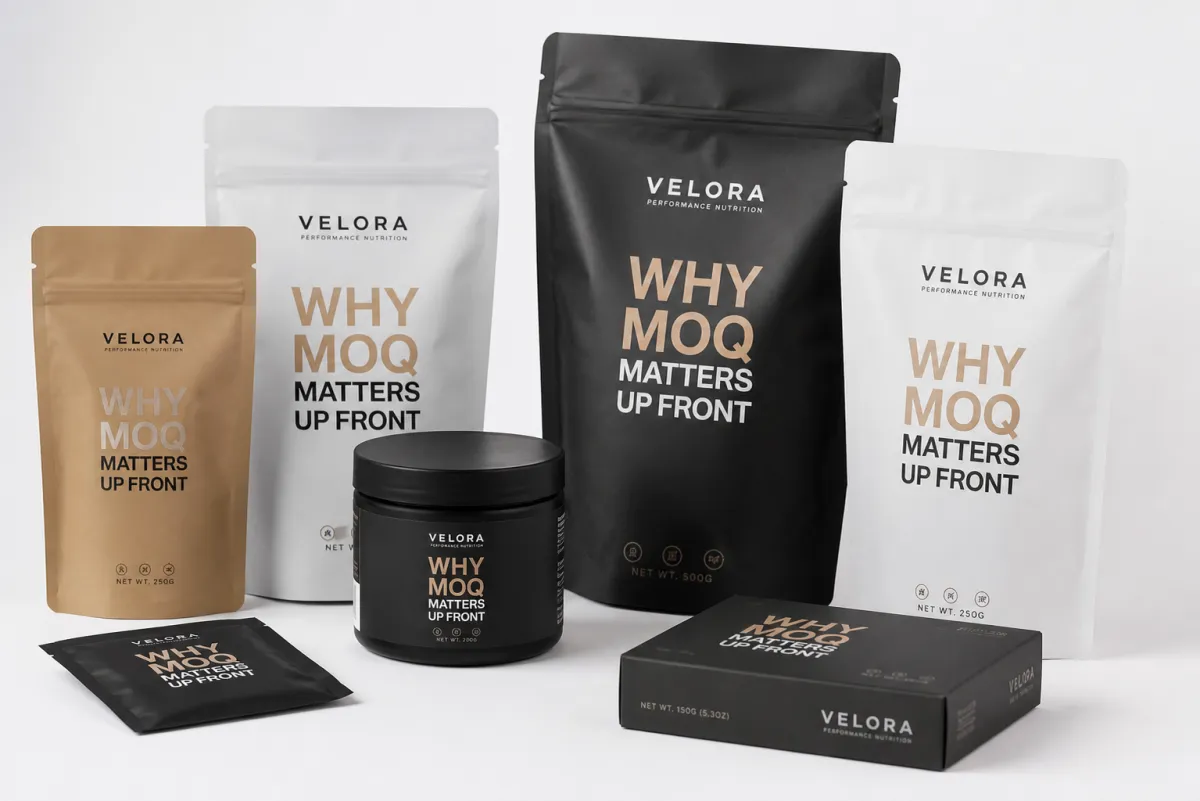
Picture a shelf-ready pouch proof that looks premium. The colors are right, the logo pops, and the matte finish feels expensive in the best way. Then production starts and the zipper sits too high for the fill volume, the headspace is wrong, or the barrier layer is too weak for the product’s moisture load. That is exactly the kind of headache branded product pouches moq is supposed to prevent, because a low order minimum only helps if the pouch is built for the item inside it.
MOQ is usually driven less by shape alone and more by the production method, the material construction, and the number of artwork versions in the job. A single-size stand-up pouch in one print version is easier to quote than three sizes, two zipper options, and a different logo treatment for each SKU. Once the buyer confirms fill weight, panel dimensions, and how many versions need to run in the same production window, branded product pouches moq often shifts.
For a new launch, the right MOQ can be the difference between a controlled test and an expensive guess. Order too much and you sit on inventory when the flavor changes or the label copy gets revised. Order too little and the per-piece price climbs while the pricing advantage of volume disappears. Smart branded product pouches moq planning keeps both problems in check. Cash flow stays healthier. Waste drops. Reorders are less annoying.
The sustainability angle belongs here too. A packaging program gets a lot less painful when you are not forced to overbuy a format just to hit a huge minimum. Smaller, well-judged branded product pouches moq quantities can support pilot programs, local launches, and seasonal items without stuffing a warehouse full of leftovers. That is often the practical route to lower-waste packaging because the cleaner choice is usually the one that avoids overproduction, not the one with the loudest green language on the front panel.
“A pouch that saves a few cents but fails on the filler is not a savings.” Most packaging buyers learn that one after the first real quote review.
Branded product pouches moq matters because the pouch is doing several jobs at once. It has to hold product securely, present the brand clearly, ship efficiently, and leave room for required copy. When those jobs are balanced well, the package can deliver strong shelf presence without stuffing in unnecessary material. That is the outcome worth chasing before anyone gets excited about the lowest minimum on paper.
I’ve had more than one buyer send me a pretty design with zero practical info behind it. Nice font. Nice render. No fill weight, no closure spec, no idea how it will run on the line. That is usually where the trouble starts. A good brief is boring in the best way.
If you want a broader overview of packaging questions before you request pricing, our FAQ is a useful place to start, and our Case Studies page shows how different package structures behave once they move past the mockup stage.
Product details: pouch styles, closures, and use cases
Start with the pouch style, because the structure drives the rest. Stand-up pouches are the most common choice for branded product pouches moq programs because they give you strong shelf visibility, a stable base, and plenty of print space on both panels. Flat pouches work well for samples, slim packs, and light items where presentation matters more than volume. Side-gusset pouches fit taller fills better, especially when a coffee-style profile is the look you want. Specialty shapes can stand out, sure, but they usually add setup complexity and can push branded product pouches moq higher than a standard format.
Closures matter just as much as shape. Resealable zippers help products stay fresh after opening, which matters for snacks, coffee, pet treats, and supplements. Tear notches make the pouch easier to open, especially when the material is heavier or carries a high-barrier layer. Hang holes support retail display, while one-way degassing valves are often needed for roasted coffee. Clear windows improve product visibility, but they also reduce printable area and can affect barrier performance depending on where they sit. Each of those features changes branded product pouches moq because each one adds material, assembly steps, or both.
Common uses include snacks, dry ingredients, specialty coffee, protein blends, powdered supplements, pet treats, bath salts, cosmetics, and sample packs. That list is broad for a reason. Pouches are flexible enough to cover very different categories, but the pouch still has to match the filling method. A thick powder behaves differently than roasted coffee beans, and a greasy snack needs a different seal and barrier profile than a dry herbal product. If the pouch does not fit the filler, branded product pouches moq turns into a distraction because the package may be cheap to order and expensive to run.
Seal width and headspace look like small details until they are not. A narrow seal saves film, but it may not leave enough security for a product with higher internal pressure or rough handling in transit. Too much headspace makes the pouch look underfilled on shelf and can make the package feel less premium than the artwork suggests. Too little headspace can lead to bulging, zipper stress, or poor seal formation. From a packaging buyer’s point of view, this is where branded product pouches moq moves out of theory and into production reality.
The best pouch is not just visually strong. It should also support storage density, shipping efficiency, and a clear brand story across the front and back panels. A pouch that stacks well in cases and fits cleanly on a shelf can lower handling costs in ways the mockup never shows. That is why branded product pouches moq should be reviewed alongside fill volume, carton pack count, and the product’s retail presentation goals.
There is a reason people get attached to pouch samples. Once the zipper feels right and the panel layup looks clean, it is easy to forget the boring specs. But boring specs are the ones that keep the line moving. Nobody puts that on the mood board, obviously.
Materials and specifications for sustainable packaging
Sustainable packaging is not one material family, and that is where plenty of buyers get tripped up. The right material for branded product pouches moq depends on what the product needs from the pouch. Recyclable mono-material films, such as PE/PE or PP/PP structures, are attractive because they can be designed for better compatibility with recycling streams in some markets. Paper-based constructions can work well for dry goods and brands that want a natural look, but they still need a barrier layer if moisture or aroma protection matters. Lower-impact laminate options can also make sense when the product needs a tougher barrier than a simple paper format can provide.
Product sensitivity drives the spec more than branding does. Moisture-sensitive products need strong water-vapor protection. Oxygen-sensitive products may need high-barrier film or an oxygen barrier layer. Greasy products need good grease resistance. Light-sensitive products need opacity or a protective print structure. In plain terms, branded product pouches moq is not just a quantity question; it is a materials question. A dry snack and a probiotic powder may both use pouches, but they do not need the same film thickness, seal profile, or barrier performance.
Finish choice affects both appearance and durability. Matte finishes create a calmer, more premium look and cut glare, which helps text stay readable under store lighting. Gloss can sharpen color and make graphics feel brighter, though it may show scuffs more clearly. Soft-touch finishes feel refined, but they can add cost and may not hold up as well during bulk shipping. Natural kraft looks are popular for sustainable branding, yet They Work Best when the print design respects the texture of the substrate and leaves enough contrast for legibility. These details all influence branded product pouches moq because finish selection can change the material build, the print process, and the cost per piece.
Print and compliance concerns should be handled early. Spot colors can help maintain logo consistency, while full-coverage graphics make the pouch feel more branded but can add ink coverage and setup complexity. Matte varnishes can soften the finish and improve scuff resistance. Food-contact requirements, ingredient declarations, barcode placement, and regulatory copy all need room. Crowding every panel with marketing language is usually a bad idea. A better structure leaves space for the required copy so the final pouch does not need a last-minute redesign that throws branded product pouches moq off track.
For buyers who need a formal sustainability lens, certification and transit standards are worth checking. Paper sourced from responsibly managed forests can be evaluated through FSC documentation, and shipping validation can be informed by ISTA transport test methods. Those references do not pick the pouch for you, but they do help a team ask better questions about chain of custody, compression, vibration, and drop performance.
Honestly, the sustainable pouch is the one that fits the product and the supply chain cleanly. A design that avoids overengineering often performs better than a package packed with unnecessary layers. That is especially true for branded product pouches moq programs, where buyers are often tempted to add every feature at once. If the product does not need a heavy barrier or a fancy window, keep the spec simple. Simpler structures are usually easier to source, easier to quote, and easier to repeat.
That part tends to surprise first-time buyers. They assume “more sustainable” means more complicated. Not really. Half the time it means stripping out the stuff nobody needs and keeping the package honest.
Branded product pouches MOQ, pricing, and order breaks
MOQ is shaped by several variables at once: pouch size, film structure, number of print colors, number of SKUs, closure features, and whether the job uses digital printing or plate-based printing. A smaller pouch with simple graphics usually has a lower setup burden than a larger, more complex build. If the brand wants two flavors, two languages, and two different closure options, branded product pouches moq usually rises because the press setup and changeover time rise with it.
Pricing usually drops as volume rises, but unit cost is not driven by volume alone. Setup charges, tooling fees, artwork revisions, freight method, and the choice between a stock-based or fully custom pouch all affect the final quote. A buyer comparing branded product pouches moq offers should separate one-time costs from recurring costs. That makes it much easier to see whether a higher order minimum is actually more economical or just more expensive up front.
Here is the practical view most packaging teams use:
| Order Route | Typical MOQ | Common Unit Cost Range | Best Fit | Cost Notes |
|---|---|---|---|---|
| Digital printed custom pouch | 250-2,000 units | $0.65-$1.35 per piece | Test launches, seasonal products, multiple SKUs | Lower setup burden, but branded product pouches moq is usually priced higher per unit. |
| Plate-based flexographic run | 5,000-25,000 units | $0.18-$0.48 per piece | Established products, repeat orders, stronger bulk pricing | Tooling fees and setup charges are higher, but unit cost improves as volume rises. |
| Stock pouch with custom label or overprint | 500-5,000 units | $0.22-$0.60 per piece | Fast-moving launches, lower artwork complexity | Useful when branded product pouches moq needs to stay flexible, though brand impact may be lower than a fully printed pouch. |
| Specialty pouch with valves, windows, or unique shapes | Often 10,000+ units | $0.30-$0.80 per piece | Coffee, premium retail items, distinctive shelf programs | Feature count and packaging complexity can move branded product pouches moq upward quickly. |
Those ranges are not universal, but they are close enough to help a buyer budget without pretending every pouch is identical. A 5,000-piece order can be efficient if the structure is standard and the art is stable. The same 5,000-piece order can get expensive fast if the pouch has a custom die-cut window, a specialty zipper, and multiple artwork versions. That is why branded product pouches moq should be quoted from a real spec sheet instead of a rough idea scribbled in a meeting.
If you want to reduce cost pressure, standardize as much as possible. Keep the pouch dimensions consistent across product variants. Limit artwork versions during the launch phase. Choose a print method that fits the launch volume rather than the one that looks best on a slide. Skip extra add-ons unless they have a real business function. Those choices do more than lower unit cost; they also simplify reorder planning and reduce the odds that a future revision triggers new setup charges.
Very low MOQs still make sense for some brands. A niche product may only need a few hundred pouches to test a retailer, gather feedback, or support a limited event release. In those cases, a higher cost per piece can be worth it because the launch risk is low and the feedback loop is fast. The mistake is assuming the cheapest branded product pouches moq option is always the best one. Sometimes the better move is to pay a little more per unit so the brand can learn faster and avoid overcommitting inventory.
For the most accurate quote, request exact dimensions, the preferred material structure, the closure type, and the fill weight. Add the number of SKUs, the target launch date, and any sustainability requirement such as recyclable film or paper-based construction. The more specific the brief, the less room there is for quote drift. That is the clearest path to a useful branded product pouches moq number rather than an estimate that changes after proof review.
If you are comparing a digital quote against a flexo quote, do not just stare at the unit price. Look at the full run. Setup, plates, shipping, and storage can move the actual cost a lot. Pretty common mistake. Very avoidable.
Process and timeline for branded product pouches
The strongest projects follow a predictable path: initial brief, product review, sizing, material selection, artwork setup, proof approval, sampling, production, quality check, and dispatch. That sequence sounds tidy, but branded product pouches moq projects move faster only when the buyer gives good information at the start. Fill weight, product behavior, target shelf life, and branding assets should all be clear in the first round if possible.
Timeline depends heavily on print method and complexity. Simple digital proofs usually move faster because they avoid plate production and can be adjusted quickly. Custom production runs using plate-based printing need more lead time for setup and verification. If the pouch includes special closures, valves, or high-barrier layers, expect extra coordination. A realistic branded product pouches moq plan should include time for proof review, material confirmation, and quality checks before shipment.
In practice, many straightforward digital jobs can move from proof approval to production in roughly 12-15 business days, though actual timing depends on the supplier’s workload and the artwork’s readiness. More complex custom runs often need several weeks from approved proof to finished goods. If freight is involved, transit time has to be added separately. That is why branded product pouches moq planning should not stop at the manufacturing date. The buyer also needs a calendar for filling, warehousing, and retail release.
Artwork revisions can take more time than people expect. So can compliance edits, barcode corrections, or a last-minute material substitution. A clean dieline and approved copy deck save a lot of stress later. If the pouch is being used for food, supplements, or cosmetics, regulatory review should happen before the final proof is signed off. Small copy changes at the end can delay the whole order and push the branded product pouches moq program past launch.
Ask for a production calendar that separates proof approval, manufacturing, and transit. That one request creates clarity for everyone involved. It also helps the brand coordinate filling schedules and distributor commitments without guessing. A good supplier will explain where the bottlenecks are likely to show up, whether they are tied to artwork, material sourcing, or a specific production step. That level of transparency is one of the strongest signs that the branded product pouches moq quote is grounded in actual production planning.
For a buyer shipping into retail, transit testing can matter as much as print quality. Compression, vibration, and drop resistance all affect how the pouch arrives on shelf. That is one reason many teams cross-check shipping expectations against ISTA methods, especially for filled pouches that must hold their shape through distribution. The package may be light, but it still has to survive a real shipping environment.
A timeline can be tight and still be sane. The trick is not pretending every approval will happen on the first pass. Build in a little slack, because somebody always changes a barcode or notices a legal line that should have been caught earlier. That happens. More than anyone wants to admit.
Why choose us for sustainable pouch packaging
What buyers usually want from a packaging partner is not drama, not overpromising, and not a quote that looks attractive until the fine print appears. They want a practical team that can match product needs, sustainability goals, and budget reality. That is where a good branded product pouches moq conversation should begin. The point is to find the right structure, the right material, and the right production path without forcing the brand into a one-size-fits-all format.
Experienced support matters because small mistakes in pouch specification can create large costs downstream. Choosing the wrong barrier can shorten shelf life. Missing a seal allowance can create filling problems. Ordering a pouch that looks beautiful but runs poorly on the filler can slow production or create scrap. When branded product pouches moq is managed well, those mistakes are caught before they become expensive. That is where packaging knowledge earns its keep.
We also know sustainability projects need practical guidance, not vague promises. A recyclable mono-material structure only helps if it fits the product and the local recovery stream. A paper-based pouch can be appealing, but only if it protects the product and presents the brand cleanly. Lower MOQ flexibility can help a brand launch responsibly, but the long-run economics still need to make sense. Good packaging advice should make those tradeoffs visible instead of hiding them behind broad claims.
Clear communication is part of the service, not a bonus. Buyers should get straightforward pricing, a proof that matches the approved spec, and timelines that separate manufacturing from transit. That is especially useful for brands that need dependable launch dates or are planning multiple SKUs at once. If you want more background on typical packaging questions, our FAQ covers common concerns, and our Case Studies page gives a better sense of how different pouch formats behave in real programs.
The value here is simple: get a pouch that performs well, shows the brand clearly, and fits the order volume without unnecessary waste. That is what buyers should expect from branded product pouches moq support, whether the job is a first run, a refill program, or a larger retail expansion.
We have also learned that the best projects are the ones where the buyer is willing to ask one annoying question early: “Will this actually run well?” That question saves a lot of money. Kinda boring. Very useful.
Next steps for your branded product pouches order
Before you request a quote, gather the practical details that actually shape the order. Product type, fill weight, target pouch size, preferred material, closure needs, artwork files, and expected monthly or launch volume all belong in the brief. If any of those items are still undecided, that is fine, but say so clearly. The more complete the brief, the more reliable the branded product pouches moq response will be.
It also helps to compare two or three structures side by side. A stand-up pouch, a flat pouch, and a side-gusset format may each work for the same product, but they will not deliver the same unit cost, shelf presence, or sustainability profile. Looking at them together makes the tradeoffs obvious. That is better than asking for the lowest branded product pouches moq quote on a single format that may not actually be the right fit.
Ask for a quote that separates unit cost, setup cost, sample cost, and freight. That makes comparison easier and keeps a cheap-looking quote from hiding expensive add-ons. If the product is sensitive, the artwork is complex, or the launch depends on a very specific shelf look, request a proof or sample. A little extra review up front is far cheaper than a reprint later.
It is also smart to ask whether any tooling fees or one-time setup charges apply if you are changing size, zipper style, or film structure. Those details matter when the project moves from a concept conversation to a production decision. Clear answers here turn branded product pouches moq from a loose estimate into a usable buying plan.
The fastest path forward is usually the simplest one: send the spec sheet, share the artwork, and ask for branded product pouches moq Options That Fit the product, the budget, and the timeline. Once the structure is right, the rest of the order gets a lot easier to manage.
If you want one practical rule to keep in your back pocket, it is this: pick the minimum that lets you test the product without overbuying, then make sure the pouch can actually survive filling, shipping, and shelf life. That is the whole job, really.
FAQs
What is the usual MOQ for branded product pouches?
MOQ depends on pouch size, material structure, print method, and whether the design is shared across one SKU or several. Digital runs usually allow lower quantities, while plate-based printing often needs a larger order to make setup charges efficient. The best way to confirm branded product pouches moq is to request a quote with exact dimensions, closure type, and artwork count.
Can branded product pouches MOQ be lowered for a small launch?
Yes, smaller launch volumes are often possible when the pouch uses a standard size or a digital print workflow. Limiting artwork versions and avoiding extra features like custom windows or specialty closures can also help. A lower branded product pouches moq usually comes with a higher unit cost, so compare the launch risk against the per-piece price before you decide.
Which material is best for sustainable branded product pouches?
The best material depends on the product’s barrier needs, shelf life, and filling method. Mono-material recyclable structures are often preferred when the product fits that format, while paper-based options work best for specific dry goods and presentation goals. Choose the material that protects the product first, then balance sustainability and brand appearance.
How do I get the most accurate branded product pouches quote?
Provide pouch dimensions, fill weight, product type, closure preference, print colors, and the number of SKUs. Include any sustainability requirements, such as recyclable or paper-based materials, plus the target launch date. Clear specs reduce revision cycles and make the quote more reliable, which is especially useful when branded product pouches moq is being compared across several options.
How long does it take to produce branded product pouches?
Timing depends on proof approval, artwork readiness, print method, and the complexity of the pouch structure. Straightforward digital jobs move faster than custom production runs that require tooling or more detailed setup. Build in extra time for proof corrections, compliance review, and shipping so the branded product pouches moq plan does not slip before launch.
Final takeaway: the best branded product pouches moq is the one that matches the product, the production method, and the launch plan. If you only optimize for the lowest minimum, you can end up with a pouch that is cheap to order and expensive everywhere else. Start with the spec, confirm the barrier and closure, and then choose the order size that lets you test without drowning in inventory.


