Buyer Fit Snapshot
| Best fit | Branded Shipping Boxes Supplier projects where brand print, material claims, artwork control, MOQ, and repeat-order consistency need to be specified before quoting. |
|---|---|
| Quote inputs | Share finished size, material target, print colors, finish, packing count, annual reorder estimate, ship-to region, and any compliance wording. |
| Proofing check | Approve dieline scale, logo placement, barcode or warning zones, color tolerance, closure strength, and carton packing before bulk production. |
| Main risk | Vague material claims, crowded artwork, missing packing details, or unclear freight terms can make a low unit price expensive after revisions. |
Fast answer: Branded Shipping Boxes Supplier: Board, Finish, Dieline, and Unit Cost should be specified like a repeatable production item. The safest quote records material, print method, finish, artwork proof, packing count, and reorder notes in one written spec.
Production checks before approval
Compare the actual filled-product size with the drawing, then confirm tolerance on folds, seals, hang holes, label areas, and retail display edges. Reserve space for logos, QR codes, warning copy, and material claims before decorative graphics fill the panel.
Quote comparison points
Review material grade, print process, finish, sampling route, tooling charges, carton quantity, and freight assumptions side by side. A quote is only useful when the supplier can repeat the same color, closure quality, and packing count on the next order.
A Branded Shipping Boxes supplier can change how a shipment feels before the product is even lifted from the carton. Two identical items can land on the same porch and trigger opposite reactions. One arrives in a plain brown box with dented corners. The other comes in a printed shipper with crisp folds, accurate color, and a structure that does not cave in halfway through transit. The product may be the same, but the signal is not. That is why a branded shipping boxes supplier is not just a printer or a box broker; it sits somewhere between structural engineer, print partner, and logistics translator for ecommerce shipping and order fulfillment.
For many brands, the shipping box is the first physical proof that the promise was taken seriously. It moves through courier networks, gets stacked in warehouses, is scanned, dropped, and tossed, then still has to look deliberate when it reaches the door. A strong branded shipping boxes supplier turns a logo, pattern, or campaign idea into transit packaging that protects the item, fits the shipping method, and still feels unmistakably tied to the brand. The choice is never only visual. Package protection, dimensional weight, durability, and the cost of getting cartons out on schedule all sit in the same decision.
That is the angle for the rest of this piece: brand consistency, structure, cost, and lead time all pull on each other. If you are comparing a branded shipping boxes supplier for a launch, a subscription program, or a steady replenishment account, the right questions tend to save more money than chasing the cheapest headline quote. For broader packaging options, it also helps to compare Custom Packaging Products, review real-world examples in our Case Studies, or contrast shippers with Custom Poly Mailers for lighter goods. The same logic applies whether you are shipping cosmetics, supplements, apparel, or electronics: the box is part of the product experience, not a separate afterthought.
Brands often come to a branded shipping boxes supplier after they have already felt the pain of a bad box. A damaged shipment, a surprise freight bill, or a fulfillment line that slows down because the carton spec was guessed instead of measured. Those are not minor annoyances. They are the kind of operational leaks that quietly eat margin. Once you start seeing packaging as a cost center and a brand signal at the same time, the supplier choice becomes much more strategic.
I've sat through more than one packaging review where a team thought they were shopping for print quality and ended up solving a warehouse problem. That happens more often than people admit. A carton that saves 15 seconds at pack-out or cuts a damage rate by even a fraction of a point can matter more than a glossy rendering ever will.
What a branded shipping boxes supplier really does
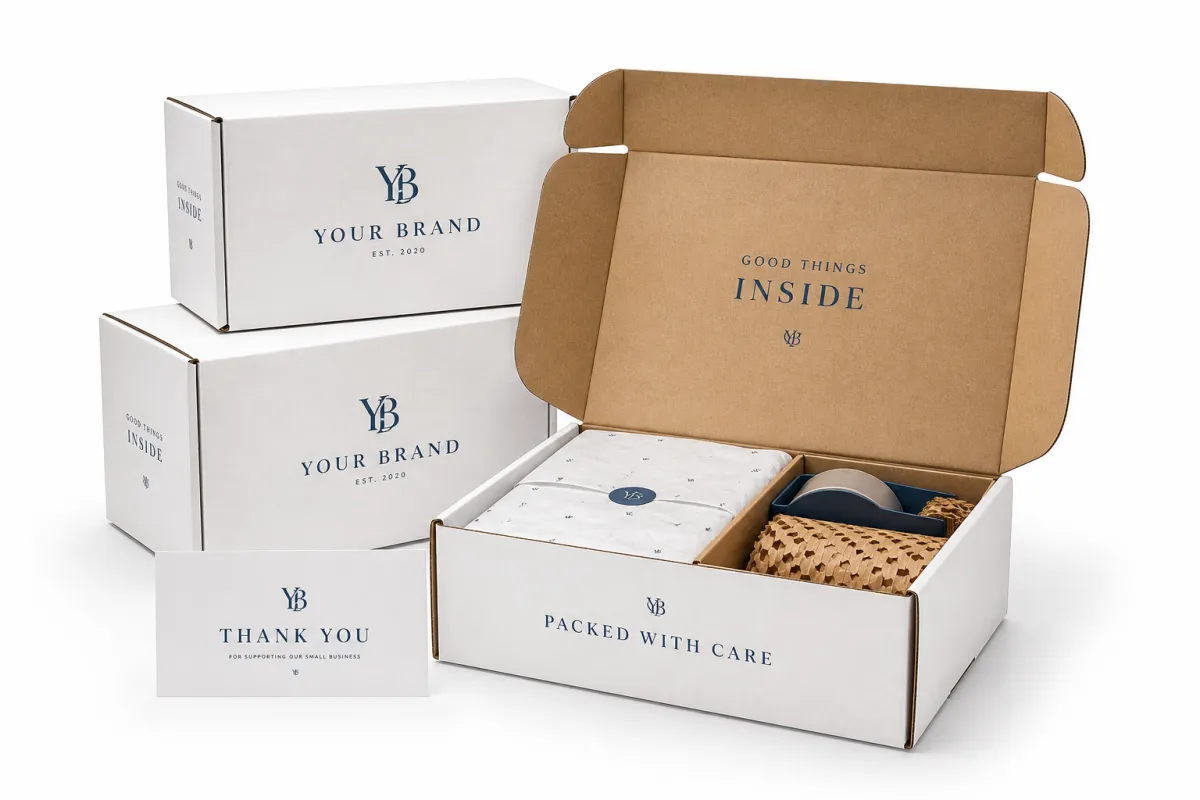
A branded shipping boxes supplier does far more than print a logo on corrugated board. The work starts with the product itself: weight, dimensions, fragility, shelf life, and the route the box will travel through the shipping environment. A good branded shipping boxes supplier looks at the full path, from packing bench to carrier truck to final doorstep, then builds a box spec That Holds Up through all of it. That is why the same supplier may recommend different board grades for a soap set, a candle kit, and a high-value electronics accessory.
The strongest suppliers sit between packaging engineer and production coordinator. They take brand assets and turn them into production-ready files, but they also check how those assets behave on a dieline, whether artwork stays inside safe zones, and whether the structure will collapse under stack pressure. A plain stock reseller usually stops at a catalog and a quantity. A real branded shipping boxes supplier helps with dieline setup, print guidance, board selection, and quality control. That difference matters because a polished mockup can fall apart once it meets shipping materials and transit abuse.
From a packaging buyer's point of view, the gap becomes obvious during order fulfillment. A stock box may be cheap and easy to source, yet it can create problems later if the fit is loose, the print is inconsistent, or the box fails carrier testing. A branded shipping boxes supplier usually thinks ahead about returns, warehousing, scan labels, bundling, and pallet stacking. That foresight can cut damaged goods, repacks, and customer complaints, which are expensive even when they do not show up on the first invoice.
A box that survives transit and still photographs well does more for perceived value than a discount on print ever will.
That is why many DTC and subscription brands treat packaging as a revenue decision, not a decoration decision. The branded shipping boxes supplier becomes part of the brand's physical presentation system. If the box tears, dents, or looks generic, the customer notices before the product has a chance. If the box opens cleanly and matches the brand's visual language, the shipment feels intentional. Small detail, outsized effect.
There is also a practical inventory angle. A branded shipping boxes supplier that understands production consistency can help reduce the risk of running three box versions that look close but pack differently. That matters for ecommerce shipping, where small shifts in box dimensions can change dimensional weight, freight tiers, and even which carton fits a fulfillment line. A good supplier helps prevent that kind of hidden leakage.
One statistic keeps resurfacing in logistics conversations: damage and rework often cost far more than the box itself. Carrier claims, replacement product, labor to repack, and customer service time can turn a cheap carton into an expensive mistake. A branded shipping boxes supplier that knows the math will talk about total landed impact, not just carton price. That wider view is one reason experienced teams keep the same supplier through multiple product launches.
It also helps to think in comparisons. A branded shipping boxes supplier is not just competing with another vendor on unit price. It is competing with the cost of a damaged customer experience, with a generic unboxing moment, and with the operational drag that comes from mismatched packaging specs. Once you frame it that way, the job description gets a little clearer. This is packaging as infrastructure, not decoration.
I once watched a fulfillment team switch from a loose-fitting mailer to a slightly tighter branded shipper and cut their complaint rate without changing the product at all. No big reveal. No marketing miracle. Just a better box. That kind of change does not make headlines, but it protects margin in a way a campaign never could.
How a branded shipping boxes supplier turns artwork into production
The path from artwork file to finished carton is more technical than most buyers expect. A branded shipping boxes supplier usually starts with a brief: product dimensions, target quantity, shipping method, brand goals, finish preferences, and any non-negotiables such as recycled content or a specific certification. From there, the supplier matches the project to a box structure, creates or confirms a dieline, and checks that the artwork can print cleanly within the selected format. That is where the first major saving often appears: a box that fits correctly can lower dimensional weight and reduce wasted shipping volume.
Good file prep matters. Bleeds, safe zones, panel orientation, and barcode placement all need to be set with real production tolerances in mind. A branded shipping boxes supplier that knows corrugated packaging will check whether logos sit too close to the fold, whether fine type will hold up at the selected line screen, and whether a full-wrap design will force unnecessary cost. A buyer may see only a flat PDF, but the supplier sees how the art lands across flaps, side seams, glue areas, and score lines.
Printing method changes both the look and the economics. Digital printing is often a strong fit for shorter runs, fast changes, and rich full-color graphics. Flexographic printing is usually better at scale, especially when the design uses simpler color builds and repeat orders. Lithographic or litho-lam options can deliver a more premium surface, but they often come with a higher setup and material cost. A thoughtful branded shipping boxes supplier will explain these tradeoffs without pretending one method fits every use case.
| Print option | Best fit | Typical price behavior | What to watch |
|---|---|---|---|
| Digital printing | Shorter runs, frequent artwork changes, launch packs | Often lower setup cost, unit price can stay higher at volume | Color matching can vary by substrate and coverage |
| Flexographic printing | Mid to high volumes, simpler graphics, repeat orders | Setup cost exists, but unit cost drops well at scale | Works best with cleaner artwork and fewer spot colors |
| Litho-lam / premium print | Retail-style presentation, stronger shelf or unboxing impact | Higher material and finishing cost, especially on custom sizes | Looks excellent, but freight and damage specs still matter |
Structure matters as much as print. Flute type, board grade, burst strength, Edge Crush Test, and finish all affect whether the box survives in the real world. A branded shipping boxes supplier that only thinks about graphics can miss the fact that a beautiful carton is useless if the corners crush under stacking pressure. That is especially true for heavier products, glass items, and kits shipped through high-volume carrier networks.
One useful question is whether the supplier can speak in standards. For fragile or high-value products, ask if they test against ISTA packaging performance protocols or related methods such as ASTM D4169. Those references do not guarantee perfection, but they do show the supplier understands package protection as a measurable discipline rather than a guess. For sustainability claims, look for FSC-certified material options and confirm the chain of custody through FSC documentation when it matters to your brand story.
A strong branded shipping boxes supplier also thinks beyond the artwork file. Warehouse handling, returns, poly bag inserts, shipping labels, and parcel-carrier abuse all affect the final result. A carton that looks great on a screen may still fail if the board is too light, the closure is weak, or the design places critical graphics where scuffing is most likely. That is where real packaging experience shows up. It is also where a supplier earns trust: by catching the small things before they become expensive things.
There is a comparison worth making here. A packaging file can be perfect and still produce a weak box if the structural decisions are wrong. The reverse is also true: a modest design can outperform a flashy one if the board, closure, and dimensions are tuned to the product. The branded shipping boxes supplier that understands both sides usually delivers the better outcome. That is why print quality alone is never enough for a serious procurement decision.
For brands that run multiple SKUs, the production step becomes even more important. A branded shipping boxes supplier may need to support a family of sizes with matching graphics, while keeping the structure stable enough that a fulfillment team can pack quickly. In that scenario, the supplier is not just making a box. It is building a repeatable system.
And yes, some of this is a little technical. But the technical pieces are exactly where money disappears if nobody is paying attention.
Key factors to compare before you choose a supplier
Material quality should come first. A branded shipping boxes supplier should be able to explain the board grade, recycled content, and finish options in plain language. If your product is light and stable, a lighter board may be enough. If it is dense, fragile, or expensive, you may need stronger corrugated construction. A one-size-fits-all box spec rarely works across multiple product lines, and that is exactly where shipping damage starts to creep in.
Customization depth is the second filter. Some suppliers can only do a logo on one panel. Others can support full-coverage graphics, inside printing, special coatings, die-cut windows, inserts, and structural variations. A branded shipping boxes supplier that can only offer minimal customization may still be fine for a commodity item, but a launch box or subscription package often needs more control over the unboxing sequence. If you want a specific reveal, the box design has to support it structurally, not just visually.
Consistency controls are where many buyers underestimate risk. Ask how the supplier checks color, print registration, and board tolerances. Ask whether they send a press proof, a structural sample, or a preproduction sample. A low price can become expensive if the second and third runs drift from the approved sample. A branded shipping boxes supplier with clear batch inspection standards is usually better than one that promises perfection and says little about how it is maintained.
Service model matters more than people sometimes admit. Responsive artwork support, defined approval stages, and milestone updates reduce the chance of surprise delays. The best branded shipping boxes supplier behaves like a production partner, not a silent quote engine. If a file has an issue or a panel needs adjustment, you want to hear about it before the run starts, not after pallets have already shipped.
Scalability is a practical concern, too. A supplier that handles 500 boxes today and 50,000 later can save a huge amount of switching pain. Even if your current order is small, it helps to know whether the branded shipping boxes supplier can grow with the line. Constantly changing vendors makes color consistency, inventory planning, and replenishment more difficult than it needs to be. It also makes it harder to learn which packaging decisions actually move the needle.
Here is a simple comparison lens that works well in procurement reviews:
- Cost - Not just unit price, but tooling, freight, sampling, and spoilage.
- Quality - Board strength, color accuracy, print registration, and box fit.
- Service - File support, response time, approval clarity, and proactive communication.
If two quotes are close, the supplier that explains the tradeoffs clearly usually wins in the long run. That is often the difference between a stressful packaging cycle and a smooth one.
Procurement teams often miss one more factor: handling on the receiving end. A supplier may deliver a good box, then bury a warehouse in awkward pallet counts or mixed-case packs. A branded shipping boxes supplier that thinks through receiving windows and pallet structure can reduce friction after the cartons leave the pressroom. The box is only half the story. The rest is how it enters your operation and how easily your team can use it.
Branded shipping boxes supplier pricing: what drives cost
Pricing is where buyers often get their first surprise. A branded shipping boxes supplier does not price from the logo alone; the quote comes from a mix of box size, board grade, print coverage, number of colors, finish, quantity, and shipping destination. A small change in dimensions can alter board yield and dimensional weight, which changes both manufacturing economics and parcel cost. A larger box also means more material, more freight, and more cube space in storage.
Volume is the biggest lever. Unit price usually falls as order quantity rises because setup is spread across more boxes. That said, total spend can climb quickly if the packaging is oversized, heavily printed, or built from premium materials. A branded shipping boxes supplier may quote a very attractive unit cost on a large run, but if the box adds enough volume to increase freight class or parcel charges, the total landed cost can still be higher than a smaller design.
There are visible costs and hidden costs. Visible costs are the quote line items most buyers expect: manufacturing, printing, finishing, and shipping. Hidden costs include plates, tooling, samples, warehousing, reprint risk, and spoilage. A branded shipping boxes supplier that offers a low factory price but leaves freight and setup vague is not giving a full picture. Good buyers ask for landed cost, not just carton cost.
The table below shows how cost typically behaves across common options. These are broad planning ranges, not universal prices, but they help anchor the discussion:
| Option | Approximate sweet spot | Indicative unit range | Cost note |
|---|---|---|---|
| Single-color digital corrugated mailer | 500-2,500 units | $0.85-$1.75 | Good for smaller launches and frequent art changes |
| Two-color flexo shipping box | 3,000-10,000 units | $0.55-$1.20 | Often efficient for repeat ecommerce shipping programs |
| Full-coverage premium litho-lam box | 1,000-5,000 units | $1.90-$4.50 | Higher visual impact, stronger presentation, higher setup cost |
| Heavy-duty custom RSC with inserts | 2,000-8,000 units | $1.10-$3.20 | Driven by board strength, internal protection, and size |
Design choices can make a real difference. Fewer ink colors usually help. Standardized dimensions often help even more, because they improve material yield and reduce dimensional weight. Full-wrap coverage, specialty coatings, and complex inserts raise price fast. A smart branded shipping boxes supplier will show where a simple layout can preserve brand feel without paying for unnecessary extras. Sometimes the smartest design is the one that spends less in the places customers never see.
That does not mean cheaper is better. A weak carton can trigger damage rates that erase any savings. One crushed shipment may cost more than the premium you avoided. A damaged box also hurts the customer experience, creates service tickets, and can increase return rates. For a packaging buyer, the cheapest unit price is only useful if package protection still holds up in the courier network.
One more factor people forget is storage. Boxes occupy space before they ship, so a large run can become a warehouse problem if the footprint is big. A branded shipping boxes supplier should help you think about pallet counts, case pack, and receiving windows. Those details affect order fulfillment in a very real way, especially if your team is working with limited back-of-house space.
There is also the cost of change. Every time a design shifts, someone has to recheck dielines, reproof art, and often revalidate the carton size against the product. A branded shipping boxes supplier that helps lock dimensions early can reduce that churn. The savings do not always appear on a quote sheet, which is exactly why they are easy to miss. Over a year, those small revisions can add up more than a one-time setup fee.
I have seen teams save money by shrinking a box a half-inch and then spend some of it back in slower pack-out because the team had to fold inserts more carefully. Packaging economics are funny that way. The cheapest change on paper is not always the cheapest change in the building.
Branded shipping boxes supplier process and timeline
The process usually starts with discovery. A branded shipping boxes supplier asks what the product weighs, how it ships, what the customer sees first, and how many units are needed. That first step matters because it sets the entire spec. If the supplier knows the product will go through parcel-carrier handling, they may recommend stronger board or a different structural style than they would for local delivery or retail pickup.
Next comes proofing and design review. The supplier confirms the dieline, checks the artwork, and flags any layout issues before anything goes to production. This stage often takes the longest when files are incomplete or when a brand is still deciding on graphics. A branded shipping boxes supplier can move quickly if the assets are clean; if not, revision cycles stack up. That is where many timelines drift.
Typical timing can look like this, though every program depends on complexity and workload:
- Discovery and quote - 1-3 business days for most standard projects.
- Dieline and artwork setup - 2-5 business days if files are complete.
- Sampling or proof approval - 3-7 business days, sometimes longer for structural changes.
- Production - often 10-20 business days after approval, depending on print method and quantity.
- Freight and receiving - 2-7 business days for domestic delivery, longer for export shipments.
Rush orders change the equation. A faster schedule may narrow customization choices, reduce proof rounds, or raise the price. That is not a flaw; it is a reality of production capacity. A branded shipping boxes supplier that is honest about tradeoffs is usually easier to work with than one that promises a miracle. If you need a launch date locked, make sure the timeline includes artwork approval, sample sign-off, and warehouse receiving time, not just the press date.
Delays often come from missing files. Common trouble points include low-resolution logos, undefined Pantone references, last-minute copy changes, and unclear box measurements. Export freight can add another layer because customs, port timing, and warehouse handoff all introduce uncertainty. A good branded shipping boxes supplier will call out these dependencies before they become problems. That kind of proactive communication saves launch plans.
For brands with recurring programs, milestone tracking is worth building into the process. Ask for a simple status flow: quote approved, artwork received, proof sent, proof approved, production started, packed, shipped. That may sound basic, but it keeps everyone aligned. It also creates a paper trail if something changes. A branded shipping boxes supplier that updates clearly helps reduce stress on the brand side and keeps replenishment more predictable.
In practice, the fastest projects are rarely the fanciest ones. Clean files, standard structures, and decisive approvals beat elaborate back-and-forth almost every time. A branded shipping boxes supplier can only move as fast as the slowest decision in the chain. If one stakeholder keeps changing the panel copy, the schedule will stretch no matter how efficient the plant is.
That is the part buyers sometimes miss. Speed is rarely a magic trick. It is usually just fewer surprises.
How to choose the right supplier step by step
Start with the use case. Before you request pricing, define product weight, shipping method, monthly volume, aesthetic goal, sustainability target, and budget ceiling. A branded shipping boxes supplier can only give useful guidance if the brief is specific enough to compare options. A 6-ounce skincare kit and a 3-pound bottle set do not belong in the same carton spec, even if the logo treatment is identical.
Then request apples-to-apples quotes. Give each branded shipping boxes supplier the same dimensions, artwork specs, quantity, delivery location, and desired finish. Otherwise, you are not comparing suppliers; you are comparing assumptions. A quote that looks cheaper can become more expensive after freight, sampling, or a size correction. I always push buyers to compare landed cost, not just per-unit print cost.
Samples and case studies matter because they show real output. A polished pitch deck is not enough. Ask for a physical sample if the product will be customer-facing. Ask for examples with similar board weight, print coverage, or carton format. A branded shipping boxes supplier with a good track record should be able to show how the packaging performs, not just how it renders on a screen. See how our Case Studies document different packaging decisions and the tradeoffs behind them.
Score each supplier on three axes: cost, quality, and service. The cheapest quote may lose once delays, reprints, or damages are factored in. The most beautiful sample may not be worth it if lead times are unstable. The easiest team to work with may be slightly more expensive but still deliver better total value because they prevent mistakes. A branded shipping boxes supplier is a long-term operational choice, not a one-time purchase.
A trial run is smart before a large commitment. Even a modest first order can reveal issues with box fit, print clarity, pack-out speed, and customer response. If the packaging is for a launch, one pilot run often catches the mistakes that are hardest to fix later. For brands comparing box formats or planning a broader packaging refresh, reviewing Custom Shipping Boxes alongside other packaging formats can help isolate the best fit.
Useful questions to ask any branded shipping boxes supplier:
- Which board grade do you recommend for this product weight?
- Can you provide a dieline, proof, and sample before production?
- What is included in the landed price?
- How do you control color consistency across repeat orders?
- What is the reprint or replacement policy if the shipment is out of spec?
That last question is more important than many buyers realize. A supplier who is willing to talk plainly about replacement terms usually has a stronger process overall. Silence around quality issues is a warning sign.
A useful shortcut is to ask for one example of a project that failed and how the supplier corrected it. The answer reveals more than a polished portfolio ever will. A branded shipping boxes supplier that can describe a problem honestly is usually the one that can prevent the next one.
One more practical check: ask who actually owns artwork changes once the order starts. If the answer is fuzzy, expect delays. If the answer is clear, you are probably dealing with a supplier that has been through enough production runs to know where the bodies are buried.
What should you ask a branded shipping boxes supplier before ordering?
Ask the questions that expose how the supplier actually works, not just how the quote looks on paper. A branded shipping boxes supplier should be able to explain recommended board grades, print methods, sampling steps, and the likely lead time with enough specificity that you can plan around it. If the answers stay vague, that is a signal in itself.
Start with the product and the shipping path. A good supplier should tell you whether the carton needs stronger corrugation, a different closure, or a different print method for the volume you expect. Then ask for a sample process that includes dieline approval, proofing, and a clear sign-off stage. A branded shipping boxes supplier that works this way is usually less likely to surprise you later with rework or missed assumptions.
You should also ask about repeat-order stability. Color consistency, board availability, and replacement policy matter more than they first appear. A branded shipping boxes supplier that can maintain a design across multiple runs is giving you operational continuity, not just packaging. That continuity becomes especially valuable if you are growing quickly or shipping through multiple fulfillment centers.
Common mistakes when buying branded shipping boxes
The first mistake is choosing on looks alone. A box can be visually attractive and still fail in transit if the compression strength is wrong or the fit is loose. A branded shipping boxes supplier should ask about shipping method, product weight, and how much handling the carton will endure. If they do not, the box may look good in a rendering and disappoint in actual use.
The second mistake is uploading weak artwork. Low-resolution logos, unapproved color values, and missing fonts create avoidable issues. Blurry print or a logo shifted too close to a fold line can make a premium package feel careless. A reliable branded shipping boxes supplier will review the files, but buyers should still provide clean assets and approve proofs carefully. Skipping that step is one of the fastest ways to burn time and budget.
The third mistake is ordering too much too soon. A big order can seem efficient, but it is risky if the box has not been validated in use. Maybe the pack-out is tight. Maybe the print needs one more adjustment. Maybe customers respond better to a smaller box with a cleaner layout. A phased order lets the brand learn before it commits to a full run. That matters especially for new ecommerce shipping programs.
The fourth mistake is overlooking freight and storage. A low factory quote can evaporate once pallet charges, inbound freight, and warehouse space are added. Dimensional weight also matters, because the box itself can change parcel cost. A branded shipping boxes supplier should help you think through both manufacturing and logistics so the real landed cost is visible. Otherwise, the savings are only theoretical.
The fifth mistake is not asking about tolerances. If the box is slightly oversized, slightly off-register, or slightly inconsistent from batch to batch, the problem may show up later as a customer complaint or an inventory headache. Ask how the supplier handles replacement runs, what their acceptable variation is, and how they manage quality checks. A good branded shipping boxes supplier does not hide those answers.
One practical habit helps avoid most of these errors: keep a written spec sheet. Include board grade, outer dimensions, print method, quantity, approved artwork version, delivery address, and sample approval date. That simple document makes the entire process easier to manage. It also gives everyone a common reference if a run needs to be repeated later.
Another mistake appears in fast-growing brands: changing dimensions without checking fulfillment impact. A quarter-inch increase can sound trivial. In a warehouse, that quarter-inch can affect pack speed, case fit, and pallet count. A branded shipping boxes supplier that flags those ripple effects is saving the team from future friction. Those are the details that separate a vendor from a partner.
Expert tips and next steps for better packaging decisions
Use packaging as a brand signal, not just a container. A clean, consistent box can make the shipping experience feel more deliberate without changing the product itself. That matters because the customer does not separate brand perception from package protection. They see one event. A branded shipping boxes supplier that understands that reality can help the box do both jobs at once.
Test one variable at a time if you can. For example, compare two print covers on the same structure, or two finishes on the same artwork. That is a much cleaner way to learn what changes perceived value than altering everything at once. If the whole package changes, it becomes hard to tell whether the lift came from color, structure, size, or just novelty. A branded shipping boxes supplier with a process mindset will support that kind of controlled test.
Build a simple scorecard. Track price, lead time, communication, sample quality, and damage rates after delivery. It does not have to be fancy. Even a spreadsheet with five columns can reveal which branded shipping boxes supplier is actually easy to work with and which one creates hidden workload. Over time, that record becomes more useful than memory alone. People forget price; they remember headaches.
Also think about the next order, not just this one. If volume may grow, ask whether the supplier can scale and whether the spec can stay stable. If the product line may split into different sizes later, ask how easy it will be to adjust the dieline. A branded shipping boxes supplier that can support growth without a full reinvention is often worth more than the lowest immediate quote.
Here is the practical move I would make: shortlist two or three suppliers, request matching samples, confirm the timeline and landed cost, then run a small first order before scaling. That sequence reduces risk without slowing the brand down too much. It is also the fastest way to see whether the vendor can handle both the creative side and the operational side of transit packaging.
For brands that want a durable relationship rather than a one-off purchase, the best branded shipping boxes supplier is the one that repeats quality, protects the product, and stays predictable as orders grow. That is the standard I would use every time. It is also the standard that keeps packaging from becoming a recurring fire drill.
There is a deeper reason to treat the supplier choice seriously. Packaging is one of the few brand assets that lives in the warehouse, rides with the carrier, and lands in the customer’s hands all in the same day. Very few marketing tools have that much physical reach. A branded shipping boxes supplier sits at the intersection of all three.
Choose well and you reduce waste, rework, and carrier damage. Choose poorly and even a handsome box can become an expensive lesson. That contrast is why procurement teams, operations leaders, and marketers should all care about the same supplier conversation.
The cleanest takeaway is this: pick the supplier that can explain structure, print, lead time, and replacement terms in the same breath. If they can do that, they probably understand your packaging problem. If they cannot, you are still shopping for a quote, not a partner.
Frequently Asked Questions
What should I ask a branded shipping boxes supplier before ordering?
Ask which box styles, board grades, and print methods they recommend for your product weight and shipping method. Then confirm whether they provide dielines, proofs, samples, and revision support before production starts. I would also request a landed-cost quote that includes freight, tooling, and any setup fees so the total spend is clear, especially if you are comparing more than one branded shipping boxes supplier.
How much does a branded shipping boxes supplier usually charge?
Pricing depends on size, print coverage, quantity, and material grade, so two boxes that look similar can have very different costs. Unit price usually drops at higher volumes, but setup, sampling, and freight can still affect the final landed cost. The cleanest comparison is an apples-to-apples quote with matching specs from each branded shipping boxes supplier.
How long does a branded shipping boxes supplier need to produce custom boxes?
Timeline depends on proofing speed, sample approval, order size, and whether the box uses standard or custom construction. Artwork revisions and missing files are common delay points, so it helps to prepare designs before asking for a quote. If you need faster turnaround, ask whether rush production is available and what customization tradeoffs it creates with that branded shipping boxes supplier.
How do I know if a branded shipping boxes supplier is reliable?
Look for clear communication, sample quality, and consistent answers about materials, lead times, and production limits. Ask for case studies or examples from similar products so you can judge fit, print quality, and packaging strength. A reliable branded shipping boxes supplier is transparent about constraints instead of overpromising on cost, speed, or customization.
What makes one branded shipping boxes supplier better than another?
The best supplier balances print quality, structural performance, and pricing instead of excelling in only one area. Strong support during artwork setup and production often matters as much as the box itself because it prevents costly errors. Compare long-term fit: a supplier that can scale with your volumes and keep quality stable usually wins over a cheaper short-term option, and that is the real mark of a dependable branded shipping boxes supplier.