Buyer Fit Snapshot
| Best fit | Branded Sustainable Product Packaging Cost projects where brand print, material claims, artwork control, MOQ, and repeat-order consistency need to be specified before quoting. |
|---|---|
| Quote inputs | Share finished size, material target, print colors, finish, packing count, annual reorder estimate, ship-to region, and any compliance wording. |
| Proofing check | Approve dieline scale, logo placement, barcode or warning zones, color tolerance, closure strength, and carton packing before bulk production. |
| Main risk | Vague material claims, crowded artwork, missing packing details, or unclear freight terms can make a low unit price expensive after revisions. |
Fast answer: Branded Sustainable Product Packaging Cost: Material, Print, Proofing, and Reorder Risk should be specified like a repeatable production item. The safest quote records material, print method, finish, artwork proof, packing count, and reorder notes in one written spec.
Production checks before approval
Compare the actual filled-product size with the drawing, then confirm tolerance on folds, seals, hang holes, label areas, and retail display edges. Reserve space for logos, QR codes, warning copy, and material claims before decorative graphics fill the panel.
Quote comparison points
Review material grade, print process, finish, sampling route, tooling charges, carton quantity, and freight assumptions side by side. A quote is only useful when the supplier can repeat the same color, closure quality, and packing count on the next order.
Branded Sustainable Product Packaging Cost: What Actually Moves the Number
I have sat through enough packaging reviews to know the pattern. A brand asks for recycled board, FSC sourcing, and a cleaner print approach, then the quote lands higher than expected and everyone blames the material. Usually that is only part of the story. Freight, setup, structural choices, assembly time, and the habit of overbuilding the pack are often doing more damage than the substrate itself.
For teams comparing custom printed boxes, mailers, pouches, or inserts, the useful question is not whether sustainable packaging is expensive. The sharper question is which combination delivers the best total value once material, shipping, labor, and damage risk are all counted. That is the lens that matters, because branded sustainable product packaging cost is a system cost, not a single line item.
Brands get tripped up when they judge a sample by hand feel and assume the production run will behave the same way. It rarely does. A dieline change, a wider ink coverage area, or a carton that looks elegant on a desk but ships poorly on a pallet can move the quote fast. The sample is the opening clue, not the final answer.
There is also a small but expensive truth that gets missed in procurement meetings: paper is not just paper. Recovered fiber supply, coating choices, board caliper, and converting method can shift the economics in ways that are hard to see from a glossy mockup. That is why two packs that look almost identical can land in very different cost bands. I have watched a design save 8% in board weight and lose 12% to extra packing labor. Not pretty.
What affects branded sustainable product packaging cost most?
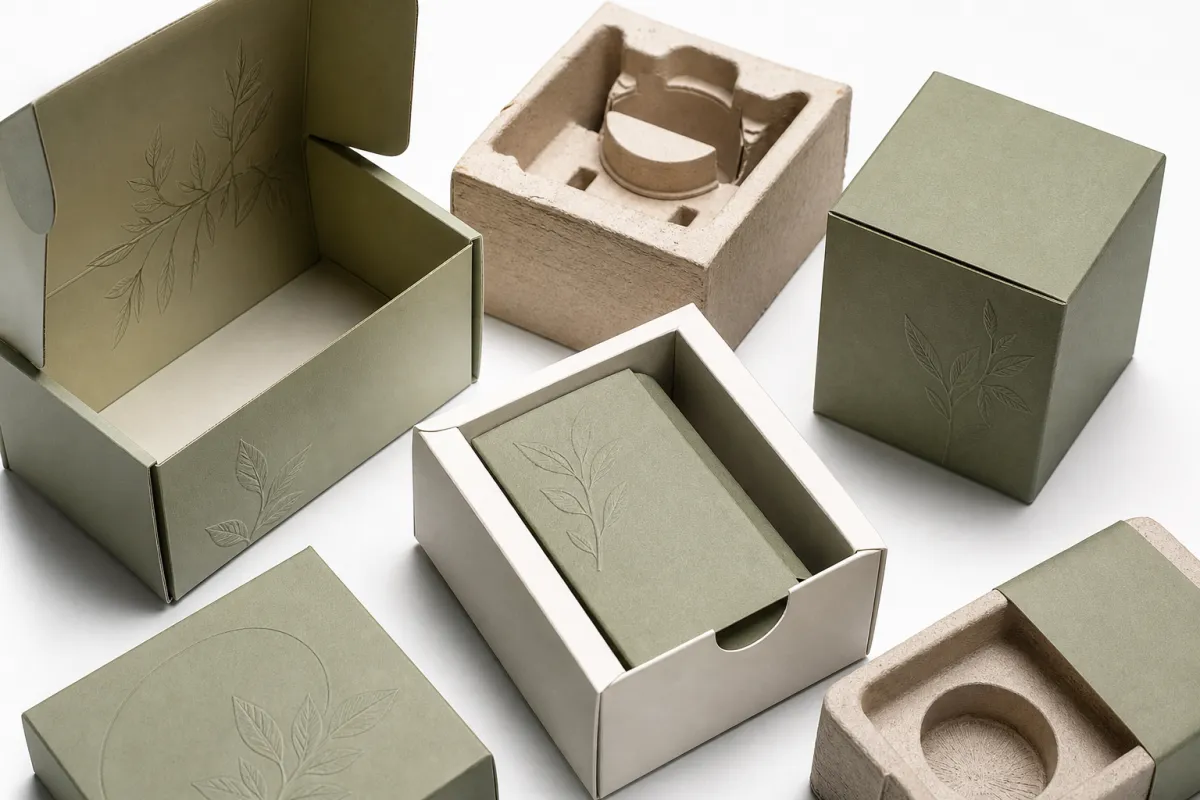
Substrate choice matters, but it is only one lever. Branded sustainable product packaging cost rises or falls based on how much structure the package needs, how it is printed, how much finishing is layered on top, and whether extra components are added to support the product. A recycled paperboard carton can look modest on a quote sheet, then turn into a pricier package once a custom insert, a laminate, and premium finishing are added.
From the buyer's side, the cost stack usually includes:
- Material grade - kraft paper, recycled paperboard, corrugated, molded fiber, or recyclable film.
- Structure complexity - tuck ends, locking tabs, sleeves, two-piece rigid-style cartons, or reinforced mailers.
- Print coverage - single-color branding, full-bleed graphics, inside printing, or variable data.
- Coatings and finishes - aqueous coating, matte varnish, embossing, foil accents, or soft-touch lamination.
- Support components - molded pulp trays, paperboard inserts, dividers, or retention features.
- Freight and handling - cube efficiency, pallet count, dimensional weight, and warehouse labor.
- Testing and setup - dieline creation, sample rounds, tooling, or drop and transit validation.
Two packages can look nearly identical on a spec sheet and still price very differently. One may use a simple corrugated sleeve with one-color print. The other may use a premium retail carton with a multi-part insert system and extra finishing. The second package can improve shelf appeal, but it also increases branded sustainable product packaging cost in a way that is easy to miss if the comparison stops at board thickness.
Sustainable choices can also lower total spend when the design is smarter. A lighter mailer can cut freight. A one-piece structure can shorten packing time. A paper-based insert can replace a plastic tray without much change to the finished carton price, especially at volume. In those cases, branded sustainable product packaging cost improves because the package is better built, not because the material is magically cheaper.
That is why I treat sustainable packaging as a design decision first and a materials decision second. Good package branding should protect the product, reinforce the brand, and stay efficient to ship. If any one of those falls apart, the economics shift right away.
"The cheapest quote is rarely the lowest landed cost. If the package ships heavier, takes longer to assemble, or damages product in transit, the savings disappear fast."
For teams building retail packaging or ecommerce packaging, the channel matters just as much as the look. A carton meant for unboxing is not the same as a shipping-grade solution for long-haul distribution. The right answer depends on product weight, fragility, order volume, and how much of the customer journey the pack has to carry. A lot of people forget that a box is not just a box; it is part protection, part logistics container, and part brand signal. That is a tricky mix, kinda by design.
What drives branded sustainable product packaging cost in custom orders
Material choice is still the headline variable, yet it is only one part of the total. Branded sustainable product packaging cost moves up or down based on a cluster of decisions, and experienced buyers review them together instead of isolating one detail at a time.
Material type is the first lever. Kraft paper fits a natural brand story and often keeps print requirements simple. Recycled paperboard is popular for retail-ready cartons because it balances presentation and cost. Corrugated board is usually the strongest candidate for shipping protection, especially when product safety matters more than shelf presence. Molded fiber works well for inserts and trays, though tooling and mold design can add cost if the shape is complicated. Recyclable or plant-based film can work for pouches, but the specification has to match the product and the barrier needs closely.
Box size comes next. Oversized packaging wastes board and raises dimensional weight. That extra air is expensive to move, and it can make the package feel less polished. Right-sizing is one of the clearest ways to lower branded sustainable product packaging cost without stripping away perceived value.
Print method changes the math too. Digital printing can support shorter runs and faster proofs, but the unit price is often higher than conventional printing at scale. Offset printing tends to be more efficient on medium and large orders, especially for custom packaging with detailed graphics. Flexographic print is often competitive for corrugated structures, particularly when the design is cleaner and the finish does not demand elaborate detail.
Number of colors matters more than many buyers expect. A one- or two-color layout can still read as premium if the material, typography, and structure carry the design. Full-color art across every surface increases ink use, setup time, and quality checks. It can still be the right choice, but only when the commercial return is obvious.
Special finishes often trigger the fastest jump in price. Soft-touch lamination, foil stamping, spot UV, debossing, and heavy embossing all add production steps. If the goal is a clean sustainable story, a restrained finish strategy can keep the pack polished while holding down branded sustainable product packaging cost.
Order volume changes the pricing tier sharply. Low quantities carry more setup burden per piece because prepress, material prep, and line changeovers are spread across fewer units. Once a brand moves from pilot run to full production, the unit price can drop quickly. A quote at 500 units and a quote at 5,000 units are not comparable unless the structure and print spec stay the same.
Hidden variables are where people usually get surprised:
- Freight class - heavier or bulkier packs cost more to move.
- Dimensional weight - oversized cartons can raise parcel spend even when the carton itself is inexpensive.
- Waste from bad sizing - off-spec dimensions can waste board, increase dunnage, and slow packing lines.
- Extra proof rounds - artwork changes after the first proof extend the timeline and can add charges.
- Testing requirements - transit or drop testing may be needed before sign-off, especially for fragile products.
If you are comparing branded sustainable product packaging cost across suppliers, ask each one to price the same spec, the same quantity, and the same delivery terms. Otherwise the lowest number can simply be the least complete number.
Product details: boxes, mailers, pouches, and inserts that fit the budget
Not every format fits every product, and that is where budgets are won or lost. A brand that chooses the right structure often reduces branded sustainable product packaging cost without making the pack feel cheap. The trick is matching the format to the product, the channel, and the shipping path.
Corrugated mailers are often the first choice for ecommerce and subscription brands. They offer solid crush resistance, good stacking performance, and a familiar unboxing experience. For shipping-heavy programs, corrugated is frequently the most economical route because it protects the product and can be produced in high volumes with efficient print methods.
Recycled Paperboard Boxes tend to win in retail packaging and presentation-led programs. They are lighter than corrugated, which can help with freight, and they produce sharper print results for shelf-facing product packaging. If the product is not especially fragile, paperboard can strike the cleanest balance between image and budget.
Paper pouches or recyclable film pouches can work for lighter, lower-profile items. They keep material use low and may shrink the shipping cube. That said, barrier requirements and sealing methods matter. If the product needs moisture protection, grease resistance, or tamper evidence, the spec can climb quickly and push branded sustainable product packaging cost upward.
Molded fiber inserts are one of the stronger replacements for plastic trays when the product needs retention inside a box. They create a natural presentation and can cut plastic use sharply. At scale, molded fiber can be cost-competitive with other insert systems, but the savings depend on geometry, mold complexity, and the number of cavities in the tray.
Paperboard inserts are useful when the brand wants an efficient recyclable internal structure. They are often easier to print and die-cut than molded parts, and they can be folded to create product retention without adding a separate plastic piece. For many kits, this is the most practical middle-ground option.
The rule I use is simple: build the simplest package that still protects the product and supports the brand story. A well-designed product packaging system usually beats an overbuilt one, even if the latter looks impressive in a sample room.
| Format | Best Use | Typical Material | Indicative Unit Cost Pressure | Budget Advantage |
|---|---|---|---|---|
| Corrugated mailer | Ecommerce, shipping, subscription kits | F-flute or E-flute recycled corrugated | Moderate, often lower at volume | Strong protection and efficient packing |
| Recycled paperboard box | Retail packaging, cosmetics, apparel accessories | 300-450gsm paperboard | Moderate to low depending on print coverage | Cleaner shelf presentation and lighter weight |
| Molded fiber insert kit | Product retention, fragile components, premium kits | Recycled pulp or molded fiber | Variable, tooling can raise startup cost | Replaces plastic trays with a recyclable alternative |
| Paper pouch | Lightweight goods, flexible items, low-profile SKUs | Kraft or barrier paper laminate | Low to moderate, barrier features add cost | Low material use and smaller shipping footprint |
If the product is fragile, the cheapest box is not the right box. If the product is durable, a simpler pack can save a lot. That is where branded packaging decisions should feel commercial, not sentimental. The best package supports the product and keeps branded sustainable product packaging cost aligned with the business the brand is actually running.
For buyers who want a broader look at structure options, the line of Custom Packaging Products is a useful place to compare formats before settling on a spec. If the team needs proof that a simpler structure can still perform, the Case Studies page shows how packaging design choices affect the finished result.
Specifications that change branded sustainable product packaging cost
Spec language is where budget decisions become real. Branded sustainable product packaging cost changes quickly once a buyer moves from broad ideas like "eco-friendly box" to precise choices like board thickness, flute profile, or coating type. The quote is only as steady as the specification behind it.
Board thickness and GSM are obvious cost drivers. Thicker board usually increases material cost, though not always in direct proportion. Sometimes a slightly lighter grade with a smarter structure performs just as well and saves money in both material and freight. In practice, the difference between 350gsm and 400gsm may be small on the shelf but meaningful across a larger run.
Flute profile matters for corrugated packaging. E-flute gives a finer print surface and a slimmer finished pack. F-flute is even thinner and can improve presentation on certain retail programs. B-flute or larger profiles increase cushioning and compression strength. The right flute can reduce damage and lessen the need for extra inserts, which directly affects branded sustainable product packaging cost.
Print area is another cost driver hiding inside design choices. A full-bleed design uses more ink and more press attention than a restrained logo on the front panel. Interior printing adds a premium feel, but it also adds setup and registration risk. If the objective is cost control, decorate the surfaces that matter most to the buyer and the end customer.
Dieline complexity affects both production time and waste. A simple tuck box is easier to produce than a carton with multiple locking points, display windows, and specialty folds. Every extra crease or cut adds room for error. That can increase sampling, inspection, and scrap. A cleaner dieline often lowers branded sustainable product packaging cost more than a small material downgrade would.
Structural lock style is especially relevant for ecommerce and shipping cartons. Auto-lock bottoms, reinforced tabs, and tamper-evident features all have a place, but each one changes material usage and assembly time. If the box is going to be hand-packed, the easiest fold is often the most economical solution.
Finishes and inks matter as well. Soy-based inks can fit certain print programs. Aqueous coatings are common because they add protection without the heavier footprint of some film laminations. Embossing can create tactile value without a large amount of extra material. Foiling looks strong on a premium retail pack, but it should be used carefully because it can raise both cost and production complexity. Matte and gloss laminations each have tradeoffs; they change touch, reflectivity, and recyclability expectations.
For sustainability documentation, buyers may need FSC chain of custody for fiber sourcing, food contact compliance for edible or cosmetic items, or validated compostable claims under standards such as ASTM D6400. If the package is being sold as recyclable, the claim has to stand up to scrutiny. A supplier with strong prepress support should be able to say what can be claimed and what should not be claimed. If they cannot, that is a red flag, plain and simple.
For transit performance, packaging that will move through parcel networks should be tested against accepted procedures such as ISTA methods. Elegant packaging that fails in shipment is expensive packaging, no matter what the unit price says.
Here is the buyer checklist I would use before requesting quotes:
- Exact product dimensions and weight.
- Target drop protection or compression requirement.
- Branding assets, print colors, and artwork status.
- Desired finish and any claims that must appear on pack.
- Shipping method: parcel, LTL, retail distribution, or mixed channel.
- Retail-ready requirement, shelf display need, or unboxing priority.
The cleaner the brief, the tighter the answer. A vague brief almost always produces a wider price range, and that makes branded sustainable product packaging cost harder to control.
Pricing, MOQ, and unit economics for branded sustainable packaging
Quotes usually break into several pieces: unit price, setup or tooling, sampling, printing, freight, and any post-processing charges. If you only look at the per-piece line, you are missing the full picture. That is how branded sustainable product packaging cost gets misread.
MOQ, or minimum order quantity, matters because production has fixed costs. The press has to be set up. The die has to be made or checked. The line has to be cleaned, calibrated, and approved. Those steps exist whether the order is 500 pieces or 10,000. A small run can still be the right business decision, but the unit price will usually be higher because those fixed costs are spread across fewer finished packs.
Here is a realistic range view for Custom Sustainable Packaging, assuming standard structures and no extreme premium finishing:
- Prototype or sample run - often priced to prove fit and print, not to optimize unit cost.
- Pilot run - usually the best stage to test demand before committing to inventory.
- Full production - where setup cost is spread more efficiently and branded sustainable product packaging cost usually drops.
For example, a recycled paperboard tuck box might land around $0.42-$0.68 per unit at 5,000 pieces, depending on size, print coverage, and finish. A corrugated mailer could sit around $0.55-$0.95 per unit for a similar volume if the board spec and graphic complexity are modest. Add a molded fiber insert system, and the total may rise, but the plastic replacement can be worth it if the product protection improves and the customer presentation gets stronger. Those figures are directional, not a promise; current paper markets, regional labor, and freight lanes all move the final number.
That is why I always compare unit cost and landed cost separately. Unit cost is the factory number. Landed cost includes freight, packaging assembly, sampling, and any in-house handling. A low ex-factory quote is not automatically the best deal if the carton ships in a larger cube, requires more labor, or damages product in transit.
A useful rule: compare packaging quotes only after every supplier has priced the same dimensions, the same substrate, the same print method, the same finish, and the same delivery terms.
Here is a simple side-by-side framework that helps buyers compare two quotes without guessing:
| Comparison Point | Quote A | Quote B | What to Check |
|---|---|---|---|
| Dimensions | Same or different? | Same or different? | Oversized packs can inflate freight and material use. |
| Material | Kraft, paperboard, corrugated, molded fiber | Kraft, paperboard, corrugated, molded fiber | Confirm grade, recycled content, and performance. |
| Print coverage | Limited or full coverage | Limited or full coverage | Ink coverage affects press time and finish choices. |
| Setup and tooling | Included or separate | Included or separate | Tooling can swing the first order dramatically. |
| Freight terms | Ex works, FOB, or delivered | Ex works, FOB, or delivered | Use the same delivery basis before comparing totals. |
| Assembly | Flat, nested, or pre-glued | Flat, nested, or pre-glued | Labor cost can matter more than the material itself. |
Price breakpoints usually show up in three places. First, the jump from sample to pilot. Second, the jump from pilot to production. Third, the jump from standard finishing to premium finishing. Those are the moments where branded sustainable product packaging cost either becomes efficient or starts to drift.
If a supplier cannot explain those breakpoints clearly, that is a warning sign. Good procurement work depends on transparency. Buyers do not need sales fluff; they need a spec, a unit cost, a setup cost, and a freight estimate that can stand up to internal review.
Process and timeline for custom sustainable packaging orders
The process is usually straightforward, but the pace depends on the quality of the brief. A well-prepared order can move from discovery to shipment without drama. A vague one can burn weeks. Every delay affects branded sustainable product packaging cost, because idle time, rush changes, and extra proofs all add expense somewhere in the chain.
Here is the typical workflow:
- Discovery - confirm product dimensions, weight, channel, and branding goals.
- Specification review - choose the substrate, structure, and finish that fit the product.
- Quotation - compare unit price, tooling, sampling, freight, and delivery terms.
- Dieline creation - develop the structural file and check fit.
- Artwork setup - place graphics, legal copy, and brand assets onto the dieline.
- Sampling - confirm dimensions, assembly, print quality, and product fit.
- Approval - sign off on the proof and final sample.
- Production - print, convert, finish, inspect, and pack.
- Shipment - release freight with buffer for customs or final delivery.
For a simple custom run, 12-15 business days from proof approval is a reasonable planning assumption once material and capacity are lined up. Custom structures, premium finishes, or molded components can take longer. If testing is needed, add extra time for sample cycles and revisions. That matters most when the packaging launch is tied to a trade show, retail reset, or product release window.
Three approval issues slow projects down more than anything else:
- Missing dimensions - the structure cannot be finalized until the product fit is confirmed.
- Unfinalized artwork - print files that are still changing force extra proof rounds.
- Unclear sustainability claims - if the pack says recyclable, compostable, or FSC-certified, the language must be accurate.
There is also a testing angle. If the package has to survive parcel handling, distribution centers, or stacked pallet loads, transit validation matters. Good suppliers ask harder questions up front. A supplier who understands those checks can protect the brand from avoidable rework and keep branded sustainable product packaging cost under control.
For fiber sourcing and chain-of-custody documentation, the FSC framework is often the first place buyers look. It does not answer every sustainability question, but it gives a credible paper trail for responsibly sourced fiber when the program needs it.
The most reliable timeline rule is simple: build in buffer. If the launch date is fixed, the packaging schedule should move earlier than you think. That creates room for samples, freight, and one inevitable adjustment. Brands that budget for that buffer usually end up with a cleaner finish and a more predictable branded sustainable product packaging cost outcome.
Why choose us and the next steps to get an accurate quote
This should read like a decision section, not a pitch. Buyers need a supplier who can explain tradeoffs, not just quote a number. For Custom Logo Things, the value sits in the process: transparent pricing, practical material guidance, and prepress support that catches problems before they become expensive production mistakes. That is what protects branded sustainable product packaging cost over the life of the program.
The operational advantages matter more than the sales language:
- Consistent print quality - so branded packaging looks deliberate across every carton or mailer.
- Sustainability documentation - so claims are supportable and internal approvals are easier.
- Production QA - so dimensions, scoring, and finish are checked before shipment.
- Responsive prepress support - so dielines, color builds, and copy placement are correct before press time.
If you want a quote that is actually useful, send a package brief with these details:
- Product dimensions, weight, and fragility level.
- Target quantity and whether it is a pilot or production run.
- Preferred format: box, mailer, pouch, or insert system.
- Material preference, if any, such as kraft, recycled board, or corrugated.
- Brand files, artwork status, and print color requirements.
- Delivery date, shipping destination, and required lead time.
Then ask for three pricing scenarios: lowest-cost option, balanced option, and premium presentation option. That comparison is the fastest way to see whether the packaging is overbuilt, underbuilt, or just right. It also makes branded sustainable product packaging cost easier to defend internally because the tradeoffs are visible.
If you are still deciding between structures, compare the outputs against Custom Packaging Products and review Case Studies to see how different package branding choices perform in real production contexts. That is usually more useful than staring at a single unit price without context.
For a final reality check, ask one more question: what is the cost of choosing the wrong pack? Extra freight, product damage, slow assembly, and weak shelf presence all show up somewhere. That is why the smartest teams measure branded sustainable product packaging cost as a finished business outcome, not as a narrow material quote. If you want a clean, defensible comparison, ask for landed cost, confirm the spec, and move forward from there.
How much does branded sustainable product packaging cost per unit?
Per-unit cost depends on format, material, print coverage, and volume, so two similar-looking packages can price very differently. Ask for landed cost, not just factory price, so freight, setup, and sampling are included in the comparison. Higher quantities usually reduce unit cost, but only if the structure and spec are not over-engineered. For many custom programs, the gap between pilot and full production is where branded sustainable product packaging cost changes the most.
Which sustainable packaging materials are usually the most cost-effective?
Recycled paperboard and standard corrugated are often the most budget-friendly for custom branded packaging. Kraft-style finishes and simplified structures usually cost less than specialty coatings or multi-part inserts. The lowest-cost choice still depends on product weight, shipping method, and the print finish you need, so the best option is the one that keeps branded sustainable product packaging cost aligned with the product's actual protection needs.
What MOQ should I expect for custom sustainable packaging?
MOQ varies by format and production method, but custom orders usually start higher than stock packaging because setup has to be recovered. Digital or short-run production can support smaller quantities, though the unit cost will usually be higher. If you are testing a new product, ask for pilot-run pricing before committing to a full production MOQ, then compare that pilot against the next volume tier to understand how branded sustainable product packaging cost improves.
How long does branded sustainable packaging take from approval to delivery?
Lead time depends on sampling, artwork approval, material availability, and production capacity. Simple projects can move quickly, while custom structures or specialty finishes need more time. Add buffer for freight and final approvals if the packaging launch is tied to a hard deadline, because a short delay in proofing can change branded sustainable product packaging cost far more than the material line itself.
How do I compare packaging quotes without missing hidden costs?
Compare the same spec across every quote: dimensions, material, print method, finish, quantity, and delivery terms. Check whether sampling, tooling, freight, and packaging assembly are included or billed separately. Use the landed cost per finished unit as the final comparison point, not the first number you see. That approach gives you the clearest view of branded sustainable product packaging cost and helps avoid unpleasant surprises after approval.

