Buyer Fit Snapshot
| Best fit | Branded Two-Piece Boxes Wholesale projects where brand print, material claims, artwork control, MOQ, and repeat-order consistency need to be specified before quoting. |
|---|---|
| Quote inputs | Share finished size, material target, print colors, finish, packing count, annual reorder estimate, ship-to region, and any compliance wording. |
| Proofing check | Approve dieline scale, logo placement, barcode or warning zones, color tolerance, closure strength, and carton packing before bulk production. |
| Main risk | Vague material claims, crowded artwork, missing packing details, or unclear freight terms can make a low unit price expensive after revisions. |
Fast answer: Branded Two-Piece Boxes Wholesale: Pricing & Lead Time should be specified like a repeatable production item. The safest quote records material, print method, finish, artwork proof, packing count, and reorder notes in one written spec.
Production checks before approval
Compare the actual filled-product size with the drawing, then confirm tolerance on folds, seals, hang holes, label areas, and retail display edges. Reserve space for logos, QR codes, warning copy, and material claims before decorative graphics fill the panel.
Quote comparison points
Review material grade, print process, finish, sampling route, tooling charges, carton quantity, and freight assumptions side by side. A quote is only useful when the supplier can repeat the same color, closure quality, and packing count on the next order.
Branded Two-Piece Boxes Wholesale: Pricing & Lead Time
Branded two-Piece Boxes Wholesale changes the way a product is received the moment it lands in someone’s hands. A good rigid box does more than hold an item. It establishes weight, structure, and intent before the product itself is even visible, and that matters a lot when the item inside carries a premium price, a giftable feel, or a brand story that deserves a better first impression than a thin carton can give.
From a buying perspective, branded two-piece boxes wholesale solves a practical problem without making the packaging team wrestle with a complicated structure. The lid lifts cleanly. The base stays steady. The presentation feels deliberate. That quiet precision is part of why so many brands keep coming back to this format; it does the job without trying too hard, which is kinda the point.
Branded Two-Piece Boxes Wholesale: Why They Sell
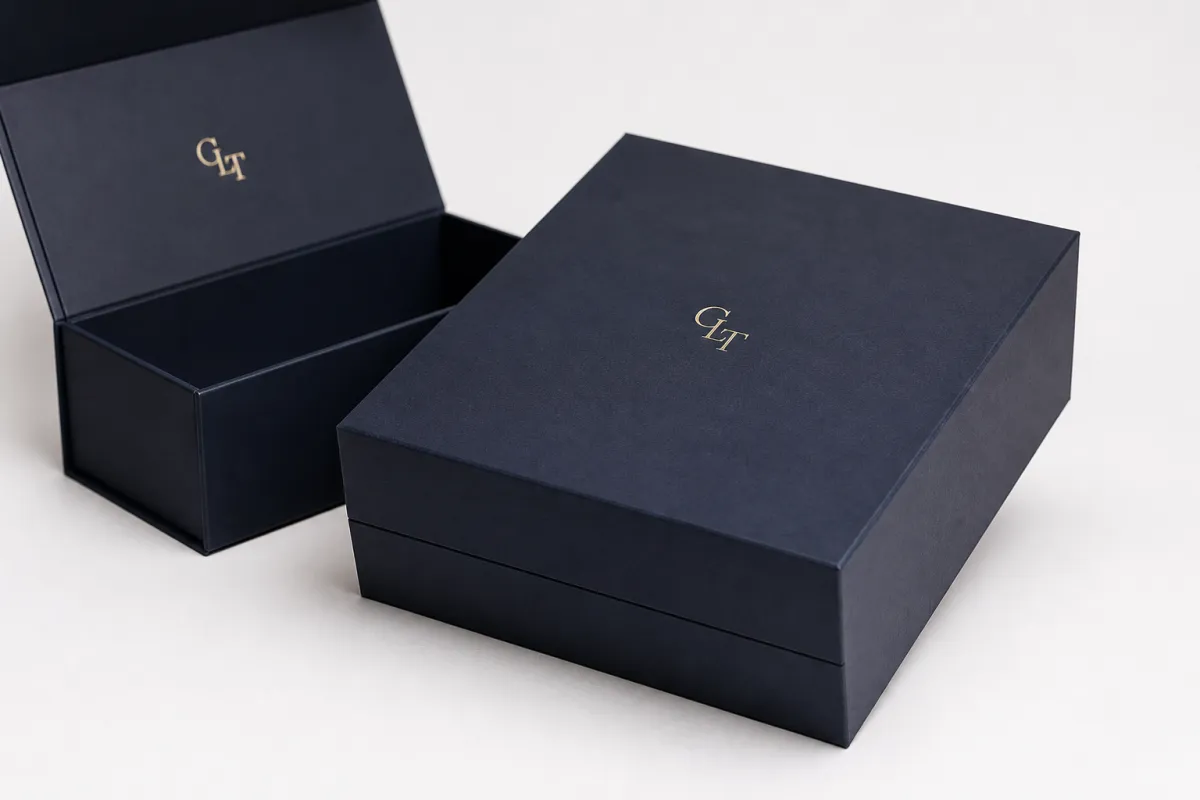
Branded two-piece boxes wholesale works because it slows the opening moment down in a way folding cartons usually do not. A lift-off lid creates a short pause, and that pause gives the product more presence. It tells the customer that what is inside was meant to be opened, handled, and remembered. Retail buyers recognize that effect quickly, even if they do not describe it in those exact words.
That is why the format keeps showing up in gift sets, cosmetics, jewelry, candles, wellness kits, apparel sets, and subscription packaging. In those categories, presentation changes how the item is judged before it is used. A rigid box can make a mid-range product feel more considered and can make a premium product feel properly finished instead of underwrapped.
Durability is another reason brands return to branded two-piece boxes wholesale. Rigid boxes are usually built from chipboard or greyboard, then wrapped in printed paper or specialty stock. The body holds its shape, the lid fits with purpose, and the package feels substantial in the hand. That solid feel does a lot of selling quietly, which is often the most effective kind of packaging work.
Packaging budgets get misread all the time. The product gets careful attention, then the box gets selected late, as if it were only a shell. That choice shows up immediately in the customer experience. A package is part of the product memory, and if it feels flimsy, the brand feels less established than it might be.
Branded two-piece boxes wholesale also gives designers room to shape the brand surface with foil, embossing, debossing, matte lamination, soft-touch coating, and specialty wrap papers. Those details influence tone before a single word is read. A box with the right finish can stay in someone’s home longer, which extends the brand moment well beyond the sale itself.
A well-made two-piece box speaks quietly. That restraint often feels more expensive than a package that tries too hard to impress.
For brands that need repeatable presentation across several SKUs, branded two-piece boxes wholesale is easier to standardize than many custom structures. The same lid-and-base format can carry different inserts, different artwork, and different product sizes without losing the family look. That is useful for product launches, seasonal sets, and retail programs where consistency matters as much as appearance.
If you want a clearer view of how rigid presentation packaging supports different products, our Case Studies page is a practical place to start. Real examples tell the story faster than packaging theory ever does.
Product Details: What Buyers Should Expect
Good branded two-piece boxes wholesale begins with a rigid base and a fitted lid. The concept is simple, though the construction details are not. The structure is normally built from greyboard or chipboard, then wrapped in printed art paper, textured paper, or another decorative stock. Clean alignment matters. A sloppy wrap makes the whole box feel cheaper than the artwork suggests, and customers notice that kind of thing right away.
The best boxes share a few clear traits. The lid slides on with controlled resistance. The base holds its square shape. The corners stay crisp under normal handling. The wrap sits flat and does not wrinkle at the edges. None of those details are flashy, yet each one affects how the customer reads quality. A premium box is usually the result of disciplined construction rather than one dramatic feature.
Branded two-piece boxes wholesale can include a wide range of customization without changing the core structure. Common options include logo printing, foil stamping, embossing, debossing, spot UV, matte lamination, gloss lamination, and soft-touch lamination. Exterior decoration is the usual starting point, though interior printing can be worth adding when the opening moment is part of the brand story.
Practical features matter too. Ribbon pulls can help with small luxury items. Paperboard inserts work well for lighter products. Foam inserts secure delicate items, though they are not always the most attractive or responsible option. Molded pulp inserts are becoming more common because they provide protection with a better material profile. Each option solves a different problem, and none of them should be chosen by habit alone.
There is also a real gap between standard and premium builds, and Buyers Should Know where that line sits. Standard branded two-piece boxes wholesale may use a simple wrap, one decoration method, and a straightforward insert. Premium versions often add specialty paper, tighter lid tolerances, more complex print effects, and a more precise interior fit. That difference shows up immediately in hand-feel and presentation.
In practice, the product experience is shaped by a handful of small details:
- Clean lid fit without wobble
- Crisp corners that hold up during handling
- Consistent board thickness throughout the run
- An insert that centers the product without forcing it
- Printing that matches the approved proof closely
Branded two-piece boxes wholesale should always be matched to the product’s physical behavior. A heavy bottle needs more support than a compact. A candle jar needs a different hold than a folded garment. When the box looks polished but the product shifts inside, the package fails where it matters most. Movement is noticed immediately, even if the customer cannot explain why the experience feels off.
For buyers comparing structure options, our Custom Packaging Products collection is a useful reference point. It helps to see where rigid boxes sit alongside folding cartons, sleeves, and other presentation formats.
Transit performance also deserves attention. The ISTA transit testing standards are a practical benchmark for checking whether packaging can survive parcel handling, vibration, drops, and stacking stress. If the box is expected to protect a premium product, the test plan should reflect that duty instead of hoping shipping stays gentle.
Specifications That Matter: Size, Material, and Finish
The strongest quote requests for branded two-piece boxes wholesale start with exact measurements. Dimensions first. Weight next. Insert needs after that. A supplier can only quote cleanly when the product size is known, and box fit becomes risky the moment the project starts on guesses instead of numbers.
Measure the item itself, then account for clearance around the insert and for hand assembly. The box should fit snugly, but it should not feel cramped. Too much empty space creates rattling and weakens the reveal. Too little space makes packing harder and raises crush risk. For most rigid two-piece projects, the internal dimensions should be based on the product plus a small tolerance for insertion and removal, adjusted for the shape of the item and the kind of insert being used.
Branded two-piece boxes wholesale usually makes the most sense with rigid chipboard in the 1.5 mm to 3 mm range, depending on product weight and the feel the brand wants in the hand. Heavier products, or products meant to feel substantial, generally call for thicker board. The wrap layer is often a 128 gsm to 157 gsm coated art paper, though specialty papers can vary widely in weight and texture depending on the finish.
Finish choice is not only about appearance. It changes how the box behaves in use. Matte looks restrained and polished. Gloss strengthens color and contrast. Soft-touch feels premium, though it can scuff if the box is handled roughly or packed carelessly. Textured papers can hide minor marks better than flat coated sheets. That is why finish decisions should follow the product’s use, not only a mood board.
Branded two-piece boxes wholesale also depends on artwork that is ready for production. That means high-resolution files, a correct dieline, and a color plan that fits the print method. Pantone matching should be discussed early if color accuracy matters. Rich black, subtle gradients, and delicate type all deserve a conversation before proofing starts, because print limits are easier to solve before the files are locked.
Useful specification items to confirm early:
- Exact internal dimensions in millimeters or inches
- Product weight and whether the item has fragile parts or sharp corners
- Board thickness and wrap paper choice
- Print method and color targets
- Finish type, inside print needs, and insert material
- Packing requirements, carton counts, and shipping expectations
If the product line is likely to expand, branded two-piece boxes wholesale works better when the core structure is planned to scale. One box size can often support more than one SKU if the insert changes. That reduces waste, keeps the look consistent, and makes procurement far easier to manage over time.
For greener material choices, ask about FSC-certified paper options. The FSC system remains one of the clearest ways to support responsible sourcing without pretending paper comes from nowhere.
Assembly should not be overlooked. A beautiful box that slows packing becomes a cost problem quickly. If the box is hand-filled, the lid fit should not fight the operator. If products are inserted at volume, the opening should be efficient enough to keep labor under control. That is where thoughtful branded two-piece boxes wholesale design shows its value in day-to-day production.
Branded Two-Piece Boxes Wholesale Pricing, MOQ, and Quote Factors
Branded two-piece boxes wholesale pricing comes down to a fairly small group of variables. Size matters. Board thickness matters. Wrap paper matters. Print coverage matters. Finish matters. Insert complexity matters. Quantity matters most of all. There is no mystery in that, despite how some quotes are written when the numbers are meant to sound more complicated than they are.
The pattern is familiar. Bigger orders lower the per-unit cost because setup and labor are spread across more boxes. Smaller runs pay more for flexibility. Larger runs pay less per unit because production gets more efficient. That is standard manufacturing math, and packaging follows the same rules.
For branded two-piece boxes wholesale, a common MOQ starts around 500 to 1,000 units for fully custom work. Some suppliers can go lower, though the unit price rises quickly once the run gets very small. If the box includes foil, embossing, specialty paper, or a highly custom insert, the minimum may climb because the setup cost needs to be supported.
These planning ranges are realistic for budgeting, not fixed promises, since final pricing still depends on structure, finish, and size.
| Build Level | Typical Spec | Best For | Approx. Unit Price at 500 | Approx. Unit Price at 1,000 | Approx. Unit Price at 5,000 |
|---|---|---|---|---|---|
| Standard | Rigid chipboard, printed wrap, basic matte or gloss finish, simple insert | Apparel sets, candles, starter gift packaging | $1.10-$1.80 | $0.85-$1.35 | $0.55-$0.95 |
| Upgraded | Thicker board, soft-touch or specialty lamination, foil or emboss, better insert | Cosmetics, premium gifts, wellness kits | $1.80-$2.80 | $1.40-$2.20 | $0.95-$1.60 |
| Premium | Specialty paper wrap, custom insert, multiple print effects, tighter finish tolerances | Jewelry, high-value gift sets, launch packaging | $2.80-$4.50 | $2.10-$3.50 | $1.40-$2.40 |
Those ranges help procurement teams plan with real numbers instead of hoping the box will land in the same pricing band as a folding carton. Branded two-piece boxes wholesale is a heavier structure, more tactile, and usually more labor-intensive. It is also tied to a higher perceived value, which is the reason many brands choose it in the first place.
One-time setup charges can show up on custom jobs. Foil plates, embossing dies, and specialty proofing can add roughly $40 to $180 per location depending on complexity. Sampling or prototypes can cost more when a new structure is being developed. That is not a hidden fee if it is disclosed clearly. It is simply part of producing a custom rigid box.
To get a useful quote for branded two-piece boxes wholesale, send the supplier this information in one shot:
- Internal dimensions or exact product measurements
- Target quantity and any repeat-order expectations
- Product weight and whether an insert is required
- Artwork files or a clean layout reference
- Finish preference, print coverage, and inside print needs
- Shipping destination and delivery deadline
If cost needs to come down without making the box feel stripped back, simplify the inside print, reduce the number of special effects, or standardize one box size across several SKUs. That approach keeps branded two-piece boxes wholesale looking intentional while avoiding unnecessary complexity. More features are not automatically better. Some of them simply add cost.
Small design choices can move the price faster than many buyers expect. A second foil area or a more complex insert may matter more than the overall artwork.
For larger programs, our Wholesale Programs are built to keep repeat orders more predictable. That matters more than a short-term bargain if the product line is going to keep moving.
Process, Timeline, and Production Steps
Branded two-piece boxes wholesale usually moves through a fixed sequence: brief intake, dieline setup, artwork review, proof approval, production, inspection, packing, and delivery. The steps sound ordinary because they are ordinary. The trouble starts when one of them gets skipped and the boxes arrive with the wrong fit, the wrong color, or the wrong insert.
Timing depends on how complete the input is. A repeat order can move quickly because the structure is already approved and the artwork is mostly settled. A first-time custom job takes longer because the box has to be checked from the ground up. When sampling is required, that adds time too. It is not a delay in the negative sense; it is the normal pace of a job that needs to be done properly.
Typical lead times for branded two-piece boxes wholesale often fall around 12 to 18 business days after proof approval for straightforward runs. Special papers, complex inserts, or several decoration steps can push that to 18 to 25 business days. If the job needs a physical sample before production begins, add roughly 5 to 7 business days, sometimes more if revisions are needed.
What slows everything down? Missing dimensions. Late artwork. Color changes after proofing. Insert revisions after the box body is already approved. Buyers usually know where the delay came from, even when nobody wants to say it directly.
The better question is not just “how fast can you make it?” It is “when does the clock start?” For branded two-piece boxes wholesale, the clock should begin after artwork and structure are approved, not before. Otherwise the quoted lead time becomes more about sales language than actual production time.
Before confirming a schedule, ask these four things:
- Is the lead time measured from payment, proof approval, or final artwork approval?
- Does the timeline include sampling or only mass production?
- Are shipping days included or billed separately?
- What happens if the proof needs another revision?
That last question matters more than it sounds. One extra revision can move a delivery date farther than expected. Branded two-piece boxes wholesale stays fast only when the brief is clean. Unclear input slows the whole chain, and that is a project issue as much as a production issue.
Quality checks should happen before shipping, not after pallets are already moving. Look for crushed corners, wrap bubbles, alignment issues, lid fit problems, and color drift from proof to production. If the box is going to be stored, shipped, and photographed, those defects will show up sooner or later. Better sooner.
For wholesale buying teams, the best rhythm is simple: approve the structure, approve the finish, approve the count, and confirm the carton pack before production starts. That is how branded two-piece boxes wholesale stays predictable instead of turning into a rescue mission right before launch.
If you are comparing lead times across programs, keep launch risk in mind. A packaging delay can hold up a photo shoot, a retail delivery, or a subscription ship date. One bad box schedule can waste far more than the box itself. Experienced buyers know the timeline is part of the spec, not a side note.
Why Choose Us for Branded Two-Piece Boxes Wholesale
Buyers do not need inflated claims. They need branded two-piece boxes wholesale that arrive on spec, on time, and with print that matches the approved proof closely enough to pass inspection without extra debate. That is the standard. Anything less creates avoidable friction.
Control is what matters most. Clean dimensions. Consistent board quality. Reliable wrap alignment. Straight answers about what the quote includes. If a box is going to support a launch product or a retail-ready gift set, those details are not extras. They are the work.
Branded two-piece boxes wholesale is especially sensitive to manufacturing discipline because rigid packaging exposes mistakes quickly. A loose lid shows. Weak corners show. Off-center wrap shows. There is very little room to hide problems, which is why the packaging partner needs to manage tolerances carefully and inspect each stage against the agreed spec.
From a wholesale buyer’s point of view, consistency protects margin. One bad batch can stall a launch, trigger returns, force a reprint, or create a rush replacement order. That is how a cheap box becomes expensive. A clean process usually costs less than a messy one, even if the upfront quote looks a little higher.
The service side matters too. Fast answers on MOQ. Clear separation of setup costs and unit costs. Practical sample guidance. No fog around the quote. Buyers should be able to move from concept to approved structure without spending days guessing what a supplier meant.
Branded two-piece boxes wholesale also helps brands create packaging that photographs well. That is not a vanity point. If the product is sold online, opened on camera, or displayed in retail, the box becomes part of the content. A crisp rigid box tends to look better in images and makes the product feel more giftable and more shareable.
If you need a reference point for how different packaging structures support different products, our Custom Packaging Products page shows the range without making the comparison feel like a sales pitch. Real examples help buyers choose faster.
Here is the plain version: branded two-piece boxes wholesale is the right choice when the product needs premium presentation, repeatable quality, and a pricing structure that does not drift every time the artwork changes. If the goal is a box that does its job and still feels thoughtful in the hand, this format fits well.
Next Steps: How to Order Branded Two-Piece Boxes Wholesale
If you want to move quickly on branded two-piece boxes wholesale, start with the product itself rather than the mood board. Measure the item. Decide the quantity. Pick a finish direction. Gather the artwork files. Then request a quote that reflects the actual job instead of a half-formed version of it.
The minimum information needed is straightforward:
- Internal dimensions or product dimensions
- Expected order quantity
- Product weight and fragility
- Insert type or support requirement
- Target finish, print method, and decoration details
- Delivery location and required date
Ask for three things in order: a quote, a dieline, and a proof or sample review. That sequence keeps branded two-piece boxes wholesale grounded in facts. Quote first so pricing is real. Dieline second so fit is checked. Proof or sample third so color, finish, and construction can be confirmed before the full run begins.
A simple approval checklist keeps surprises out of the project:
- Confirm color targets and print method
- Check lid fit and product clearance
- Review insert depth and product stability
- Verify carton count and pack style
- Confirm shipping method and delivery date
That checklist is boring, and that is a good thing. Boring packaging approval is usually profitable packaging approval. If the project needs FSC-certified stock or a transit test plan, those choices should be locked before production, not argued about after the box is already moving through the schedule.
Branded two-piece boxes wholesale is the right move when the brand wants premium presentation, controlled cost, and a repeatable packaging system that still feels deliberate in the hand. If the product deserves a stronger first impression, this is one of the clearest ways to deliver it.
For teams planning a larger rollout, a rigid two-piece structure can become the packaging backbone for months, sometimes longer, as long as the sizing and insert strategy are set up properly. That is the part many people miss. The box is not just a container. It is a system that supports the product, the brand, and the launch schedule.
What is the usual MOQ for branded two-piece boxes wholesale?
A common starting point is 500 to 1,000 units for fully custom branded two-piece boxes wholesale. Special finishes, custom inserts, or unusual dimensions can push the minimum higher. Repeat orders usually move more smoothly because the structure is already approved.
How do I get an accurate quote for branded two-piece boxes wholesale?
Send exact dimensions, quantity, product weight, artwork files, finish preferences, and insert requirements. Ask the supplier to separate setup costs, unit cost, and shipping so the branded two-piece boxes wholesale quote is easy to compare. Vague inputs always lead to vague numbers.
What material works best for branded two-piece boxes wholesale?
Rigid chipboard wrapped in printed or specialty paper is the standard choice for branded two-piece boxes wholesale. Heavier products usually need thicker board and stronger inserts. If the goal is a more premium feel, soft-touch, textured paper, or foil details can help without changing the structure.
How long does branded two-piece box production usually take?
Simple repeat jobs are usually faster than first-time custom builds. First-time branded two-piece boxes wholesale orders often take longer because proofing, sampling, and approvals add steps. Ask when the timeline starts, because lead time should begin after artwork approval, not before.
Can branded two-piece boxes wholesale include custom inserts?
Yes, and they should whenever the product can shift during shipping or opening. Common insert options for branded two-piece boxes wholesale include paperboard, foam, molded pulp, and custom-cut support pieces. The insert design affects cost and lead time, so it should be specified early.
Takeaway: If you are preparing a run, lock the internal dimensions, insert style, finish, quantity, and delivery target in one brief before requesting quotes; that single step makes branded two-piece boxes wholesale easier to price, faster to approve, and far less likely to miss the launch window.


