Buyer Fit Snapshot
| Best fit | Printed Paper Merchandise Bags projects where brand print, material claims, artwork control, MOQ, and repeat-order consistency need to be specified before quoting. |
|---|---|
| Quote inputs | Share finished size, material target, print colors, finish, packing count, annual reorder estimate, ship-to region, and any compliance wording. |
| Proofing check | Approve dieline scale, logo placement, barcode or warning zones, color tolerance, closure strength, and carton packing before bulk production. |
| Main risk | Vague material claims, crowded artwork, missing packing details, or unclear freight terms can make a low unit price expensive after revisions. |
Fast answer: Printed Paper Merchandise Bags: Film, Print, MOQ, and Carton Packing should be specified like a repeatable production item. The safest quote records material, print method, finish, artwork proof, packing count, and reorder notes in one written spec.
Production checks before approval
Compare the actual filled-product size with the drawing, then confirm tolerance on folds, seals, hang holes, label areas, and retail display edges. Reserve space for logos, QR codes, warning copy, and material claims before decorative graphics fill the panel.
Quote comparison points
Review material grade, print process, finish, sampling route, tooling charges, carton quantity, and freight assumptions side by side. A quote is only useful when the supplier can repeat the same color, closure quality, and packing count on the next order.
Printed paper merchandise bags can look simple right up until the handle pulls loose, the gusset gives out, or the bag arrives one size too tight for the product you planned to hand over. That is usually where the real cost shows up. Printed paper merchandise bags are not just containers; they shape the handoff, carry the brand out into the street, and, if they are specified poorly, turn a smooth sale into a small but memorable frustration.
From a packaging buyer's perspective, these bags sit in a useful middle space. They feel more considered than a plain carrier, they stay visible longer than a box tucked into a shipper, and they are easier to brand than a stack of generic takeaway bags. I have seen plenty of retail programs rise or fall on bag quality alone, which sounds dramatic until you watch a customer try to carry a heavy purchase in a bag that was never built for it. The wrong size, thin stock, cheap handles, or muddy print rarely hide for long. Printed paper merchandise bags tend to reveal mistakes in use rather than in theory, which is exactly why the spec matters.
This is not a category where vague language helps. If you are sourcing printed paper merchandise bags, the practical details decide the result: paper weight, print process, handle construction, reinforcement, minimum order quantity, and lead time. Those choices determine whether the bag feels polished or flimsy, whether it survives a real retail load, and whether the landed price still makes sense after freight, setup, and packing are added in.
Paper bags are not automatically sustainable, recyclable, or premium just because the material is paper. The build determines that, along with coatings, inks, local recycling rules, and how the bag is assembled. Ordered well, printed paper merchandise bags carry a brand beautifully. Ordered carelessly, they become a reminder that packaging is never as simple as it looks on a screen.
Printed paper merchandise bags: what they are and why they matter
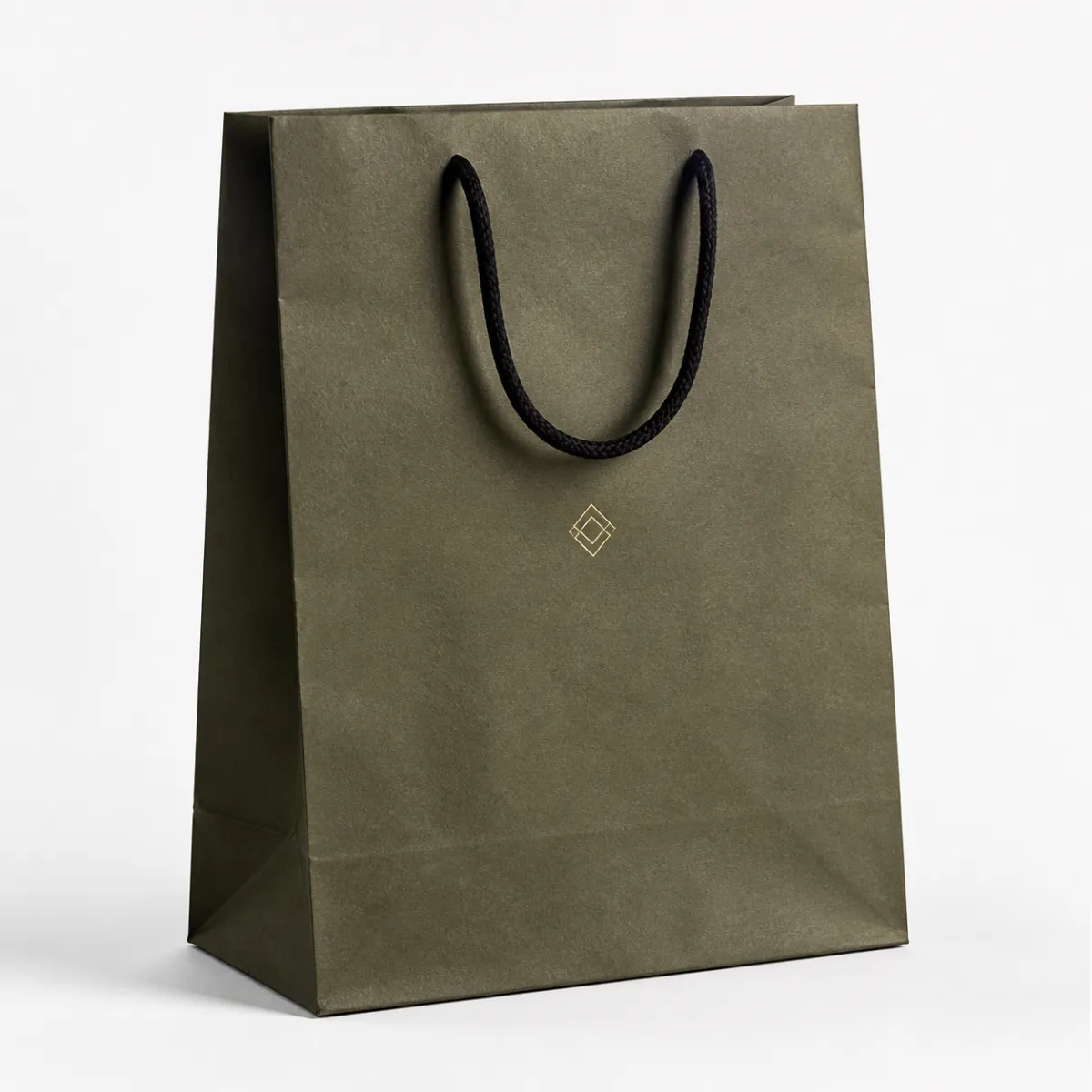
Printed paper merchandise bags are Branded Paper Carry Bags used for retail handoffs, events, gifting, boutique sales, and any moment when the customer leaves with a physical item in hand. That definition sounds plain, but buyers often underestimate what the bag is doing. It is packaging, yes, yet it is also visible branding, a carrying surface, and a quiet signal that the company paid attention to the details surrounding the sale.
The weakest point on most bags is not the paper itself. It is usually the handle bond, the bottom patch, the gusset fold, or a size that leaves no room for the actual item once the product is inside. A bag can look solid from a distance and still fail where the hand carries it. That is also why printed paper merchandise bags deserve the same practical review you would give to a carton, mailer, or retail insert.
Brands keep coming back to them for good reasons. They show up in transit, they feel more finished than a plain carrier, and they fit a wide range of products. Apparel, candles, books, cosmetics, boxed snacks, small home goods, and event kits all sit comfortably within the same family of printed paper merchandise bags. Paper is not the choice here because it is poetic. It is the choice because it is presentable, adaptable, and usually easier to brand than many rigid formats.
There is a useful psychological effect too. A customer leaves a store or event carrying a well-printed bag, and the bag keeps advertising long after the transaction ends. That kind of exposure has value if the bag survives the trip home. A clean stack of printed paper merchandise bags can do more brand work than many digital touchpoints because it lives in the physical world where people actually see it.
If the bag cannot make it from counter to car without failing, it is not a premium bag. It is a decorated problem.
Use case should lead the conversation. A boutique with light apparel needs one structure, a trade show handout needs another, and a candle shop has a different set of load concerns entirely. That choice changes the price, the durability, and the look. Printed paper merchandise bags are not one product. They are a range of builds that behave very differently once weight, shape, and handling enter the picture.
Keep the expectations grounded. Paper bags can be durable, attractive, and recyclable, but only if the spec supports those claims. If the bag needs to live through repeated retail use, ask for stronger stock and better reinforcement. If the bag is for a short-run event, there may be no reason to pay for more structure than the job requires. The smart move is matching printed paper merchandise bags to the work they need to do, not buying the fanciest version just because it looks impressive in a quote.
How printed paper merchandise bags are made
The production path is simple on paper, which is fitting. Sheets are cut, folded into a tube, glued or otherwise joined, bottomed, reinforced, printed, and then fitted with handles if the design calls for them. Printed paper merchandise bags are not mechanically complicated, yet the small choices inside that sequence influence the finish, the holding strength, and the final cost in ways buyers notice quickly.
Paper selection comes first. Kraft paper usually gives a natural look and solid tear resistance for the money. It also hides scuffs better than some smoother stocks. Coated stock supports cleaner graphics and richer color work, which matters when the artwork relies on crisp detail. Recycled paper can support a more responsible material story, though the surface and appearance vary enough that buyers should not assume all recycled options behave the same. The right base for printed paper merchandise bags depends on the brand story and the load the bag has to carry.
Print method follows. Flexographic printing is common for simpler work at scale, especially when solid colors and speed matter. Offset printing gives sharper detail and suits full-color branding on smoother stocks. Digital printing works well for shorter runs, version changes, or fast artwork turnover. None of these is universally better. They are different tools for different jobs. If your printed paper merchandise bags need photographic color depth, flexo may not be the best fit. If you are ordering a straightforward one-color bag in volume, offset may be more than you need.
Handle selection changes both the feel and the performance of the bag. Twisted paper handles are practical and usually cost-conscious. Rope handles feel more refined and can be more comfortable in hand, though they often raise the price. Die-cut handles keep the silhouette clean and work well for lighter loads or a fashion-driven presentation. Some designs rely on reinforced top folds or bottom pads for extra support. That reinforcement is not decorative. It is what keeps printed paper merchandise bags standing up once real products go in.
Finish decisions affect appearance and handling at the same time. Matte gives a softer, quieter look. Gloss pushes color and helps graphics read from farther away. Uncoated stock feels more natural and can suit brands that want an earthy, plainspoken look. Coatings also influence stacking, folding, and shipping behavior. Heavy coverage can crack along folds. Excess ink can slow drying. The more visual intensity you add to printed paper merchandise bags, the more you should ask how that choice affects production in practice.
What good production files should include
Before anything goes to press, the supplier needs a clean dieline, final artwork in the correct format, bleed, safe area, color references, and notes about handle placement or seam interruptions. Many problems with printed paper merchandise bags start because the artwork was built like a flat poster instead of a folded object that will be seen in the hand. If there is a barcode, QR code, or tiny legal copy, check it carefully before approving the run. Small type and fold lines are not friendly neighbors.
For buyers who want a more formal check, this is also where common packaging standards help. ISTA test logic is often used when shipment handling matters, and FSC documentation is useful if you want traceable fiber claims. The goal is not to turn a bag order into a laboratory exercise. The goal is to specify printed paper merchandise bags as a real product with real handling requirements, not as a guess dressed up as a specification.
For background on fiber sourcing and packaging handling, the FSC site is a practical place to start. For shipping and distribution principles, ISTA is worth knowing if the bags will carry heavier items or travel with other packaged goods.
Printed paper merchandise bags pricing, MOQ, and cost drivers
Pricing for printed paper merchandise bags rarely comes down to one number. It is a stack of variables, and the quote on the first page is only one piece of the picture. Paper weight, size, handle type, print colors, finish, reinforcement, packing, and freight all feed into the final cost. A unit price alone does not tell you what the bag really costs. It only tells you where the supplier started the conversation.
MOQ, or minimum order quantity, matters just as much. Standard bags in common sizes can often be produced in smaller runs than custom builds with specialty handles, unusual coatings, or detailed full-color artwork. Small orders carry a higher per-piece cost because setup is spread across fewer units. That is not a supplier tactic. It is simple arithmetic. The same press preparation, cutting, and assembly work for 500 bags costs more per piece than it does for 5,000 printed paper merchandise bags.
Most buyers understand volume pricing in principle and then forget about setup when the quote arrives. Printing plates, cutting dies, make-ready sheets, and press setup all happen before the first finished bag is packed. That is why unit cost usually drops as order size rises. It is also why the lowest quote is not always the best one. Thin stock, weak glue, crooked print, or handles that feel attached as an afterthought can ruin a bag program faster than a slightly higher price ever will.
Here is a practical way to frame the common options. These ranges are illustrative, because region, freight, paper choice, and decoration complexity move the numbers around, but they give buyers a better anchor than a vague promise:
| Bag style | Typical unit range at 5,000 pcs | Common MOQ | Best fit | Tradeoff |
|---|---|---|---|---|
| Simple kraft, one-color print, twisted paper handle | $0.18-$0.28 | 1,000-3,000 | Retail basics, events, light apparel | Lower cost, less premium feel |
| Coated stock, full-color offset print, paper handle or rope handle | $0.32-$0.58 | 2,000-5,000 | Boutiques, cosmetics, gift programs | Sharper branding, higher setup and finish cost |
| Heavy paper, reinforced top and bottom, rope handle, specialty finish | $0.60-$1.20+ | 3,000-10,000 | Premium retail, luxury gifting, launches | Best shelf presence, most expensive to produce |
Those numbers are not fictional, yet they are not a promise either. Freight, duties, print coverage, and packing needs can shift the landed price a lot. If you are comparing suppliers for printed paper merchandise bags, ask each one to quote the same bag size, paper weight, handle type, finish, quantity, and destination. Otherwise you are comparing apples to oranges and calling it procurement.
Another trap is a low unit price built on weak assumptions. If damage, reorders, or customer complaints show up later, the savings disappear quickly. When the bag is part of the retail experience, a few cents saved on printed paper merchandise bags can cost more in reputation than it saves in budget.
Production steps, timeline, and lead time for printed paper merchandise bags
The schedule begins long before the bags are printed. Artwork comes first, then dieline review, then proofing, then approval, then production, then drying or curing, then packing, then shipping. With printed paper merchandise bags, the buyer-side mistake is usually assuming the clock starts at the purchase order. More often, it starts when the proof is signed off and the files are truly ready.
Lead time depends on order complexity and the supplier's queue. Straightforward orders with standard dimensions and simple print can move fairly quickly once approved. Custom sizes, specialty finishes, custom handles, and seasonal congestion all add time. A small spec change can add days. A late file correction can add more. A material shortage can push the whole job out. None of that is unusual, which is exactly why it deserves attention.
Most delays come from a familiar set of causes. Missing dielines. Artwork that is not press-ready. Proofs that sit in an inbox for days. A revision request after production has already been scheduled. A color adjustment that should have happened during design instead of on the factory floor. Printed paper merchandise bags are not difficult to produce, but they are easy to delay if the buyer keeps moving the target.
As a planning rule, build a buffer into the calendar. Simple jobs may only need a few extra days. Launch-critical orders, especially where the bags are tied to a store opening or an event, need more room. You do not want the bags landing after the product. That is how a polished launch turns into a counter full of merchandise with nothing proper to carry it out.
It also helps to confirm what the supplier counts as the start date. Some begin with the deposit. Some begin with final artwork approval. Some begin once print-ready files arrive, which is not the same thing. Ask directly. For printed paper merchandise bags, assumptions about lead time are where a lot of avoidable stress begins.
What a realistic workflow looks like
- Send exact dimensions, quantity, and brand files.
- Review the dieline and confirm print-safe areas.
- Approve a digital proof or sample.
- Production runs, with drying or curing time built in.
- Quality check, pack-out, and ship.
That sequence sounds ordinary because it is. Ordinary is good. A clean workflow gives printed paper merchandise bags a fair chance of arriving on time and looking the way they were meant to look. Trouble usually starts when the front end gets rushed and the rest of the schedule has to absorb the damage.
How to choose the right size, paper, and finish
Size should be chosen with a real product in hand. Measure the item first, then add clearance for loading, the gusset, and the customer's grip. If the product is boxed, rigid, or includes inserts, give it more room than you think you need. A bag that is too tight is awkward to load and usually looks worse once the customer starts using it. That is especially true for printed paper merchandise bags used in retail, where the handoff happens in a matter of seconds.
Paper weight should match the load, not the hope. Lighter stock lowers cost and can be fine for giveaways, light apparel, or small accessories. Heavier items need stronger paper and usually better reinforcement. A bag that feels pleasant with tissue paper inside can fail when a candle, bottle, or boxed set goes in. Buyers should ask for the actual board or paper spec instead of settling for a phrase like "strong paper." Strong compared with what, exactly?
Finish should follow the brand and the use case. Matte works well for softer luxury cues and a quieter visual presence. Gloss is better when color vibrancy matters and the graphics need to read from a distance. Uncoated stock feels more natural and suits brands that want an earthy, honest presentation. There is no universal winner. The best finish for printed paper merchandise bags is the one that fits the product price point and the environment where the customer will carry it.
Sustainability claims need care. Recycled content matters. FSC sourcing matters. Recyclable construction matters. Yet coatings, foil, lamination, and local recycling systems can change the practical outcome. A paper bag that looks recyclable may not be accepted everywhere. Buyers should check the rules in the markets where the bag will actually be used. Not the factory. Not the brochure. The real market.
Brand fit is the final filter. A premium candle brand should not use a thin carrier that feels like a grocery bag in disguise. A low-cost event handout does not need a luxury rope-handle build with an elaborate finish stack. The bag should fit the product, the store environment, and the amount of time the customer spends carrying it. For printed paper merchandise bags, that alignment matters more than any single feature on its own.
Quick fit check before you place the order
- Measure the item with packaging included.
- Add clearance for easy loading and hand space.
- Test the bag with a real sample product.
- Check whether seams or folds block key artwork.
- Confirm the handle can support the real load, not just the sample weight.
If the sample looks polished empty and awkward full, the size is off. That simple check catches a lot of bad printed paper merchandise bags before the full order turns into a problem.
Common mistakes with printed paper merchandise bags
The most common mistake is choosing by appearance alone. A bag can look elegant on a screen and still fail once a real product goes inside. The handle may be too weak. The base may bow. The gusset may be too shallow. Printed paper merchandise bags should be treated as a structural product first and a branding item second.
The next mistake is forgetting clearance. Buyers often measure only the item itself and ignore seams, gussets, inserts, tissue, rigid packaging, or the way a customer actually loads the bag. That is how you end up with awkward bulging at the top or a bag that looks squashed the moment it is filled. Good printed paper merchandise bags need room to breathe and room for the hand that carries them.
Too many print colors can create trouble too. Every added color can increase cost, complicate setup, and raise the odds of alignment issues. If the design does not need six colors, do not force it. Strong contrast, a clean logo, and well-spaced typography usually do more for the brand than a crowded composition with expensive mistakes. There is a reason restrained bags often age better.
Another quiet problem is skipping proof details. Bleed, safe margins, tiny type, barcodes, and seam interruptions all matter. A logo can look perfect in a digital file and still land split across a fold in the actual bag. This is where printed paper merchandise bags punish casual approvals. The proof exists for a reason. Read it carefully.
Finally, sample testing with the real item is non-negotiable when the bag will carry weight or stand in for a premium brand moment. A sample that passes visually can still tilt, tear, or feel cheap under load. If you are buying printed paper merchandise bags for retail, ask for a sample or prototype. The extra step costs far less than a full reprint.
The cheapest way to buy a paper bag is to buy it correctly the first time.
Expert tips and next steps for printed paper merchandise bags
If the bags will carry heavier items or represent a premium store environment, start with a sample or prototype. That sounds basic, yet plenty of buyers skip it because they want to move quickly. Then they discover the handle feels weak, the bag leans, or the finish looks different under store lighting. For printed paper merchandise bags, a sample is not a luxury. It is a cheap insurance step that protects the rest of the order.
Standardizing helps too. One core size, one backup size, and perhaps one or two print variations usually keep reorders cheaper and faster. Every extra unique spec adds setup, more risk, and more chances to be surprised by lead time. If your brand uses printed paper merchandise bags across several locations or seasons, a controlled size system usually works better than a constant stream of one-off ideas.
Keep the artwork production-friendly. Fewer spot colors. Strong contrast. Clean vector files. Enough margin around critical copy. That does not mean dull. It means smarter. The strongest-looking printed paper merchandise bags often have simple artwork because the design works with the manufacturing process instead of fighting it.
Here is the buying checklist I would use before requesting quotes:
- Product dimensions with packaging included.
- Target quantity and acceptable MOQ.
- Budget range per unit and landed cost ceiling.
- Preferred handle type and finish.
- Shipping deadline and launch date.
- Brand files, logo formats, and any legal copy.
- Any sustainability requirement such as FSC paper or recycled content.
Then ask for two or three supplier quotes using the exact same specification. Not "close enough." Exact. Compare unit cost, setup fees, freight, proofing time, and production lead time. The cheapest option is not always the best one, and the highest quote is not always the better bag. The right choice is the one that balances print quality, durability, timing, and actual use. That is how buyers end up with useful printed paper merchandise bags instead of expensive headaches.
One final point before you place the order: if a supplier cannot explain the paper weight, handle build, print method, and timing in plain language, keep looking. A good supplier should be able to tell you why one version of printed paper merchandise bags costs more, where the weak point is, and what tradeoff you are making. That conversation is often more valuable than a low quote with no context.
What size printed paper merchandise bags do I need for apparel?
Measure the folded garment, then add clearance for the gusset and easy loading. If the item is boxed or has rigid packaging, size up so the top does not bulge awkwardly. Ask for a sample fit check before you commit to the full run of printed paper merchandise bags.
Are printed paper merchandise bags recyclable?
Usually yes if they are made from mostly paper with minimal coating or mixed materials. Heavy lamination, foil, or certain specialty finishes can affect local recyclability. Check the rules where your customers actually live, not where the bag was made. That is the only answer that matters for printed paper merchandise bags.
What is the typical MOQ for printed paper merchandise bags?
MOQ depends on paper type, print method, and handle style more than the bag itself. Simple, single-size orders are usually easier to run in smaller quantities than premium custom builds. Ask suppliers to quote multiple quantity tiers so you can see where unit cost starts to improve for printed paper merchandise bags.
How long does it take to produce printed paper merchandise bags?
Lead time usually starts after artwork approval, not when you first ask for a quote. Standard orders move faster than jobs with specialty finishes, custom handles, or complex artwork. Shipping and proof revisions can add time, so build in buffer if the bags support a store opening or launch. That buffer saves a lot of stress with printed paper merchandise bags.
How do I reduce cost without making the bags look cheap?
Use fewer colors, standardize sizes, and avoid unnecessary specialty finishes. Choose a paper weight that fits the product instead of overbuying material you do not need. Spend where the customer notices it first: print clarity, handle quality, and structure. That is the cleanest way to keep printed paper merchandise bags sharp without burning budget.
If you are planning a run, start with the product in hand, lock the dimensions, choose the lightest spec that still passes a loaded sample test, and quote the exact same file set with every supplier. That simple sequence keeps printed paper merchandise bags honest, useful, and much less likely to turn into a last-minute scramble.
Related packaging resources
Use these related guides to compare specs, costs, quality checks, and buyer decisions before making the final call.

