A bucket hats Wholesale Supplier for Coffee roaster buyers has to solve a slightly unusual merchandising problem: the product needs to feel branded without feeling precious, useful without feeling generic, and retail-ready without creating sizing friction. Bucket hats do that better than many apparel items. They are one of the few accessories that can sit on a cafe shelf, travel to a farmers market, and still make sense on a customer heading home from a cupping session.
The appeal is practical. A hat gives shade, covers a bad hair day, and does not require the buyer to guess between eight sizes. That matters for coffee brands, where merch often has to compete with bags of beans, brewing tools, and impulse purchases at the counter. If the item is easy to understand in three seconds, it has a better chance of moving.
Still, good bucket hat programs are not built from blanks and optimism. The fabric, shape, decoration method, and packing style all affect whether the product looks like a real retail item or a giveaway with a logo. Buyers who treat the hat as a simple accessory usually discover that the details are where margin, wearability, and repeat orders get decided.
Why bucket hats work for coffee roaster merch programs
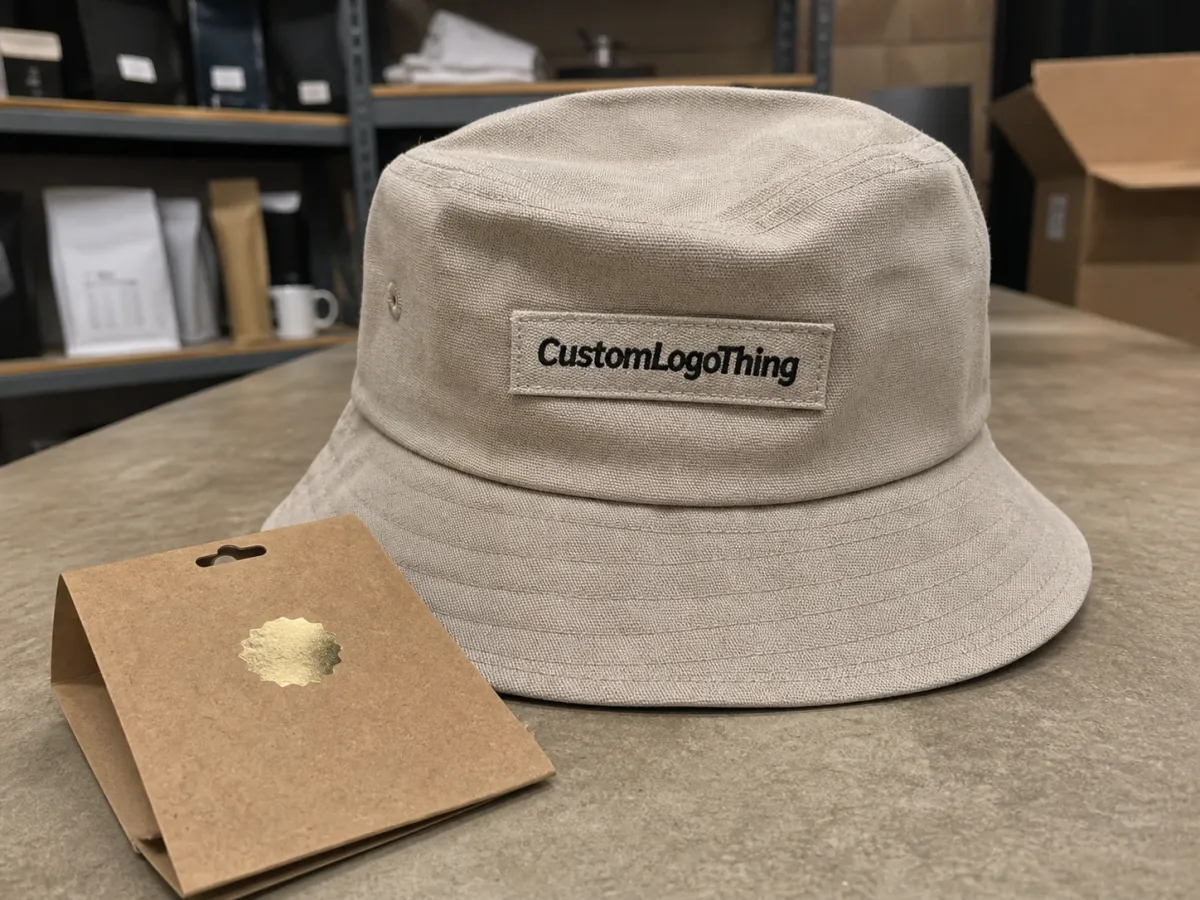
Bucket hats fit the way coffee brands actually sell. Roaster merch rarely lives in a single channel. It has to perform at the cafe register, on an e-commerce page, at pop-ups, and sometimes in wholesale accounts that want a clean, giftable item with broad appeal. A bucket hat can move across all of those settings without asking the customer to know their size or commit to a full outfit.
They also age better than many trend-driven accessories. A tee can feel dated if the graphic overcommits to a season. A bucket hat, by contrast, can be minimal and still hold the brand. That is useful for roasters that want long shelf life and low return risk. The same shape can support a quiet logo, a bold wordmark, or a patch that feels closer to outdoor gear than souvenir merch.
There is a retail logic to the category as well. Many coffee buyers pick up accessories on impulse. A hat priced in the mid-range looks like a considered purchase rather than an afterthought, especially if the fabric feels substantial and the shape photographs well. In stores, that balance matters more than a polished brand deck. People reach for what looks comfortable.
“The best merch items are the ones customers can imagine wearing the same day. Bucket hats succeed because the use case is obvious, the fit is forgiving, and the brand message sits where people can actually see it.”
For buyers, the key is not finding any supplier. It is finding a bucket hats wholesale supplier for coffee roaster buyers who understands how limited drops, reorder runs, and cafe shelf presentation change the brief. A supplier who only quotes blank stock misses half the job. The better partner asks how the hat will be sold, how often it will be reordered, and whether the brand needs a core piece or a seasonal release.
Product details that affect retail appeal and wearability
Bucket hats can look close enough in photos and still feel very different in hand. Crown depth, brim width, panel count, stitching density, and fabric weight all shape the final impression. A shallow crown can sit awkwardly. A brim that is too floppy can look cheap on the shelf. Too stiff, and it starts to feel like costume apparel rather than something people would actually wear.
Fabric choice usually comes first. Cotton twill is a dependable starting point because it holds embroidery well and reads as familiar retail apparel. Most buyers will recognize the hand-feel immediately. Washed cotton softens the look and works well for cafes that want a more relaxed, lived-in aesthetic. Canvas brings more body and a heavier drape, while nylon blends push the hat toward a lighter, more technical finish that suits outdoor or travel-focused audiences.
For many coffee brands, a fabric in the 240-320 gsm range is a sensible middle ground. Light enough to wear comfortably, heavy enough to feel worth paying for. Go much lighter and the hat can lose shape in transit. Go much heavier and the brim can become bulky, especially if you are shipping by the carton rather than displaying on hooks.
Decoration is where a lot of buyer mistakes happen. Embroidery is the default for good reason: it is durable, legible, and has enough texture to feel intentional. But dense embroidery can distort a softer crown if the fabric is too light. Woven labels create a cleaner, finer-detail look and often suit understated branding. Patches can be the best answer when the artwork has too much detail for stitch work, though they add thickness and can affect how the front of the hat sits.
Inside finishing matters more than most people expect. A rough seam can irritate the forehead after an hour of wear. An uneven sweatband can cause returns even if the front logo looks perfect. Retail buyers notice that kind of thing quickly. A hat that looks clean from a distance but feels sloppy up close will struggle in repeat sales.
Color is another place where coffee brands need discipline. Neutral shades often perform best because they fit the visual language of most roaster packaging. Black, stone, washed olive, sand, and charcoal tend to be safer than bright fashion colors. That said, a warm seasonal tone can work if it ties directly to packaging or a campaign. The point is to make the hat feel connected to the brand, not copied from it.
Packaging should be planned with the same care as decoration. Foldability affects shipping cost and how the item arrives on the table. If the hat comes packed too tightly, the brim may need reshaping before display. If you want hang tags, barcode stickers, or FSC-certified paper components, that needs to be decided before production starts. Late changes tend to be expensive, and they often show up as a delay rather than a design improvement.
Sample testing should go beyond a quick look in a bright room. Wear the hat for a few hours. Check whether the seam allowance bites into the forehead, whether the brim keeps its shape after folding, and whether the logo distorts when the crown flexes. The issues that matter most in retail are often the ones that do not show up in a static product photo.
Specifications to lock before sampling and production
The fastest way to compare suppliers fairly is to lock the specs before requesting final pricing. Otherwise one quote may assume a soft, unstructured crown and another may price a reinforced build with a stitched brim insert. Those are not comparable products, even if the photos look similar.
Start with the physical dimensions. Brim width, crown height, circumference, and panel count all change the silhouette. For coffee merch, a brim around 2.25 to 2.75 inches is common because it gives enough shade without pushing the hat into exaggerated territory. Crown height should be tall enough to sit comfortably on a range of head shapes, but not so tall that the profile looks oversized.
Then define the construction. Decide whether you want six panels or a simpler cut, whether the crown should be structured or soft, and whether the brim needs topstitch reinforcement. If the hat includes lining, a drawcord, ventilation eyelets, or an adjustable fit system, those details need to be listed clearly. Each one changes both cost and wearability.
Artwork prep is equally important. A supplier can only quote accurately if they know the stitch count, placement, size, and file format. A simple wordmark is straightforward. A logo with fine line detail, gradients, or tiny typography may need simplification before it can be stitched cleanly. That is not a design failure; it is a production constraint. Good buyers treat it as part of the process, not a surprise.
Color approval should be handled with references, not vague descriptions. Provide PMS numbers if you have them, but also include packaging images, cafe interior photos, or a prior product sample if the brand already has one. Dye behavior and screen color do not always match, and fabric texture can make the same tone look warmer or cooler depending on lighting.
Inspection standards should be written down before the order moves ahead. That checklist does not need to be long. It should cover logo placement tolerance, stitch cleanliness, seam symmetry, color consistency, brim shape, and obvious defects such as loose threads or skipped stitches. Ask the supplier how they handle a short-run rejection threshold and what happens if the sample is approved but bulk production drifts. Those answers reveal more than the sales copy does.
A reliable bucket hats wholesale supplier for coffee roaster buyers will also be willing to explain what can stay standard and what should be customized. That distinction saves money. A custom label may improve perceived value. Custom internal taping, on the other hand, may be visible only to the warehouse team and not to the customer. Buyers who know the difference usually get a cleaner margin.
Cost, pricing, and MOQ for wholesale bucket hats
Bucket hat pricing usually comes down to five variables: fabric, decoration complexity, quantity, packaging, and freight. Simple embroidery on a standard cotton twill hat will usually sit at the lower end of the market. Add custom labels, a denser stitch count, heavier fabric, or individual packaging, and the price rises fast. That is predictable, but it still catches first-time buyers off guard.
For planning purposes, many wholesale bucket hats land in a rough range of $4.50 to $7.50 per unit for moderate quantities with straightforward decoration. Larger orders, especially those with simple artwork and limited add-ons, can come down to $3.25 to $5.50 per unit. Heavier canvases, patches, specialty packaging, and more complex construction can push the price into the $6.25 to $10.00 range or beyond. Those are unit costs, not landed costs.
Landed cost is where the real math lives. Freight, duty, carton handling, and domestic receiving can add more than buyers expect, especially if the order is split across locations or shipped during a congested period. A hat that looks inexpensive in the quote may lose its appeal once the full inbound cost is visible. For coffee brands that set retail prices around $24 to $32, a landed cost that stays in the $6.80 to $9.50 range is usually workable. Above that, margin gets tight quickly.
| Option | Typical MOQ | Indicative unit price | Best fit | Notes |
|---|---|---|---|---|
| Cotton twill with embroidery | 300-500 pcs | $4.50-$7.50 | Core cafe merch | Easy to wear, reliable for repeat ordering |
| Washed cotton with woven label | 300-800 pcs | $5.25-$8.25 | Relaxed premium drops | Soft hand-feel and strong lifestyle appeal |
| Nylon blend with patch | 500-1,000 pcs | $5.75-$9.00 | Outdoor and travel collections | Lighter weight, more technical look |
| Canvas with custom label set | 500-1,000 pcs | $6.25-$10.00 | Heavier retail statement pieces | Higher perceived value, higher freight and handling cost |
MOQ is often where buyers need the most realism. Smaller runs can be useful, especially for a first release or a seasonal test, but they usually cost more per unit because setup fees are spread across fewer hats. A 100-piece trial run may make sense if the goal is to validate a new colorway or test a cafe opening. It will not usually produce the best cost efficiency.
The better approach is to ask for two quotes: one for a test order and one for a repeat. That gives you a clear read on whether the line can scale. If the price drops sharply at 500 or 1,000 units, you may decide to keep the first order small and plan a second run once demand is clearer. A supplier who is comfortable showing both numbers is usually easier to work with than one who only talks about the headline price.
One more caution: compare quotes line by line. Sample fees, tooling, tag setup, cartons, and freight should be visible. Otherwise the lowest number may not be the lowest total. It is common for a quote to look competitive until packaging or shipping gets added at the end. That is the kind of detail experienced buyers check early.
In most cases, the smartest first order is not the most complicated one. A straightforward hat with clean branding, stable fabric, and a limited color choice tends to outperform a crowded design that looks impressive on paper but costs too much to move. The retail floor usually rewards clarity.
Process, timeline, and lead time from proof to shipment
The production path should be clear from the first conversation. For Custom Bucket Hats, the sequence usually runs like this: spec confirmation, artwork review, digital proof, sample production, sample approval, bulk production, inspection, and shipment. If a supplier cannot walk you through those steps, the order may still happen, but the risk of surprises goes up.
Timelines vary by decoration method and order size, but a realistic schedule often looks like this: 3 to 5 business days for proofing and internal approvals, 7 to 12 business days for sample work, and 12 to 20 business days for production after approval on a standard run. Larger quantities, multiple colorways, or complex patch work can extend the schedule. Shorter lead times are possible, but they should be treated carefully if the art files are not already production-ready.
Many delays come from simple things: missing vector files, changes to logo size, a late color correction, or a revised packaging request after sample approval. Coffee teams are usually busy, so one person should own the final sign-off. That keeps the back-and-forth from dragging out longer than the schedule allows.
Inspection and shipping matter just as much as production. Ask whether the supplier does final carton checks, how they handle loose threads or misaligned logos, and whether hats are packed individually or in bulk inside master cartons. If the order is going to multiple cafes, a clear carton label system helps a lot. It reduces receiving errors and saves staff time at the end of the chain.
For seasonal launches, build in a buffer. A hat that arrives one week late may miss the window for photography, shelf setup, or event merchandising. That is not dramatic; it is just how retail timing works. Even a five-day cushion can be the difference between a clean launch and a rushed one.
What a bucket hats wholesale supplier for coffee roaster buyers should see first
A good quote starts with a concise brief. Send quantity, target retail date, material preference, decoration method, logo file, color references, and packaging requirements. If you already know your retail price, include it. That helps the supplier recommend a build that fits the margin rather than a build that only looks good on paper.
For Coffee Roaster Merch, the supplier should also understand the use case. Is the hat meant for a tasting room counter, a seasonal online drop, a staff uniform, or a wider retail push? Those scenarios point to different decisions. A counter item may need a lower landed cost and simpler packaging. A limited release can justify a more premium finish. A staff item may prioritize durability and comfort over shelf appeal.
Most buyers get better results by starting narrow. One colorway, one decoration method, one packaging style. Test the sell-through. Then decide whether the next order should add a color, change the label, or shift to a heavier fabric. That path is slower than guessing, but it usually produces fewer dead boxes in storage.
A bucket hats wholesale supplier for coffee roaster buyers should also be willing to explain the tradeoffs in plain language. If embroidery will distort a fine-line logo, they should say so. If a woven label will look sharper but cost slightly more, that should be visible in the quote. The strongest suppliers do not hide the compromises; they help you choose which ones are worth making.
For teams that need a repeatable process, the real value is consistency. A hat program succeeds when the second order matches the first closely enough that the customer cannot tell the difference. That sounds simple. It is not. Fabric dye lots, stitch tension, and packing methods all matter. A supplier who can manage those variables is usually the one worth keeping.
What MOQ should I expect from a bucket hats wholesale supplier for coffee roaster buyers?
MOQ usually starts around 300 to 500 pieces for a simple decorated hat, though smaller trials are sometimes possible. More complex decoration, multiple colorways, or custom trims can push the minimum higher. If you are testing a new merch direction, ask for both trial and repeat-order pricing so you can see whether the item scales cleanly.
Which materials are best for coffee roaster bucket hats?
Cotton twill is the safest starting point because it holds embroidery well and wears comfortably. Washed cotton gives a softer, more relaxed feel, while canvas adds weight and durability. Nylon blends work if the brand wants a lighter, outdoor-friendly look. The right choice depends on the audience, climate, and price target.
Can bucket hats be matched to coffee packaging and cafe branding?
Yes, and the best programs usually do. Share PMS references, packaging photos, or brand guidelines early so the supplier can align the hat with the rest of the merch mix. Small choices like label color, thread shade, and brim tone can make the item feel connected without making it look overdesigned.
What affects the unit price most on wholesale bucket hats?
Fabric weight, decoration method, order quantity, and packaging are usually the biggest cost drivers. Dense embroidery, custom labels, and specialty cartons all raise the price. Freight and duty can also change the final number, so compare landed cost rather than only the factory quote.
How long does production usually take after approval?
For a standard custom run, proofing may take a few business days, samples around one to two weeks, and bulk production another two to three weeks after approval. The exact timeline depends on the decoration method and the supplier’s capacity. Late artwork changes and color revisions are the most common reasons schedules slip.
For coffee roasters, bucket hats earn their place because they solve a merchandising problem that many other items do not. They are wearable without being fussy, visible without being loud, and practical without feeling plain. A well-made hat can sit comfortably beside beans, brewing gear, and tote bags as part of a broader retail story.
That only works if the production side is handled with discipline. The right fabric, the right shape, the right decoration method, and a clear inspection process turn a simple accessory into a dependable product line. If the supplier understands that balance, the hat program has a much better chance of becoming a repeat seller instead of a one-off experiment.