Bulk beanies are decided by specs, not slogans. In a custom acrylic Beanies Bulk Order, the real pressure points are usually yarn count, knit density, finish, and pack-out before logo size ever becomes the sticking point. That is true whether the order is for a retail launch, a school program, a sponsorship drop, or a 100-piece event run that needs to look uniform under harsh lighting and still feel comfortable after a full day of wear.
Acrylic stays the default bulk material for practical reasons. It is durable, color-stable, easy to care for, and predictable in production. It also behaves well in standard knit constructions, which matters when a sample has to turn into a larger run without subtle changes in shape or texture. Buyers who understand those constraints usually get tighter quotes, fewer revisions, and fewer unpleasant surprises after approval.
There is another reason acrylic is so common: it gives a decent balance between cost and presentation. A beanie that needs to move through retail, giveaway, and staff-use channels can be spec'd without chasing premium yarns that push the price up faster than the brand value justifies. The trick is choosing the right knit structure, the right decoration method, and the right packaging level for the actual use case.
A clean quote starts with clean inputs: quantity, yarn colors, logo file, target ship date, and packaging needs. Leave one of those vague, and the first estimate is usually softer than the final price.
Custom Acrylic Beanies Bulk Order: What Buyers Should Know
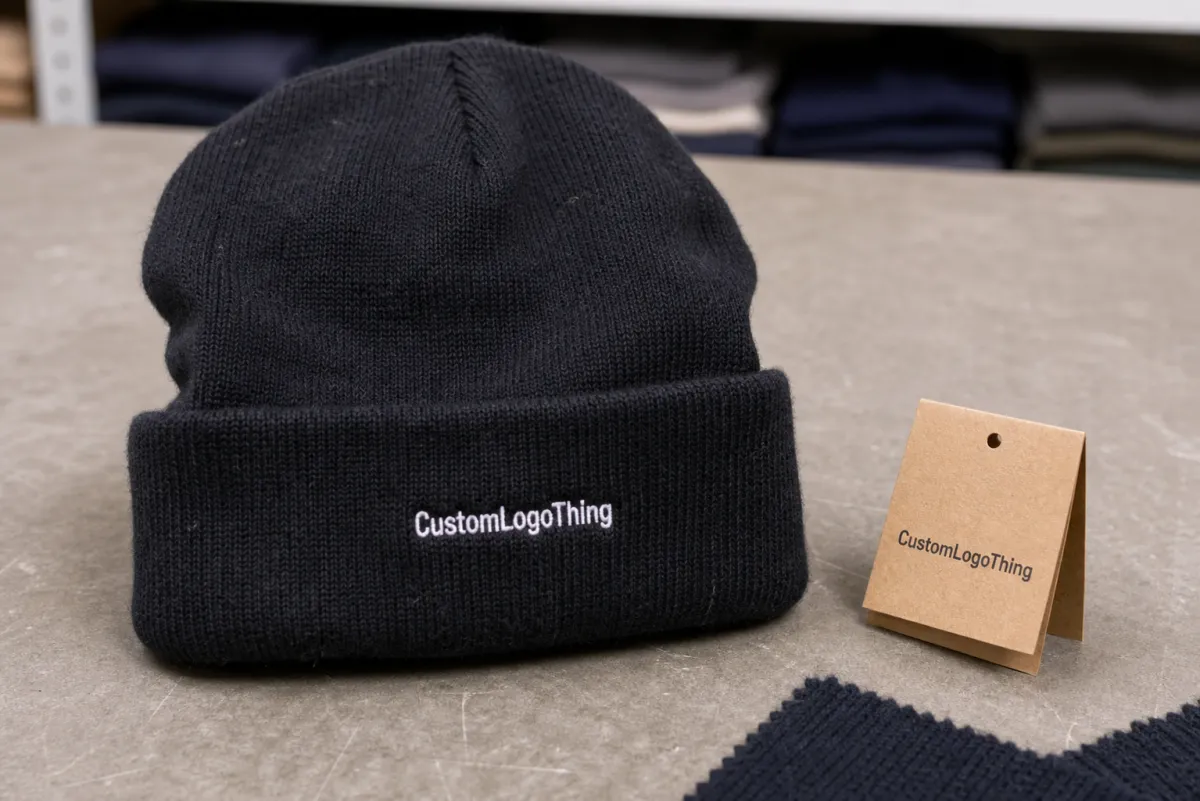
Most buyers start with the logo. Experienced buyers start with construction. A custom acrylic Beanies Bulk Order can look inexpensive at first glance and then climb once the pattern calls for extra stitch work, multiple yarn colors, a deeper cuff, or a decoration area that needs to be rebuilt to make the artwork readable. In knit headwear, the price is often driven more by the fabric itself than by the logo sitting on top of it, because the logo is usually part of the fabric.
That distinction matters in the real world. A retail buyer wants beanies that photograph cleanly on a shelf and still look right in social media images. A school or club order needs consistent color across several size lots. An event team usually cares most about visual uniformity and comfort, because the hats will be worn in short bursts, passed out in a hurry, and judged from a distance. A good spec sheet has to account for all of that.
Acrylic also gives buyers flexibility on presentation. The same beanie can be folded for retail packaging, banded for a promo kit, or boxed with a simple insert. Those choices affect labor and landed cost, but they also affect perceived value. A plain knit hat in a tidy retail pack often outsells a better-made hat that arrives loose and unlabelled.
One practical reality: the order is only as strong as the paperwork. If the file format, color callouts, and pack-out instructions are incomplete, the project spends too much time in clarification and not enough time in production. That is where budgets slip.
Acrylic Yarn, Fit, and Cuff Options That Change the Look
Acrylic is not one look. Yarn weight, gauge, and knit density shape both hand feel and visual sharpness. A tighter gauge gives the fabric a cleaner surface and usually helps the logo read better from a distance. A looser knit can feel softer right away, but it tends to relax more over time and can blur small details. For buyers comparing samples, the difference often shows up in the cuff and around the logo edges before it shows anywhere else.
Fit matters just as much. Standard cuff, slouch, and youth sizing each change the silhouette. The standard cuff is still the most decoration-friendly because it creates a stable front panel and gives the artwork a consistent landing area. Slouch styles look more relaxed and fashion-driven, but the logo can ride higher or lower depending on how the wearer folds the hat. Youth sizing is easy to overlook until the sample arrives and the crown looks too tall or the opening feels oversized for the intended audience.
For buyers thinking about shelf presence, the knit itself becomes part of the brand story. A tighter rib structure, a well-shaped cuff, and a consistent stitch pattern all signal control. That is why a lower-priced style is not always the better value if it photographs poorly or stretches out faster than expected.
Common construction choices include:
- Jacquard knit logos for integrated color work and a clean overall appearance.
- Woven labels when the artwork is too detailed for knit reproduction or needs a sharper edge.
- Embroidered patches for a dimensional finish that sits well on thicker cuffs.
One more practical point: the material choice should match the use. A hat meant for heavy winter wear benefits from a denser knit and a more structured cuff. A promotional run may prioritize cost and broad appeal instead. The best spec is rarely the fanciest one; it is the one that fits the channel.
Logo Placement and Decoration Specs to Approve Before Production
Approval is where projects stay on schedule or start drifting. Before production begins, confirm exact placement, yarn color count, font thickness, border treatment, and any cleanup needed around small shapes. Knit production is honest in a way digital mockups are not. Thin lines can vanish. Gradients can flatten out. Tiny text can turn into texture when the gauge is too loose or the artwork is too busy for the medium.
Simple vector logos usually reproduce better than artwork built from shadows, hairlines, and soft edges. That does not mean the design has to become plain. It means the design needs to work with the material. A strong two-color mark often looks sharper than a six-color image that loses definition once the yarn is laid into the knit structure. The best logos for beanies are the ones that survive translation.
Front-only decoration remains the most common choice, especially for larger runs where speed and clarity matter. Front-plus-cuff decoration can work if the artwork is simple and the buyer wants a more premium feel. A woven label is often the cleaner route when the logo includes tiny type, a narrow border, or detail that would be difficult to knit cleanly.
Proof review should not be rushed. The digital proof is the last controlled checkpoint before knitting starts. After that, changes are possible, but they are slower and more expensive. If the order also includes packaging, review that proof with the same discipline. The beanie and the package should look like they belong to the same program, not two different ones glued together at the last minute.
For shipping expectations, it helps to think past appearance. If the hats are being bagged, banded, or packed for retail or distribution, using a recognized handling benchmark such as ISTA guidance is a sensible way to think about transit risk, especially when cartons may be stacked, compressed, or handled multiple times.
Pricing, MOQ, and Unit Cost Drivers for Larger Orders
Pricing on a Custom Acrylic Beanies Bulk Order usually comes down to five variables: quantity, knit color count, decoration method, packaging, and destination. That last one is easy to ignore and expensive to forget. Freight, carton count, and final-mile handling can move the landed cost enough to change the buying decision, particularly when the margin is tight or the event date is fixed.
MOQ depends on the pattern. A simple one-color cuff beanie can often start lower than a complex jacquard style because the setup is easier and the knitting time is shorter. Larger quantities usually reduce unit cost, but only to a point. Once the run is set, the fastest savings usually come from simplifying the design, not from trimming a few dozen pieces off the order.
| Style | Typical MOQ | Typical Unit Cost Range | What Drives the Price |
|---|---|---|---|
| Single-color cuff knit | 100-200 pcs | $3.20-$4.80 | Lower setup, fewer yarn changes |
| Two-color jacquard logo | 200-300 pcs | $4.10-$6.20 | Logo stitch complexity, tighter proof control |
| Jacquard knit + woven label | 300+ pcs | $4.80-$6.90 | Two decoration steps, cleaner retail presentation |
| Patch or embroidery add-on | 200-500 pcs | $5.40-$8.50 | Patch production, application labor, packaging |
Those ranges are planning figures, not promises. A custom acrylic beanies bulk order with unusual yarn colors, individual bagging, or custom inserts can land above them. A simplified order with fewer colors and standard folding may come in lower. That is why a useful quote request includes a file-ready logo, the preferred hat color, the target ship date, and any packaging requirement from the start.
There is also a pricing trap that catches first-time buyers: comparing unit price without checking what the unit includes. A lower quote can exclude folding, labeling, or individual polybags. A slightly higher quote can be the better deal if it includes the details that would otherwise be added later. Landed cost is the number that matters, not the first number someone sends over email.
Process, Timeline, and Lead Time From Proof to Ship
The production path is straightforward, but each step depends on the one before it. First comes the inquiry, then the quote, artwork review, digital proof, approval, knitting, finishing, packing, and shipment. If the artwork is clean and the buyer responds quickly, the process moves at a steady pace. If not, delays usually cluster around the proof stage, because that is where the unanswered questions pile up.
The two most common slowdowns are unclear logos and late color approvals. A Pantone reference is useful, but knit yarn is not paint. Matching is approximate, and the proof should show the intended contrast rather than pretend every color will behave the same way it does on a screen. Another delay appears when a buyer wants to tweak wording after approval. That sounds minor. It is not minor once production has started and the run is already locked.
Standard lead times often run about 12-20 business days from final proof approval, depending on order size and production load. Rush requests can sometimes shorten that, but usually at a cost and with less flexibility on packaging or finishing. Freight time is separate. A beanie order can finish on schedule and still miss a launch if transit was not planned correctly.
That split matters for school deadlines, retail resets, and event calendars. Production time is the making. Shipping time is the move. Buyers who treat them as one bucket often discover too late that the order itself was fine; the schedule was not.
For cartonization and storage, a custom acrylic beanies bulk order is easier to manage when the hats are folded uniformly and packed with clear carton labels. That helps receiving teams count quickly and lowers the odds of mix-ups when multiple colors or sizes are included in the same shipment.
Quality Checks, Packing, and Labeling for Resale or Events
Quality control on knit headwear is not glamorous, but it prevents the expensive kind of surprise. The main checks are simple: consistent sizing, clean logo edges, correct color placement, and even stitching across the run. If one carton feels noticeably different from the next, that deserves a question before the shipment leaves.
Packing matters almost as much as the hat itself. Uniform folding speeds up distribution at events. Individual polybags help retail handling. Carton labels should show SKU, color, quantity, and destination so the receiving team can move fast without opening every box. If the order includes custom inserts or hang tags, those need to be counted in the packing plan rather than treated as a last-minute add-on.
For resale programs, the presentation layer can influence sell-through nearly as much as the knit. A clean hang tag, a simple belly band, or a coordinated insert can make the item feel intentional without adding much cost. That is why packaging should be treated as part of the merchandise plan, not as decoration after the fact.
If the shipment is likely to be stacked, shifted, or handled repeatedly, ask whether the cartons should be evaluated against a relevant ISTA profile or equivalent handling expectation. For paper-based inserts or tags, FSC-certified stock from FSC sources can support a cleaner sourcing story without changing the core decoration spec.
One practical rule holds up across every run: the larger the order, the less room there is for assumption. A custom acrylic beanies bulk order should arrive sorted the way it will be used, not the way it was easiest to pack.
Why Buyers Reorder From a Supplier That Handles Bulk Knit Runs Well
Repeat orders reveal whether the first run was truly controlled. If the sample approval was tight and the production notes were clear, the second order is faster, easier, and cheaper to manage. If the first order depended on loose communication, the reorder turns into a correction project, which is exactly the kind of work buyers try to avoid.
Consistency is the main advantage. A supplier that keeps proof structure, color references, and packing format stable can reproduce the same beanie with less back-and-forth. That is a business advantage, not just a convenience. It reduces the chance that a second batch arrives with a slightly different cuff shape or a logo that no longer matches the earlier run.
Communication matters more than polished sales language. Clear turnaround estimates, precise documentation, and prompt proof responses save more money than vague promises about speed. In bulk programs, time is usually lost in the gaps between messages, not in the knitting room.
That is why buyers should look for a process, not a pitch. The beanie, the label, the carton, the insert, and the shipping docs all affect the outcome. When those pieces are handled with the same discipline, the reorder becomes a routine procurement decision instead of a fresh round of problem-solving.
From a buyer's point of view, reliability is measurable. Fewer revisions. Fewer missed details. Fewer surprises in receiving. That is what a well-run custom acrylic beanies bulk order should deliver.
What to Prepare Before Requesting a Quote
Before asking for pricing, decide what the order is actually for. Retail. Giveaway. Staff use. School program. That one choice changes how the beanie should be spec'd, packed, and priced. A retail launch may need hang tags and cleaner folding. A giveaway may only need basic polybags. Staff use may prioritize warmth and color consistency over presentation.
Then gather the essentials: final quantity, target ship date, logo file, preferred colors, decoration style, and packaging needs. If the order is a custom acrylic beanies bulk order, ask for a proof before approving production and confirm the MOQ on the exact style you want. It also helps to compare landed cost, not just unit price, because freight and packaging can change the total.
- Send a vector logo when possible.
- Specify the hat color and any Pantone targets.
- Confirm front-only, cuff, patch, or label decoration.
- State whether the order is for resale, giveaways, or uniforms.
- Include carton, bagging, and insert requirements early.
That checklist saves time on both sides. It also makes quotes easier to compare because the specs are finally equal. If the beanies need to support a retail launch or a branded campaign, the packaging plan should be settled before approval, not patched together later.
For buyers who want the order to move cleanly through production, the best starting point is simple: final file, final quantity, final pack-out. Once those three pieces are stable, the rest of the process becomes much more predictable.
What is the usual MOQ for a custom acrylic beanies bulk order?
MOQ depends on yarn color count, decoration method, and whether the beanie is a simple knit or a more complex jacquard build. In many programs, the practical starting point is 100-200 pieces for simple styles and higher for more detailed patterns. Larger quantities usually reduce unit cost, while very small runs often carry heavier setup charges.
How many logo colors can I use on acrylic beanies in bulk?
Most suppliers can knit multiple colors, but each added color increases setup complexity and can raise the price. In practice, two to three logo colors often produce the cleanest result because contrast stays strong and the knit surface remains readable. Fine gradients and tiny type are harder to reproduce cleanly.
Can I approve a proof before my bulk beanie order goes to production?
Yes. A digital proof should show placement, color callouts, and decoration style before anything is knitted. That proof is the point where buyers should catch spacing issues, missing elements, or color mismatches. Once production starts, changes can delay the schedule and increase cost.
How long does a custom acrylic beanies bulk order usually take?
Lead time depends on artwork approval speed, order size, and current production load. A common production window is about 12-20 business days after final approval, with shipping time added separately. If the order is tied to a launch or event, both production and freight should be confirmed before the date is set.
What do you need to quote a custom acrylic beanies bulk order quickly?
Provide quantity, logo file, preferred colors, decoration style, target ship date, and destination ZIP or country. If you also include packaging needs and whether the order is for resale or giveaway use, the quote will usually be tighter and more useful on the first pass.

