For buyers who need product visibility, quick replenishment, and a clean shelf read, a custom Clear Poly Retail Bags bulk order is often the most practical packaging choice. The bag is there to protect the item, keep it visible, and move through packing and receiving without slowing the line. That simplicity is the point.
Clear poly works best when the package has one job and does it well: keep dust off, reduce scuffing, show color and shape, and make counts easy to verify. Buyers use it for accessories, stationery, craft components, hardware, apparel parts, and other light consumer goods that need retail packaging with minimal visual noise. A transparent format also helps the back room; staff can identify contents faster, and defects are harder to miss before the product reaches the floor.
What a custom clear poly retail bags bulk order solves
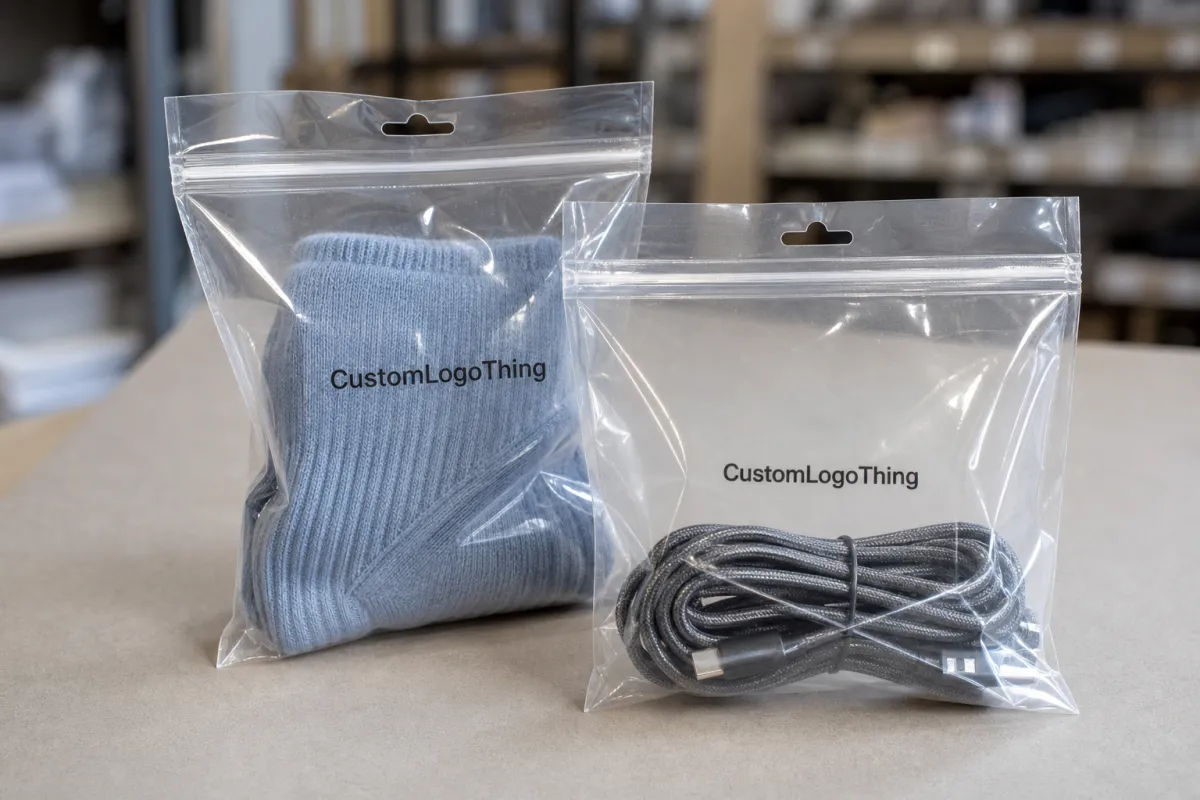
The biggest advantage is visibility. Shoppers can inspect color, shape, count, and general condition without opening the package, which matters more than many buyers expect. Once a line grows to multiple SKUs, one consistent bag format also simplifies packing, stockroom handling, and replenishment.
Clear poly reduces everyday wear. It keeps dust off, limits light handling scuffs, and protects the item from incidental abrasion during transit or shelf movement. It is not a substitute for heavy-duty shipping protection, so it works best when the product is light, stable, and meant to be seen.
The best retail bag is the one that protects the product without getting in the way of packing, stocking, or the shopper's first look.
For buyers, the value is repeatability. If one size can cover several related products, a bulk order becomes easier to manage because it reduces inventory fragments and the number of packaging decisions the team has to make every month.
- Best fit for accessories, stationery, small apparel items, hardware, and low-weight consumer goods.
- Main benefit product visibility with basic protection.
- Operational win one bag style can support several SKUs if fit is tested correctly.
Film, seal, and finish options that affect performance
Not all clear poly bags behave the same way. The film can be softer or stiffer, clearer or slightly hazier, and those differences change both the look and the handling feel. Softer film may be easier to open and load by hand, while a stiffer film usually holds a cleaner shape.
Thickness is one of the first decisions buyers should make. Thin film can work for small, smooth, low-weight products, but it is less forgiving around edges and corners. Heavier gauges, often in the 2 mil to 4 mil range, are more appropriate when the contents are sharper, heavier, or likely to be handled many times before sale. Above that range, the bag may feel overbuilt for simple retail use and can raise cost without improving the shopper's experience.
Seal and opening style matter just as much as thickness. Heat seals create a permanent closure and a tidy edge, which is useful when the product should not be reopened in store. Lip-and-tape closures are better when the package needs to be loaded quickly or resealed. Tear notches, hang holes, rounded corners, and vents can improve handling or display, but every added feature increases complexity.
For hanging displays, hole placement should support the product's weight and leave room for the product itself to sit naturally. For manual packing, a wider mouth usually saves more labor than a tighter opening that looks neat on a drawing but fights the operator on the line. If you are comparing clear bags with other retail formats, the range of Custom Packaging Products can help you evaluate where the bag belongs in the broader package system.
Sizing and fit rules for retail products
Fit starts with the product, not the bag. Measure the item first, then add room for loading, small product variation, and the closure method. A bag that looks fine on paper can still be awkward if the opening is too tight or the contents move too freely inside.
Width, length, and gusset depth need to be considered together. A flat bag may work cleanly for a single carded item or a narrow accessory, but a gusseted bag often makes more sense for a thicker item or a bundled set. If the package must also hold an insert, hang tag, or barcode label, that space has to be reserved in the spec so the information stays legible and the seal zone stays clean.
The most useful rule is simple: choose the smallest bag that still loads easily and presents cleanly. Oversized film makes the package look loose and undisciplined. Undersized film slows packing, increases the chance of split seams or crushed corners, and usually creates more waste than buyers expect during the first run.
Before committing to a full order, test the bag against real samples, not drawings. A difference of 1/8 inch can matter when a product has rigid edges or when the pack team is moving quickly. Case-pack efficiency also deserves attention because bag size affects carton yield, storage density, and shipping cost.
- Measure the product with any insert or accessory included.
- Add practical clearance for loading and closure.
- Test a sample against the actual item.
- Check carton yield so the master case stays efficient.
Print, labeling, and barcode needs
Some buyers need plain clear bags, and that is often enough. Others need a logo, size mark, warning copy, or a barcode that helps stores scan and stock faster. The right answer depends on how much work the package is supposed to do. A single-color mark can be enough for a simple line.
Clear packaging should preserve visibility first. Print should stay in non-critical zones so the shopper can still inspect the product. A barcode placed over a fold, seal, or reflection-prone area can slow checkout and create avoidable friction in stores. The same issue applies to lot codes and compliance text.
Good file prep shortens approval. Clean vector art, exact placement measurements, and final copy reduce proof cycles. Buyers who plan the print area carefully usually get cleaner production and fewer corrections.
For broader packaging standards and terminology, the Packaging Institute is a useful reference point for comparing clear poly formats with other package branding decisions across a product line.
Cost, pricing, MOQ, and quote details
Unit price is shaped by size, thickness, print complexity, and quantity. Larger runs usually lower the per-bag cost because setup is spread across more pieces. That is why a custom clear poly retail Bags Bulk Order often makes more sense than placing multiple smaller orders throughout the year.
MOQ is more than a supplier threshold. It is a planning tool. If one size can cover several SKUs, a higher minimum may still be reasonable because the bag becomes a shared platform instead of a one-off item. Where buyers get into trouble is treating every product as if it needs its own unique bag spec.
| Bag option | Typical use | Common features | Indicative unit price at 5,000 pcs |
|---|---|---|---|
| Plain clear poly bag | Simple retail items, fast packout | No print, standard seal, clear visibility | $0.05-$0.09 |
| Printed clear poly bag | Brand-led product packaging | Logo, size mark, barcode area, warning text | $0.08-$0.18 |
| Gusseted clear poly bag | Thicker items, better shelf shape | Side or bottom gusset, more volume | $0.10-$0.22 |
Those numbers are planning ranges, not promises. Freight, carton size, tooling, and sample requirements can shift landed cost even when the unit price looks stable. Ask for quote breaks at a few volume levels so you can compare the first run with repeat-order economics.
When comparing packaging categories, it can also help to review adjacent formats such as Custom Poly Mailers. That comparison is useful when the question is not only how the product looks on shelf, but how it moves through fulfillment, storage, and retail replenishment.
Include dimensions, gauge, print colors, quantity, and delivery window on the quote request. If the product line has compliance text, list that too. For paper inserts or cartons, it is worth checking whether FSC-certified sourcing matters for that portion of the order; the FSC site is the right place to confirm the language and certification basics.
Process and lead time from spec to shipment
The order path should be straightforward: gather the spec, confirm artwork or samples, approve a proof, schedule production, then pack and ship. When dimensions, thickness, finish, and print placement are clear at the start, estimating is faster and the order is less likely to stall.
Lead time depends on whether the bags are printed, how many colors are involved, and whether special finishing is needed. Plain clear bags usually move faster. Printed versions require proofing, registration checks, and more careful setup. In many production schedules, a complete spec and final artwork can keep the timeline around 12 to 15 business days after approval, though the actual window depends on factory load and shipping method.
A digital proof or pre-production sample is worth the time. Catching a barcode shift, a size mismatch, or a copy error before the run starts is far easier than fixing a mistake after cartons are already staged.
For orders that will face repeated handling, it is smart to think beyond the bag itself. Aligning the bag spec with relevant abuse-test principles from ISTA keeps the conversation grounded in how goods actually move through warehouses and stores.
Quality checks and handling practices
Clear poly bags are unforgiving in a useful way. If the film is clean and consistent, the product looks better. If the bag has haze, wrinkles, dust, or contamination, the flaw is obvious immediately. That makes inspection less about decoration and more about discipline.
Uniform packing matters as much as manufacturing quality. If every carton contains the same count and the cases are labeled correctly, receiving moves faster and the warehouse makes fewer errors. Repeat orders should always be checked against the original approved spec. Small drift in gauge, size, or print placement can produce visible differences on shelf.
Storage should also be part of the spec conversation. Cartons need to stay dry, out of direct sunlight, and away from sharp edges. Poly film can be damaged long before the bags reach display if the cartons are handled carelessly.
Quality checklist
- Check clarity and haze level.
- Confirm seal strength and seal placement.
- Measure bag dimensions against the approved spec.
- Inspect print registration and barcode readability.
- Verify case count and carton labeling.
What to send for a fast reorder and accurate quote
If you want a clean quote, send exact product dimensions, target bag size, quantity, and whether the bag should be plain or printed. Photos help more than a paragraph of explanation. A picture of the product or the previous package often reveals fit issues, opening direction, and display needs that are hard to explain in text.
Include the target ship date and destination ZIP or port so the quote reflects production and freight reality. Add compliance text, preferred gauge, and whether samples are required. Those details keep the approval path shorter and reduce the chance of rework on a custom Clear Poly Retail Bags bulk order. They also help prevent the common problem of a bag that prices well but does not actually fit the workflow.
For the final comparison, look at size, thickness, print, MOQ, and delivery timing together. A lower unit price is not always the best answer if the bag is too large, too thin, or too slow to arrive. The right spec is the one that fits the product, supports the shelf, and keeps packing efficient.
For repeat retail programs, a clear bag can be the simplest solid choice: easy to stock, easy to inspect, and easy to reorder once the spec is settled. Lock the dimensions, choose the right gauge, keep branding restrained, and make sure the sample reflects the real product.
What MOQ should I expect for a custom clear poly retail bags bulk order?
MOQ depends on size, gauge, and whether the bags are printed or plain. Higher quantities usually improve pricing, especially when the same bag can serve multiple SKUs. Ask for tiered quotes so you can compare the first run with repeat-order economics.
How do I choose the right size for clear poly retail bags?
Measure the product first, then add room for loading, any inserts, and normal variation. Decide whether a flat bag or a gusseted bag fits the item better. A sample checked against the actual product is more reliable than a specification sheet alone.
What thickness works best for retail poly bags?
Lighter gauges are usually fine for small, low-weight items that do not need much puncture resistance. Heavier gauges work better for sharper edges, heavier contents, or bags that need a firmer look on shelf. The best choice balances clarity, strength, and ease of packing.
How long does production usually take after artwork is approved?
Lead time depends on print complexity, quantity, and whether special finishing or tooling is required. A complete spec sheet and final artwork usually shorten the proof cycle. Freight method also affects the schedule, so shipping time should be built into the plan early.
Can I reorder the same retail bag later with small changes?
Yes, repeat orders are usually straightforward if the core size and construction stay the same. Artwork or labeling changes should still be reviewed on a fresh proof. If the product dimensions changed, the fit should be checked again before confirming the reorder.

