A Clear Poly Retail Bags sample approval checklist helps buyers catch the small issues that create real cost later. A bag can look fine in a flat proof and still fail once it is loaded, hung, or exposed to retail lighting. That is when haze, crooked seals, off-center artwork, weak closures, and poor fit become obvious.
Sample approval is not a formality. It is the last low-cost chance to confirm that the package shows the product clearly, holds up in handling, and still looks worth buying. For clear poly bags, those three requirements are tightly linked. If one is off, the whole presentation suffers.
Because clear film shows everything, even minor flaws matter. A slight wrinkle at the seal or a hang hole that sits a few millimeters off can turn into a shelf problem. Buyers who treat approval as a risk check usually avoid the most expensive surprises.
Clear Poly Retail Bags Sample Approval Checklist: Why Small Flaws Cost Real Money
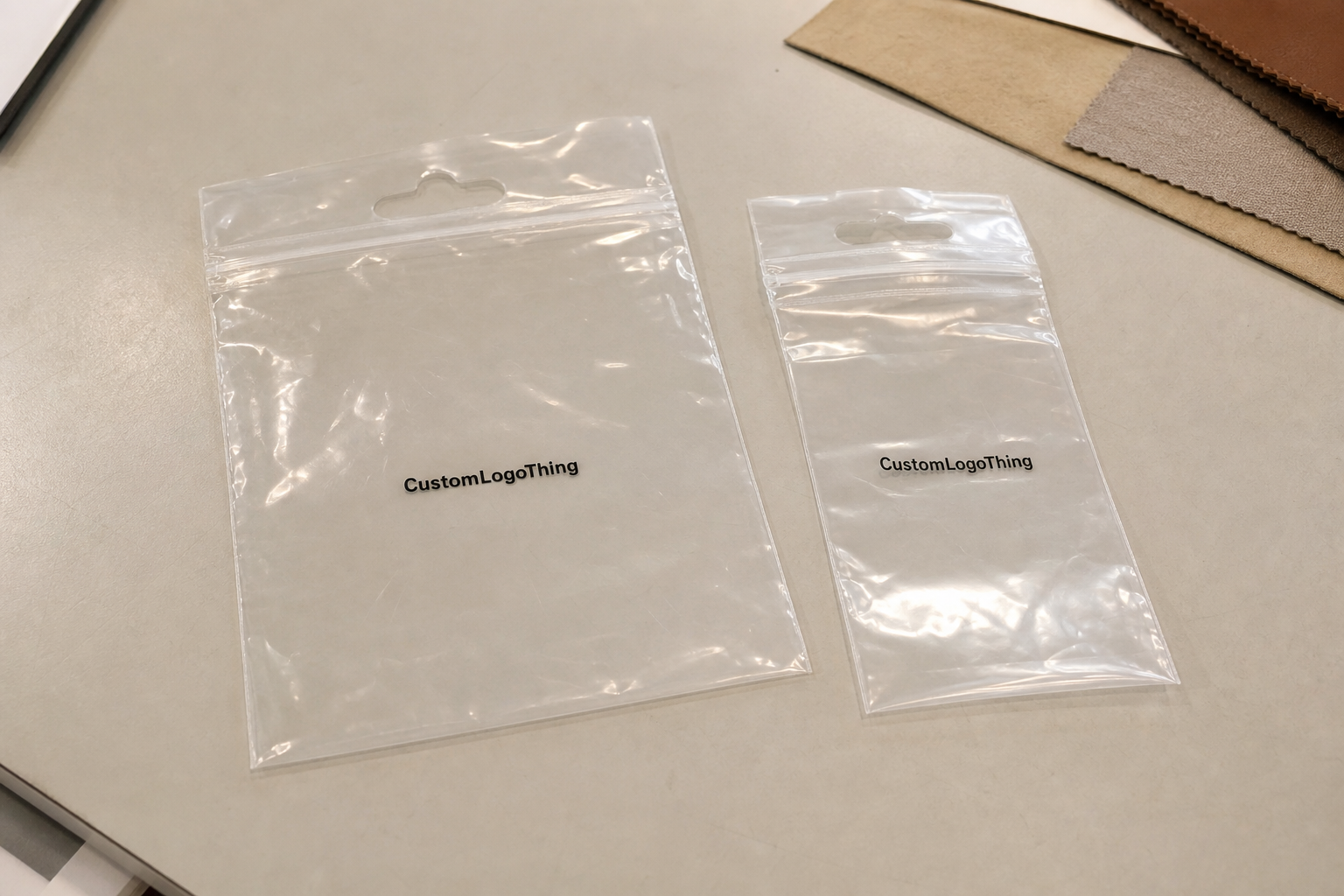
Most losses come from bags that are almost right. The dimensions are close, the artwork is close, and the closure works most of the time. Then production starts and the final package looks slightly wrong in a way customers notice immediately. That is how reprints, markdowns, and dead stock happen.
With Clear Poly Retail Bags, the usual problems are both visual and functional. Haze can dull the item. Scuffs can make a bag look handled before it reaches the shelf. A weak seal can open after repeated flexing. A bad fit can wrinkle the film or push the product off center.
A useful checklist asks a few direct questions:
- Does the product fit without forcing the seams?
- Does the film stay clear under store-style lighting?
- Do the seals hold after normal handling?
- Does the loaded package still look intentional on a peg or shelf?
The last question matters most. Packaging is visual selling space. If the bag bends oddly, clouds the artwork, or makes the product look distorted, it hurts the sale. A sample that only looks good empty is not ready for approval.
Sample Approval Process: From Spec Sheet to Final Signoff
Start with the spec sheet, not the artwork. Confirm the bag style, dimensions, film gauge, closure type, print method, and retail features such as hang holes, tear notches, reseal strips, header area, or reinforced seams. If the written spec is vague, the approval will be vague too.
It also helps to separate the sample types. A digital proof checks layout and copy. A material swatch checks clarity and feel. A physical sample checks fit and presentation. A pre-production sample is the closest match to the final run. Approving one as if it were another is where mistakes start.
A practical approval flow is simple:
- Review the spec sheet and artwork together.
- Confirm dimensions, tolerances, closure type, and print placement.
- Test the sample with the actual product, not a placeholder.
- Mark issues with measurements, photos, and plain language.
- Record written signoff so the approved version is traceable.
Written signoff matters because production moves faster than memory. If a later shipment drifts from the approved version, you need a record of what was accepted. A vague “looks fine” email is not enough. A signed PDF or a specific approval note is better.
For teams managing multiple packaging formats, keep the approval record with the product file so the same standards can be reused. That becomes especially useful when the retail program also includes matching formats such as Custom Packaging Products or related shipping formats like Custom Poly Mailers.
It helps to borrow some discipline from packaging testing and transport review. Resources from ISTA are useful for thinking about handling risk, while packaging-industry resources help standardize process language. The goal is not perfection. It is repeatable approval.
Specs That Matter Most for Clear Poly Bags
Clarity is usually the first spec buyers notice. A clear poly bag should disappear around the product, not tint it, cloud it, or make it look frosted under retail lights. Haze and scuffing are the biggest presentation killers because they make a fresh product look tired.
Film type matters too. LDPE is softer and more flexible. OPP or CPP usually gives a crisper, cleaner look with better clarity, though the exact feel depends on the build. Thickness is often measured in mils, and retail uses commonly fall somewhere around 1.5 to 4 mil depending on protection needs, weight, and stiffness.
Thicker is not always better. Heavier gauge film can feel more substantial, but it can also make the bag bulky or hard to fold neatly. Fit matters just as much. Always test the sample with the actual product, including tags and inserts, because an empty bag can hide a fit problem that appears as soon as the item is loaded.
Useful checks during review:
- Clarity and haze: inspect under bright, retail-style light.
- Seal integrity: press, flex, and tug the seams gently.
- Print placement: confirm logos, size labels, and warnings are centered.
- Retail features: verify hang holes, tear notches, and adhesive closures.
- Load fit: test the actual product, not a substitute item.
Also check how the bag behaves after handling. Clear film can scuff during fulfillment or carton rub, and that is often missed in an office review. ASTM D882 is sometimes used as a reference for film tensile properties, but a lab reference does not replace a hands-on inspection of the finished package.
Production Timeline After Approval: What Happens Next
Once the sample is approved, production still has several steps to complete. The usual sequence is artwork release, spec lock, material allocation, converting, inspection, packing, and shipment. If any of those changes, the schedule changes too.
Lead time depends on the order. Stock bags move quickly because the material and size already exist. Printed custom bags need setup. Fully custom sizes or special constructions take longer because the film, cutting, sealing, and finishing all have to be adjusted. A simple stock-style order may ship in a few business days. A custom printed order with revisions often needs two to six weeks after approval.
Sample review itself also has a timeline. A digital proof may come back in one to two days. A physical sample can take several business days. Pre-production samples take longer because they are meant to mirror the final run more closely.
Here is a simple comparison:
| Approval Path | Best Use | Typical Timing | Risk Level |
|---|---|---|---|
| Digital proof | Artwork layout and copy checks | Same day to 2 business days | High if fit or finish matters |
| Physical sample | Size, clarity, seal, and presentation review | 3 to 10 business days | Medium |
| Pre-production sample | Final check before the full run | About 1 to 2 weeks, sometimes longer | Lowest |
One revision can reset the clock. Change the hang hole, adjust the width, or update the artwork after signoff, and part of the process may need to be repeated. That is how a “minor tweak” becomes a missed launch date.
A bag that passes on a desk can still fail after box compression, vibration, or repeated handling. The package is not just a clear sleeve. It is a retail item that has to survive the trip from converting line to store shelf.
Cost, Pricing, MOQ, and Unit Cost Drivers
Pricing usually comes down to five things: bag size, film thickness, print complexity, converting difficulty, and order quantity. Larger bags use more material. Thicker film uses more resin. More print colors mean more setup. Odd sizes and special features add labor and waste.
MOQ exists because production has fixed setup costs. A supplier cannot run a tiny custom lot at the same unit price as a larger one. The setup, material allocation, and machine time have to be spread across the order.
Sample charges, setup fees, and production pricing should be separated clearly in writing. A sample may be refundable, credited later, or billed as a development cost. Ask about plates, tooling, and extra proof rounds too. If you cannot tell which costs are one-time and which repeat, the unit price is not really comparable.
Typical cost drivers look like this:
- Basic clear bag: lowest cost, simplest build, easiest approval.
- Printed clear bag: higher cost because of setup and color control.
- Custom size or feature: higher cost due to converting complexity.
- Heavier gauge film: higher material cost, sometimes better protection.
- Lower quantity: higher unit cost because setup is spread thin.
For a fair comparison, look at total landed cost, not just the unit price. A cheaper bag that needs rework, extra freight, or replacement stock is not cheaper. It is just underpriced in the wrong place.
Common Approval Mistakes That Cause Reprints
The first mistake is approving from a screen only. Digital proofs help with layout, but they do not show how the film feels, whether the seal is crisp, or whether the bag collapses oddly around the product. A PDF cannot catch a crooked fold.
The second mistake is testing the bag empty. Empty bags hide fit problems. Filled bags tell the truth. If the real product stretches the seams, creates visual distortion, or pulls the closure out of shape, that has to be caught before production starts.
The third mistake is ignoring the environment where the bag will actually live. Retail lighting, humidity, carton rub, stacking pressure, and shipping abrasion all affect presentation. A sample that looks perfect in a clean office can behave differently in a warehouse or on a peg wall.
The fourth mistake is vague feedback. “Looks good” is not feedback. Mark up the sample, list the exact measurement, and include photos. If the print needs to move 3 mm or the width needs to change by half an inch, say that plainly.
Approval rule: If the sample changes shelf appearance, loading behavior, or seal performance, it is not acceptable just because it is close.
Another failure point is forgetting to compare against the retained approved sample. Keep one approved version on file and compare the first production run against it rather than against memory.
Final Checks Before You Sign Off
Before final signoff, put the approval details on one page. Include the approved dimensions, film gauge, closure type, print placement, tolerance range, date, and approver name. If those details live in several inboxes and one shared folder nobody trusts, they will not help later.
Run the sample in three states: empty, filled, and packed for shipment. Empty shows build quality. Filled shows fit and seal behavior. Packed shows how the bag handles friction, pressure, and movement. That is where the expensive mistakes are usually caught.
Also confirm what changes require a fresh approval. A new logo position? Reapprove. A gauge change? Reapprove. A different adhesive strip? Reapprove. Silent drift is how the final run ends up “close enough” in a way that is absolutely not close enough.
For teams that reorder often, the Clear Poly Retail Bags Sample Approval Checklist becomes a repeatable quality step instead of a memory test. It keeps the approval process from turning into guesswork, and it gives the buyer a cleaner first run with fewer surprises. The payoff is fewer reprints and packaging that still looks intentional after shipping, handling, and display.
What belongs on a clear poly retail bags sample approval checklist?
Include size, gauge, clarity, seal quality, print placement, closure type, and an actual loaded fit test. Add photo documentation and written signoff so the approved sample can be matched to the production run without guesswork.
How long does sample approval usually add to a retail bag order?
A digital proof may take one to two days, a physical sample often takes several business days, and a pre-production sample can take longer. The timeline depends on whether the sample is stock-based, custom-sized, or tied to revised artwork.
What affects clear poly retail bag pricing the most?
The biggest drivers are bag size, film thickness, print complexity, and total quantity. MOQ, setup fees, and special converting steps can move the price more than buyers expect, especially on smaller orders.
Can I approve a sample if the size is slightly off?
Only if the difference sits inside an agreed tolerance and the product still fits correctly. If the bag changes shelf appearance, load behavior, or seal performance, it should be revised instead of approved.
Is a photo of the sample enough for final approval?
Photos help, but they do not show feel, clarity, seal strength, or how the bag behaves when filled. Use photos as support, not as the only proof, unless the order is very low risk and the supplier agrees in writing.