Custom Frosted Garment Bags Bulk Order for Retailers
If you are pricing a custom frosted garment Bags Bulk Order, the first question is usually not the lowest unit price. It is whether the bag fits the garment, protects the finish, and still looks clean on a rack, in a carton, or in a receiving room. A frosted sleeve reduces glare, softens visual clutter, and makes folded edges read more deliberately than clear poly.
That matters because packaging changes how a garment is judged before anyone touches it. Clear film can expose wrinkles, hanger marks, and uneven folds that are harmless in transit but distracting at retail. Frosted film works like a visual filter: the garment remains visible, but the presentation looks calmer and more controlled.
For retailers, bridal labels, uniform programs, and private-label apparel, the sleeve is part of the merchandising system. The right frost level, film weight, closure style, and print layout can reduce rework, keep presentation consistent, and make it easier to compare quotes without guessing.
Why Frosted Packaging Changes How Garments Are Perceived
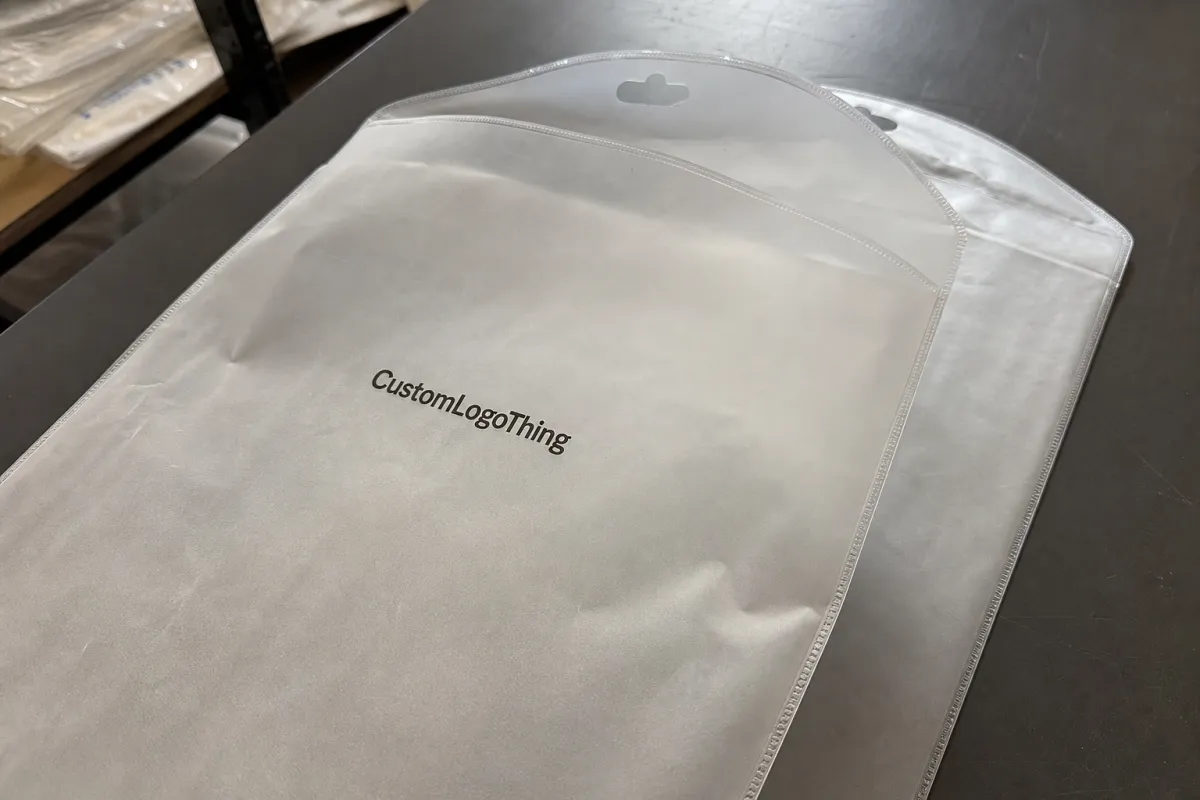
Packaging shapes perceived value very quickly. Buyers and store teams do not overanalyze a sleeve, but they do notice whether it looks clean, straight, and consistent. Clear film shows everything, including compression lines, seam shadows, and hanger hardware. Frosted film softens those details without hiding the garment itself.
That helps on the sales floor, where glare from overhead lighting and window exposure can make clear poly look busy. A matte-frosted finish is easier to photograph, easier to scan visually from a distance, and less likely to make the garment look rushed. The effect is subtle in a spec sheet and obvious in use.
It also matters in the back room. A sleeve that looks controlled gives receiving teams and buyers a better first impression of the product line. The package does not fix a bad fold, but it can prevent the packaging from making a good garment look worse.
The goal is not concealment. It is removing visual noise so the garment reads first.
Material, Finish, and Closure Options for Bulk Runs
Most Frosted Garment Bags are made from polyethylene film. Common thicknesses run from 1.5 mil to 3 mil, with heavier gauges used for coats, suits, and higher-handling programs. Film weight affects more than durability; it changes drape, stiffness, and how the bag hangs once it is filled.
Frost level is another important variable. A lighter frost keeps more garment detail visible, while a denser frost creates a softer, more private look and hides wrinkles better. There is no universal best choice. A showroom sample sleeve and a warehouse sleeve usually need different balances of visibility and opacity.
Closure style should follow the garment and the distribution path. Open-top sleeves are the most economical. Adhesive flaps help keep dust out and keep folded garments neat. Hanger-hole bags with a flap are common for products that stay on hangers. Zipper or button closures add reusability, but they also raise cost and production complexity. Gusseted bags are better for jackets, suits, and bulky outerwear.
Small details often make the biggest difference in handling:
- Vent holes let air escape so the sleeve stacks flatter.
- Tear notches make opening easier and reduce snagging.
- Reinforced seams improve strength near stress points.
- Defined print zones keep logos away from seals, folds, and cut edges.
If the order covers multiple categories, keep the structure as simple as the product allows. Shirts, dresses, suits, and outerwear rarely need the same sleeve format, and using one oversized spec for all of them often creates waste.
Size, Fit, and Print Specs That Prevent Reorders
Wrong size is the most expensive mistake because it usually appears only after the run is complete. Measure the garment in its real folded state, not just the flat garment dimensions. Allow for seam thickness, hanger hardware, closure overlap, and any extra depth created by folding. Hanging items need shoulder width and hem length checked together.
Common size ranges are predictable, though the final spec still depends on cut and fold style:
- Shirts and tops: often 24 x 36 in. or 24 x 40 in.
- Dresses: often 30 x 40 in. or longer for full-length styles.
- Suits and blazers: often 30 x 48 in. with hanger allowance.
- Coats and outerwear: often 40 x 60 in. or a gusseted format.
Print specs need the same discipline. Before approving a custom frosted Garment Bags Bulk Order, confirm logo placement, print count, ink coverage, and whether the artwork appears on one side or both. Heavy ink coverage can reduce the frosted effect and make the sleeve look more opaque than intended. In many cases, a simple logo is easier to read because the film already provides texture.
The most common reorders come from three avoidable mistakes:
- Ordering a sleeve that fits the garment flat but fails once it is folded and sealed.
- Placing artwork too close to a seal, hanger cutout, or fold line.
- Ignoring how the bag behaves after air is pushed out and the garment is hanging inside it.
Proofing should not stop at a PDF. Review edge margins, logo placement, and hanger opening alignment. If the run is large or the fit is tight, a physical sample is worth the time because opacity and seal placement are easier to judge in hand than on screen.
Pricing, MOQ, and Quote Factors for a custom frosted garment bags bulk order
Unit cost depends on more than volume. Film thickness, dimensions, closure style, print method, and whether the bag is stock-based or fully custom all affect the quote. A one-color sleeve on a common size can price very differently from a gusseted bag with heavier film and a premium closure. If the program includes multiple sizes, each tier usually needs its own assumptions.
For planning, these ranges are common in the market:
| Option | Typical MOQ | Typical Unit Cost | Best Fit |
|---|---|---|---|
| Stock frosted sleeve, one-color logo | 3,000-5,000 pcs | $0.12-$0.22 | Retail basics, uniforms, folded apparel |
| Fully custom size, one- or two-color print | 5,000-10,000 pcs | $0.18-$0.34 | Private-label apparel, branded packaging programs |
| Heavy-gauge gusseted bag with premium closure | 5,000-15,000 pcs | $0.28-$0.55 | Suits, outerwear, bridal, travel and gift sets |
Those numbers move if the order needs sampling, special cartons, or rush production. Freight can also change landed cost more than the bag itself, especially on larger runs. Buyers should ask whether the quote is factory-direct or landed, whether revisions are included, and whether artwork changes trigger a new setup charge.
There is one hidden cost that matters in practice: repacking labor. If the bag is too tight, too flimsy, or awkward to open on the floor, stores pay for it later in time. A slightly better sleeve can be the lower-cost option once labor and damage are included.
Production Steps, Lead Times, and Shipment Scheduling
The production sequence is usually straightforward: request for quote, artwork review, proof or sample approval, manufacturing, inspection, packing, and shipment booking. Each step depends on the one before it. If artwork changes after proof approval, the schedule moves. If a sample is required, add time. If the bag includes a custom closure or nonstandard size, add more.
For many runs, production takes about 12-18 business days after proof approval. A pre-production sample can add 5-7 business days, sometimes more if the spec is unusual or the print is complex. Expedited production exists, but printing, sealing, inspection, and packing still take time, so rushed schedules leave less room to catch defects.
Plan around the in-hand date, not just factory completion. Transit time, receiving hours, weekend delivery windows, and warehouse scheduling all matter. For shipments that will face rough handling, ask whether the packaging plan aligns with ISTA transit test standards. The standard is not a guarantee, but it is a useful benchmark for distribution conditions.
A practical schedule should include:
- target ship date
- in-hand deadline
- destination receiving hours
- freight method
- sample approval deadline
- backup stock level if the launch slips
Quality Checks and Compliance Before You Approve a Bulk Run
Quality control should be measurable. Review seal strength, tear resistance, odor, opacity consistency, and print registration. A bag can look fine at first glance and still fail at the hanger hole or along a seam. That is why sample review is the cheapest place to catch a defect.
Check the bag the way a store associate or fulfillment team will use it. Does the opening tear cleanly? Does the film split when pulled? Does the logo drift toward the edge after the bag is filled? Those are the questions that determine whether the sleeve helps the operation or slows it down.
Compliance depends on the market and the claims printed on the package. Ask for material declarations, recycling marks if applicable, and any region-specific packaging requirements. Plastic film recycling acceptance varies by municipality, so a sustainability claim should match the actual destination market. If the packaging set includes paper inserts, printed cartons, or hang tags, make sure FSC claims are documented properly. For mixed-material programs, FSC guidelines matter when paper components are part of the order.
A sample that looks acceptable on a table can fail once the hanger hole, fold line, and seam are under real load.
Consistency matters as much as design. If bags in the same carton vary noticeably in frost level or trim, the run looks less controlled. That kind of variance is usually a production issue, not a branding issue.
Where Frosted Garment Bags Work Best in Retail and E-Commerce
Frosted Garment Bags work best when presentation needs to feel polished without becoming fully opaque. Boutiques like them because they look tidy without exposing every wrinkle. Bridal shops use them because they preserve enough visibility to identify the garment while still feeling refined. Uniform programs benefit because the finish standardizes presentation across large SKU counts.
Compared with clear sleeves, frosted bags hide small imperfections and reduce glare. Compared with opaque sleeves, they still allow quick identification. That middle position is useful in apparel packaging because it balances visibility and restraint. The customer can recognize the product, while the brand controls the frame.
For e-commerce, the sleeve does not replace a shipper box or mailer, but it improves the first layer the buyer sees after opening the carton. That matters for returns, reorders, and gift purchases where presentation affects confidence. Standardizing the sleeve across retail, fulfillment, and wholesale also reduces version sprawl for operations.
What to Send Now to Lock in Your Bulk Order
A usable quote starts with specifics. For a frosted garment bag program, send the exact bag size, garment type, closure style, film thickness target, print file, quantity, and destination. That gives the supplier enough information to estimate film usage, tooling, setup, and freight without guessing.
Include these details as well:
- target ship date and in-hand deadline
- whether a sample or proof is required first
- folding method or hanger constraints
- preferred print color count
- sample photos or an existing sleeve if fit must be matched closely
If the program may expand later, mention that early. It helps the supplier plan the sequence and can keep the spec flexible if later sizes or colors are added. The cleanest brief names the use case, states the numbers, and asks for tiered pricing. Ambiguity is what slows the order down.
What MOQ should I expect for custom frosted garment bags bulk order requests?
MOQ usually depends on size, film thickness, and print complexity more than the garment category. Stock-based dimensions often allow lower entry quantities than fully custom sizes or multi-color printing. Tiered pricing is useful because it shows where the unit cost improves and whether a slightly larger run is worth it.
Can frosted garment bags be printed with my logo and still stay semi-transparent?
Yes, but ink coverage matters. Simple one- or two-color branding usually preserves more of the frosted effect than full-panel graphics. Ask to see how the logo reads under store lighting and in shipping photos, since those conditions can make a small design decision look much larger.
How do I choose the right size for suits, dresses, or coats?
Measure the garment at its widest folded point and add allowance for hanger hardware, seams, and closure overlap. Long coats and structured garments need more depth than folded tops. If the fit is borderline, send a current sample bag or dimension sheet for spec matching before the run is approved.
What affects the lead time for a bulk frosted garment bag order?
Artwork approval, sample requests, and print complexity affect timing most often. Production moves faster when the size and files are final at the start of the quote process. Freight method adds time as well, so the in-hand deadline should be shared early rather than treated as a later detail.
What should I include when requesting a quote for frosted garment bags?
Send size, thickness, quantity, closure type, print details, and the delivery destination for freight calculation. Mention whether samples, rush service, or a reprint of an existing design are needed. The more complete the brief, the fewer revision cycles the order usually needs.

