Custom Embroidered Baseball Caps for corporate event gifts are one of the few giveaways that can keep working after the event floor is empty. A flyer gets glanced at, a badge lanyard gets stuffed into a drawer, but a cap gets worn on the train ride home, at weekend errands, and sometimes for years. From a packaging buyer’s point of view, that repeated wear is the real return: one handoff, many impressions.
They also solve a practical event problem. If you are outfitting staff at a trade show, thanking speakers at a summit, or packing client swag into a welcome bag, you need something that looks polished, ships well, and is easy to distribute fast. Embroidery adds texture and perceived value in a way flat print often cannot. The cap itself matters, but so do fit, comfort, logo size, and how cleanly the item fits into your broader branded packaging or package branding plan.
Custom Embroidered Baseball Caps for Corporate Event Gifts: Why They Work
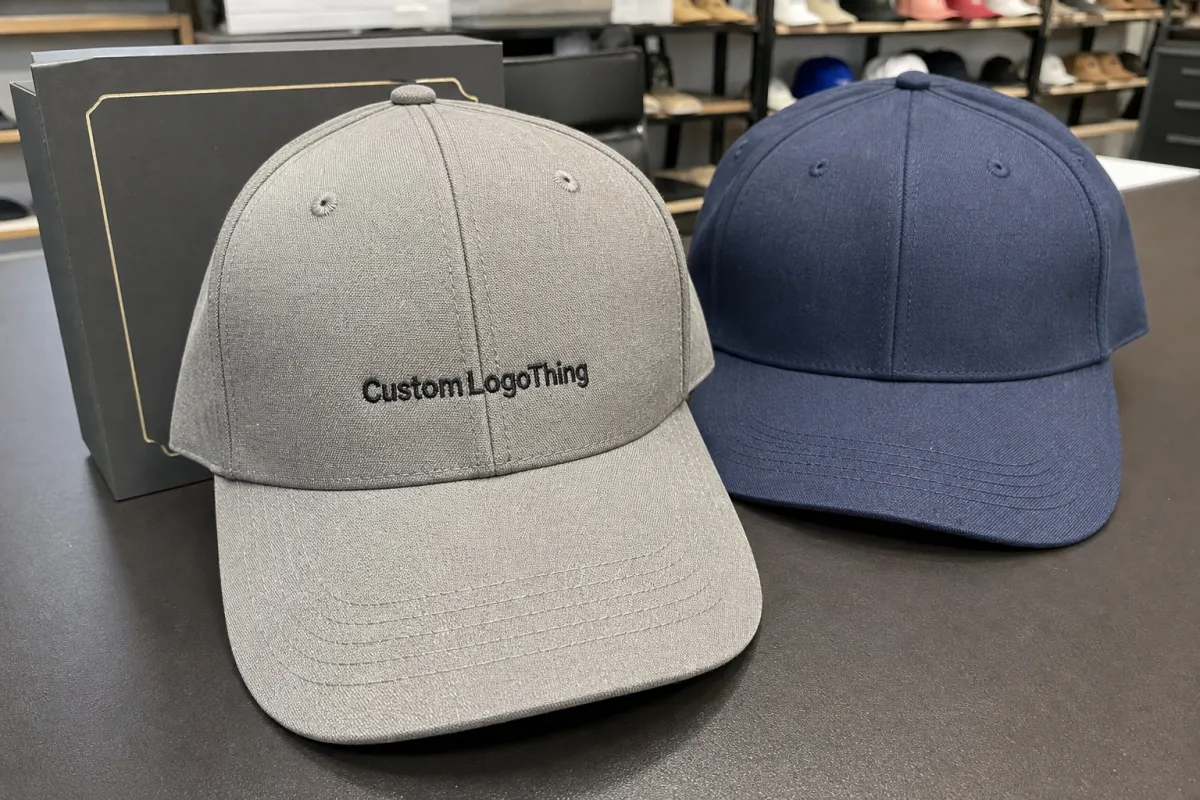
The simplest reason these caps work is also the most overlooked: people wear them. That sounds obvious, yet so many corporate gifts fail because they are decorative rather than useful. A wearable item extends your brand far beyond the event hall, and Custom Embroidered Baseball Caps for corporate event gifts do that without feeling forced. They sit in a sweet spot between merchandise and uniform piece, which is why they work for volunteer teams, client hospitality, and internal kickoffs alike.
Embroidery changes the perceived value immediately. Stitching has depth, shadow, and a tactile quality that printed ink cannot mimic. A small logo on a well-shaped cap looks intentional. A too-large printed graphic on the wrong cap style looks like a rushed promo item. That difference matters if the gift is going to executives, speakers, or high-value prospects who notice finish quality faster than most buyers expect.
There is also a distribution advantage. Caps are compact enough for event tables, room drops, and welcome kits, but they still feel substantial. In practice, they outperform flyers, postcard inserts, and one-time trinkets because they solve a real wardrobe need. A sun-exposed expo floor, outdoor team activity, or casual Friday office culture all give the cap another chance to earn its keep.
From a retail packaging perspective, the cap becomes even more effective when it is presented well. If it arrives inside a clean box, a branded pouch, or a structured welcome kit, the opening moment feels more deliberate. That is where product packaging and the gift itself start working together instead of competing for attention.
A cap is not just a cap if the audience will wear it twice, ten times, or fifty times. That is where embroidered gifts beat disposable swag.
Embroidery Process and Timeline: From Artwork to Delivery
The embroidery process is straightforward on paper and more sensitive in practice. It usually starts with logo review, then digitizing the art into a stitch file, then proofing, thread matching, production, quality control, packing, and shipment. The stitching itself is rarely the slowest part. Approvals, artwork cleanup, cap stock availability, and response time are what stretch the schedule.
Good digitizing is the difference between a logo that reads cleanly and one that turns into a fuzzy patch. A strong vendor will flag thin text, tiny lines, or crowded elements before production starts. For most corporate logos, a stitch count somewhere in the 6,000 to 9,000 range is common, but that depends on the size of the decoration and how dense the artwork is. More stitches are not automatically better; they can create a heavier, stiffer feel if the design does not need them.
A sample or virtual proof matters because it shows the buyer what is actually being approved. That proof should answer three questions: where the logo sits, how large it is, and how the thread colors read against the cap color. If those three items look right at cap size, you are usually in good shape. If the proof is still unclear, stop and fix it before production. Rework after approval is where timelines get expensive.
Rush orders usually fail for predictable reasons. The art file is incomplete. The logo is revised after proof approval. The cap style is changed after stock has already been reserved. Shipping windows do not leave any room for damage, weather delays, or a replacement run. A normal order might take 12-15 business days from proof approval to shipment, while a more complex order or a tight stock situation can push beyond that. The fastest way to keep control is to approve early and keep the design simple.
For buyers who also manage welcome kits, it helps to think about the cap as part of a packaging system rather than a standalone item. If the cap has to sit next to custom printed boxes, inserts, or other branded packaging, the proofing should cover the whole presentation, not just the embroidery.
Cost, Pricing, and MOQ: What Actually Changes the Quote
Quote changes are usually driven by five things: cap style, quantity, stitch complexity, thread color count, and packaging or shipping requirements. Buyers often focus on the unit price first, but the real comparison is the all-in cost. Setup, digitizing, freight, and rush charges can move the final number more than a small difference in the base cap price.
MOQ is not just a vendor rule; it is a production math problem. Digitizing, machine setup, thread loading, and proofing all carry fixed cost. Spread those costs over 24 caps and the unit price climbs. Spread them over 250 caps and the value improves quickly. That is why small runs are not automatically “expensive” and large runs are not automatically “cheap.” They are simply distributed differently.
| Order Type | Typical Quantity | Approx. Unit Price | Best Fit |
|---|---|---|---|
| Basic cotton twill, one-location embroidery | 24-49 | $7.50-$12.00 | Small teams, quick gifts, internal use |
| Structured cap with standard logo stitch | 50-249 | $4.25-$7.25 | Trade shows, speaker gifts, client swag |
| Premium performance or higher-end cap | 250+ | $3.00-$5.75 | Large events, sponsor kits, executive gifting |
Those ranges are directional, not universal. A simple one-color logo on an in-stock cap may come in lower. A dense logo with multiple placements, custom packing, or split shipping may come in higher. I like to tell buyers to compare quotes line by line. Watch for setup fees, digitizing charges, proof charges, freight, and rush production costs. If one quote looks much cheaper, the missing line item is often hiding somewhere else.
Here is the cleanest way to think about it: a basic cap works fine for large internal events where volume matters most. A premium structured cap makes more sense for client-facing gifts or executive programs where the item has to feel more like apparel than swag. The cap is part of the message.
Choosing Cap Style, Fabric, and Stitch Details That Fit the Event
Cap style changes the whole mood of the gift. A structured cap has a firmer front panel and usually looks more polished. An unstructured cap feels softer and more relaxed. Low-profile caps sit closer to the head, while high-profile caps rise a bit more and can look more traditional. Curved brims feel familiar to most buyers. Flat brims skew younger and more fashion-forward. Snapback closures are flexible for mixed audiences, while strapback or fitted options can feel more refined if you know the wearer profile.
Fabric matters just as much. Cotton twill reads classic, breathable, and easy to wear. Performance fabrics bring moisture management and a sportier look, which helps at outdoor events or active staff programs. Brushed cotton and washed finishes can feel more premium, though they are not always the best match for crisp corporate branding. A cap that suits a golf outing may not be the right answer for a boardroom-adjacent event.
Logo readability is where many buyers get surprised. Very small text, thin lines, tight letter spacing, and soft gradients all need simplification for embroidery. Thread is not a print engine. It has thickness, angle, and texture. If a design only reads because of a delicate gradient or a hairline rule, it will probably need adjustment. Good suppliers will tell you that before production, which is exactly what you want.
Fit is the last variable people underestimate. Event gifts need broad wearability across staff, clients, speakers, and volunteers, not just one head shape or one style preference. A cap that sits comfortably on more people gets worn more often. That is the whole point.
Step-by-Step Ordering Plan for Event Teams
If you want a smoother order, start with the event goal. Is the cap for staff identification, VIP gifting, lead capture, sponsor visibility, or general attendee swag? The answer changes everything. It affects cap style, decoration size, packaging, and even whether the item should ship bulk-packed or individually bagged.
- Define the purpose and audience.
- Collect quantity, delivery date, cap style, and logo files.
- Confirm thread colors and placement.
- Review the proof at actual cap size.
- Approve only when the branding still reads clearly from a few feet away.
The minimum inputs for a useful quote are simple: quantity, target delivery date, cap style, logo file, preferred thread colors, and any packaging needs. If you have those six items ready, the first quote is usually much more accurate. If you do not, the supplier is guessing, and guesswork has a cost.
Here is the line I wish more buyers repeated to themselves:
A proof is the cheapest place to catch a mistake; production is the expensive one.
That is especially true for corporate events. Once the inventory is staged, cartons are labeled, and schedules are locked, even a small change can trigger a chain reaction. A logo shift, a cap-color swap, or a quantity change can move freight, packaging, and labor at the same time. Good event teams build in buffer time for reorders, replacements, and one or two extra units in case the unexpected shows up on site.
If the caps are part of a broader branded packaging plan, coordinate the cap order with the rest of the kit. A neat presentation inside a custom printed box can raise the perceived value of even a modest gift. That is not cosmetic fluff; it is package branding doing its job.
Shipping, Packing, and Event-Day Distribution That Prevents Chaos
Shipping decisions matter more than many buyers realize. Bulk-packed caps are efficient and usually the best choice for large, organized distributions. Individually bagged caps work better when the gifts are being handed out one by one, placed into welcome kits, or sent to multiple offices. Pre-distribution by team, booth, or location can save time on the event floor, but it only works if the cartons are labeled clearly.
Labeling is a small detail with big consequences. If one carton is going to the booth and another is going to a hotel loading dock, the team needs to know which is which without opening anything. Clear carton labels, pack lists, and color-coded stickers can prevent the classic event-day scramble where everyone is trying to find the right box five minutes before doors open.
For higher-value programs, think about transit durability too. The ISTA testing standards are useful reference points if cartons will travel through multiple hands or transfers. For packaging board, FSC-certified material can be a sensible choice if the organization wants a more responsible paperboard story. Neither of those choices is mandatory for a cap order, but both can support a more disciplined supply chain approach.
Event teams also need extras. Add units for VIPs, speaker swaps, damaged pieces, late RSVPs, and the person who suddenly decides to join the booth crew. A small overage is cheaper than emergency sourcing. If the caps are going into a welcome kit, think about how they fit with inserts, tissue, and other product packaging elements so the box opens cleanly and the cap does not crush the presentation.
That is where Custom Packaging Products can help align the cap with the rest of the kit. When the cap, box, and inserts are planned together, the opening moment feels deliberate instead of pieced together at the last minute.
Common Mistakes That Lead to Delays, Reorders, or Weak Branding
The most common mistake is sending artwork that was never meant for embroidery. Low-resolution files, thin fonts, and tiny details are all harder to stitch cleanly. If the logo depends on a fine gradient or a delicate line, ask for simplification. Embroidery rewards bold shapes and clean contrast. It does not reward wishful thinking.
A second mistake is approving too quickly. Buyers often look at the proof on a laptop, say yes, and then notice problems later: the mark is too small, the thread is too close to the cap color, or the placement sits awkwardly on the front panel. A few extra minutes of review beats a costly correction. If the design does not read at cap size, it is not ready.
Budget errors happen just as often. Freight, setup fees, digitizing, and rush costs can make a quote look better or worse than it really is. Compare the total landed cost, not just the headline unit price. Also, do not forget that special packaging, split shipping, and carton reconfiguration may add cost even when the cap itself is straightforward.
Operational misses are the last trap. Orders are delayed when teams forget extra units, underestimate lead time, or choose a cap style that does not match the weather or audience. A heavy structured cap in a humid outdoor setting may not get the same wear rate as a lighter performance cap. The strongest branding in the world still fails if nobody wants to put the cap on.
Expert Tips and Next Steps Before You Request a Quote
Before you ask for pricing, gather three things: a clean vector logo, a realistic budget range, and the exact delivery date. That is the fastest way to get a useful quote instead of a vague estimate. If the logo has thin lines, small type, or multiple colors, ask for a stitch simulation or mockup before production starts. It is much easier to fix a logo on screen than on a production line.
Ask one more question that buyers skip too often: how will the caps be packed and shipped? If the answer affects a welcome kit, multiple event locations, or custom printed boxes, the logistics should be mapped early. If you are coordinating with Custom Packaging Products, align the packaging schedule with the cap approval schedule so the art, inserts, and ship date all land together.
A useful checklist looks like this:
- Choose the cap style that fits the audience.
- Confirm the quantity and any overage.
- Verify the logo file and thread colors.
- Decide on bulk packing, bagging, or kit assembly.
- Request a production timeline that matches the event date.
That process keeps the order grounded in reality. It also helps protect the part that matters most: the final presentation. A cap can be a simple item, but in the right packaging context, it becomes a better corporate gift and a better brand touchpoint. If you need custom embroidered baseball caps for corporate event gifts, the safest path is to settle the art early, choose a wearable style, and build enough time for proofing, stitching, packing, and shipping. That is how the order lands cleanly and the gift actually gets worn.
How far in advance should I order custom embroidered baseball caps for corporate event gifts?
Plan early enough to cover artwork cleanup, proof approval, production, and shipping. A typical order may need 12-15 business days after approval, but revisions, stock issues, and transit time can stretch that window quickly. If the event date is fixed, build extra buffer.
What affects the price of custom embroidered baseball caps for corporate event gifts the most?
The biggest drivers are quantity, cap style, stitch complexity, thread colors, and any special packing or split shipping. Setup and digitizing often matter more than buyers expect, so the lowest unit price is not always the lowest all-in cost.
What is a typical MOQ for embroidered corporate event caps?
MOQ varies by supplier and cap type. Smaller runs usually carry a higher unit cost because the setup is spread across fewer pieces. If you only need a limited quantity, ask whether a small run is available and what tradeoffs come with it.
Which cap style is best for client-facing corporate gifts?
Structured caps usually feel more polished, while low-profile or softer styles can read more relaxed and modern. The best choice depends on audience, brand tone, and whether the logo still reads cleanly at cap size.
Can I rush custom embroidered baseball caps for a last-minute event?
Sometimes, but rush orders usually narrow cap options, reduce proofing flexibility, and raise shipping costs. Your odds improve if the artwork is ready, the design is simple, and approvals move quickly.
For most teams, the smartest way to Buy Custom Embroidered Baseball Caps for corporate event gifts is to treat them like a small packaging project, not a casual swag purchase. Get the art right, keep the timeline honest, and make sure the cap looks good enough that people actually wear it after the event.

