Custom Kraft Paper Shopping Bags for soap makers do more than carry a bar from the counter to the door. They carry price perception, brand character, and a quiet promise that the product inside was made with care. Soap is a small item with a surprisingly large branding burden. It has to feel handmade without looking improvised, premium without feeling overdesigned, and practical without slipping into plainness.
That balance is why the bag matters so much at retail. A shopper often touches the bag before they study the label. If it feels soft, weak, or undersized, the product loses authority before the conversation starts. If it feels sturdy, clean, and well proportioned, the soap looks more finished and the purchase feels easier to justify.
For many makers, the question is not whether packaging matters. It is which packaging choice supports the product line without draining margin or creating waste. A well-made kraft bag can be a simple carrier, a giftable presentation piece, and a subtle sales aid all at once. The trick is choosing the right stock, size, and print plan for the way the soap is actually sold.
Why soap bags win or lose at the checkout counter
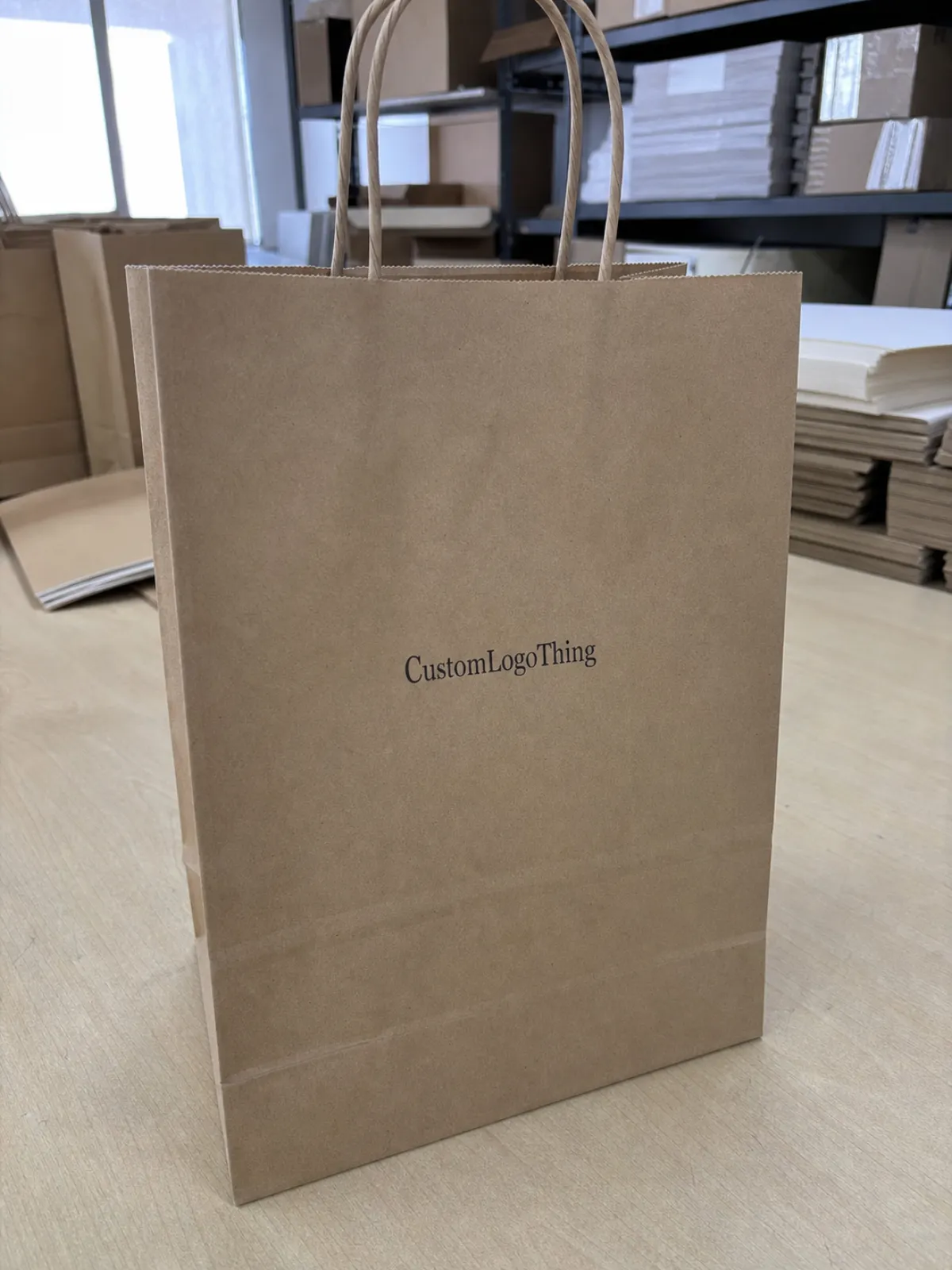
Soap shoppers decide quickly. They are buying scent, texture, ingredients, and trust, usually in a few seconds and often while standing at a market table or boutique counter. That gives the bag more influence than many makers expect. A bag that looks generic can make a thoughtful soap line feel ordinary. A bag with the right texture and branding can lift the same product into a more giftable, more considered category.
Kraft has a particular advantage here. Brown kraft suggests handcraft, practicality, and a lighter environmental footprint. White kraft feels cleaner and more boutique-oriented. Neither is inherently better. The choice should match the brand story and the retail setting. A rustic soap line at a farmers market may feel most natural in brown kraft. A spa collection or wedding favor line may benefit from the sharper presentation of white stock.
The bag often carries the first price cue, too. A handmade bar wrapped in tissue and placed inside a custom printed bag will usually read as more valuable than the same soap handed over loose or in an off-the-shelf pouch. That matters because soap pricing can be delicate. A customer may hesitate at $8 or $12 unless the presentation supports the number. The bag helps bridge that gap without adding a hard sell.
A bag that looks attractive but sags in the hand does not feel artisanal. It feels underplanned.
That is the part many small brands miss. They invest in ingredient stories, fragrance names, and label art, then pair all of it with packaging that quietly weakens the brand. A customer rarely says, “The bag was wrong.” They just feel that the product was not fully finished. Small details carry more weight than they seem to on a spreadsheet.
So the real job of the bag is simple: support the sale without shouting over the soap. If the packaging can do that, it is earning its place.
What custom kraft paper shopping bags do for soap brands
At a basic level, custom kraft Paper Shopping Bags for soap makers act as a carry solution. In practice, they do more. They protect the product from scuffs, give the brand a visible surface, and help the soap feel like a complete retail item rather than a loose handmade object. That combination is especially useful for brands that sell through boutiques, pop-ups, farmers markets, and seasonal gift counters.
Material choice changes the message immediately. Plain kraft feels earthy and direct. White kraft gives more contrast for logos and usually looks cleaner under retail lighting. Recycled kraft can strengthen a sustainability story, especially when the rest of the packaging stays simple and low-ink. The best option depends on price point, product style, and how the soap is displayed.
Most shopping bags for soap packaging share a few features: a reinforced top edge, a paper body, handles, and a gusset that gives the bag depth. That gusset matters more than it gets credit for. Soap bars are compact, but bundles, boxed bars, and sampler kits need room to stand upright. If the bag is too shallow, it buckles. If it is too deep, the product rattles and looks lost inside.
The most practical programs usually match the bag to the product format.
- Single-bar retail: a compact bag for one wrapped bar, a tissue layer, and a small card.
- Two-bar bundles: a wider size that holds stacked or side-by-side bars without pressing the handles outward.
- Gift sets: a deeper bag for boxed soaps, sampler assortments, or seasonal bundles.
- Market carry-outs: a light but sturdy bag that looks clean while standing up to repeated handling.
Many brands pair bag work with broader Custom Packaging Products so the full product line feels connected. That matters once the business grows beyond one soap size or one sales channel. Bags, boxes, inserts, and mailers do not have to match exactly, but they should feel like the same family. A strong visual system reduces confusion and makes the brand easier to recognize at a glance.
Kraft also has a practical psychological effect. Buyers tend to read it as more personal than shiny stock or coated paper. Not automatically premium, and not always sustainable, but personal. For handmade soap, that is often the point. Customers want evidence of a real maker, not a faceless commodity line. The package can reinforce that story without becoming decorative clutter.
Material, size, and print choices that affect performance
Paper weight is the first technical decision worth paying attention to. A light bag may look fine during sample review and then fail once a customer adds a second bar or a small lotion. A heavier bag feels better in hand and usually handles more abuse, but it can raise cost and create visual overkill if the brand is intentionally simple. For soap, the useful range is usually the middle ground: sturdy enough to carry without complaint, light enough to stay economical.
Material descriptions vary by supplier, but a practical shopping bag spec often falls around 120-250 gsm for paper body stock, with reinforcement added where the handles meet the bag. That does not mean every soap brand needs the same weight. A market bag for a single wrapped bar is different from a gift bag carrying boxed soaps and a candle. The job is to match the build to the load, not to buy the heaviest option on principle.
Sizing by product format
Single bars often fit in a compact size around 5 x 3 x 8 inches or similar. Two-bar bundles usually need something closer to 6 x 4 x 9 inches. Gift sets may move toward 8 x 4 x 10 inches or larger, especially if the soap is boxed or paired with extras. Those numbers are starting points, not rules. A bag that is technically “big enough” can still look wrong if it leaves the product swimming around inside it.
Oversizing wastes money and weakens presentation. Undersizing is worse because it turns the package into a problem the customer has to solve. Good sizing should leave enough top clearance for tissue or a thank-you card without forcing the handles apart. The bag should close visually without compressing the soap or making the contents look crowded.
Print and finish decisions
For Custom Kraft Paper Shopping Bags for soap makers, print clarity matters more than complex artwork. Strong logos, bold type, and simple icons usually work best on brown kraft. Fine lines and pale colors can disappear into the stock. If the design relies on delicate gradients or tiny text, white kraft is usually the safer canvas.
A useful rule: the more natural the paper surface, the stronger the contrast needs to be. A one-color logo on brown kraft can look excellent if the mark is well spaced and confident. Full-panel artwork can also work, but only when the design has enough room to breathe and the budget can support the coverage.
Other details deserve attention as well:
- Twisted handles are common for a balanced retail look and comfortable carry.
- Flat handles can be economical and work well for lighter loads.
- Reinforced tops help the bag keep its shape and reduce tearing at stress points.
- Uncoated texture usually reads more authentic for handmade products than a glossy finish.
Moisture is worth a practical note. Soap is not usually wet enough to harm a bag during a normal sale, but product oils, condensation, or damp wrap materials can still create problems. If bars are unwrapped or lightly wrapped, they should have an inner layer before they go into the bag. Kraft paper is useful, but it is not a substitute for basic product protection.
For brands comparing bags against custom printed boxes or mailer formats, the channel should drive the decision. Bags work well for walkout retail and immediate handoff. Boxes make more sense when stacking, shipping, or shelf rigidity matters more. If the product line also ships online, corrugated cardboard usually enters the conversation somewhere, because retail presentation and transit protection are not the same requirement.
Production steps and turnaround from artwork to delivery
The production path is straightforward on paper, but small mistakes at each step can push the whole schedule back. It usually starts with a size and spec review, moves into quoting, then proofing, then sampling if the project needs it, and finally production and shipping. Each stage seems minor until a logo is supplied in the wrong format or a handle style is changed after proof approval.
- Size and spec review - confirm dimensions, paper weight, handle type, and print coverage.
- Artwork cleanup - convert files to vector, check line thickness, and remove colors that will disappear on kraft.
- Proof approval - review spelling, placement, logo scale, and any color notes before production starts.
- Sampling - request a physical sample when the bag size, load, or print result is central to the launch.
- Production and delivery - manufacture the run, pack it securely, and schedule freight or parcel shipping.
The delays are usually predictable. Artwork cleanup takes longer than most buyers expect. Color matching on kraft is harder than on coated stock. Custom sizing can require different tooling. Handles, paper grades, and reinforcement materials can tighten up during peak packaging season. None of that is unusual. It just means the lead time should reflect the real complexity of the order.
For simple stock-size runs with one-color branding, a common window is often 12-15 business days after proof approval. If the bag needs custom sizing, heavier paper, or more complicated print coverage, 15-25 business days is a more realistic planning range. Add sampling, freight, and holiday congestion, and the calendar can move quickly.
That is why planning buffer time matters. Soap launches, spring markets, and holiday retail all create demand spikes. If packaging arrives late, product sits in storage instead of selling. Build the timeline around the launch date, not around the best-case production estimate. If the bags will support retail inventory that also ships, it is worth checking transit behavior against a standard such as ISTA methods so the outer packaging survives realistic handling.
If the order supports a launch, coordinate it with the rest of the packaging system. A bag can be approved on its own and still clash with the label, carton, or insert card. Good packaging looks planned. The parts should feel related, even if they were produced at different times.
Cost, pricing, MOQ, and quote factors for soap packaging
Price depends on more variables than many buyers expect. Quantity matters first. Then paper weight. Then handle style. Then print coverage. Then any reinforcement, finishing, or custom sizing. Each choice nudges the quote, which is why a simple bag can become expensive once several upgrades are layered together.
For custom kraft paper shopping bags for soap makers, minimum order quantity matters a lot. A small maker may want 500 units, but many suppliers price more efficiently at 1,000, 3,000, or 5,000 pieces depending on the spec. Ordering slightly above immediate need can lower unit cost, but only if the inventory will move before the brand changes size, logo, or season.
A useful pricing lens is to compare the bag cost with the soap’s retail price and gross margin. If a bar sells for $7 and margin is already tight, a $0.80 premium bag may be difficult to justify unless it supports a higher selling price or a more valuable presentation. If the soap is part of a $12 gift set, that same bag can make sense because the packaging is part of the perceived value.
| Bag approach | Typical MOQ | Typical unit cost | Best fit | Tradeoff |
|---|---|---|---|---|
| Plain kraft with small logo | 1,000-5,000 | $0.18-$0.35 | Market sales, entry-level retail | Limited visual impact |
| Custom size with one-color print | 1,000-3,000 | $0.28-$0.55 | Core soap line, boutique shops | Higher setup cost |
| Heavier stock, multi-color branding | 3,000+ | $0.45-$0.90 | Gift sets, premium seasonal packs | More capital tied in inventory |
The table is a guide, not a quote sheet. Real pricing shifts with handle construction, reinforcement, paper grade, print coverage, and shipping terms. A flat handle can cost less than a twisted one. A reinforced top can be worth the extra spend if the bag carries more than one item. Brown kraft and white kraft can price differently too, depending on supply and print compatibility.
The cleanest comparison is between two versions of the same spec. Keep the size, paper weight, handle style, print colors, and quantity identical across quotes. Otherwise the numbers are hard to read. It also helps to compare the quote against a target packaging cost as a percentage of retail, so the decision stays tied to margin rather than only to sticker price.
If you need to benchmark the bag against other retail packaging options, review Custom Packaging Products and compare the total cost per sale. Sometimes the bag is the right answer. Sometimes a box-based system gives better protection or a cleaner shelf stack. The best choice depends on how the soap is sold, stored, and handed over.
Common mistakes that create weak bags and wasted budget
The first mistake is choosing a handle that cannot support the load. Handmade soap is not especially heavy in an industrial sense, but bars can be dense, and sets often include more than one item. A weak handle may survive a quick handoff and fail on the walk to the car. Even without a break, a handle that feels uncertain lowers confidence.
The second mistake is paper that is too light for the product mix. A thin bag may work for one wrapped bar and then fail once a customer adds a second bar, a lotion, or a gift card. That problem shows up a lot when makers assume one bag can cover every format in the line.
The third mistake is poor gusset planning. If the bag is too shallow, boxed soap sets push the sides outward. If it is too deep, the product shifts around and looks unconsidered. Good bag design is not only about fit. It is about how the product sits, carries, and presents itself in the customer’s hand.
Artwork creates its own set of problems. Thin lines, tiny taglines, and pale inks often disappear on kraft surfaces. That does not mean the design must be minimal, but it does mean the artwork has to respect the substrate. Brown kraft absorbs visual energy. If the logo is delicate, the bag will swallow it. A proof on actual stock is far more useful than judging from a screen mockup.
Overbuying is another quiet budget drain. A maker may save a few cents per unit by ordering a larger size, then sit on thousands of bags when the assortment changes. That dead inventory ties up cash and storage space. Packaging should support growth, not trap the brand inside a size that no longer fits the catalog.
For soap makers who also use corrugated shipping cartons or custom printed boxes, the mismatch can spread beyond one bag order. A packaging program that ignores the rest of the product system can create a split identity. The retail shelf says one thing, the mailer says another, and the customer experiences two different versions of the brand.
Next steps for sampling, artwork, and launch planning
The most useful next step is a real-load test. Pick two bag sizes, request a sample, and pack the heaviest soap set before approving the full run. That one check catches more problems than a long chain of design comments.
After that, move the artwork into vector format and check contrast against both brown kraft and white kraft. If the design depends on fine type or subtle tones, ask for a proof or sample print. The proof stage is the least expensive place to fix a problem, and paper surfaces rarely forgive guesswork.
Next, compare at least two quotes using identical specs. Keep the size, paper weight, handle style, print colors, and quantity the same. Once the specs are aligned, the real differences in cost and turnaround become visible. Without that discipline, pricing comparisons can be misleading.
A short launch checklist helps keep the order grounded in actual use:
- Confirm the product dimensions and the heaviest packaged soap.
- Decide whether the bag is for single bars, bundles, or gift sets.
- Approve the artwork in vector format.
- Request a sample before full production.
- Leave buffer time for proofing, freight, and seasonal demand spikes.
That is the simplest way to approach custom kraft paper shopping bags for soap makers without ending up with packaging that looks good only on paper. A bag should fit the soap, support the brand, and stay within margin. If it does those three things, it is doing real work. If the product line expands, the packaging can expand with it through a tighter system of branded packaging and Custom Packaging Products that keep the presentation consistent.
What size custom kraft paper shopping bag works best for soap makers?
Single-bar soaps usually fit best in a compact bag that leaves room for tissue, a wrap edge, or a small insert card. Gift sets and bundled soaps need a wider gusset so the bag stands upright and does not crush the presentation. Test the bag with the heaviest packaged soap before placing a full order.
Are custom kraft paper shopping bags durable enough for handmade soap?
Yes, if the paper weight and handle style match the load. Reinforced tops and dependable handles matter more than the print finish for everyday use. If the soap is damp, unwrapped, or packaged with moisture-sensitive materials, an inner wrap should still be used before the product goes into the bag.
How do I keep pricing low on kraft paper soap bags?
Use a standard size, limit print colors, and avoid specialty finishes unless they support a higher retail price. Larger quantities usually lower unit cost, but only if the inventory will move before the packaging changes. Ask for quotes using identical specs so you can compare real cost differences rather than headline prices.
What artwork prints best on kraft paper bags for soap brands?
Bold logos, high-contrast type, and simple icons usually read best on kraft paper. Thin lines, tiny text, and pale tones can disappear or look muddy on brown stock. If the design is intricate, request a proof or sample before approving the full run.
How far in advance should soap makers order custom kraft bags?
Plan around proofing, sampling, production, and shipping so the bags arrive before launch or market dates. Custom sizing, heavier paper, and larger runs usually need more lead time than a simple one-color order. A buffer is especially useful during holiday seasons, because packaging delays can stall sales even when the product is ready.

