Custom Kraft Paper Shopping Bags for coffee roaster retail do more than move beans from the counter to the car. They carry a roast, a mug, a box of filters, maybe a grinder brush, and then they spend the rest of the day representing the shop wherever the customer takes them. That makes the bag a working retail tool, not a decorative extra. It has to hold up in actual use, print clearly on imperfect paper, and fit the way coffee is sold instead of the way packaging looks in a mockup.
Most coffee roasters want packaging that feels natural, not flashy. Kraft paper fits that brief because it has warmth, a dry tactile feel, and enough contrast to support a clean logo without needing heavy ink coverage. The buying decision usually comes down to a few practical questions: what size fits the order mix, what print method stays readable on kraft, how much structure the bag needs, and how much inventory can be stored without tying up cash. Those questions matter more than chasing a perfect-looking sample that does not match real checkout behavior.
There is also a branding layer that is easy to underestimate. A good retail bag should feel related to the rest of the coffee program, whether that includes labels, shipping cartons, or custom printed boxes for subscriptions. The match does not need to be exact. It does need to feel intentional, with the same tone, hierarchy, and level of finish. If the bag looks like an afterthought, customers notice that before they ever notice the roast profile on the label.
“A coffee bag has one job at the register and a second job after the customer leaves. If it fails at either stage, the brand loses more than the packaging cost.”
That is why the spec sheet deserves more attention than the artwork file. A strong bag spec can save labor at the counter, reduce complaints about ripping or collapsing handles, and keep reorders consistent across seasons. A weak one creates a pile of small problems that add up fast.
Custom Kraft Paper Shopping Bags for Coffee Roaster Retail
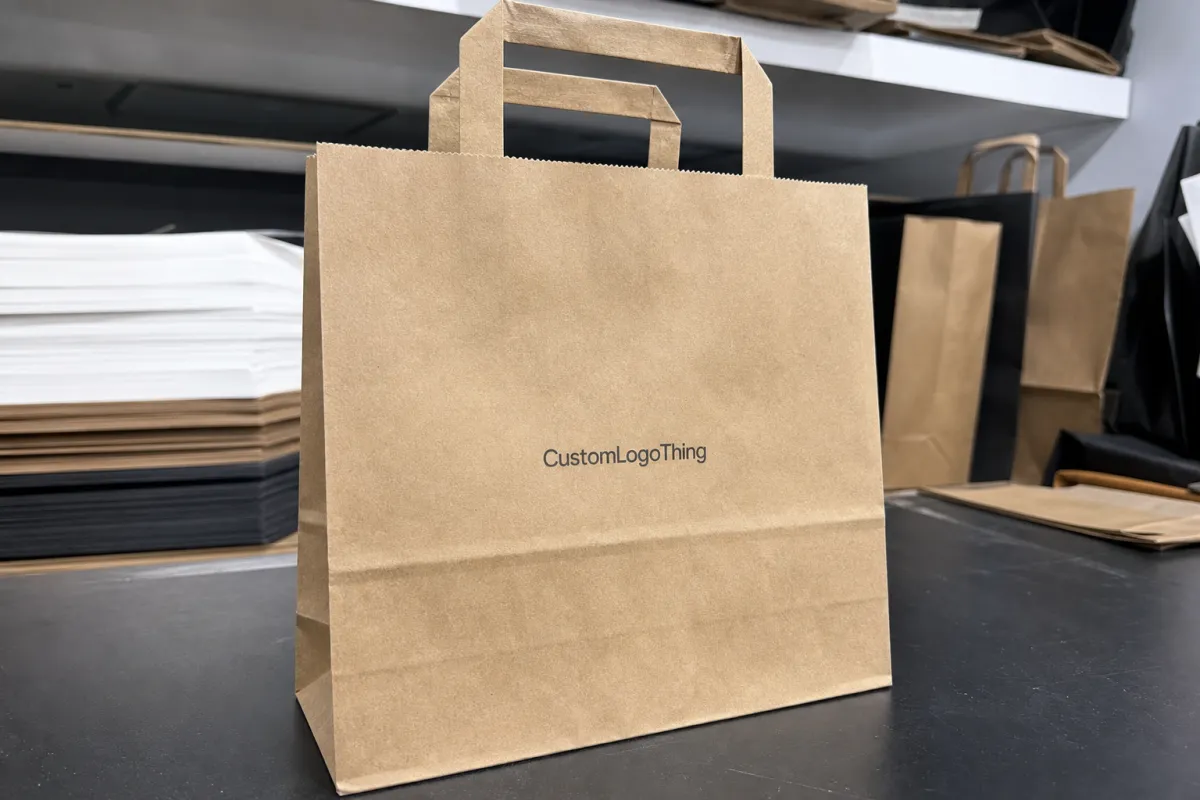
The best starting point is not “What looks premium?” It is “What gets used every day without causing friction?” A coffee roaster often needs one bag for a single retail purchase and another for a fuller order with multiple bags of beans or gift items. The bag should feel easy to open, quick to pack, and sturdy enough that staff do not have to baby it during a rush.
Kraft is popular in coffee because it supports a restrained visual language. Dark logos, simple typography, and one or two ink colors tend to look sharp against brown stock. Busy art, hairline type, and soft pastel shades often print flatter than expected. That is not a style preference so much as a material reality. Kraft is a textured, absorbent base, and the artwork has to be designed with that in mind.
For roasters that sell beans across retail and wholesale channels, the shopping bag should sit inside the same packaging system as the rest of the line. If the main product packaging leans earthy and minimal, the carry bag should not suddenly become glossy or overdesigned. Consistency matters because customers compare everything they carry out of the store, even if they do it unconsciously.
There is a practical customer-experience angle too. A bag that opens wide, stands upright on the counter, and resists tearing feels better in hand and makes checkout faster. Those small details do not show up in a design render, but they show up in the store every single day. That is where Custom Kraft Paper Shopping Bags for coffee roaster retail earn their keep.
If you are comparing packaging formats, the Custom Packaging Products page is a useful starting point for looking at how shopping bags, retail boxes, and other branded pieces can work together.
Sizing, Gussets, and Weight Capacity for Coffee Orders
Bag size gets misjudged more often than almost any other spec. A single 12 oz or 1 lb bag of beans is simple enough, but a normal retail order can include a second bag, filters, a mug, or a small brewing accessory. Once that happens, a narrow bag that looked fine in a sample room starts to feel cramped at the register.
Common retail starting points are around 8 x 4.5 x 10 inches for a compact carryout bag, 10 x 5 x 13 inches for a more flexible retail size, and 12 x 5 x 15 inches for heavier bundles or gift sets. Those dimensions are not universal, but they cover a lot of coffee shop use cases. The important part is matching the interior space to the actual product mix, not just the most common coffee bag size.
Gusset width deserves more attention than it usually gets. A deeper gusset improves stability, gives the bag room to breathe, and makes it easier to pack irregular items without bowing the sides. A shallow gusset can look tidy when empty and turn into a problem once the order grows. If the bag stands better on the counter, the team packs faster and the customer leaves with less awkward shifting in the parking lot.
Paper weight and reinforcement control how hard the bag can be pushed. In many retail programs, 120-150 gsm kraft works for light carryout and single-item orders. Around 170-250 gsm makes more sense for heavier bags, multiple products, or sharper corners that put stress on the base. Once an order regularly climbs above 5-7 lb, bottom inserts and stronger handle attachments stop being optional extras and start becoming basic protection against failure. For 10-12 lb loads, the bag has to be built for that job from the start.
Handle length changes the feel of the bag more than people expect. Shorter handles are fine for short handoffs, but longer handles are easier for customers walking several blocks or carrying other purchases. The opening should also be wide enough for a packed coffee bag and add-ons without forcing a staff member to pry the top open with one hand. That kind of small frustration repeats all day, which is why it matters.
Storage matters too. A good retail bag nests cleanly, stacks flat, and fits your counter bins or backroom cartons without wasted space. If the pack size is awkward, the staff loses time during restock and the packaging budget starts leaking through inefficiency. Good sizing helps front-of-house speed and back-of-house organization at the same time.
Print Methods and Branding Choices That Actually Show Up
For most coffee retail bags, one-color printing is the cleanest place to begin. A dark brown, black, or deep green logo usually reads well on kraft and keeps the process efficient. Two-color printing can add dimension, but each added color increases setup cost and creates another opportunity for registration drift or muddy edges. Full-coverage artwork is possible, though it often costs more than it returns unless the brand system truly needs it.
Thin lines and low-contrast art are the usual trouble spots. Kraft paper is not a white backdrop, so pale inks and hairline details can disappear or soften more than expected. Strong type, simple symbols, and generous spacing tend to hold up better. If the artwork needs to be legible from across a shop floor or visible in a customer’s hand, it should be built for clarity first and decoration second.
Placement is part of the design. A centered logo is the most dependable option because it stays readable when the bag is on a counter or carried at the side. Side-panel branding can work well on longer bags where the face is interrupted by handles or folds. Bottom marks are more decorative than practical, so they only make sense if the main panel already carries the identity clearly.
Special finishes can add value, but they are easy to overuse. White ink can stand out on darker kraft if the print process is controlled carefully. Foil can create contrast, though it often feels too polished for an everyday coffee carryout bag unless the brand is deliberately aiming for that effect. Texture coatings, spot treatments, and other upgrades should be judged against actual use, not just against a sample board. If the bag is going to be folded, carried, and handled roughly, the finish should survive the job.
Quality control starts with the proof, but it should not end there. Ask for print position, ink density, handle placement, and base reinforcement to be checked against the approved spec. On kraft, even a decent print can look weak if the ink lay is too light or the image sits too close to a fold. A simple pre-production review catches more problems than a polished presentation ever will.
For general material and sourcing references, the FSC and ISTA sites are useful if you want to understand certification language and freight-related handling checks. The main takeaway is straightforward: ask for the exact paper grade, any certification claims, and the test standard used for outer cartons if the shipment will be palletized.
Cost, Pricing, MOQ, and Unit Cost: What Changes the Quote
The quote for custom kraft Paper Shopping Bags for coffee roaster retail usually moves with five variables: size, paper weight, handle style, print color count, and quantity. Add reinforced construction or special finishing, and the number shifts again. That is normal. The material, setup, and labor are doing real work, so the price should reflect that.
MOQ is where many small roasters get caught. A 500-piece order can feel reasonable until the setup fee gets divided across too few bags and the unit cost jumps. A larger run, such as 3,000 or 5,000 pieces, often brings the per-bag price down in a noticeable way, but only if the shop can actually use the stock before the next design change. Ordering too little is expensive. Ordering far too much is just slower waste.
| Spec choice | Typical unit cost range | Best for | Tradeoff |
|---|---|---|---|
| Stock kraft bag, no print | $0.12-$0.22 | Temporary use or very early-stage shops | No brand value, generic appearance |
| One-color custom print, standard handle | $0.18-$0.38 | Most specialty coffee retail programs | Best balance of cost and visibility |
| Two-color print with reinforced bottom | $0.30-$0.55 | Heavier orders or more premium retail positioning | Higher setup and material cost |
| Premium handle, specialty ink, finish upgrade | $0.45-$0.85+ | Launches, gift retail, flagship stores | Easy to overbuild for daily carryout |
Those are broad ranges on purpose, because price changes with geography, freight, order timing, and the details of the spec. A larger order generally wins on unit cost, but the buyer still needs to think about cash flow and storage. The lowest quote on paper is not the cheapest outcome if the bags sit in a back room for a year or need to be reprinted because the artwork changed.
Watch the adders. Sample charges, color matching, plate or setup costs, rush fees, and upgraded handles can move the total more than the base unit price suggests. If the quote includes a special kraft tone or a very specific branded packaging look, ask whether proofing and production setup are included. It is better to see the full landed number early than to discover the extras after approval.
Production Steps, Lead Time, and Turnaround From Proof to Ship
The cleanest orders follow a predictable sequence: artwork submission, spec confirmation, proofing, production, finishing, packing, and freight. A well-run supplier will send a proof before anything goes to press or into assembly. That is the stage where the buyer catches a wrong handle, a misplaced logo, a file that needs correction, or a size that does not match the actual retail need.
Most delays come from two places. Either the artwork file is not ready for production, or the spec keeps changing after approval. Both are preventable. A dieline that is even slightly off can change the visual balance enough to make the bag look amateurish. Changing the size after proof approval usually means changing the layout too. That is one reason the spec sheet matters more than the sales sample.
Typical turnaround for a straightforward custom run often sits around 12-18 business days after proof approval, though quantity and complexity can push that longer. Special ink work, reinforced construction, or more involved finishing can extend the timeline. Rush production is sometimes possible, but it usually narrows the available choices and adds cost. If a store opening or seasonal launch depends on the bags, build a buffer for both production and freight. Shipping delays still happen, even on well-managed jobs.
For programs that distribute bags across multiple retail locations, case pack counts are worth confirming before production starts. The number of bags per carton affects freight efficiency, warehouse handling, and how quickly a store can restock. It also affects how tidy the pallet ships. Buyers often focus on the print file and forget the carton math, but the carton math is what keeps replenishment sane.
If the bags are going to ride inside larger cartons with other retail goods, ask about handling checks for the outer pack. The bag itself is not being drop-tested as a product shipper, yet the way it is packed still influences damage rates and corner crushing. A supplier that can speak clearly about carton protection and shipping orientation usually has a better handle on overall production discipline.
Handles, Paper Grade, and Finish Choices That Change Performance
Twisted paper handles are the most common workhorse option. They are affordable, hold up well in normal retail use, and suit the natural look of kraft. Flat paper handles are usually the lower-cost choice and can work for lighter carryout, though they feel less substantial. Rope handles lift the perceived value and are attractive for higher-end gift retail, but they can push the unit cost up quickly. For a lot of coffee roasters, twisted handles land in the best middle ground.
Paper grade changes both appearance and function. A stiffer sheet stands up more cleanly, looks better when empty, and resists the worn-in look that softer kraft can pick up after repeated handling. Softer stock may still be fine for light use, but it can sag and crease sooner. If presentation matters at the counter, the stiffness of the paper should be part of the decision, not an afterthought.
Finish shifts the tone of the bag. Natural kraft reads honest, practical, and grounded. A smoother or lightly coated surface can improve print sharpness, especially for text-heavy marks. Matte finishes usually feel calmer and more in line with specialty coffee. Gloss is less common in this category because it can move the bag away from the dry, tactile feel many roasters want. The finish should support the brand language already in use, not fight it.
For heavier orders, reinforcement matters more than style. Internal patches near the handle anchors, stronger base construction, and better top folds all reduce the risk of failure. If a bag is going to carry a couple of roast bags and a small accessory, the seam strength needs to match the load. It is cheaper to build in the strength once than to replace failed bags and absorb the damage to trust.
Think in real use cases. A bag used for one 12 oz sale is not the same bag needed for a three-item bundle during a holiday rush. The right spec has a little margin built in, not so much that it becomes expensive overkill. That balance is what makes retail packaging useful instead of just attractive.
Common Ordering Mistakes That Burn Margin and Time
The first mistake is choosing a size from a sample that looked fine on a table but fails once the real products go in. A bag needs to fit the coffee, the handle area, and any add-ons without looking stretched or forcing the staff to jam items inside. If the customer has to wrestle with the bag at checkout, the spec is off.
The second mistake is overcomplicating the artwork. Too many colors, tiny type, and delicate lines tend to get lost on kraft. Simpler layouts are not only easier to print; they also age better in use. A bag with a strong logo and a clear hierarchy often looks more polished than a crowded design that tries to say everything at once.
The third mistake is under-ordering and then paying for urgency later. Coffee volume is rarely flat. A launch, a seasonal blend, or a wholesale push can drain retail bags faster than expected. Reorders that happen too late bring freight pressure and limited production options, and they make it harder to keep the next batch consistent with the first.
The fourth mistake is skipping samples or proof review. A printed proof on actual kraft stock is worth far more than a screen render. The difference between paper white and paper brown changes contrast, detail, and perceived color more than many buyers expect. If the supplier will not show how the artwork sits on the real stock, that is a signal to slow down.
The last mistake is making the price decision from the unit cost alone. Cheap bags become expensive when they rip, arrive late, or force a reorder because the first spec was wrong. Better to choose the bag that works cleanly once than to save a few cents and pay for the correction later.
Next Steps: Build a Quote-Ready Spec Sheet for Reorders
The best way to get accurate quotes is to stop guessing and document how the bags are actually used. Track common order combinations for a week or two: one bag of beans, two bags plus filters, a bean-and-mug bundle, or anything else that repeats often. That gives you real demand patterns instead of assumptions based on one quiet afternoon.
Before requesting pricing for custom kraft paper shopping bags for coffee roaster retail, gather the basics in one place: bag dimensions, gusset depth, paper weight, handle type, print colors, quantity tiers, and the delivery window. If you know the preferred reorder cadence, include that too. Suppliers can usually recommend a better structure when the use case is specific and the numbers are clear.
If the packaging system is still being refined, order a short test run before committing to a larger production batch. That is especially useful when the shopping bag needs to align with labels, boxes, or mailers already in circulation. Testing one piece of the system before scaling saves time and stock later.
Set a reorder trigger based on real weekly usage, not on panic. Many shops do better ordering when they have four to six weeks of supply left, then adjusting the trigger after seeing seasonal changes. That keeps inventory from getting too thin without tying up cash in excess stock. If the business has holiday spikes or summer shifts, the reorder point should follow those patterns.
When comparing quotes, look at landed cost instead of the unit price alone. Freight, cartons, sample charges, and rush fees belong in the actual number. Once the spec is locked and the math works, the bag stops being a recurring headache and turns into a quiet part of the operation. That is the real goal: sturdy, predictable packaging that does its job without asking for attention.
What size custom kraft paper shopping bags work best for a standard coffee roast order?
A single 12 oz or 1 lb bag usually fits well in a small retail carryout bag, but the right size depends on whether customers often add filters, mugs, or other items. A useful starting point is around 8 x 4.5 x 10 inches for a compact order and 10 x 5 x 13 inches for more flexible retail use. Gusset depth helps the bag stay upright and prevents it from looking overstuffed.
Are kraft paper coffee shopping bags strong enough for beans and merch?
Yes, if the paper weight, bottom structure, and handle attachment match the load. Lighter orders can work with standard kraft, but heavier roast bags, mugs, and gift bundles need stronger bases and better reinforcement near the handles. If the bag starts creasing hard at the seams or flexing at the bottom, the spec should move up before the failure becomes visible to customers.
How much do custom kraft paper shopping bags usually cost for small roasters?
Small runs usually cost more per bag because setup expenses are spread across fewer units. For many specialty coffee programs, one-color custom print can fall somewhere around $0.18-$0.38 per unit, while premium constructions run higher depending on paper weight, handle choice, and order size. Ask for pricing at several quantity levels so you can see where the break points really are.
What is the typical lead time for custom kraft paper shopping bags?
Lead time usually includes proofing, production, finishing, packing, and freight, so it is longer than the print run by itself. Straightforward orders often move in about 12-18 business days after approval, while more complex specs can take longer. If the bags support an opening date or seasonal release, leave enough time for freight delays and one round of proof corrections.
What artwork prints best on kraft paper shopping bags for coffee retail?
Bold logos, dark inks, and clean typography usually print best because kraft paper can soften fine lines and pale colors. A simple layout with strong contrast often outperforms a crowded design, especially on brown stock. Always review a proof on the actual paper color, because a design that looks sharp on screen can look much quieter once it hits kraft.

