Buyer Fit Snapshot
| Best fit | buy custom packaging for holiday popups fast for packaging buyers comparing material specs, print proof, MOQ, unit cost, freight, and repeat-order risk where brand print, material, artwork control, and repeat-order consistency matter. |
|---|---|
| Quote inputs | Share finished size, material target, print colors, finish, packing count, annual reorder estimate, and delivery region. |
| Proofing check | Approve dieline scale, logo placement, barcode or warning zones, color tolerance, and any recyclable or compostable wording before bulk production. |
| Main risk | Vague material claims, crowded artwork, or missing packing details can create delays even when the unit price looks attractive. |
Fast answer: Buy Custom Packaging for Holiday Popups Fast: Material, Print, MOQ, and Cost should be specified like a repeatable production item. The safest quote includes material, print method, finish, artwork proof, carton packing, and reorder notes in one written spec.
What to confirm before approving the packaging proof
Check the product dimensions against the actual filled item, not only the sales mockup. Ask for tolerance on folds, seals, hang holes, label areas, and retail display edges. If the package carries a logo, QR code, warning copy, or legal claim, reserve that space before decorative graphics fill the panel.
How to compare quotes without losing quality
Compare board or film grade, print process, finish, sampling route, tooling charges, carton quantity, and freight assumptions side by side. A lower quote is only useful if the supplier can repeat the same color, closure quality, and packing count on the next order.
Buy Custom Packaging for Holiday Popups That Sells Fast
If you need to buy custom packaging for holiday popups, timing can make or break the whole program. I have seen strong products get ignored because the box looked like a placeholder. Holiday shoppers decide quickly. Often faster than brands expect. A package has to help sell before the lid opens, before the price gets weighed against the gift budget, and before the customer has time to talk themselves out of the purchase. That is not decoration. That is retail math.
Brands that move early are rarely chasing a prettier box just for fun. They are buying branded packaging that can do real work across the display table, the carryout moment, the gift handoff, and the social post afterward. A generic package makes a product feel generic, even when the product is anything but. Wait too long and the clean structures, practical board grades, and sane freight options start disappearing fast.
The smartest time to buy custom packaging for holiday popups is before the season starts squeezing the calendar. Dielines need time. Proofs need time. Small corrections need time too, and those corrections are often the difference between a launch that feels planned and one that feels a little taped together. The least expensive packaging is not always the lowest quote. It is the packaging that arrives on time, fits properly, and makes the display look intentional.
Holiday popup packaging is a bit like stage lighting. You only really notice it when it is wrong. When it is right, the whole scene feels more expensive. A sturdy carton, a logo placed with discipline, and a finish that catches light can turn a small seasonal setup into something that looks larger and more polished than its footprint. That matters because popup shoppers are not browsing in a vacuum. They are comparing, carrying, gifting, and posting. The package is in the frame whether anyone planned it that way or not.
Why You Should Buy Custom Packaging for Holiday Popups Early
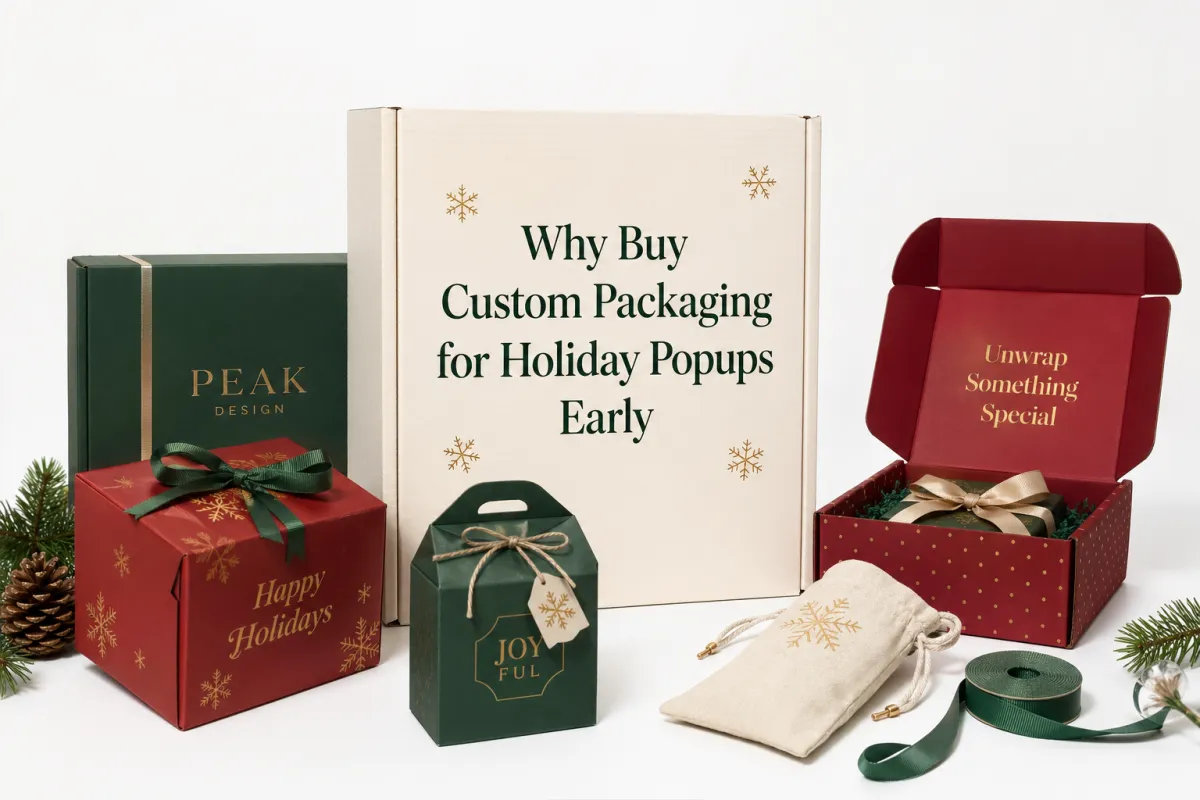
If you plan to buy custom packaging for holiday popups early, you get something late buyers usually lose: choices. The people who wait are sorting through leftovers. Fewer structures. Fewer board grades. Tighter production windows. More pressure to approve the first proof that can be squeezed into a slot. Early buyers can Choose the Right custom printed boxes, the right insert, and the right finish instead of settling for whatever happens to be available.
The real cost of delay is not just rush fees. It is the chain reaction. A late dieline slows artwork. Delayed artwork slows proof approval. Proof approval slows production. Freight gets expensive because normal schedules are gone. I have watched brands try to buy custom packaging for holiday popups two weeks before opening and pay extra just to force a basic carton into behaving like it had months of planning behind it. That is not strategy. That is panic with an invoice attached.
Holiday popup shoppers respond to presentation almost instantly. They are moving, carrying bags, checking prices, deciding what feels giftable and what feels like a compromise. Packaging has to act like a salesperson that never blinks. A clean structure, a strong logo hit, and a finish that catches light can lift perceived value without changing the product at all. Package branding is not abstract. It helps product packaging do more work with the same item.
"If the package looks last-minute, the product feels last-minute. Holiday shoppers do not separate the two."
From a packaging buyer's point of view, the best reason to buy custom packaging for holiday popups early is control. You control the display look. You control the amount of hand assembly at the popup. You control how gift-ready the product feels the second someone picks it up. That matters for retail packaging, gift sets, and seasonal drops where the box is part of the sale, not a disposable afterthought.
One overlooked piece is photography. Holiday popups get photographed, posted, shared, and re-shared. Clean, cohesive packaging creates its own small halo. It delivers the kind of social proof a plain shipper never will. Staff also spend less time fixing mismatched trays, overstuffed bags, and boxes that need tape every time someone opens a display sample. Time is a cost. So is embarrassment.
So yes, the product matters. Still, if you want it to look finished, you need to buy custom packaging for holiday popups with enough runway to build the presentation properly. That is how small seasonal launches look bigger than their footprint.
How Early Should You Buy Custom Packaging for Holiday Popups?
You should start as early as your calendar allows, and earlier if the packaging has to do more than one job. If the same package needs to protect the product, stand up in a retail display, and look gift-ready at checkout, the schedule gets tighter. To buy custom packaging for holiday popups without stress, work backward from the opening date and treat each approval step as a real deadline, not a soft target.
A practical rule helps. If your popup opens in late November, packaging conversations should begin in early fall, not after the holiday assortment is already on the sales floor. For simple folding cartons or sleeves, the process can move faster. For rigid gift boxes, special inserts, or printed bags with multiple finishes, the runway should be longer. That extra time is not waste. It is how you avoid cutting corners on seasonal packaging that carries your brand through the busiest retail weeks of the year.
There is also a buyer psychology issue here. The earlier you decide to buy custom packaging for holiday popups, the more likely the format will match the product instead of the deadline. That sounds obvious, yet many teams still let timing choose the structure. Timing should inform the choice, not make it for you. A package selected under pressure often looks like a compromise because it is one.
I have seen a 60-second display decision turn into a six-week packaging headache. The fix was not fancy. The team simply started asking a more useful question: what does this package need to do in the store, in the bag, and at home? Once that answer was clear, the structure picked itself.
What You Need to Buy Custom Packaging for Holiday Popups
To buy custom packaging for holiday popups well, begin with use case, not aesthetics. A box that looks beautiful in a render can be a weak choice if it takes too long to assemble, consumes too much shelf space, or cannot hold the product weight. The right format depends on whether the package must protect, present, or do both at once.
Best formats by product type
Folding cartons usually work best for lightweight retail goods. Candles. Ornaments. Cosmetics. Small accessories. Tea tins. Confectionery in a secondary pack. They stack efficiently, they assemble quickly, and they suit buyers who want custom printed boxes with strong branding but without a heavy labor burden. If you want to buy custom packaging for holiday popups for a product under about 1.5 lb, folding cartons deserve serious attention.
Rigid boxes fit premium sets, curated bundles, and items that need a more substantial feel in the hand. They cost more, and they should. The payoff is a stronger unboxing moment and a cleaner sense of value. For a holiday gift set, a fragrance duo, or a seasonal assortment, rigid packaging can make the price feel justified before the customer has read the tag.
Mailer boxes are the practical answer for shipped orders or popup goods that need a protective package for the ride home. They work well for ecommerce add-ons, subscription tie-ins, and click-and-collect orders. If you plan to buy custom packaging for holiday popups and also send replenishment stock to another channel, a mailer can cover both roles without creating a second packaging system.
Sleeves are the fastest branding layer when the base container already exists. They are useful when the seasonal change is visual rather than structural. A sleeve can turn a plain tray, jar, carton, or gift box into a holiday SKU without rebuilding the entire package from scratch. For limited runs and quick turns, that kind of restraint can be the smartest move in the room.
Paper bags remain the easiest carryout format for many popup settings. They are not glamorous. They are efficient, familiar, and easy to brand with a strong one-color or two-color print. Add rope handles, twisted handles, or flat handles based on the weight and the expected haul. If you need to buy custom packaging for holiday popups for a fast-moving retail counter, a properly spec'd bag can save labor and keep the line moving. And yes, the line matters. A backup at checkout can cost sales just as surely as a weak display can.
Single-item versus bundle packaging
Single-item packaging is simpler: fewer components, faster picking, lower odds of fit mistakes. Bundle packaging works better when the sale depends on the set rather than the parts. Think of a candle with matches and a wick trimmer, a skincare trio, or a holiday assortment of small pieces that belong together. If the product is sold as a bundle, do not force it into a single-item package. That choice creates empty space, awkward inserts, and a look that never quite resolves.
Here is a quick comparison that helps buyers decide where to buy custom packaging for holiday popups based on format, budget, and speed.
| Format | Best for | Typical MOQ | Common Unit Cost | Lead Time Range | Buyer Notes |
|---|---|---|---|---|---|
| Folding carton | Light retail goods, candles, cosmetics, ornaments | 1,000-3,000 | $0.28-$0.85 | 12-20 business days after proof approval | Strong value for custom printed boxes and quick assembly |
| Rigid box | Premium sets, gift bundles, presentation pieces | 500-1,500 | $2.00-$6.50 | 18-30 business days after proof approval | Best for perceived value, but more expensive to ship |
| Mailer box | Shipped orders, omnichannel popup inventory | 500-2,000 | $0.60-$1.75 | 10-18 business days after proof approval | Good if the same product moves from popup to ecommerce |
| Sleeve | Seasonal branding on existing packaging | 1,000-5,000 | $0.12-$0.45 | 8-15 business days after proof approval | Fastest path when the base pack is already solved |
| Paper bag | Carryout, quick retail handoff, gift wrap substitute | 500-3,000 | $0.22-$0.90 | 10-16 business days after proof approval | Easy branding, but handle strength and gusset size matter |
If the product is fragile, think beyond appearance. Ask whether the carton needs a partition, a molded pulp insert, a paperboard tray, or a foam-free cushion. If the item ships, ask whether the structure should be tested against ISTA transport methods. If sustainability matters to the pitch, ask about FSC-certified board and recyclable adhesives. The standards are worth checking at ISTA transport testing standards and FSC certification guidelines.
Product categories each bring their own practical answer. Candles usually need a snug folding carton with a paperboard insert. Ornaments need crush protection and a stable cavity. Cosmetics often benefit from a premium printed carton or rigid set box. Apparel tends to use sleeves, cartons, or branded bags depending on how it is folded and presented. Baked goods need food-safe materials and a structure that protects the product without making it look clinical. Gift sets need internal organization so pieces do not rattle or shift during handling.
That is the point. To buy custom packaging for holiday popups well, match the format to the product and the sale moment. Not the trend. Not the prettiest mockup. The actual use case.
If you want to compare options before you lock anything in, start with our Custom Packaging Products and narrow the choice by product weight, display style, and delivery method.
Custom Packaging Specifications That Matter
If you plan to buy custom packaging for holiday popups, the spec sheet is not paperwork. It is the job. Dimensions, stock, coating, print coverage, and inserts determine whether the package fits, prints cleanly, and survives real handling. A polished render cannot rescue a bad dieline. Buyers who skip the basics usually pay twice: once for the packaging and again for the correction.
Dimensions should come from the actual product, not a vendor's guess. Measure the longest, widest, and tallest points, then add clearance for wrapping, tissue, or internal trays if needed. Tolerances matter in retail packs. A difference of 1-2 mm can decide whether the box closes cleanly or fights back. If you are bundling multiple pieces, measure the assembled set, not each item in isolation.
Board stock changes the feel immediately. A 350gsm C1S artboard can work for a lightweight retail carton. A 24pt SBS may be a better fit when the structure needs more stiffness. For premium presentation, rigid board with wrap paper adds substance, but the price climbs quickly. If you want to buy custom packaging for holiday popups with lower unit cost, simple paperboard often wins. If you want a stronger gift cue, rigidity wins. It really is that blunt.
Print sides matter more than many buyers expect. Exterior-only printing keeps the budget controlled. Inside printing adds polish and earns its keep when the unboxing moment is part of the sale. A plain interior can work for carryout packaging. A printed interior can feel far more deliberate for Holiday Gift Boxes, especially when the customer opens the package in front of friends or posts the reveal online.
Coatings and finishes affect both appearance and durability. Matte aqueous coating is a dependable baseline. Gloss coating gives a brighter retail look and helps graphics pop. Soft-touch lamination creates a velvety finish that suits premium sets. Foil stamping adds shine, embossing adds depth, and spot UV draws the eye to logos or seasonal art. None of those finishes is free. The right question is whether the added cost changes the sale. Sometimes it does. Sometimes it is just expensive shine.
Dielines and bleed are where buyers save themselves from avoidable mistakes. Ask for the dieline early. Keep critical text and logos inside the safe zone. Extend background art beyond the trim with proper bleed so white edges do not appear after slippage. A Packaging Design That ignores bleed is how a polished concept turns into a slightly off box. No one wants that sitting beside a competitor's cleaner display.
Color control deserves real scrutiny. If your logo color is specific, provide Pantone references or approved CMYK values. Digital proofs help, but they are not the final surface. Board absorbency, coating choice, and print method all shift color. Ask for a hard proof or a press-calibrated sample if the branding is sensitive. A holiday red that leans orange or sinks too dark can change the whole mood of the table.
Use this order: lock the structure first, then the graphics, then the finish. That keeps the process sane. It also helps the supplier quote accurately when you decide to buy custom packaging for holiday popups across multiple SKUs. Shared dimensions or a shared format can cut tooling and make reorders easier later.
Here is a technical checklist that keeps the order moving:
- Final product dimensions, including sleeves, closures, and any attached accessories.
- Target quantity by SKU and whether orders will repeat after the popup.
- Board weight or construction preference for custom printed boxes or bags.
- Finish selection, such as matte, gloss, soft-touch, foil, embossing, or spot UV.
- Insert style, including paperboard, molded pulp, corrugated, or no insert.
- Artwork files in editable format, plus any brand color standards.
- Ship-to details and whether product will be stored, stacked, or hand-carried.
If your packaging needs to survive freight, sit in a backroom, and still look sharp on the table, say that up front. You may need a stronger board, a different lock flap, or another carton style. That is not upselling. That is avoiding damage and repacking labor.
To buy custom packaging for holiday popups that actually does the job, the spec sheet should answer three questions fast: does it fit, does it hold up, and does it present the product in a way that helps the sale? If any answer is fuzzy, the packaging is not ready yet.
Pricing and MOQ for Holiday Popup Packaging
Buyers usually start with price, which makes sense. The better question is how the cost is built. To buy custom packaging for holiday popups with a clear budget, You Need to Know what changes the total. Quantity, material, print coverage, inserts, special finishes, sampling, tooling, and freight all matter. The quote that looks cheapest on paper can turn expensive if it leaves out samples or shipping.
Quantity is the biggest lever. Higher volume lowers unit cost because setup gets spread across more pieces. Small runs are useful for test markets, limited seasonal drops, or popup-only collections, but the per-unit number will rise. That is normal. If the popup is a one-month experiment, paying more per unit can still be the right move because it limits inventory risk.
Material choice shifts the pricing picture too. Basic paperboard is usually the most economical path for retail packaging. Rigid board, specialty paper wraps, magnetic closures, and printed inserts all raise cost. If you plan to buy custom packaging for holiday popups in a premium category, expect the packaging to sit closer to gift-box pricing than to a basic carton budget.
Print coverage also matters. One-color branding on a kraft bag is a different job than full-coverage artwork with inside print, foil, and spot UV. More coverage means more ink, more setup, and more chances for registration problems. If the design is busy, make sure the artwork earns the extra spend. If not, a cleaner composition can look sharper and cost less.
Special finishes are seductive because they look expensive. They are also where budgets drift. Foil, embossing, soft-touch lamination, windows, and custom inserts can each be worth it, but not all at once. For a holiday popup, one or two strong details usually beat six competing effects. A clean box with a strong logo and one premium finish often feels more expensive than a cluttered package packed with extras.
Tooling and dielines can surprise first-time buyers. New structures may require new cutters, additional sample rounds, or artwork adjustments that were not part of the first quote. Ask early. If the supplier needs to build a new dieline from scratch, budget a little more time and a little more money.
Freight is another line item buyers underestimate. Shipping a few hundred boxes is not the same as shipping pallets. If the packaging needs to go to multiple popup locations, split shipments may be required, and those add cost fast. If you are trying to buy custom packaging for holiday popups and send stock to several cities, build the freight plan before approval, not after production.
Here are realistic MOQ ranges that help with planning, though the exact floor depends on size, material, and print method:
- Paper bags and sleeves: often 500-1,000 units for simple programs.
- Folding cartons: commonly 1,000-3,000 units, sometimes more for heavily customized jobs.
- Rigid boxes: often 500-1,500 units because assembly is more labor intensive.
- Mailer boxes: usually 500-2,000 units depending on print and board style.
For small popup launches, the tradeoff is plain. Lower quantity gives speed and less inventory risk, but higher unit cost. Larger quantity improves unit economics, but you carry more stock and need more storage. There is no magical number. If the popup may repeat, it can make sense to buy custom packaging for holiday popups in a smaller first run, then reorder once demand is real.
That is also where quote review matters. Ask what is included. Ask whether proofs are one round or multiple rounds. Ask whether freight is estimated or fixed. Ask whether the pricing assumes a standard finish or a custom one. Honest packaging pricing is specific. Vague pricing usually hides extra charges for later.
If you are comparing vendors, keep the question tight: what does it cost to buy custom packaging for holiday popups that arrives on time, fits the product, and matches the brand? That is the number that matters. Not the one that only looks low in an inbox.
Production Process and Timeline
To buy custom packaging for holiday popups without scrambling, build the schedule backward. Start with the popup opening date, subtract shipping time, subtract production, subtract proofing, and the real deadline appears. That is the number that matters. Not the date you wish you had.
- Quote: share dimensions, quantity, format, finish, and delivery location. A good quote should reflect the actual job, not a vague estimate.
- Specification review: confirm the board, construction, print sides, and insert type before art starts.
- Dieline approval: check dimensions, folds, glue flaps, and safe areas. This is where fit problems get caught early.
- Artwork setup: place logos, copy, legal text, and images on the dieline with correct bleed.
- Proofing: review digital or press proofs for color, alignment, and text accuracy.
- Production: print, cut, finish, and assemble based on the approved spec.
- Packing and delivery: schedule shipping with enough buffer for inbound receiving and merchandising.
For many standard paper-based projects, a practical lead time after proof approval is often 10-20 business days. Rigid boxes, complex inserts, or special finishes can stretch that to 18-30 business days. Freight adds more. If you need to buy custom packaging for holiday popups on a hard deadline, assume there will be at least one point of friction somewhere in the process. That is simply how production behaves.
The common delays are easy to predict. Missing dimensions create bad dielines. Low-resolution artwork causes proof issues. Slow approvals hold the schedule hostage. Last-minute color changes force rework. The holiday classic is worse: changing the structure after the production slot is already booked. That is how a good plan turns into a costly delay.
Near peak season, even simple jobs get crowded by schedule pressure. A supplier may accept the order, but if you are trying to buy custom packaging for holiday popups at the last minute, you will probably lose options on finish, assembly, or freight routing. Set the production deadline first and let the art work around it.
Here is the rule I use with buyers: if the popup date is fixed, the packaging deadline needs to be fixed first. The artwork sign-off date, the proof approval date, and the freight booking date all need a buffer. One week helps. Two weeks helps more when the job includes inserts or multiple SKUs.
For brands that want repeatability, create a shared packaging system. One carton width across several products. One sleeve size across a seasonal line. One mailer style for ecommerce and popup replenishment. That makes reorders easier and keeps package branding consistent without rebuilding the wheel for every launch.
People often assume fast packaging means sloppy packaging. It does not have to. You can still buy custom packaging for holiday popups with a clean spec, clean artwork, and a sensible schedule if you decide early and approve quickly. Speed is usually a planning problem, not a quality problem.
Why Choose Us for Holiday Popup Packaging
Custom Logo Things is built for buyers who want straight answers, not packaging theater. If you want to buy custom packaging for holiday popups, the useful things are clear quotes, practical specs, and support that helps you Choose the Right structure instead of padding the order with extras you do not need. That is the difference between a packaging partner and a catalog with branding.
We focus on the details that matter in a seasonal launch: product fit, print clarity, finish selection, and production timing. That means less back-and-forth, fewer surprises, and fewer moments where someone on your team has to guess whether the box will actually work. Buyers do not need a speech. They need a package that shows up on time and looks like it belongs in the display.
If you are comparing vendors, look for three things. First, whether they can quote against the actual product instead of a vague description. Second, whether they can explain the tradeoff between cost, MOQ, and finish without playing games. Third, whether they can support both a small seasonal run and a repeat order later. Holiday programs often start small and then grow if the display works.
That is where a focused packaging supplier helps. A marketplace listing can work for generic stock items, but it is not the same as choosing custom packaging that reflects the product, the shelf, and the gift moment. If you need custom printed boxes, Branded Paper Bags, sleeves, or gift-ready mailers, a proper packaging partner can point you toward the structure that actually supports the sale.
Color deserves attention too. Holiday reds, metallics, deep greens, and winter neutrals can drift if the process is loose. Good packaging support includes proof review and clear expectations around print variation. That is how you protect package branding without treating every run like a lottery ticket.
For buyers who want speed, a low-friction process matters as much as the box itself. Send dimensions, upload artwork, choose the format, confirm the quantity, and review the proof. That is the simplest path to buy custom packaging for holiday popups without creating unnecessary work for your team. If you already know what you need, start with our Custom Packaging Products and narrow the options from there.
If the project includes multiple product types, we can help keep the system consistent. One seasonal carton style can cover several SKUs. One paper bag can carry the whole popup look. One sleeve format can refresh a base pack without rebuilding the structure. That kind of consistency makes retail packaging feel organized instead of improvised.
That is the job. Not to make packaging dramatic for its own sake. To make it work. If you want to buy custom packaging for holiday popups and avoid the usual launch chaos, choose a supplier that respects schedule, specs, and the actual product instead of pretending every box needs a grand story.
Next Steps to Buy Custom Packaging for Holiday Popups
If you are ready to buy custom packaging for holiday popups, do not start with a vague request. Start with measurements. Then format. Then quantity. Then artwork. That sequence saves time and gets you a quote that means something. A supplier can move quickly only when the inputs are clear.
Send these details first:
- Product dimensions, weight, and whether the item needs an insert.
- Target format, such as folding carton, rigid box, mailer, sleeve, or bag.
- Approximate quantity by SKU and whether the program may repeat.
- Artwork files, brand colors, and any print restrictions.
- Finish preferences like matte, gloss, soft-touch, foil, embossing, or spot UV.
- Delivery date, ship-to address, and any storage or distribution constraints.
Before approval, run this quick checklist. Review the dieline. Confirm the color references. Check the insert fit. Verify the ship-to address. Lock the production slot. If you need to buy custom packaging for holiday popups across more than one location, make sure every receiving point is ready before freight leaves the dock. That saves a lot of unnecessary chaos.
One more smart move: ask for a sample or proof when the product is sensitive. You do not need samples for every project, but if the fit is tight or the art is color-critical, a proof can prevent a costly mistake. The cheapest answer is not always the best answer. Late packaging, misfit packaging, and reprint packaging all cost more than doing it properly once.
If you are still deciding, start with the product and the sale. Will the customer carry it out? Ship it later? Give it as a gift? Stack it on a display? That answer points you to the right package. Then the rest gets easier. That is how to buy custom packaging for holiday popups without guessing.
From there, the process is simple. Measure the product, choose the format, confirm the quantity, gather the artwork, and request a quote with the target delivery date. If you want the season to look polished instead of rushed, now is the time to buy custom packaging for holiday popups and get the order moving.
If I had to reduce the whole process to one line, it would be this: measure today, lock the format this week, and approve the proof before the holiday calendar starts crowding your team out. That is the cleanest path to packaging that earns its place on the table instead of just taking up space.
How early should I buy custom packaging for holiday popups?
Plan as early as you can. A normal custom packaging run needs time for quote review, dieline setup, proofing, production, and freight. Simple paper formats can move faster, while rigid boxes and custom inserts usually need more lead time. If your popup date is fixed, work backward from delivery and leave a buffer for artwork changes or shipping delays.
What is the best packaging format for a holiday popup product?
Choose the format based on product weight, presentation, and whether the package needs to ship or just sit on a counter. Folding cartons work well for lighter retail goods; rigid boxes fit premium gift sets; mailers are better for shipped orders. If the product is being handed over in-store, a fast-assemble format with strong shelf presence usually wins.
What specs do I need before I request custom packaging pricing?
Have the product dimensions, approximate weight, and desired packaging format ready before asking for a quote. Include print details like colors, finishes, inserts, and whether you need inside printing or just exterior branding. If you already have a dieline or artwork file, send it. That speeds up pricing and reduces quote surprises.
Can I order low-MOQ custom packaging for holiday popups?
Yes, but the unit cost is usually higher when quantities are small. Low-MOQ orders make sense for test markets, limited seasonal drops, and popup-only collections. If you think demand will repeat, compare a smaller first run against the cost of a larger run with better unit economics.
What affects the final price of holiday popup packaging?
The biggest drivers are quantity, material, print coverage, and any special finishes or inserts. Rush timing, freight, and extra proofing rounds can also move the total price more than buyers expect. The cheapest quote is not always the cheapest outcome if the packaging arrives late or needs rework.

