A weak carrier can drag down a jewelry sale before the customer even opens the box. Custom Ribbon Handle Paper Bags for jewelry gift orders solve that by making the handoff look deliberate, gift-ready, and worth the price. The bag does not change the product, but it changes how the purchase feels.
This format works best when the order is compact and presentation matters more than heavy-duty transport. It gives boutiques, studios, and jewelry brands a cleaner counter experience without requiring extra wrapping labor. The decision usually comes down to whether the bag can stay square, carry a boxed item neatly, and support the brand finish without slowing staff down.
A jewelry bag should look engineered, not improvised. Handle attachment, board stiffness, fold accuracy, and print finish all need to support the same premium signal.
Why a ribbon-handle bag can raise jewelry order value instantly
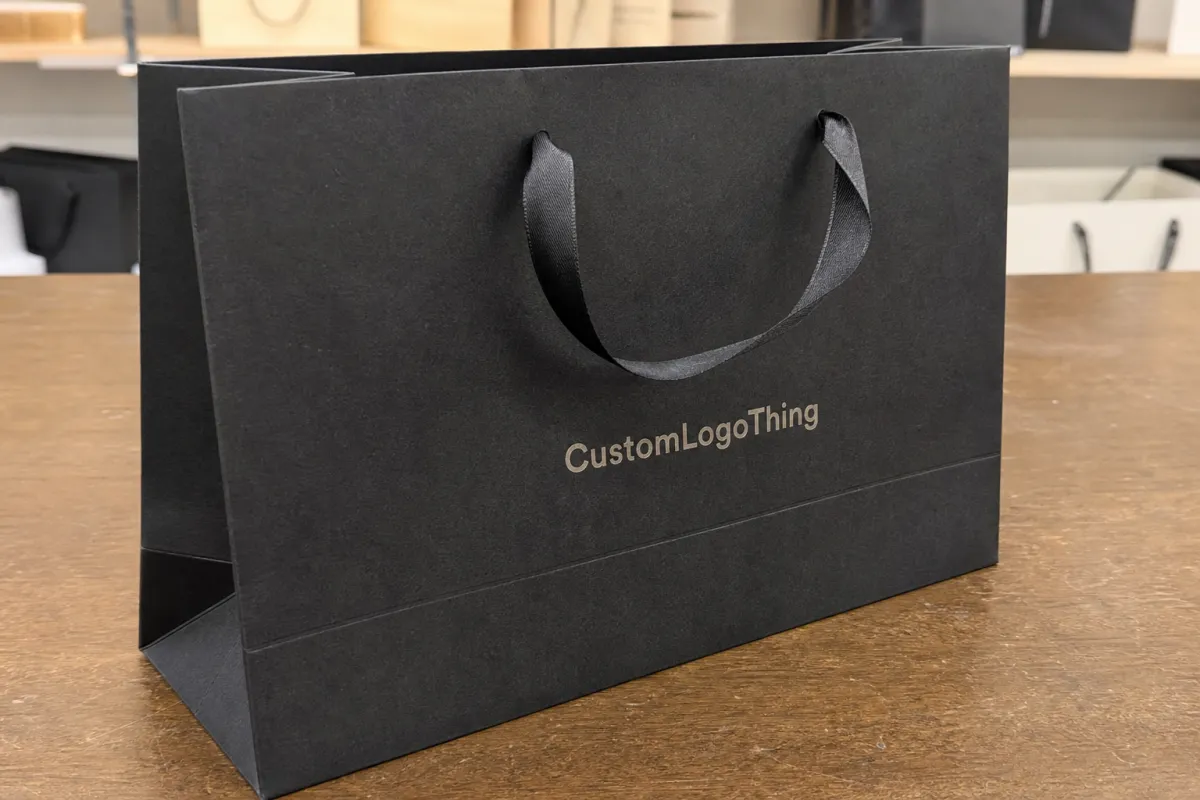
Jewelry buyers judge presentation fast. If the bag sags, creases, or feels thin at the handle, the product inside starts with less perceived value. A better bag does not increase the metal or stone quality, but it does improve the emotional read of the sale.
That is why gift-oriented retailers keep using this format. It creates a polished carry without separate wrapping steps, and it avoids the overbuilt look that can happen when a small jewelry box is placed in a carrier made for larger goods. For earrings, pendants, bracelets, and small sets, the goal is a clean handoff, not excess protection.
There is also a workflow benefit. Staff can pack faster when the bag already feels finished. No extra ribbon tying, no last-minute tissue folding, and no improvised presentation fix at checkout. In busy retail periods, that saves time and keeps the spec consistent across every order.
For brands comparing a bag to a custom box, the bag usually wins when the item is compact and the customer receives it at the counter. Boxes make more sense when the product needs rigid protection inside a mailer. The best packaging programs choose the format based on the actual use case, not just on appearance.
Custom ribbon handle paper bags for jewelry gift orders: standard build
The build is straightforward, but the details matter. A proper bag uses a stiff paper stock or laminated board, a reinforced opening, ribbon handles anchored through the top edge, and side gussets sized to fit a jewelry box without buckling. If the paper is too soft, the top edge bows. If the gusset is too shallow, the box catches and the bag loses its premium feel.
For most jewelry gift orders, the target is a straight silhouette that still feels balanced in the hand. The bag should open cleanly, hold shape after handling, and keep the product centered instead of wobbling at checkout. That is the difference between packaging that looks considered and packaging that feels temporary.
Handle choice changes the tone. Satin ribbon reads softer and more gift-like. Grosgrain has more texture and a slightly firmer look. Matching ribbon gives a restrained finish, while contrast ribbon can work when the brand needs color emphasis. Width matters too: very narrow ribbon can twist under load, while oversized ribbon can take over the design. For many jewelry programs, 6 mm to 12 mm is the practical range.
Common upgrades include:
- Hot stamping for a sharp metallic or matte logo mark.
- Foil accents when the brand wants visual lift without full artwork coverage.
- Matte or soft-touch lamination for better feel and scuff resistance.
- Interior card pockets or inserts to keep small boxes and tissue from shifting.
The strongest spec is not always the heaviest one. A bag that opens well, carries securely, and stays crisp through checkout usually performs better than an overbuilt bag that adds cost without improving the customer experience.
If sustainability claims matter, specify them carefully. FSC-certified board is useful when the chain of custody is real and current; the source at fsc.org is the right place to verify basics. For durability expectations, transit testing should confirm that the bag survives handling before full production. ISTA provides practical guidance at ista.org.
Sizes, paper stocks, finishes, and insert options that matter
Start with the jewelry box or pouch, not the bag. That is where most sizing mistakes begin. If the carrier is chosen first, the finished pack can end up too loose, too tight, or awkward once tissue and cards are added. A good fit leaves enough room for the product to sit square without rattling.
For rings and studs, compact sizes around 4 x 2 x 6 inches or 5 x 3 x 7 inches often work. For bracelets, small gift sets, or multi-item orders, 6 x 3 x 9 inches or 8 x 4 x 10 inches is more practical. These are starting points, not rules. The exact size depends on whether the jewelry is packed in a rigid box, folding carton, or pouch.
Paper stock affects the look, the feel, and the failure point. Many premium jewelry bags use art paper laminated over greyboard, often around 157 gsm to 200 gsm paper wrap with a 1.5 mm to 2 mm board structure. Lighter builds can work for smaller orders, but they need proper handle attachment and folding accuracy to avoid sagging. The goal is not the thickest spec; it is a structure that keeps its shape after handling.
Finish changes how the bag behaves in use. Gloss lamination reflects more light and can make colors feel brighter, but it also shows scuffs sooner. Matte finish is calmer and often better for understated jewelry branding. Soft-touch adds a velvety feel, though it needs more careful packing because it marks more easily.
| Build option | Typical MOQ | Practical unit cost | Best fit |
|---|---|---|---|
| Single-color print, standard board, satin ribbon | 500-1,000 pcs | $0.38-$0.78 at 1,000; $0.22-$0.45 at 5,000 | Simple retail packaging and boutique gift orders |
| Matte lamination, foil logo, reinforced base | 1,000 pcs+ | $0.68-$1.35 at 1,000; $0.42-$0.88 at 5,000 | Mid-premium launches and seasonal gift runs |
| Rigid board, emboss/deboss, insert card, premium ribbon | 1,000-3,000 pcs | $1.10-$2.40 at 1,000; $0.78-$1.60 at 5,000 | High-ticket packaging and flagship store use |
These ranges move with size, print coverage, ribbon choice, and assembly work. A small one-color bag can be inexpensive. A larger bag with foil, custom ribbon color, interior lining, and a reinforced base will move into premium territory quickly. Manual ribbon threading or tight alignment also raises labor even when the bag looks simple.
Print method matters as much as stock. CMYK works for artwork with gradients or many hues. Spot colors are better when the logo needs to stay consistent across reorders. Foil stamping adds shine but also adds tooling and proofing time. Embossing or debossing usually suits jewelry well because it is subtle and does not compete with the product.
Inside details are easy to overlook and hard to forgive when they fail. Bottom reinforcement prevents bowing. Proper gusset depth keeps the shape upright. A simple insert can stop a ring box from sliding into a corner during handoff. These are practical choices, not decorative extras.
Pricing, MOQ, and quote factors for custom ribbon handle bags
Price is driven by size, board thickness, print coverage, ribbon type, finish, insert work, and assembly steps. There is no shortcut that makes a premium jewelry bag cheap. The features that improve appearance are usually the same ones that raise cost.
For custom ribbon Handle Paper Bags for jewelry gift orders, unit cost usually drops as quantity rises, but setup fees can make very small runs look expensive. A 300-piece order can take nearly as much planning as a 1,000-piece order if the design needs color matching, new tooling, or careful handle placement. The press still has to be set, the proof still has to be checked, and the finished bag still has to be inspected.
Useful quote requests include the following:
- Target dimensions based on the jewelry box or pouch.
- Expected quantity, even if it is a range.
- Logo files in vector format where possible.
- Print colors, ribbon style, and finish preference.
- Delivery window and whether the bags must arrive flat-packed.
MOQ depends on complexity. A simple one-color structure can often be supported at lower quantities than a full premium build. If the run is small, start with a standard structure and only add finishes that support the brand story.
Typical tradeoffs are straightforward:
- Lower MOQ gives more flexibility, but the per-unit cost rises.
- Premium finish improves handoff presence, but adds lead time.
- Heavier board improves structure, but increases freight and storage demand.
- Fewer print colors usually lowers cost and keeps the logo cleaner.
The cheapest quote is not always the best buy. If the handle pulls loose, the finish scuffs fast, or the bag size is off by half an inch, the real cost shows up later in damaged presentation and slower packing. That is not savings; it is delayed expense with a prettier quote sheet.
Process and turnaround from proof to delivery
A clean production flow usually runs from brief to dieline confirmation, then artwork placement, digital proofing, sample or pre-production review, and full production. Skip a step and rework usually follows. The process is simple, but it is easy to rush past when the bag looks easy on screen.
Most delays come from missing artwork, slow approvals, or late changes after the structure has already been quoted. A small revision to ribbon color or bag depth can change stock usage, assembly timing, and sometimes the print setup. By the time the change reaches the line, it is no longer small.
Turnaround depends on the spec. Stock-based runs with straightforward printing can move faster than custom sizes with foil, rigid board, or special inserts. As a practical guide, simple ribbon-Handle Paper Bags often take about 12-18 business days after proof approval. More complex work can stretch to 20-30 business days, especially when the job includes custom ribbon colors, embossing, or laminated board with tight color matching. Rush service is possible in some cases, but it usually narrows finish options and raises cost.
Packaging also needs to be packed correctly for delivery and storage. Most paper bags ship flat-packed to save space, though some structures need partial assembly depending on the handle and opening method. Ask how the bags are packed before approval. If your team receives high volumes, flat packs reduce shelf space and make counting easier. If staff are pre-building bags daily, assembly style becomes part of the labor cost.
If the bag needs to work at pickup and again as a gift bag later, the structure has to be cleaner than most first-time buyers expect.
For brands using Wholesale Programs, the proofing process matters even more because one approved spec can support many reorders. A clean dieline, a saved print profile, and a stable ribbon spec reduce repeat mistakes later.
Why repeat buyers keep this packaging spec on reorder
Once a size, stock, and finish work, most buyers keep them. That is practical. Reordering the same packaging saves approval time, lowers the chance of mismatch across locations, and keeps the customer experience steady.
Consistency matters because premium perception depends on repetition. If the color shifts, the ribbon attachment changes, or the board thickness drops, customers may not be able to explain what feels different, but they feel it. Package branding is memory built from repeated quality.
For multi-location retail, pop-ups, and e-commerce gift orders, repeatable packaging is a real operational advantage. Staff know how it opens. Customers know how it carries. Replenishment becomes simpler because the approved dieline and build notes are already on file. That reduces errors and makes reorders faster.
The best repeat orders also improve packing speed. If the bag size fits the jewelry box, insert card, and tissue routine, the counter workflow stays lean. A good bag does not create extra steps. It quietly removes them.
Next steps to order without rework or rushed charges
Measure the jewelry box or pouch first, then choose the bag size with enough clearance for tissue, inserts, or a small card. If you skip that step, the bag ends up too tight to close cleanly or too large to feel intentional.
Decide early whether the run needs a basic branded finish or a more premium look. That decision affects cost and lead time right away. A one-color logo on solid board is a very different project from foil stamping, soft-touch lamination, and custom ribbon color.
Before requesting a quote, prepare the logo file, size targets, print references, quantity estimate, and delivery window. If you already have an approved previous spec, send that as well. Clear information shortens the quoting cycle and reduces the risk of pricing the wrong structure.
- Measure the product and box, not just the product.
- Choose a size that leaves room for tissue and inserts.
- Select the finish that fits the margin and the product tier.
- Approve the dieline and sample before full production.
- Save the approved spec for the next reorder.
If the goal is a packaging program that scales, treat the first run like a buying spec, not a design experiment. Once the structure is stable, the bag can do its job quietly: support the sale, protect the presentation, and keep the brand visible after the customer leaves.
FAQ
What size custom ribbon handle paper bags work best for jewelry gift orders?
Choose the bag based on the jewelry box or pouch, then add enough room for tissue, inserts, or a small card. Compact sizes usually work best because they keep the product from shifting and preserve the premium look. If you sell several product tiers, standardizing on two or three bag sizes is usually more efficient than custom-sizing every order.
Can I print my logo on ribbon handle paper bags for jewelry gifts?
Yes. Common options include single-color printing, full-color printing, foil stamping, embossing, and debossing. The best method depends on the logo detail, the target price point, and how polished you want the bag to feel. Clean vector artwork almost always prints better than fine raster graphics or very thin type.
What is the usual MOQ for custom ribbon handle paper bags?
MOQ depends on size, board, print method, and finish, so there is no single number that fits every project. Simple designs usually support lower minimums than custom colors or specialty finishes. If the run is small, ask for a quote on a standard structure first and add premium features only where they matter.
How long does production take after I approve the proof?
Timing depends on quantity, print complexity, and finishing steps, but proof approval speed matters just as much as factory time. A clean file, a confirmed dieline, and no late revisions keep the schedule moving. Simple runs can finish in roughly 12-18 business days after approval, while more complex builds often need 20-30 business days.
Are these bags strong enough for retail handoff and shipping inserts?
Yes, if the paper weight, handle attachment, and bottom reinforcement match the load. Lightweight jewelry pouches need less structure than boxed sets or heavier gift orders. For shipping, the bag should support presentation while the outer mailer handles impact protection in transit.

