A bakery buyer comparing matte zipper Bags for Bakeries Wholesale Pricing is usually trying to solve three problems at once: keep the product fresh, make the shelf look better, and keep the unit cost under control. That sounds simple until the details show up. Finish, film structure, zipper style, fill weight, and print coverage all change the real number.
Matte packaging has a practical advantage, not just a visual one. Under retail lighting, it cuts glare, so the product, logo, and ingredient copy are easier to read. That matters for cookies, brownies, granola, trail mixes, and other bakery items that depend on a clean shelf presentation. A pouch that looks premium but fails at closure or scuffs badly in transit is not premium. It is just expensive film with better art.
The fastest way to avoid waste is to align the pouch structure first, then lock the size, then finalize print. Reorders go smoother when the first order is built around a format that can survive packing, shipping, and store handling without constant adjustments. If you are comparing recurring options, the Wholesale Programs page is a useful starting point for sorting stock and custom formats.
Why matte resealable bags win the bakery shelf test
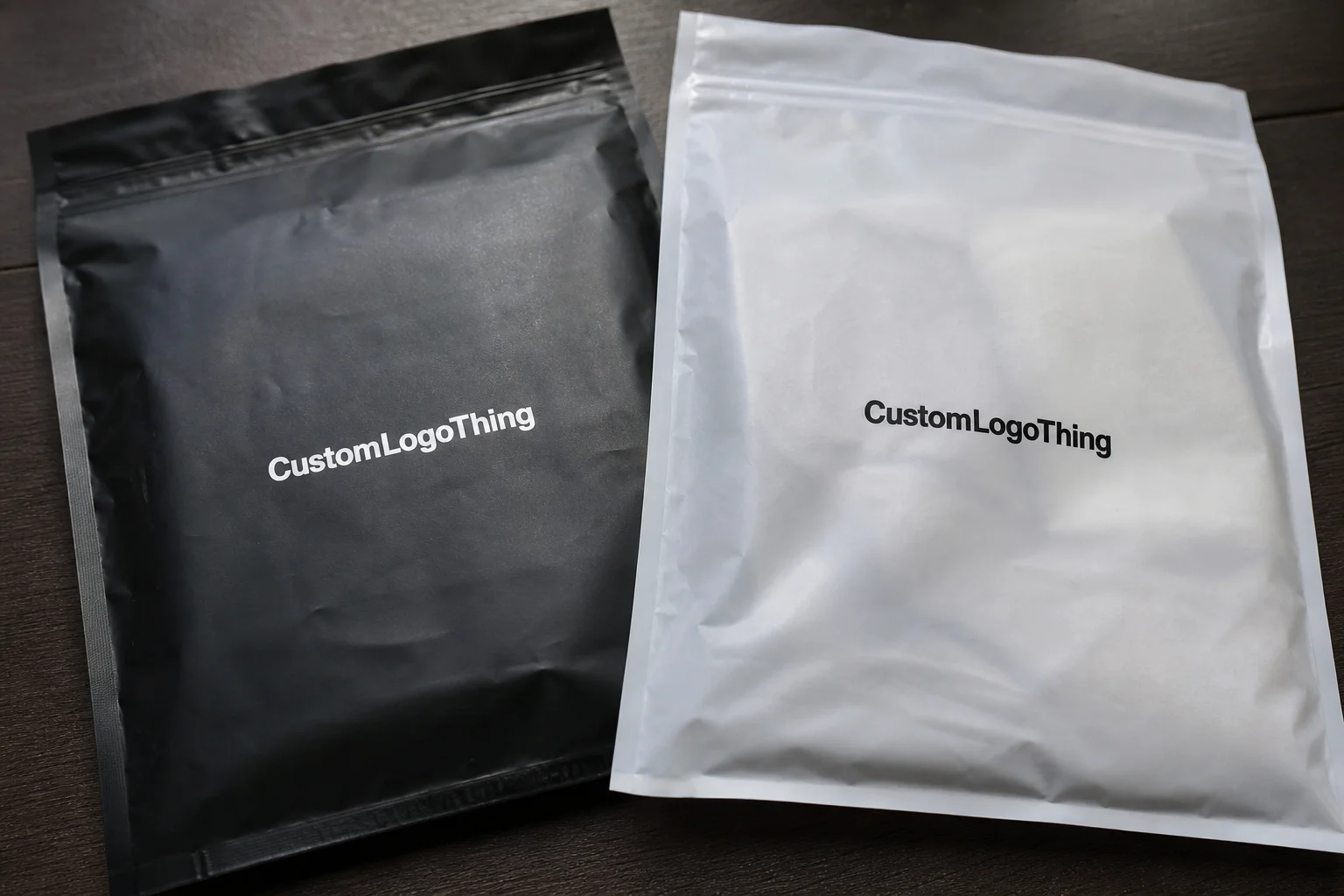
Walk a bakery aisle and the difference is obvious. Glossy bags throw reflections. That can make dark cookies, seeded snack blends, or chocolate-heavy products look busier than they are. Matte film behaves better under lights. The artwork reads more clearly, the product looks calmer, and the package usually feels more controlled in hand.
That visual restraint is part of why matte finish gets associated with artisan or premium lines. It does not automatically make the product better, but it helps the packaging do less damage to the product story. For a bakery brand, that matters. Customers often decide whether something feels worth the price before they ever open the bag.
Resealability is the other half of the equation. For items sold in smaller quantities, shared at events, or kept on kitchen counters after purchase, a working zipper extends usability and helps preserve texture. It is especially useful for crisp items. Once a package opens, stale air and crumbs become a real issue. A good zipper does not solve everything, but it slows the damage.
The shelf test is straightforward: does the pouch protect the product, hold its shape, and stay presentable after handling? If yes, it is doing the job. If not, the lower unit price is probably fake savings. Returns, spoilage, and weak shelf appeal erase cheap packaging faster than most buyers expect.
"A matte pouch can carry a premium look, but the zipper, seal, and film still have to survive real use. Style does not forgive poor construction."
There is also a perception gap many teams miss. Matte finishes tend to read as specialty or small-batch, while clear glossy bags can feel more commodity unless the design is very strong. That does not mean gloss should be avoided. It means the finish should match the product. A holiday cookie set, a granola blend, and a bulk brownie bite line do not need the same visual language.
Barrier layers, zippers, and finish options that preserve product quality
Most bakery zipper pouches are built from a laminate such as PET/PE, sometimes with an added barrier layer depending on the product. PET contributes stiffness and print quality. PE supports sealing. For products with aroma sensitivity or fat content, a stronger barrier can help with odor control and shelf life. That matters for items like coffee-flavored biscuits, nut-heavy granola, dried fruit mixes, and anything with oils that go stale quickly.
A common production spec for matte bakery pouches sits in the 100 to 160 micron range, though the right thickness depends on fill weight, seal geometry, and how rough the pack will be treated in transit. Thicker is not automatically better. Too much gauge can make the bag hard to fill, more expensive to ship, and less efficient to store. Thin film can work, but only if the seal strength and barrier performance are still acceptable.
Recyclable structures exist, usually as mono-material PE or PP formats. They are useful only if the local recycling stream can actually accept them. Otherwise, the sustainability claim becomes marketing noise. If your bakery line uses cartons, inserts, or outer boxes, FSC-certified paper can still support the overall story without forcing the pouch to do a job it cannot support.
The zipper choice changes both user experience and cost. Standard press-to-close zippers are common for cookies, snack blends, and granola. Slider zippers are easier for customers to use, especially on larger bags, but they add cost and usually increase the pouch profile. For soft baked goods, the seal area needs enough strength to survive shipping and case packing without popping open. A pretty zipper that fails in the carton is a bad trade.
Matte finish helps more than appearance. It can hide minor scuffs from carton movement and shelf stocking better than gloss. It can also make minor handling marks less obvious, which is useful for premium retail packaging that spends time in displays. Still, matte is not magic. Deep crease whitening, bad lamination, or rough overfilling will still show up.
For teams comparing flexible packaging terms, packaging.org is a decent reference for basic terminology and format differences. It will not Choose the Right bag for you, but it does help prevent confusion when discussing laminations, closures, and print methods.
Sizes, fill weights, and print specs to standardize before ordering
The easiest way to reduce mistakes is to build a SKU map before you ask for quotes. Start with finished product dimensions, fill weight, closure type, and whether the bag must stand upright or lay flat in a case pack. A 6 oz cookie mix pouch and a 16 oz brownie bite bag are not the same job, even if the logo is identical.
Bakeries usually save money by standardizing around a narrow group of proven pouch sizes instead of building a custom dimension for every item. Fewer dielines mean fewer artwork errors, fewer proofs, and less time spent chasing corrections. It also makes reorders easier. A sensible program often covers most SKUs with a handful of repeatable formats, then uses labels or Inserts for Product variation.
Print specs should be settled before the quote is finalized. That includes the number of colors, whether there is full-panel art, barcode placement, ingredient copy, and how much matte contrast the artwork needs. If the pouch is going to retail, the back panel needs enough quiet space for compliance information. If the pouch is for gifting, double-sided print may be worth the extra cost because the package is seen from both sides.
Physical fit is where a lot of good ideas fail. Check gusset depth, zipper height, and tear notch placement. Leave enough headspace so the product does not crush the top seal. Too little room makes the pouch look stuffed and can stress the closure. Too much room makes it look underfilled and cheap. Neither helps sell product.
- Gusset depth: Deep enough to stand the pouch without bowing or tipping.
- Zipper height: Positioned so customers can close the bag without pinching product.
- Tear notch: Clean opening without weakening the top seal.
- Headspace: Enough room for seal integrity and a cleaner shelf profile.
One more practical point: ask for artwork proofs at actual size, not just a flat mockup. Pouches behave differently once folded, filled, and sealed. A layout that looks fine on screen can turn awkward when the gusset opens or the barcode lands too close to a fold.
Matte zipper bags for bakeries wholesale pricing: what drives cost
If you are comparing matte zipper Bags for Bakeries Wholesale Pricing, read the quote like a packaging spec, not a sticker price. The main drivers are material gauge, barrier level, zipper type, size, print coverage, and order quantity. Stock pouches, semi-custom runs, and fully custom builds all price differently because setup, tooling, and print preparation are spread across different volumes.
Unit price by itself can be misleading. A lighter film may look cheaper, but if it scuffs faster, seals weaker, or shortens shelf life, the real cost rises. The same is true for saving money on a zipper upgrade. If the package gets used in-store or opened repeatedly by consumers, a poor zipper can create returns and complaints that erase the savings.
| Option | Typical MOQ | Typical unit price | Best for | Notes |
|---|---|---|---|---|
| Stock matte zipper pouch, no print | 500-1,000 pcs | $0.12-$0.20 | Testing, seasonal items, short launches | Lowest setup cost, limited branding control |
| Semi-custom pouch with 1-2 color logo | 3,000-5,000 pcs | $0.18-$0.32 | Core bakery SKUs, repeat retail programs | Balanced option for price and branding consistency |
| Full custom matte pouch with heavier barrier and full print coverage | 10,000+ pcs | $0.24-$0.48 | Gift packs, premium lines, larger rollouts | Higher setup, tighter spec control, stronger shelf impact |
MOQ changes the math quickly. A low minimum can still be expensive if setup charges, plate costs, or proofing fees are spread across too few bags. At higher volumes, the unit cost usually improves, but only if freight and handling stay controlled. Ask for landed unit cost, not just factory cost. Freight, cartons, duties, and warehousing can shift the real number by 8% to 25%, depending on the lane and shipment size.
There are other costs that do not show up cleanly in a quote. Rework after a design error. Extra samples because the first version missed the fill line. Slow lead times that force a rush freight move. These are the hidden ways packaging gets expensive.
A bakery line with strong velocity can absorb a better pouch much more easily than a low-margin item with erratic sales. That is the commercial test. The packaging should support the product economics, not fight them.
Production steps, lead time, and reorder timing
The production sequence is usually predictable, but each stage can create delay if the brief is loose. It starts with artwork and dimensions, moves into prepress, printing, lamination, cutting, zipper insertion, inspection, and packing. Specialty matte finishes, custom die cuts, or unusual structure changes add time. So do late artwork revisions.
For a standard custom run, a realistic timeline is often 12 to 15 business days after proof approval, then additional time for freight. Complex print builds, foil accents, or last-minute changes can stretch beyond that. The mistake most buyers make is treating packaging like a simple purchase order. Packaging is part of production. If it is late, the launch is late.
Reorders should be planned backward from the ship date, not forward from the approval date. Seasonal assortment boxes, holiday gift bags, and promo programs need more buffer than core SKUs because they usually have tighter launch windows. If the packaging arrives after the product is ready, the whole line stalls.
A practical tracking system helps keep everyone honest:
- Approval date: Artwork, dimensions, and print map are locked.
- Production start: The order enters the manufacturing schedule.
- QC milestone: Sample check or inspection happens before packing.
- Ship date: The order leaves the plant or warehouse.
- Delivery window: Realistic buffer before launch or replenishment.
For transit-heavy programs, ask whether the cartons have been validated against ISTA drop and vibration methods. Not every bakery pouch needs formal transit testing, but if the product moves through multiple distribution points, the package should survive handling without seal failure or product loss. ASTM methods can also be useful when film strength or seal performance needs a written benchmark for quality control.
Quality checks should not stop at appearance. A good inspection plan usually includes seal integrity, zipper function, print registration, scuff resistance, and fill-line accuracy. If the bag is heat-sealed in-house, temperature and dwell time need to match the film structure. Too hot and the seal can distort. Too cool and it can peel under stress.
What to send for a bakery-ready quote and first order
Accurate quoting starts with a clear brief. Send the product dimensions, fill weight, print artwork, finish preference, target quantity, and required delivery date. If the pouch must fit a specific case pack or shelf tray, include that too. The more precise the brief, the less back-and-forth later. A vague request almost always turns into a slow quote cycle.
Include compliance details up front. That can mean ingredient panel space, barcode placement, food-contact documentation, or a separate inner liner. If you need a sample pack or mockup, ask for it before production. That step catches fit and print problems while the cost of fixing them is still low. It is cheaper to reject a sample than to reject a pallet.
For bakery buyers building recurring programs, the useful comparison is not just price. It is price against fit, barrier level, lead time, and reorder reliability. That is the real answer behind Matte Zipper Bags for bakeries wholesale pricing. The right pouch protects freshness, keeps the shelf clean, and does not create headaches when the order repeats. If you are setting up a new SKU or tightening an existing pack, start with the specs you can repeat, then build the quote around those numbers.
FAQ
What size matte zipper bag works best for bakery cookies and brownies?
Choose the pouch around the finished product footprint, then leave enough headspace so the zipper closes without compressing the item. For thicker brownies or clustered cookies, confirm fill weight and gusset depth before ordering because those details affect fit. A pouch that is too tight looks overfilled and can stress the seal.
Can matte bakery zipper bags be printed on both sides?
Yes. Double-sided print is common for retail display and premium gift packaging, but it usually increases setup cost and unit price. Before approving the layout, ask for a print map that shows the front, back, barcode area, ingredient copy, and any unprinted zones needed for sealing or compliance.
What is a normal MOQ for wholesale bakery zipper bags?
MOQ depends on material, print complexity, and size. Stock pouches can start in the low hundreds, while full custom runs usually need much higher quantities. The right minimum is the one that fits your sales velocity and storage capacity. A lower MOQ is not a win if the landed price is too high.
How do matte zipper bags compare with glossy pouches for freshness?
Freshness depends more on barrier structure and seal quality than surface finish. Matte is mainly a presentation choice, although it often hides handling marks better than gloss. For bakery products, that can matter as much as the technical spec because the pouch still has to look sellable after shipping and stocking.
What do I need to request an accurate wholesale pricing quote?
Provide size, fill weight, material preference, print coverage, quantity, and your required delivery date. If possible, include a dieline or sample photo so the supplier can estimate unit cost, setup charges, and lead time without guessing. Compare the quote against MOQ, barrier level, zipper type, and freight before approving the order.


