If you are doing a soap embroidered beanies Unit Cost Review, start with the parts that actually affect the buy: knit behavior, logo size, stitch count, and placement. Beanies are less forgiving than flat apparel. A design that looks fine on screen can distort on ribbed yarn, especially if the embroidery is too wide, too dense, or placed on an area with too much stretch.
The practical question is not whether embroidery is “better” in general. It is whether the decoration holds up, how much production time it uses, and what the landed cost looks like once setup, packing, and freight are included. That is the lens buyers need for winter promos, staff kits, and resale-ready merch.
Most quotes use the same inputs: blank style, thread colors, stitch count, quantity, placement, and any digitizing or setup fees. Shipping and packaging can change the final number more than buyers expect, especially if the order ships to more than one location. A low factory price is not always a good landed price.
Why embroidered beanies often outperform print
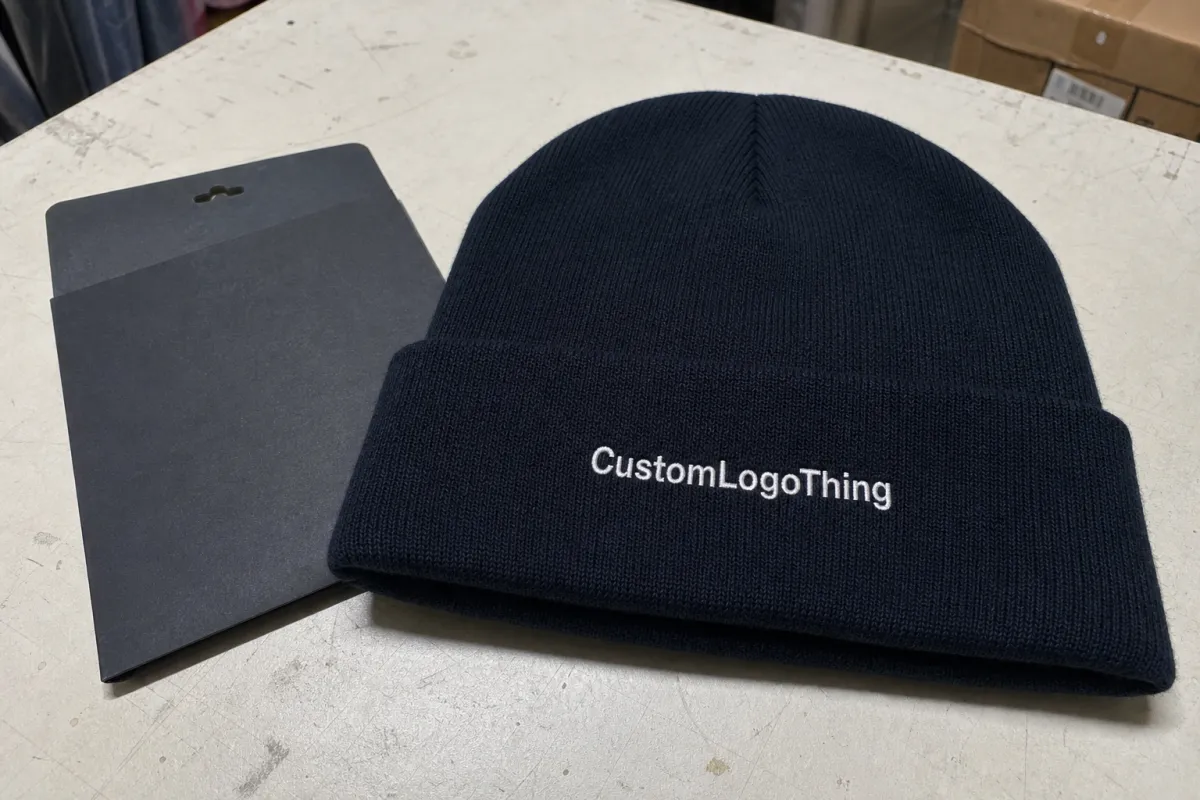
Embroidery usually wins on knitwear because the thread becomes part of the surface instead of sitting on top of a stretchy fabric. That matters on cuffed beanies, where the logo is small, exposed to friction, and seen up close. A compact stitched mark often looks more finished than a printed graphic that can crack, fade, or flatten over time.
Print still has a place. On smoother knits, it can be soft to the touch and work well for simple artwork. But ribbed beanies are difficult. Texture breaks up detail, and fabric movement exposes weak ink coverage quickly. Woven patches can solve fine-text problems, but they add another component and an extra production step. Direct embroidery stays popular because it is durable, compact, and straightforward.
The best way to compare decoration methods is by use case:
- Direct embroidery suits short logos, initials, and simple brand marks that need to read cleanly at a glance.
- Woven patches fit art with fine text or tight line work that would blur in thread.
- Print can work for casual merch, but it is less reliable on thick rib-knit surfaces and repeated abrasion.
Stitch count matters more than raw size. A small logo with dense fill can cost more than a slightly larger outline mark with lighter coverage. If the budget needs to move, simplifying the art usually helps more than changing the entire product type.
Practical rule: if a logo reads clearly on a cuffed knit at a glance, embroidery usually gives the best balance of appearance and cost.
Details that change the look and the quote
Material choice changes both feel and price. Acrylic is the most common blank because it is consistent, cost-efficient, and available in many colors. Acrylic-wool blends feel a bit warmer and more classic. Recycled polyester is useful when a buyer needs recycled-content documentation, but that specification should be confirmed early. Heavier rib-knit bodies hold shape well, yet the texture can affect how the embroidery sits.
Cuffed beanies usually give the cleanest embroidery field. The cuff creates a flatter area, keeps the logo visible while worn, and gives the decorator a stable placement zone. Slouch styles can look good, but they are less predictable because the logo position shifts with drape. Low-profile knits also need simpler artwork. If the design is too tall or too detailed, stitches can pull the fabric and distort the finish.
Thread color is another place where mockups can mislead. Dark thread on a dark heather body can disappear more than expected, while high-contrast thread makes misalignment easier to see. Proofs should show the logo against the actual blank, not just a vector on a white screen. A useful approval image includes the beanie style, not only the artwork.
Decoration style changes the final feel. Direct embroidery is the most traditional option. A woven label gives a flatter, graphic look and can show fine detail better than stitching. A leatherette patch can make the beanie feel more premium or rugged, but it adds another component. Mixed decoration can work for retail-minded programs, but only when the extra detail supports the brand.
For shipping-heavy programs, ask how the beanies will be packed. Knitwear compresses, and the logo can crease if cartons are overfilled or the fold line lands on the decoration. If the order moves through distribution, some teams reference ISTA testing practices as a guide for transit stress. If inserts or tags are included, paper-based materials may need separate documentation, and in some cases FSC references help support those claims.
Specs to lock before you request pricing
Accurate pricing starts with specs, not with a rough image attachment. Blank style, knit gauge, cuff height, decoration width, logo placement, and thread color count all affect the quote. Front-center embroidery on a standard cuffed beanie is usually the simplest path. Side placement, oversized marks, or dense fill areas add labor and can raise the cost per piece quickly.
Stitch count deserves more attention than most first-time buyers give it. A clean outline logo with limited fill can be cheaper than a design that looks simple but uses a lot of dense coverage. On embroidery, the machine is pricing motion, not just surface area. Every extra pass through the fabric takes time, and time is what drives the quote.
Artwork prep should happen early. Vector files are the safest starting point. Low-resolution images can be digitized, but they often need cleanup before production. Tiny text is risky on knitwear because yarn texture can close up narrow spaces. Thin strokes can vanish, so small file adjustments are far cheaper than correcting the problem after approval.
Fit matters too. Youth, unisex, and oversized bodies wear differently, and the logo can sit differently depending on the wearer. A wider cuff gives more decoration room. A shallow cuff limits placement and can force the mark lower than intended. If the beanies are for staff, event teams, or resale, match the blank to the audience instead of assuming one fit works for everyone.
Before you request pricing, have these details ready:
- Quantity needed, plus any expected reorder volume.
- Beanie style, color, and cuff height.
- Logo file, preferred thread colors, and approximate decoration width.
- Delivery window, ship-to location, and use case.
- Whether the order is for retail, events, uniforms, or seasonal gifting.
Soap embroidered beanies unit cost review: pricing and MOQ
A useful soap embroidered Beanies Unit Cost Review starts with the pieces you can actually trace: blank price, digitizing or tooling, embroidery time, thread usage, packaging, and freight. If the order ships to multiple destinations, the landed cost can move even when the factory price stays stable. Buyers who compare only the unit price often miss that second layer.
Quantity is the biggest pricing lever. Setup fees do not shrink just because the run is small. Once digitizing, thread setup, and machine scheduling are spread across more units, the per-piece cost drops. That is why a 50-piece order can look expensive while a 250-piece order lands in a much better range, even when the artwork is identical.
MOQ is the smallest quantity the factory will produce at the quoted rate. It exists because embroidery setup and material ordering take time whether the job is 25 pieces or 250. MOQ can be tied to the blank body, the decoration method, or both. Ask which one is driving the threshold, because that detail matters when comparing suppliers.
Tiered pricing is the clearest way to see breakpoints:
| Order size | Typical unit cost range | What usually drives the price | Best use case |
|---|---|---|---|
| 50 pieces | $7.50-$11.00 | Higher setup share, smaller production run, freight spread is thin | Small internal programs, samples, pilot runs |
| 100 pieces | $6.20-$8.90 | Better setup absorption, steadier machine time, more efficient packing | Events, sales teams, moderate test runs |
| 250 pieces | $4.90-$7.20 | Lower setup impact, better blank buying, improved throughput | Retail programs, seasonal gifting, larger uniform orders |
Those ranges are directional, not fixed. A simple one-color logo on a standard acrylic cuffed blank usually sits toward the lower end. Dense multi-color artwork, special placement, premium yarn, or custom packaging pushes the quote higher. Rush production, sample revisions, and upgraded freight do the same. The only honest comparison is landed cost, not the line item alone.
Cost control works best when it improves the quote without hurting the product. Keeping the logo compact, reducing stitch-heavy fill areas, and choosing a standard blank often save more money than trimming packaging or selecting a fit that feels awkward on the wearer. A small, sharp embroidered mark on a dependable beanie usually looks stronger than a larger design that fights the knit surface.
Process, timeline, and approval points
The production path is usually straightforward: artwork submission, digitizing, proof approval, scheduling, embroidery, inspection, packing, and shipment. The delays happen when one step is not ready for the next. Clear art speeds everything up. Unclear art slows the job before the first stitch is sewn.
Lead time depends heavily on approval speed. Same-day proof responses keep a job moving. Multi-day pauses delay not only the proof, but the entire schedule. Nonstandard blank colors, specialty threads, or unusual placements can add time too, because those inputs may need to be confirmed or sourced before production begins. A simple run can move quickly; a complex run with revisions cannot.
Rush orders are possible in many cases, but they work best when the buyer sends clean vector art, accepts practical placement guidance, and responds quickly to proof questions. The most common delays are missing files, late approvals, unclear sizing, and midstream design changes after the proof is already out.
Quality control on knitwear is practical and visual. Stitch registration needs to stay tight. The cuff should be aligned so the logo sits where it was approved. Loose threads need to be trimmed cleanly. The mark should still read clearly after folding and packing, because that is how the piece is usually delivered.
For seasonal programs, the safest path is to lock the details before the job enters the schedule. Quantity, placement, thread colors, blank style, and shipping address should all be confirmed before approval. Once those inputs are stable, the production team can focus on consistency instead of chasing clarification.
What repeat orders usually teach buyers
Repeat orders usually come down to consistency, not drama. Buyers reorder when the logo lands in the same place, the thread colors match the approved proof closely, and the final beanie feels like the sample they already signed off on. That is more valuable than a low first-run price that cannot be repeated.
Saved artwork files and prior placement notes shorten quoting and reduce the chance of drifting from the original spec. For seasonal programs, that history matters because the same style may be reordered months later, when nobody wants to rebuild the job from scratch. A clean record makes the next round faster and keeps the unit cost easier to predict.
Repeat orders also expose weak points in the original spec. If the logo is too small, it gets harder to read when the beanie is stretched. If the thread contrast is too aggressive, the color may feel louder in person than it did on screen. If the cuff height was marginal, the placement may have looked acceptable in proof but awkward on the head. Buyers who reorder well usually adjust once, then keep the stronger version in rotation.
There is also a transportation reality that does not show up in the proof. Knitwear compresses in cartons, and a beanie packed too tightly can crease at the fold line or flatten the embroidery. Good packaging does not need to be elaborate, but it does need to protect the decoration zone. That detail matters more on repeat programs, because consistency in transit becomes part of product quality whether anyone lists it or not.
The main takeaway from a reorder is simple: the spec should be strong enough to survive production, packing, shipping, and another order later. If the item can do that, it has value beyond the first invoice.
What to send for an accurate quote
If you want a quick, accurate number, send the logo file, target quantity, preferred beanie style, and any reference image you have. That gives the decorator enough information to decide whether direct embroidery, a woven patch, or another treatment makes the most sense for your order. Without those inputs, pricing is guesswork.
Include the deadline, shipping location, and end use. Retail, staff uniforms, event giveaways, and resale packaging do not all need the same presentation or pack-out. Thread color preferences, placement notes, and brand rules also help the proof stage move faster because the first sample is closer to final approval. If there is a past sample you want matched, send that too.
A clean quoting process usually follows a predictable order:
- Collect artwork, quantity, and product spec.
- Review tiered pricing and confirm MOQ.
- Approve the proof and lock placement.
- Confirm the schedule and delivery window.
- Move into production, inspection, packing, and shipment.
If the goal is efficiency, keep the decoration simple. A standard cuffed blank, a compact logo, and a clear approval path usually produce the best balance of appearance and cost per piece. That is especially true when the order needs to ship quickly or may be reordered later with little change. Complexity is not free, and on knitwear it rarely pays for itself unless the artwork truly needs it.
For a buyer, the value is straightforward: the right spec, a readable proof, and a transparent quote. That is what turns a soap embroidered beanies Unit Cost Review into a purchase plan that can actually be executed.
How does soap embroidered beanies unit cost change with order quantity?
Unit cost usually falls as quantity rises because setup and digitizing are spread across more pieces. Small runs carry more overhead per item, while larger runs benefit from steadier material use and better production efficiency. Tiered pricing is the clearest way to see the breakpoints.
What beanie specs have the biggest impact on embroidered pricing?
Logo size, stitch count, and thread color count usually affect the quote more than small wording changes. Cuffed styles are easier to decorate consistently than slouch or heavily textured knits. Blank material, placement, and packaging can also move the price.
How can I lower the unit cost without hurting the look?
Keep the logo compact and use clean vector art with fewer stitch-heavy fills. Choose a standard beanie body and a familiar placement like front cuff embroidery. Avoid rush production unless the deadline truly requires it, since expedited schedules can add cost fast.
What is the MOQ for custom embroidered beanies?
MOQ is the smallest run the factory will produce at the quoted rate. It exists because setup time, machine scheduling, and material ordering need to be efficient. If your quantity is flexible, ask for multiple MOQ-based pricing tiers so you can compare options cleanly.
What should I send to get an accurate quote fast?
Send a vector logo or the cleanest available art file, plus quantity and preferred beanie style. Include your deadline, delivery address, thread color preferences, and logo placement notes. A past sample or reference image helps the proof stage move faster and keeps the final result closer to the original approval.

