The vitamin ribbed winter beanies Digital Proof Checklist exists for one reason: to catch the kind of errors that look tiny on a screen and expensive in a carton. Wrong placement, poor scale, overlooked spelling, and an unrealistic expectation of how ribbed knit behaves once it is stretched on an actual head all show up here. If those details survive the proof, they usually survive into production too.
Ribbed beanies are less forgiving than flat-brim caps or smooth knit hats. The fabric has ridges, the cuff changes the decoration zone, and the beanie looks different when worn, folded, or packed. A logo that reads clearly in a PDF can suddenly feel too wide, too low, or too compressed once the knit starts doing what knit does. That gap between mockup and reality is where most avoidable mistakes live.
Vitamin ribbed winter beanies digital proof checklist: what it actually catches
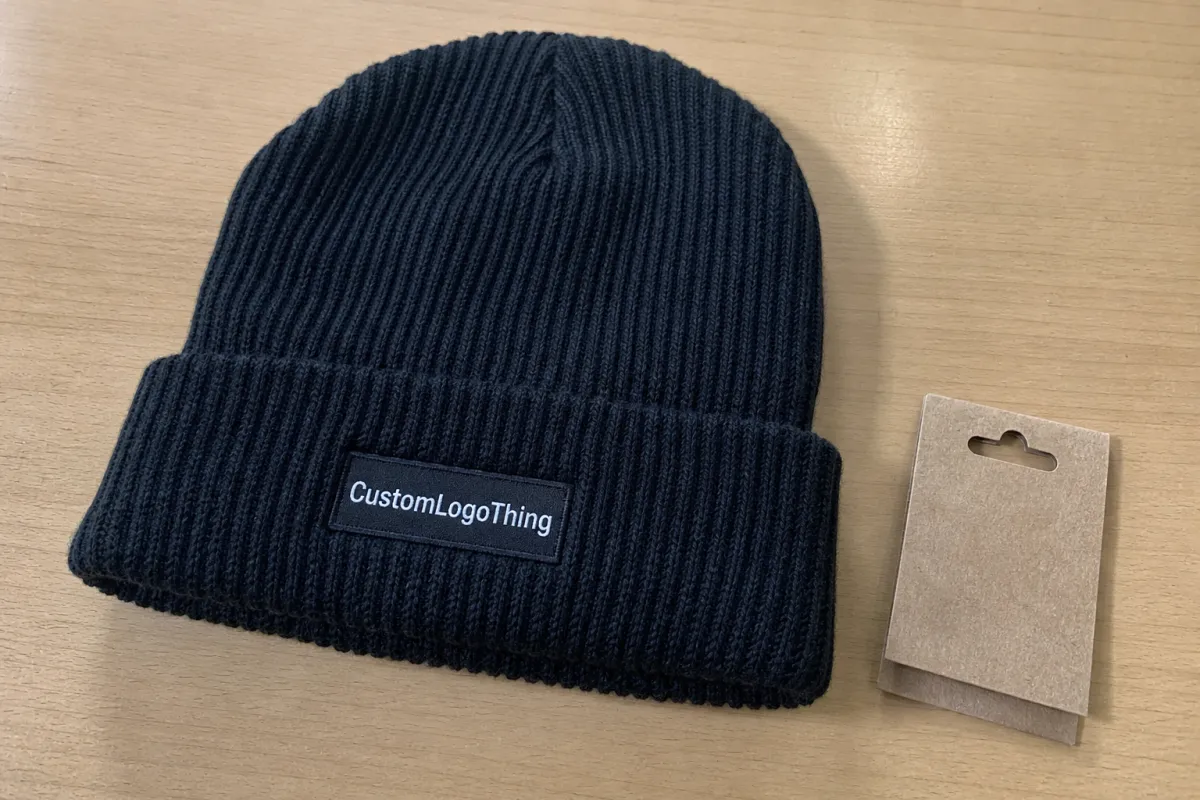
A digital proof is a production layout, not a final sample. It confirms that the artwork is legible, the placement makes sense, and the order specs match what was requested. It does not guarantee identical appearance under every light source, on every head size, or with every knit tension. That distinction matters more on Ribbed Winter Beanies than on smoother garments because the texture changes how the eye reads proportion.
Vertical ribs can make a logo appear slimmer. A folded cuff can hide part of the decoration field. Depending on cuff depth, roughly half an inch to more than an inch of visible space can disappear or return once the hat is worn. None of that is a defect. It is simply the difference between a flat mockup and a flexible textile.
A useful proof catches the problem before 300 units are stitched, patched, or tagged. A weak proof only reassures everyone while the error keeps moving.
The checklist is especially helpful when the order includes embroidery, woven patches, faux leather patches, heat transfers, printed labels, or custom tags. Each decoration method behaves differently on ribbed knit. Embroidery can pull thin fabric inward if the stitch count is too dense. Patches need enough flat area to sit cleanly. Printed labels can vanish visually against textured yarn if contrast is weak. The proof should expose those risks early, not after the material has been cut.
What a proof should not do is pretend to be a sample. If someone expects the screen mockup to reproduce every yarn slub, shadow, and stretch point in the final beanie, they are asking too much of a layout file. Color-critical orders deserve a yarn swatch, a physical sample, or at least a prior production reference. The proof is strongest at catching proportion and placement. It is weaker at predicting texture and touch.
For buyers managing private-label winter accessories, the same proof often becomes the first real quality gate. If the knit weight is off, the cuff looks too shallow, or the logo is too close to the seam, those problems are easier to fix here than in a later sample round. That is why disciplined buyers treat the proof as a control document, not a formality.
How the proof process moves from artwork file to sign-off
The cleanest proof starts with complete artwork. Vector files are the standard for a reason: they scale without blur and give the layout team a real starting point for stitch or patch dimensions. A low-resolution PNG can work for a quick visual, but it usually forces extra clarification. Missing fonts, fuzzy outlines, and vague color notes slow everything down. A file that says “make it close” usually produces a proof that still needs work.
The workflow is usually straightforward:
- Submit artwork, beanie color, decoration method, and target quantity.
- Receive a mockup or layout with size callouts, placement notes, and basic color references.
- Request changes if the cuff position, logo scale, or knit style looks wrong.
- Confirm wording, measurements, and any packaging or tag details.
- Approve the proof and release the order into production.
Delays tend to come from the same three places. First, missing files. Second, unclear internal approvals. Third, the familiar situation where marketing wants one version, operations wants another, and the production team has not been told which decision is final. If a proof needs multiple internal sign-offs, collect them before the file goes out. A one-day review can stretch into a week when everyone comments separately and nobody consolidates the changes.
For a simple single-location embroidery order, one proof round is often enough. Multi-color patch work, side branding, youth sizing, or retail packaging usually needs a second pass. Fast proofing is common when the artwork is clean; 1 to 2 business days is a realistic window for straightforward layouts. Change the decoration method or ask for several colorways, and the timeline expands. That is not slowness. It is the cost of not guessing.
Production timelines matter too. A typical custom beanie order may move from approved proof to finished goods in about 7 to 15 business days, depending on quantity, decoration complexity, and the current queue. Holiday demand, yarn availability, or late-stage revisions can extend that. Buyers who build in a small buffer tend to have fewer shipping surprises and fewer rushed approvals.
Specs that change the look before you approve anything
Ribbed beanies are not one-size-fits-all from a design standpoint, even though the garment stretches across a wide range of head sizes. Knit gauge, cuff depth, fold style, and decoration area all change what the final product will look like. A 7-gauge rib knit appears heavier and more textured than a 12-gauge knit. A deep cuff gives more room for branding, but it also shifts the visual balance of the hat. Small adjustments, large consequences.
The fiber blend matters as well. Acrylic is common because it is affordable, warm enough for most cold-weather use, and easy to knit in consistent lots. Recycled polyester is often chosen when buyers want a lower-impact material story or a smoother hand feel. Wool or wool blends offer better warmth-to-weight performance, but they can increase cost, require more care, and introduce batch variation that makes color matching more sensitive. None of these options is universally best. The right answer depends on use, budget, and the level of finish the brand wants to communicate.
Decoration method deserves the same scrutiny:
- Embroidery is durable and clean, but dense stitch counts can pucker thin knits.
- Woven patches handle detail well and are useful for small logos that would blur in thread.
- Faux leather patches can look premium, though they need enough flat surface to sit naturally.
- Printed labels support subtle branding, but texture can reduce visual contrast.
- Woven tags work well for side branding and private-label pieces, provided placement is precise.
Placement is where many proofs fail quietly. A logo that sits three-quarters of an inch too high can be swallowed by the cuff. A patch too near a seam can tilt once the beanie stretches. The proof should show the decoration relative to the center line, fold line, and seam line, not just hovering in open white space like a sales sheet.
Color is a second trap. Screen proofs are useful for contrast, but they do not reproduce yarn texture. Heather, melange, and off-white yarns all shift how a printed color reads. A deep navy mark on charcoal may look decisive on screen and flatter in person. If exact color matching matters, ask for Pantone references or an approved swatch range before sign-off. For packaging inserts or retail cartons, FSC-certified paper from FSC is a sensible choice when the buyer wants the packaging story to match the product story.
Package performance matters too. If the order includes cartons, mailers, or club-style gift packaging, validation methods from ISTA are more useful than a visual guess. A sturdy-looking box that arrives crushed is still a failed package.
One detail that is often underexplained in proofs is the assumed circumference. A flat width measurement means little without knowing how the beanie is meant to wear. For most adult ribbed beanies, a relaxed circumference around 18 to 20 inches is common, with stretch into the low-to-mid 20s. Youth sizing runs smaller and should be identified explicitly. If the proof does not show that assumption, buyers can end up approving a layout that fits the wrong audience.
Step-by-step proof review before you click approve
Proof approval should not be rushed. This is the last low-cost moment to remove errors that become expensive once material, labor, and shipping are involved. Start with the obvious checks: spelling, punctuation, and file names. A beanie printed or stitched with the wrong word does not become acceptable because the order was fast.
Then check placement. Three questions cover most of the risk:
- Will the wearer actually see the logo where it is placed?
- Does the decoration avoid the cuff edge, fold line, and seam?
- Does the size still look balanced on a ribbed surface after stretch?
After that, compare dimensions against the logo detail itself. Small type and thin strokes disappear quickly on ribbed knit, especially with embroidery. A design that looks crisp at 4 inches wide may turn soft at 2 inches. That is not a production flaw. It is the reality of small-format branding on textured fabric.
Check the supporting pieces too. If the order includes woven labels, care tags, retail inserts, or hangtags, the proof should either show them clearly or state that they are excluded. Many buyers assume every component appears in the mockup. Usually it does not. Proofs often focus on the decoration and leave secondary items to a separate file unless the buyer asks for all of it together.
Before approval, review the details that are easiest to miss:
- Quantities by colorway
- Adult versus youth sizing
- Shipping address and delivery window
- Fold, polybag, or retail pack-out instructions
- Any do-not-change notes for size, color, or placement
It also helps to keep the approved proof in a clearly named folder. Reorders become much easier when no one has to guess which version was signed off. A tidy approval trail is not glamorous, but it saves time every season.
Cost, pricing, and MOQ on ribbed winter beanie orders
Proof choices affect cost more than many buyers expect. Decoration method, stitch density, patch type, label additions, and packaging all influence the final number. Quantity matters just as much. Low-volume orders carry a higher per-unit cost because setup is spread across fewer pieces. That is not a penalty. It is production math.
Materials and decoration combine to create very different price points. An acrylic rib knit with simple embroidery behaves differently from a wool-blend beanie with a woven patch and custom tag package. The second looks more premium, but it also adds sourcing, approval, and handling time. Buyers should compare those tradeoffs before the proof is even opened.
These are practical working ranges, not fixed quotes:
| Option | Typical MOQ | Typical unit range | Best for | Main tradeoff |
|---|---|---|---|---|
| Single-location embroidery | 48-100 pieces | $4.25-$7.50 | Simple logos and quicker approval | Dense stitching can tighten the knit if the design is too detailed |
| Woven patch with sew-on application | 100-250 pieces | $4.75-$8.25 | Sharper detail in a small branding area | Needs a flat enough zone for clean placement |
| Faux leather patch | 100-250 pieces | $5.00-$8.75 | High-contrast, premium-looking branding | Less forgiving on curved or narrow cuffs |
| Custom label or tag package | 200-500 pieces | $5.50-$9.50 | Retail presentation and private-label work | Adds setup time and more review points |
Extra proof work can also affect cost. One or two revisions is often included when the artwork is ready. Additional mockups, method changes, or new placement options may add $25-$75 per round, depending on complexity. Rush requests usually carry a premium because they interrupt the normal production queue. That premium is not unique to beanies; it appears anywhere time has to be moved ahead of schedule.
Minimum order quantity is really a setup threshold. A small custom run can still make sense if the goal is brand consistency rather than the absolute lowest unit cost. Larger runs improve price efficiency, but only if the style is stable enough to justify the volume. The better question is not “What is the cheapest proof?” It is “What proof gets me to the right product without a second production run?”
If a buyer needs to compare material and decoration choices before locking the proof, the useful comparison is not only price per unit. It is price against expected wear, visual impact, and the amount of risk that remains after approval. A low-cost embroidery proof that hides a placement issue can be more expensive than a cleaner, slightly pricier patch layout.
Common proof mistakes that waste time and budget
Most proof mistakes are small, which is why they slip through. Nobody misses the giant error. They miss the tiny text, the logo that sits too close to the cuff, the side placement that was never confirmed, or the colorway that looked fine in email but was never actually approved.
- Treating the proof like a product photo. It is a layout tool, not a finished mock product.
- Skipping the minimum text-size check. Fine lines and small type vanish fast on ribbed knit.
- Ignoring side or back placements. Front-only review misses part of the garment.
- Not checking color splits and quantities. A bad count leads to a bad production plan.
- Forgetting the pack-out instructions. Folding, tagging, and bagging details need confirmation.
Another common mistake is approving the layout before the decoration method is final. Embroidery, patch work, and label applications are not interchangeable once the proof has been built around one of them. Changing methods late often means a new layout, a new cost structure, and a new timeline. A “small tweak” can become a restart very quickly.
Color review also deserves more care than it gets. Warm office lights, cool screens, and laptop brightness all change how the same proof appears. If three reviewers look at the file in three different environments, they may think they are reviewing three different products. A Pantone reference, approved sample, or prior production run gives everyone the same baseline.
Pack-out is another quiet failure point. If the beanies need hangtags attached in a specific direction, folded a certain way, or packed by size run, that instruction should be confirmed before approval. Otherwise production defaults to what it considers standard, which is only useful if “standard” matches the buyer’s expectation.
Finally, if the beanie order includes a premium presentation element, such as woven sleeve cards, retail cartons, or custom tissue, the proof should say whether those pieces are part of the approval or merely referenced. Ambiguity there creates rework later, and rework is where margins quietly disappear.
Next steps for a clean approval and faster production
The easiest way to keep an order moving is to send the proof team one complete packet. Include vector art, exact logo colors, beanie color, decoration method, target quantity, delivery date, and any hard rules that should not change. If the logo should never be smaller than 3 inches, say so. If the label must stay off the front cuff, say that too. Clear instructions reduce revision loops.
Ask for multiple views when placement matters. Front, side, and folded-cuff views are enough for most ribbed beanie orders. If the order is retail-facing, include packaging or label views as well. One angle rarely tells the whole story once a cuff can hide or reveal a large portion of the decoration.
Before the deposit is released, run the vitamin ribbed winter beanies Digital Proof Checklist one more time:
- Spelling and punctuation are correct
- Logo size fits the knit and cuff
- Decoration method matches the intended look
- Quantities and colorways are final
- Shipping and pack-out details are confirmed
Keep the approved file where it can be found quickly for reorder season. That habit matters more than it sounds. When the same style comes back with a new patch shape or a small logo color change, an organized approval trail saves time and protects consistency.
The real value of the checklist is not speed by itself. It is fewer revisions, fewer surprises, and fewer orders that look fine in a mockup but awkward in hand. Ribbed winter beanies are simple products only until the proof is rushed. After that, every millimeter starts to matter.
What should a vitamin ribbed winter beanies digital proof show?
It should show placement, logo size, color references, cuff or fold position, and any assumptions about sizing. If packaging, labels, or alternate views are not included, the proof should say so clearly.
How many revisions are normal for ribbed winter beanie proofs?
One or two rounds is common when artwork is complete and the decoration method is already decided. More revisions usually mean the buyer is still narrowing down size, color, or placement.
Does a digital proof match the final beanie exactly?
No. Screen color and textured knit do not behave like a finished sample. Use the proof to confirm layout and dimensions, then ask for swatches or sample photos if color accuracy is critical.
What changes MOQ and unit cost on custom ribbed beanies?
Decoration method, stitch complexity, number of colors, material blend, labels, and packaging all affect price. Lower quantities usually cost more per unit because setup is spread across fewer pieces.
What should I send before I approve the beanie proof?
Send vector art, exact logo colors, placement instructions, target quantity, and delivery date. A short do-not-change list helps prevent confusion during the last review.