The Slider Lock Clothing Bags Sample Approval Checklist is the point where packaging stops being an idea and starts being a production decision. That sounds simple until a sample arrives that looks sharp on the table, then pinches a folded hoodie, catches at the slider, or shifts the print half a centimeter once it is filled. Empty bags are forgiving. Real garments are not.
That is why experienced buyers look past the surface. They check whether the bag protects the fold, keeps the closure moving cleanly, and still looks aligned after handling. A bag can measure correctly and still fail if the zipper track steals interior room or if the film flexes too much under load. Small errors matter because apparel packaging is judged in sequence: warehouse speed, retail appearance, customer perception, and freight damage all stack up.
For Slider Lock Clothing Bags, approval is really a question of repeatability. Can the same bag be made again, packed the same way, and still perform after storage, stacking, and transport? If the answer is uncertain, the sample is not ready yet. The checklist exists to catch that uncertainty before it becomes rework, delayed freight, or a production run that cannot be trusted.
What This Checklist Catches Before You Approve
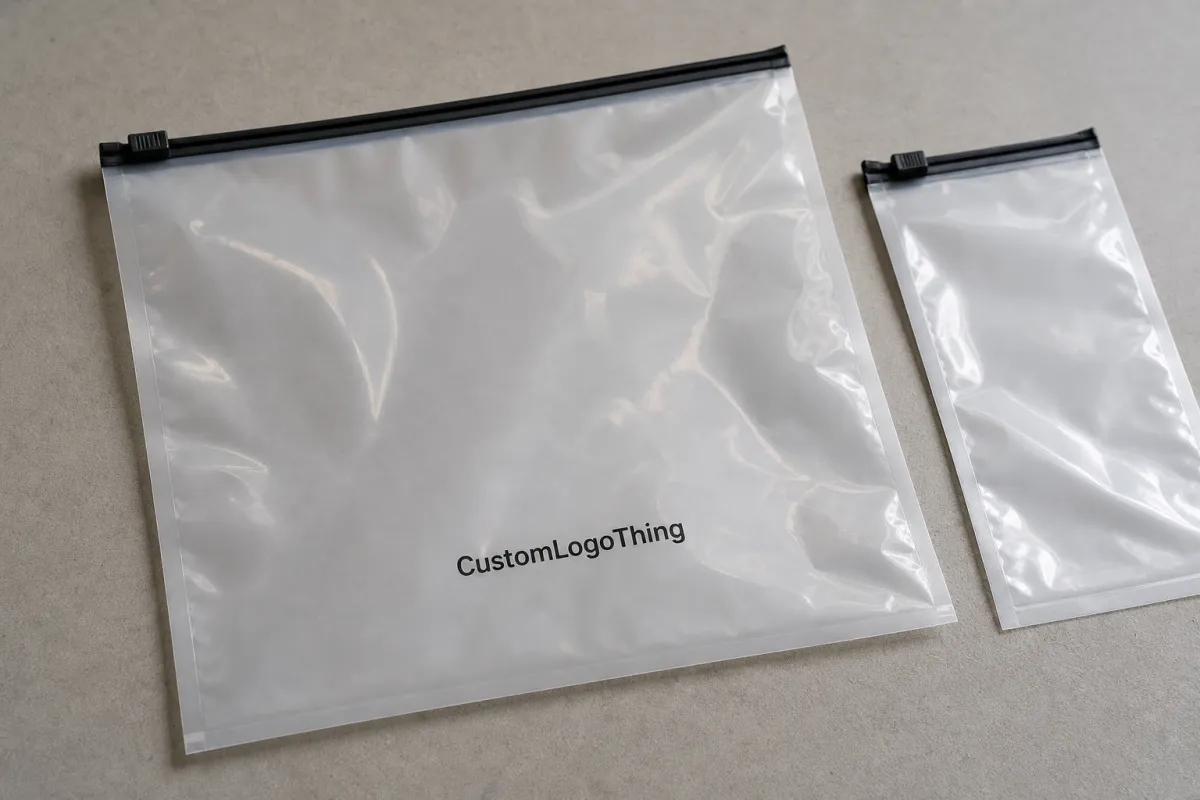
A useful sample review catches mismatch early. The written spec may call for a 14 x 18 inch clear bag with a 2 mil film and a smooth slider lock, but the physical sample has to prove those words translate into a usable package. That means checking more than size. It means asking whether the closure glides without force, the seals stay even, and the bag still looks balanced once the garment is inside.
Packaging defects rarely announce themselves in dramatic ways. They show up as a bag that bows after filling, a slider that hesitates at one end, a seal line that wanders slightly, or artwork that sits too close to the top edge. On a desk, those issues can look minor. On a packing line, they slow down throughput. In retail, they make the product feel less finished. Buyers who work with clothing packaging learn quickly that a small offset can be more costly than a visible flaw because it affects every unit in the run.
There is also a practical reason to test the filled bag, not the empty one. A folded shirt, sweater, or set of lounge pants changes the geometry inside the package. It pushes against the slider path, alters how the front panel hangs, and reveals weak seals that a flat sample hides. If the bag only behaves well without product inside, it is not approved.
Approval should mean one thing: the result can be repeated at scale. That includes normal warehouse handling, the expected shipping route, and the number of open-close cycles the pack will see before the item reaches the customer. If the order will sit in humid storage or move through cold environments, those conditions belong in the review too. The best checklist is not a formality. It is a control point.
How the slider lock clothing bags sample approval checklist works
A clean sample workflow usually moves through five stages: request, prototype review, revision, final signoff, and production release. Each stage should reduce uncertainty. If a supplier keeps sending revised samples without clear notes, the process is already drifting. The point of the slider lock clothing Bags Sample Approval Checklist is to make every revision answer a practical question: what changed, and did the change improve the filled bag?
- Request - Send the supplier the written spec, artwork, target quantity, and the actual folded garment dimensions.
- Prototype review - Compare the first sample against the spec sheet and artwork proof.
- Revision - Mark the differences clearly and ask only for the changes that matter.
- Final signoff - Approve a dated golden sample only after filled testing passes.
- Production release - Lock the approved version and share it with procurement, QA, and the factory.
Testing should mimic the real use case. Fold the garment the way the warehouse will fold it. Add the size card if one will ship with the order. Close the slider the way a packer would close it on the line. Those details sound small, but they affect speed, feel, and the chance of edge damage. A good sample is one that behaves well under ordinary handling, not one that only looks right under ideal conditions.
Every revision should carry the same core information: dimensions, film thickness, seal consistency, slider movement, artwork version, and the intended product fit. If the bag is for hanging display, the punch hole or header area needs to match the hook hardware. If it is for compressed apparel sets, interior clearance matters more than the empty profile. The sample should answer the use case, not just the spec sheet.
| Review Stage | What You Check | Approval Risk |
|---|---|---|
| Empty sample | Dimensions, seal line, print placement | High if used alone |
| Filled sample | Closure feel, usable space, visual balance | Medium if garment differs from spec |
| Golden sample | Measured specs plus production reference match | Lowest when locked properly |
Fit, Material, and Closure Specs That Decide Approval
Most sample mistakes start with measurements. Buyers should verify bag width, height, gusset depth if used, opening clearance, and the interior space left after the garment is folded. A bag can match the printed size and still fail if the zipper track reduces the usable opening or if the seal starts too close to the product edge. For a slim tee pack, 2 mm can change the fold appearance. For a bulkier knit, the same 2 mm can decide whether the bag closes cleanly at all.
Material choice matters just as much. Clear polyethylene and LDPE blends are common in apparel packaging because they balance clarity, flexibility, and cost. Film thickness often falls in the 2 mil to 4 mil range for many clothing uses. Thicker film usually resists tearing better and feels firmer in hand, but it can also make the closure feel stiffer if the slider track is not aligned well. That tradeoff is one reason buyers should avoid approving by appearance alone.
The closure deserves its own test. Check pull strength, end-stop security, zipper alignment, and whether the bag can be opened one-handed without snagging. If the slider hangs up near the end stop or requires an awkward grip to start the opening, packout speed will suffer. A closure that works on the first open may still feel rough after several cycles, especially if the track is slightly off-center or the film is too tight at the top edge.
Measurements that matter first
Start with internal dimensions, then compare them with the folded garment plus a small allowance for movement. A 0.25 inch difference can be enough to change how a shirt collar sits or how a sweatshirt fold settles near the top seal. If the bag includes a gusset, check whether it opens evenly or collapses into a wrinkle that distorts shelf presentation. That wrinkle may not affect function, but it can make a premium item look ordinary.
Visual details that buyers should not ignore
Clarity, tint, and print registration shape how the package feels to the eye. A slight haze may be acceptable on an inner poly bag, but it may not work for retail display. The same goes for logo placement. If the artwork sits too close to the seal line or shifts when the bag is filled, the package can look off even when the dimensions are correct. On high-volume programs, those inconsistencies are what separate a controlled run from a messy one.
For buyers managing multiple SKUs, standardizing a few closure styles can reduce confusion. One slider type, one print zone, and a fixed tolerance band make it easier to compare samples side by side. That consistency also helps procurement because it limits the number of variables that can move the quote. The cheapest option on paper is not always the cheaper option after revisions, freight, and rework are counted.
If sustainability claims are part of the pack, the material discussion changes. Paper inserts or hang tags may need certified stock, and that is where a source like FSC can matter. For shipping and handling expectations, many teams use ISTA methods as a reference for drop and vibration scenarios, especially when the bag is part of a larger retail packout. Those references do not replace the spec sheet, but they give the review some structure.
Approval Process and Timeline: What Happens When
Most delays happen before production begins. The buyer sends incomplete artwork, the fold style is unclear, or the garment thickness is missing from the brief. The factory guesses. That guess becomes a sample. The sample gets revised. Time slips away. This is a familiar pattern, and it usually starts with one missing detail that seemed minor during sourcing.
For a straightforward clear slider bag, first samples often arrive in about 5 to 10 business days after the brief is complete. Revised samples may take 7 to 12 business days, especially if the supplier needs to adjust tooling, print plates, or bag dimensions. More complex requests take longer. Correction rounds almost always move slower than the first prototype because the factory is reworking something instead of building from a fresh spec.
Each revision should travel with the same documentation:
- Dated photos of the sample from front, back, and side angles
- Marked-up comments tied to the spec sheet
- Artwork file name and version number
- Measured dimensions and tolerance notes
- The current decision: approve, revise, or reject
Version control saves a surprising amount of time. Without it, two people can review two different files and believe they are discussing the same bag. That confusion becomes expensive late in the process, usually after freight dates or launch windows are already in motion. A clear paper trail matters even on a small order because a small order can still miss a season.
Approval timing also affects the wider supply chain. Production slots move. Freight bookings slip. Inventory plans drift. If the bags support a clothing launch, every lost week matters because packaging is often tied to product photography, e-commerce timing, and the first replenishment plan. A slow sample cycle can force compromises later, and those compromises are usually more expensive than the sample revision would have been.
Pricing, MOQ, and Unit Cost Drivers
Sample review is also where pricing starts to become real. The first quote may look attractive until the buyer adds a custom logo, a wider format, or a stronger slider lock. Then the cost changes. That is normal. What matters is whether the quote separates one-time charges from recurring unit price so the comparison stays honest.
Typical sample fees for custom slider lock clothing bags can range from about $35 to $120, depending on complexity. Production pricing often lands somewhere around $0.18 to $0.45 per unit for orders near 5,000 pieces. Larger sizes, fuller print coverage, thicker film, or specialty finishes can push that higher. Lower quantities usually carry a higher unit cost because setup and waste are spread over fewer pieces. A buyer ordering 1,000 units may pay more per bag than expected even if the material looks simple.
| Option | Typical Cost Impact | Why It Moves the Price |
|---|---|---|
| Standard clear bag, one-color logo | Lower | Simple print setup and familiar material |
| Thicker film, larger format | Moderate | More resin usage and slower conversion speed |
| Full-coverage print or special finish | Higher | Extra color passes, ink coverage, or finishing labor |
| New closure style or custom slider | Higher | Tooling, testing, and possible minimum run requirements |
The hidden cost is revision time. Every new proof adds labor, shipping, and another round of buyer review. If the first sample missed the mark because the brief was incomplete, the second sample is not really extra. It is the price of missing information. That is one reason experienced buyers spend more time on the initial brief than on the first round of comments.
MOQ also shapes the economics. Some suppliers can work with 3,000 units on a simple bag; others prefer 5,000 to 10,000 because setup time makes smaller runs inefficient. If the order supports a retail test, a smaller MOQ may be fine. If the bag is a core replenishment item, a slightly larger MOQ can reduce per-unit cost enough to matter over the full season.
Buyers can control more than they think. Simplify the print area. Standardize the size family. Approve one closure style instead of debating three. Ask the supplier to quote sample fees, tooling or plate charges, freight, and unit pricing separately so the numbers can be compared cleanly. That approach keeps the conversation grounded in total cost, not just the headline price.
Common Mistakes That Slow Approval and Raise Rework
The most expensive mistake is approving an empty bag. A bag that feels smooth and looks square on a table can behave very differently once a folded garment pushes against the slider track. Closure tension changes. Fold height changes. The visual balance changes. That is exactly why the filled test belongs in the review.
Vague feedback causes another round of delay. “Make it better” does not help anyone. Better how? Wider opening? Cleaner print? Stronger seal? Faster slider motion? The supplier needs measurable instructions, not a mood. If the buyer wants a 3 mm wider opening and the print lowered by 5 mm, say that. Specific feedback shortens the loop and reduces the chance of a new mistake being introduced while fixing the old one.
Version control failures create wasted work. Teams sometimes review a sample against one artwork file while procurement is quoting another. Or a factory sends two revised samples and nobody labels which one was approved. Once that happens, final signoff turns into paperwork instead of technical control. A dated golden sample prevents a lot of argument later.
Testing failures are just as common. Do not skip these:
- Cold-room handling if the bags move through refrigerated storage
- Repeated opening and closing, at least 20 to 30 cycles on the sample
- Vibration or drop simulation if the shipment will travel long distance
- Stacking pressure if cartons will be packed tightly in transit
For more formal handling references, many teams borrow from ISTA test logic for transit stress and from FSC documentation when paper-based components are involved. Those references are not a substitute for your own approval checklist, but they help align the factory, the buyer, and QA around the same expectations.
One more issue gets overlooked: response time. If the buyer waits two weeks to send comments, the factory may have already moved on to other work. Fast, specific replies keep the project from stretching out. That matters most with seasonal clothing orders, where packaging approval can affect photography, launch timing, and replenishment planning all at once.
Expert Tips and Next Steps After Final Signoff
Once the bag is approved, lock the reference. Keep one master sample with dated photos, measured dimensions, artwork version, and a short note on the garment used for testing. That reference becomes the benchmark if a later production run starts to drift. Without it, teams end up arguing from memory, and memory is a weak control document.
Send a final release note that repeats the approved size, material, closure spec, print version, and packing method. The note should be plain. Plain is useful because it leaves less room for interpretation. The same idea applies to the spec sheet: concise language, exact measurements, and no extra assumptions.
Ask the supplier for a production control plan before bulk runs begin. A basic plan should say what they inspect at startup, what tolerance limits they use, and how they handle the first carton if it fails. If that process cannot be explained clearly, the sample approval may not be enough protection by itself. Good suppliers are usually specific here because they know the first-run check is where most hidden problems surface.
The practical next step is not another round of debate. It is to compare the approved sample with the production reference, confirm the garment fit, and keep the approved version visible to procurement and QA. That is what turns the slider lock clothing bags Sample Approval Checklist into a working control tool instead of a one-time document.
For Custom Apparel Packaging, the difference between a passable sample and a dependable production bag is often only a few millimeters, one or two material choices, and a disciplined review process. That may sound narrow, but it is exactly where most packaging risk lives. A good checklist catches the small things before the order gets expensive.
What should a slider lock clothing bags sample approval checklist include?
It should cover bag dimensions, film thickness, closure function, artwork placement, and fit against the spec sheet. Test the sample with the actual folded garment, not an empty bag. Record photos, notes, and the exact version approved for production so the factory has one clear reference.
How many sample rounds are normal before approving slider lock clothing bags?
One or two rounds is common when the brief is complete and the filled-product test is included. More rounds usually mean the first instructions were unclear or the sample was reviewed empty. Complex print changes, unusual folds, or tight tolerances can add another revision.
What measurements matter most on a clothing bag sample?
Check width, height, opening clearance, and any gusset depth first. Then confirm seal placement, slider track alignment, and usable internal space with the garment inside. Small measurement drift can affect both fit and how premium the package looks.
How does sample approval affect production lead time?
Approval starts the production clock, so any delay in signoff pushes the whole order back. Revisions often take longer than the first sample because changes may require retooling or reprinting. A clean approval path protects launch dates, freight bookings, and seasonal inventory timing.
Why does the quote change after the first sample review?
Changes to size, print coverage, closure style, or material can raise setup and unit costs. Lower quantities usually carry a higher unit cost, especially with custom packaging. Ask suppliers to separate sample fees, tooling, and shipping so you can compare quotes accurately.

