Candle Ribbed Winter Beanies sample guide for buyers
The candle Ribbed Winter Beanies Material Sample guide exists for a simple reason: rib knit can look clean, soft, and well balanced in a flat sample, then behave very differently once it is stretched, folded into a cuff, and worn for an afternoon. A buyer is not approving a photo. They are approving recovery, insulation, hand feel, shape retention, and whether the hat still looks commercial after use.
That shift matters more than many teams expect. A ribbed beanie may seem like a small item, but the material choices behind it can change the whole product. A slightly tighter knit can improve structure. A different yarn blend can change warmth, pilling, and price. One sample can tell you whether the final run is likely to hold up, or whether the “nice on the table” version will disappoint once it reaches a customer.
Buyers usually get the best results by judging the construction before the artwork. If the yarn, gauge, and cuff height are right, the logo has a better chance of sitting cleanly. If those basics are off, no amount of decoration fixes the hat.
Candle Ribbed Winter Beanies Material Sample Guide: What It Proves
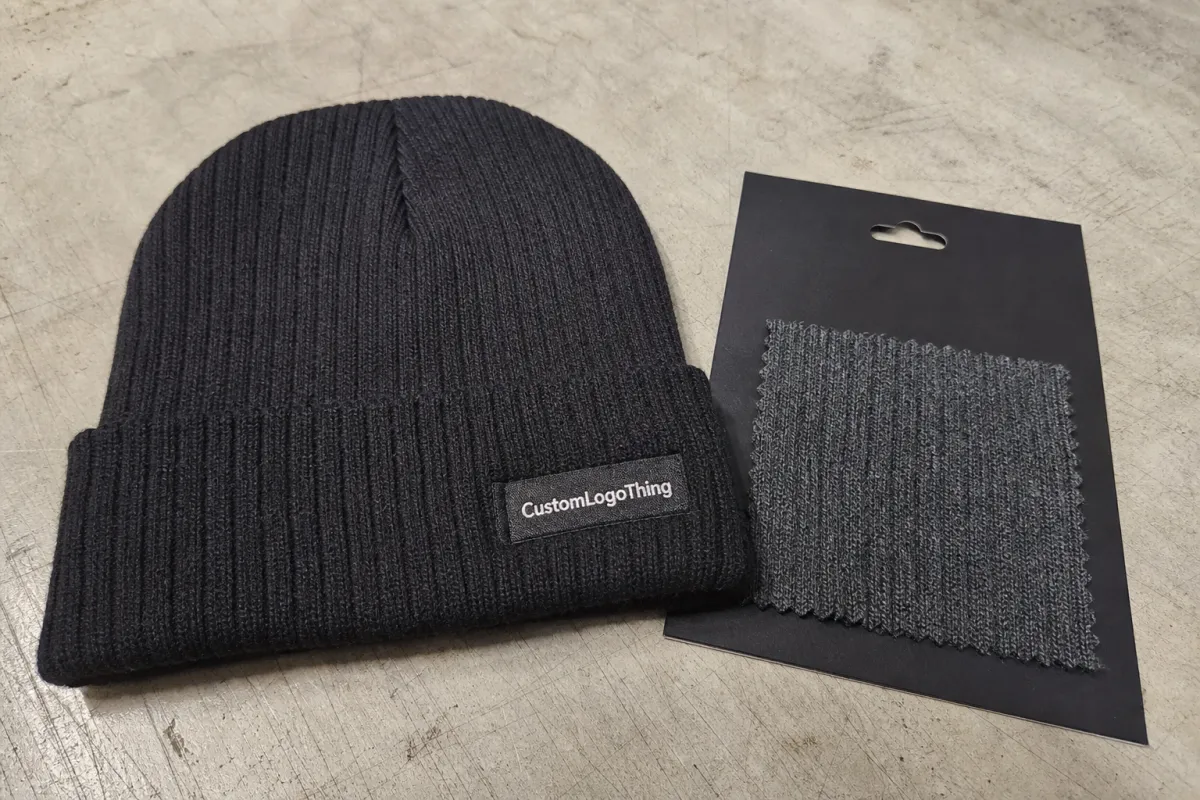
A sample proves more than color. It shows how the knit behaves under pressure, how the material feels against skin, and whether the hat keeps its shape after it has been stretched and set down again. The most useful sample is the one that answers practical questions before production money is committed.
Start with fiber content. Acrylic remains common because it is cost-efficient, soft enough for broad retail use, and usually easy to knit consistently. Wool blends increase warmth and give a more substantial hand, but they can also raise the price and introduce itch concerns if the blend or finishing is poor. Cotton is breathable and familiar, though it does not trap heat as aggressively unless the knit is dense. Recycled yarns are increasingly requested for brand positioning, but recycled content still needs the same hands-on review as any other fiber. A sustainability label does not make a beanie warmer, softer, or more durable by itself.
Rib density is another early clue. A tighter rib often feels more secure and looks cleaner around the cuff. A looser rib can feel softer at first, but it may relax faster with wear and storage. That is why a sample should be inspected flat, folded, stretched, and worn on a head form or actual fit model if one is available. One still image will not reveal the full behavior.
The sample also helps a buyer decide whether the intended use case and the material spec match. A promotional beanie for wide distribution may need a more forgiving acrylic knit and a simpler logo treatment. A retail beanie priced higher can justify a better yarn blend, a denser rib, and a more controlled finish. The wrong fabric at the wrong price point creates a mismatch the customer feels immediately.
A ribbed beanie that looks polished in a photo has only passed the first test. The useful sample still feels right after stretching, folding, wearing, and measuring again.
How Ribbed Winter Beanie Samples Are Built and Tested
Sampling usually follows a predictable path: yarn selection, knitting, shaping, finishing, and inspection after any wash, steam, or softening process. That final stage can change the result more than buyers expect. A beanie that feels slightly firm straight off the machine may settle into a better shape after finishing. The reverse happens too. Some materials open up, lose structure, and never quite recover.
The rib construction is the heart of the sample. A 1x1 rib behaves differently from a 2x2 rib, especially in elasticity and surface texture. Wider ribs can look more relaxed and tactile. Narrow ribs often give a cleaner, more controlled appearance. Neither is automatically better. They simply create different wearing behavior, and that behavior should match the target market.
Buyers often receive several sample types, and each one serves a different purpose:
- Raw material swatch - confirms yarn feel, twist, and color direction before knitting starts.
- Knit-only sample - shows the rib structure, gauge, and recovery without decoration.
- Decorated sample - checks embroidery, woven labels, patches, or print on the actual knit surface.
- Pre-production reference - becomes the approved benchmark for bulk production and quality control.
Decoration on ribbed knit needs more care than decoration on a flat woven textile. Embroidery can pull if stitch density is too heavy. A patch may sit neatly, but only if it avoids the most stretch-prone zone. Heat transfers and silicone labels need a stable area. On a cuff that stretches every time the beanie is worn, placement matters as much as the artwork itself.
From a buyer’s perspective, the most revealing tests are straightforward. Stretch the cuff several times. Leave the beanie on a form for a few minutes. Rub the surface lightly to check for early pilling. Fold and unfold it to see whether the shape rebounds or stays creased. If the sample is going to be shipped tightly packed, compress it for a day and inspect it again. Some yarns recover cleanly. Others keep a memory line that never fully disappears.
Key Material Factors Buyers Should Check First
If time is limited, inspect the material stack in a fixed order: fiber blend, yarn weight, rib density, cuff depth, fit, then color and decoration. That sequence keeps the review grounded in performance instead of appearance alone.
Fiber blend is the first filter. Acrylic is usually the safest cost-control option. Wool or wool blends increase warmth and often improve perceived quality, but results vary by source, finishing, and the percentage of wool used. Cotton can work for a milder winter market or a more casual fashion look, though it may not feel insulating enough unless the knit is substantial. Recycled yarn can support a stronger sustainability story, but buyers still need to check recovery, softness, and pilling risk as carefully as they would with conventional yarn.
Yarn weight and gauge shape the final feel. A lighter gauge can look modern and refined, yet still fail a winter performance brief if the hat feels thin on the head. A heavy gauge may feel cozy, but it can also make the beanie bulky, stiff, or slow to recover after being folded. The right choice depends on the retail position and climate, not on what is easiest to knit.
Rib density and cuff depth affect both fit and branding. A shallow cuff can crowd embroidery or labels. A deep cuff can overpower the crown and change the silhouette. Ribbing that is too open may look attractive at first and then lose tension under repeated wear. Buyers should measure the flat width, unrolled height, cuff height, and stretch range. Those numbers make reorder conversations far easier later.
Colorfastness and pilling risk are often underestimated. A quick rub test can reveal loose surface fibers. A short wear test will show whether the yarn sheds more than expected. If the beanies will be handled a lot in retail, packed tightly for freight, or stored for long periods, that early wear pattern matters. A hat that looks fresh on day one but pills after a short use cycle can still create customer complaints.
Fit deserves more than one head size if possible. A sample can look ideal on a form and still feel shallow on a wearer, or the opposite. Measure against the actual spec, not just the visual impression. A precise fit check also helps the factory reproduce the same size range in bulk knitting.
Packaging deserves attention at the same stage, especially if the brand wants the sample to reflect the final presentation. If the plan includes a corrugated cardboard mailer, kraft paper tissue, FSC certified inserts, or biodegradable packaging, the sample should reflect that direction as closely as possible. Packaging may seem secondary, but it affects perceived quality, storage behavior, and shipping resilience.
For broader packing and shipping context, the ISTA transport testing standards and the FSC certification system are useful references. They are not beanie-specific, but they help teams evaluate carton durability and paper sourcing with more discipline.
Sampling Process and Timeline: From Request to Approval
The clearest sampling programs start with a clear spec sheet. Send the supplier the target size, rib style, cuff height, color reference, decoration method, packaging preference, and delivery deadline. If any of those items are missing, the sample can still look acceptable while missing the commercial target.
For most projects, the best sequence is swatch first, full sample second. A swatch confirms yarn feel and color direction before anyone spends time on a full knit. The decorated sample then shows how the logo behaves on the actual surface. That two-step process can prevent a lot of avoidable rework, especially when the buyer is still deciding between embroidery, a woven label, a patch, or print.
Typical timing depends on yarn availability and how much decoration is involved. A plain knit sample often takes 5-10 business days after confirmation of the spec. A decorated sample commonly lands in the 7-14 business day range. Special yarn sourcing, custom dyeing, or recycled fiber availability can push the schedule longer. If the buyer wants a second round, time must be added for knitting, finishing, transit, and internal review. That delay is normal. It is also cheaper than approving the wrong thing.
Here is a practical view of sample types and their usual range:
| Sample Type | Typical Use | Common Cost Range | Typical Lead Time |
|---|---|---|---|
| Material swatch | Yarn feel, color, and basic texture check | $10-$25 | 2-4 business days |
| Knit-only beanie | Fit, rib recovery, and shape review | $35-$80 | 5-10 business days |
| Decorated pre-production sample | Final approval for logo, placement, and packaging | $60-$150 | 7-14 business days |
Those numbers are working ranges, not fixed rules. A custom-dyed yarn, a recycled blend, or a complex packout can move the cost up quickly. If the order includes insert cards, hangtags, or branded cartons, ask for the sample to use the intended paper stock. A neat knit can lose impact if the finishing materials are poorly matched.
Request photos, flat measurements, and notes at every stage. A factory photo alone does not tell the whole story. A close-up of the knit, a measurement sheet, and a written note on what changed between versions will save time during approval.
Cost, Pricing, MOQ, and Quote Drivers
Pricing is driven by more than the hat itself. Yarn type, knit complexity, decoration method, finishing, packaging, and freight all affect the final number. A simple acrylic ribbed sample will usually cost less than a wool blend with embroidery and custom packaging. That sounds obvious, yet quote comparisons often become misleading when two vendors are not pricing the same specification.
MOQ has a real effect on unit pricing. A low-quantity order carries the same setup work as a larger run, but the cost is spread over fewer pieces. A buyer ordering 300 hats will generally pay more per unit than a buyer ordering 3,000. That is standard manufacturing math, not a penalty. In practical terms, a simple ribbed winter beanie may fall around $2.10-$3.20 per unit at 500-1,000 pieces, while a wool blend, recycled yarn, or decorated version may move toward $3.60-$5.50, depending on branding and packaging. Smaller runs can sit higher still because setup cost has less volume to absorb it.
Sample fees should be clarified early. Some suppliers credit the charge back against production. Others do not. That difference matters when the buyer is working within a tight budget or comparing vendors on a first order. Freight also needs attention. A rush sample may require express courier service, and a revision caused by changed artwork or a missed placement detail can add both time and money.
The cleanest comparisons use one spec sheet across all quotes. Match the exact fiber blend, rib style, cuff height, label method, packaging standard, and shipping term. If one supplier includes recycled yarn, FSC board, and individual bagging while another quotes only the knit cap, the prices are not equivalent. The lower number is not necessarily the better number.
Packaging can shift the budget more than expected. A beanie packed in a plain polybag and shipped in a simple carton is one cost profile. The same beanie packed in a corrugated cardboard outer carton with kraft paper wrap and a printed insert card is another. If the brand wants to use recycled materials or post-consumer waste content in the packout, that should be tested during sampling so the final presentation does not feel improvised.
The most useful quote is the one that makes the scope clear. It should show what is included, what can vary, and where extra cost appears if the order changes. Cheap quotes can be expensive later if the hidden assumptions are doing the work.
Common Mistakes When Approving Ribbed Beanie Samples
Approving color without checking stretch is a common mistake. Ribbed knit changes how light hits the surface, so a shade can look deeper when relaxed and lighter when worn. If a buyer only inspects the beanie flat under office lighting, the final look on a person’s head may feel off.
Another miss is skipping a wash or recovery test. Even a short wash and dry cycle can reveal shrinkage, cuff twist, or a change in surface texture. A sample that comes back slightly shorter may still be acceptable, but only if the buyer knows that before bulk starts. Measuring after care testing is more useful than measuring only the untouched sample.
Logo placement on the cuff needs special care. Some samples are approved with the cuff folded one way, then worn another way in the field. If decoration sits too close to the fold line, it can distort once the cuff opens. The safer approach is to test both folded and unfolded positions before signing off.
Another trap is comparing the sample to a photo instead of the actual piece. Photography flattens texture and hides depth. A thick rib can appear lighter in a picture than it really is, and a slightly uneven knit may not show at all. The physical sample, notes, and measurements should carry more weight than the image.
Finally, many buyers skip a brief wear test. That is where slipping, pressure points, and collapse show up. A hat can feel fine at first and then relax too much after several minutes. That kind of issue usually becomes a returns problem or a customer complaint later, which is exactly why it belongs in the approval stage.
If a sample only passes the “looks good” test, it is not ready. It should also pass the stretch, wear, fold, and measure test.
Expert Tips and Next Steps Before Full Production
Use a short approval checklist every time. Keep it consistent: hand feel, fit, color, decoration placement, measurement tolerance, and packaging. It sounds plain, but it prevents vague approvals that become expensive later.
Mark the sample clearly and save the notes with it. The approved version should say exactly what is locked and what can still vary within tolerance. For example, a buyer may approve a cuff height of 7.5 cm with a 0.5 cm tolerance and allow minor dye lot variation within a defined range. That level of precision removes a lot of argument later.
If the beanie will sit on retail shelves, compare the sample against the full presentation, not just the hat. Hangtag, inner label, outer pack, carton, and insert card should all feel like one system. A good knit in weak packaging still looks unfinished. If the packout uses biodegradable packaging or FSC certified paper, the sample should show that clearly rather than implying it in the spec notes.
Ask for a new pre-production confirmation if the order changes after approval. Quantity shifts, yarn substitutions, late logo edits, and packaging changes can all affect knit tension or decoration behavior. Small paper changes can become production problems if nobody checks the physical sample again.
Keep the approved sample with the spec pack for reorders. Include the measurements, yarn composition, decoration method, packaging spec, and tolerance notes. That archive is more useful than the email trail and far more reliable than memory.
Handled with that discipline, the candle Ribbed Winter Beanies Material Sample guide becomes a control point, not a formality. It protects fit, appearance, budget, and delivery confidence before production starts.
Frequently Asked Questions
What should I check on a candle ribbed winter beanies sample first?
Start with fiber blend, stretch recovery, cuff depth, and hand feel. Measure the sample flat and on-head, then do a short wear test to see whether the ribbing relaxes too much or keeps its shape.
How many revisions are normal for a ribbed winter beanie sample?
One revision is common for a color, label placement, or measurement tweak. Two rounds can still be normal if the yarn, gauge, or decoration method changes. If revisions keep repeating, the spec sheet likely needs tighter definition before production moves ahead.
Does the material sample match final production exactly?
It should match the intended construction closely, but small dye lot and texture differences can still happen in bulk. The sample is most valuable when it proves fit, feel, and decoration placement. Written tolerances help everyone agree on what is acceptable.
How do I compare pricing between ribbed beanie suppliers?
Compare the same yarn blend, decoration method, MOQ, packaging, and shipping terms so the quotes are equivalent. Ask whether sample fees are credited back on the production order, and watch for setup, rush, or rework charges that can change the landed cost.
What information should I send with a beanie sample request?
Send the target size, rib style, color reference, logo artwork, and packaging requirements. Include the intended use case, such as retail, team wear, or promotional distribution, because that changes the recommended material and fit. Share the deadline early so the schedule can be planned properly.