Candle Frosted Zipper Bags material Sample Guide for Buyers
If a candle package looks refined in a mockup but feels flimsy in hand, the gap usually shows up in the sample stage. That is the real purpose of the candle Frosted Zipper Bags Material sample guide: not to admire a finish, but to test whether the bag performs like packaging. Frosted film can soften a brand image, hide minor scuffs, and photograph well. It can also become cloudy, weak, or cheap-looking if the wrong structure is chosen.
Candle buyers feel those differences quickly. Wax jars are heavier than the average small accessory. Labels have edges. Fragrance oils can make nearby materials look richer or more brittle depending on the film, the zipper, and the lighting. A bag that passes on a design screen can fail the moment it meets the actual candle, the actual insert, and the actual warehouse routine.
The sample is where assumptions get priced out. If the bag only looks good when it is empty, that is not a packaging solution. It is a visual promise waiting for a stress test.
What the candle frosted zipper bags material sample guide actually helps you judge
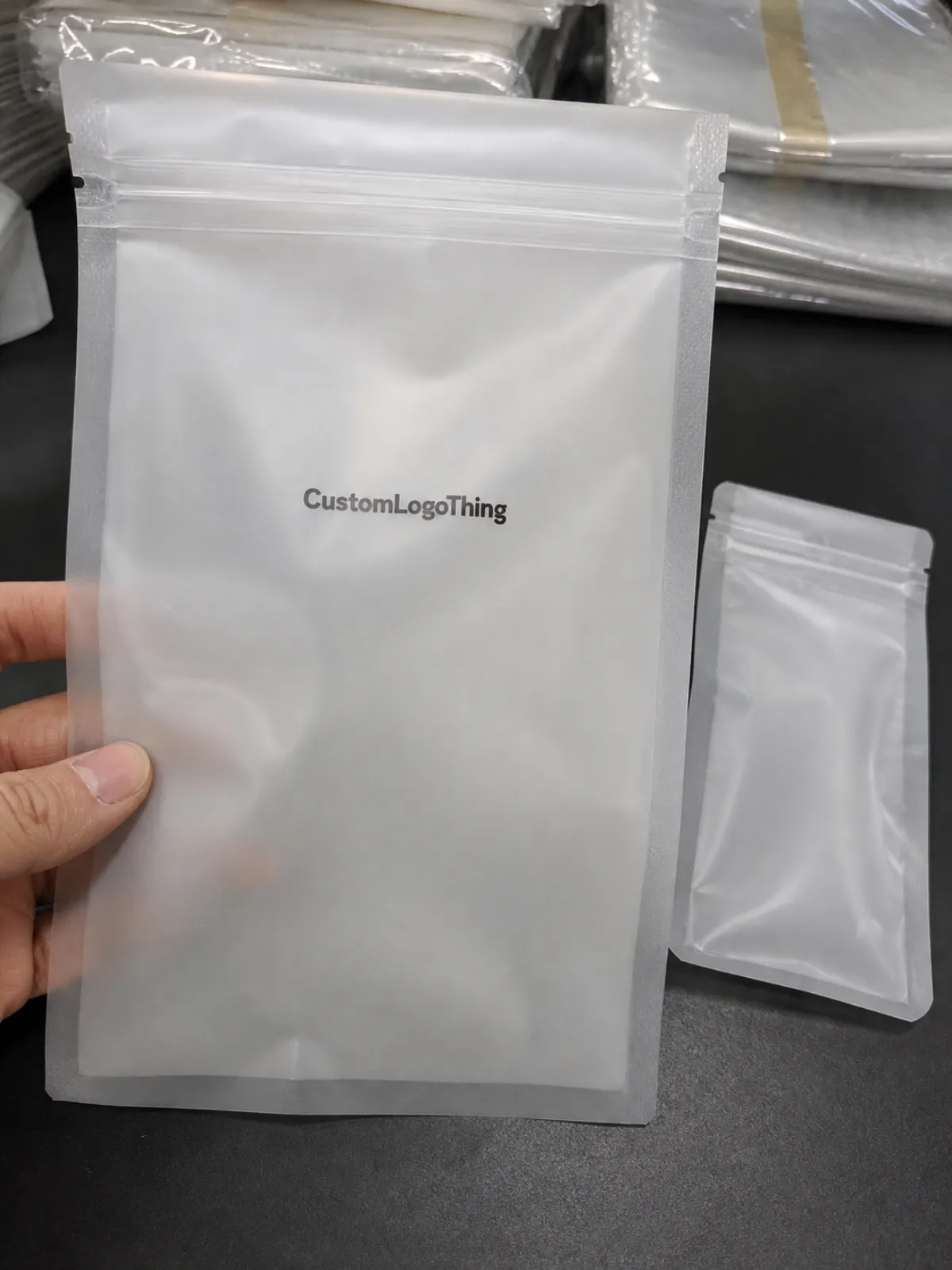
The sample has one job: show whether the bag suits the product you plan to ship. Not the product you wish you had. The real one. That means checking fit, closure feel, seal strength, frost level, print behavior, and how the bag looks once the candle is inside it. If the candle includes a jar, lid, insert card, or tissue wrap, those pieces belong in the test too.
For candles, this matters more than it does for light consumer goods. Glass jars create pressure points. Heavier fills distort a thin film faster than expected. Labels shift the visual center of gravity. A bag that is too soft can wrinkle around the base and make the pack look tired. One that is too stiff may stack neatly but read brittle or overbuilt in the hand. Neither result is ideal.
There is also a retail reality that buyers sometimes ignore: frosted film changes under different lighting. A bag that looks crisp on a white desk can turn dull under warm store lights or slightly blue under fluorescent fixtures. That difference affects the candle color, the logo, and even the perceived quality of the wax itself. A sample should be checked where the product will actually live, not only in a studio or sample room.
One more point that is easy to miss: a sample is a promise only if it is honest about what is final and what is provisional. Some suppliers send pre-production film, demonstration zipper stock, or reference print methods because they are faster to produce. That can be acceptable if it is disclosed. If the supplier does not say which elements are final-spec, the sample becomes a guess with nice edges.
If a frosted zipper bag only performs when it is empty, it has not passed a packaging test. It has passed a styling test.
How frosted film, zipper seals, and print layers work together
Most Frosted Zipper Bags are built from a film body, a frosted finish or haze layer, a zipper track, side seals, and a decoration method such as printing, labeling, or hot stamping. Those pieces do not behave independently. Change one, and the whole bag changes. Thickness alone does not tell you enough because two bags with the same nominal gauge can feel very different if the resin blend, seal width, or zipper profile changes.
The frosted effect is usually created by a surface treatment or a film structure that scatters light. That haze is doing real work. It softens contrast, blurs scuffs, and creates a more premium impression than clear plastic in many candle lines. But there is a tradeoff. More frost means less clarity and softer color reading. Less frost gives a sharper view of the candle and label, though it can move the bag toward a more ordinary retail look. The useful range is usually somewhere in the middle.
The zipper deserves more attention than it gets. It is not only a closure. It is the part the customer touches, opens, closes, and judges repeatedly. A good zipper closes evenly, holds without snagging, and keeps its feel after multiple cycles. A weak zipper can still look fine in a photo and fail the minute the package is reused for storage or gifting. That kind of failure is small on paper and obvious in the customer’s hand.
Print or labeling adds another layer of complexity. Frosted film can dull a light-colored logo, and certain inks look flatter on matte surfaces than on smoother stock. If the design uses fine line work, check edge sharpness in the sample. If the design depends on a specific pantone or foil effect, ask for a close match under neutral light. A sample that looks “close enough” on a monitor can be noticeably off once it is printed onto a translucent surface.
For packaging standards, I often compare the sample mindset to ISTA transport testing: a package that only behaves well in a controlled setting is not ready for distribution. And if your outer materials include fiber-based inserts, sleeves, or cartons, FSC-certified paper components can help keep the set aligned with a recycled-content message.
Material factors that change feel, barrier, and shelf appeal
Material choice is where a sample earns or loses credibility. For frosted zipper bags used with candles, a practical thickness range is often around 80 to 140 microns, or roughly 3 to 5.5 mil, depending on size, fill weight, and the degree of premium feel you want. Heavier film adds body, resists denting, and usually looks more deliberate on shelf. Lighter film can still work, but it needs cleaner handling and tighter quality control during packing.
Frost intensity changes the bag’s personality. Light frost keeps the candle visible and works well when the jar shape or wax color is part of the brand story. A deeper frost hides minor flaws and gives a softer, more restrained look, but it can flatten vibrant labels or mute a carefully chosen brand color. That is why samples need to be judged in bright retail light and in the light where photos will be taken. A bag that looks polished in one setting can look ordinary in another.
Barrier performance matters too, even if candles do not demand the same protection as food. The bag should resist moisture, scuffing, and the gradual dulling that happens in storage. If candles sit in warm stockrooms or travel through seasonal temperature swings, weak film can distort at the edges or show stress lines around folds and seals. A good sample should stay presentable after a few days, not only on the day it arrives.
There is always a tradeoff between softness and stiffness. Softer film tends to feel nicer in the hand and may close with less resistance. Stiffer film stacks more neatly, protects the contents better, and generally looks more structured in shipping cartons. A brand focused on retail display may prefer the second option. A brand trying to minimize shipping volume may lean the other way. The wrong choice is not softness or stiffness by itself; it is choosing one without knowing which part of the experience you are optimizing.
- Heavier film usually improves body, scuff resistance, and perceived quality.
- Higher frost level softens the look but can reduce logo clarity.
- Cleaner zipper tracks improve repeat-open performance and reduce snagging.
- Strong side seals lower the risk of split edges during packing or transit.
Secondary packaging affects the reading of the bag more than many teams expect. A frosted pouch can look expensive beside a kraft paper sleeve, a recycled paperboard insert, or a well-sized corrugated cardboard mailer. Put it beside the wrong outer pack and it can look improvised. That is why the sample should be reviewed as a full set, not as a floating object without context.
Process, lead time, and sample turnaround from request to approval
Better samples usually start with better input. If the request says only “frosted zipper bag for candles” and includes a logo file, the rest of the conversation gets slowed by assumptions. A good brief should include bag dimensions, zipper style, target thickness, frost level, decoration method, candle dimensions, and whether the bag is for a single candle or a set. The more exact the measurements, the less room there is for expensive guessing.
Timing is rarely mysterious, though it does vary. Simple reference samples often ship in about 3 to 7 business days. Custom material samples usually take 7 to 14 business days, and more if the bag size is unusual, the print method needs setup, or the zipper request is nonstandard. If artwork requires revision, the clock stretches again. Waiting on final candle measurements can slow the process too, which is why the pack should not be approved while the product inside is still changing.
A sensible workflow is usually: request the spec options, confirm the film and zipper availability, receive the sample or sample kit, test it with the actual candle, then approve production only after the filled bag passes. That sequence sounds obvious. In practice, people skip steps because they want to save a week. The result is usually another round of corrections and another week lost.
A simple checklist helps reduce that risk. Ask for exact bag size, thickness, finish level, zipper type, seal construction, print method, and production quantity before the sample is made. If you need a specific closure feel or clarity level, say so in plain language. Words like “premium” and “elegant” are hard to measure. “Closeable with light finger pressure” is not.
The best sample reviews are also the most boring ones. They involve a ruler, a scale, the real candle, the real label, and the actual packaging method. That is the part that protects the order. Not the presentation.
Cost, MOQ, and the tradeoffs behind a quote
Pricing has several layers. There may be a sample fee, setup charges if the structure is custom, freight, and then the production unit price after approval. Buyers often ask for a single number, but packaging quotes are usually built from assumptions. The sample may be cheap because the supplier expects a larger order later. Or the sample may be expensive because it includes more handwork than the production run will require. Knowing what is included matters more than the sticker price.
MOQ is part of the same equation. A smaller order nearly always carries a higher unit cost because setup is spread across fewer pieces. Larger runs usually lower the per-unit number, but only if the spec is final. If the size changes after approval, any early savings vanish quickly. Packaging projects do not reward moving targets.
For a rough planning frame, sample and production costs often fall into these buckets:
| Option | Typical use | Sample fee range | What you learn | Risk level |
|---|---|---|---|---|
| Stock reference sample | Basic feel check and size review | $0-$25 plus freight | Film feel, zipper action, basic appearance | Low |
| Custom material sample | Exact size, finish, and closure review | $25-$120 plus freight | Fit, seal quality, frost level, decoration alignment | Medium |
| Pre-production prototype | Final approval before full run | $80-$250 plus freight | Near-final performance and visual approval | Lowest |
On the production side, a custom frosted zipper bag for candles may land roughly in the $0.18 to $0.42 per unit range at around 5,000 pieces, depending on size, zipper quality, decoration coverage, and the actual film spec. Smaller runs usually cost more. Special finishes push the number higher. A complicated print layout can do the same. Ask whether the sample fee is creditable toward production, and ask what the quote assumes about freight, print colors, zipper style, and tolerances. If those assumptions are not written down, the quote is incomplete no matter how polished it looks.
There is another quiet cost to avoid: paying for a full prototype before confirming basic fit. That is an expensive way to learn that the candle is too tall, the zipper sits too high, or the label crowding is wrong. The smart sequence is basic fit first, then visual approval, then pre-production signoff. Each step answers a different question.
Mistakes that make a good sample look better than it is
The most common mistake is judging the bag empty. Empty bags flatter themselves. Once the candle is inside, the drape changes, the zipper behaves differently, and the side seals carry real weight. A sample that stands upright beautifully on a table can slump as soon as a jar is added. That is not failure by itself. It is simply the difference between display and use.
Lighting is another trap. Frosted film can look crisp under controlled photography and far less convincing under store lighting. Fluorescent light tends to flatten the finish. Warm light can make the same bag appear softer and more premium. If the bag will be sold in retail, tested on a packing line, or photographed for e-commerce, it should be reviewed in each setting. The material is not changing. The appearance is.
Zipper testing needs repetition. Open it, close it, and do that several more times. Weak zipper tracks often reveal themselves on the third or fifth cycle, not the first. If the closure starts to snag, drift, or make a rough sound, treat that as signal, not noise. Customers rarely forgive a package that feels worn before the candle has even been used.
Another easy mistake is testing the bag without the final label, insert, or packing method. A bag can look balanced with a small label and become crowded with a larger one. A rigid insert may shift the usable width. A different fold can make the top line look crooked even if the bag itself is well made. Sample reviews work best when the full packout is present.
Finally, be careful with sustainability language. If the outer system includes recycled paperboard, FSC-certified components, or post-consumer waste content, the packaging should communicate that honestly. A frosted zipper bag may pair well with those materials, but it should not be described as something it is not. Customers notice overstatement quickly. So do retailers.
How to lock the spec and avoid avoidable rework
Start with a one-page spec. Keep it direct. List the bag dimensions, thickness target, frost level, zipper style, decoration method, expected quantity, and exact candle measurements. Add notes about whether the product is packed singly or in a set, whether there is an insert, and whether the bag will ship inside a mailer or a box. If the supplier is expected to match a very specific look, say so plainly.
Then test with the real item. Put the actual candle inside, not a placeholder of similar shape. Use the real label. Use the real insert. If the package includes tissue, kraft wrap, or a corrugated cardboard shipper, include those too. Leave the sample alone for a day and look again. Some issues only appear after the material relaxes under weight.
Compare quotes on the same spec, not on different assumptions. Same size. Same finish. Same zipper. Same quantity. That is the only clean way to compare unit price, turnaround, and build quality. If one quote is far below the others, check what is being omitted. If one sample seems unusually polished, ask which parts are final-spec and which are simply stand-ins for speed.
Use the candle Frosted Zipper Bags Material sample guide as the checkpoint that turns packaging from a concept into something repeatable. The bag should protect the candle, support the brand, and hold up through storage, shipping, and customer handling. If it cannot do those three things, it is not ready for scale.
Consistency matters more than polish. A pack built with recycled paperboard, FSC-certified inserts, and a frosted zipper bag can look considered without pretending every part is biodegradable packaging. That kind of honesty reads as competence. It also makes procurement easier, because the story and the spec line up.
FAQs
What should I check in a candle frosted zipper bags material sample?
Check film thickness, frost clarity, zipper smoothness, seal strength, and how the bag behaves with the actual candle inside it. Then review it with the final label and any insert or tissue so you can see whether the full package still feels balanced. That is the fastest useful version of the candle frosted zipper bags material sample guide.
Can a candle frosted zipper bag sample match final production exactly?
Often it is close, but not always exact. Some samples use reference film or demo zipper stock to move faster, while production uses the final material set. Ask which parts are final-spec and which are placeholders, especially for film finish, zipper feel, and print accuracy. If the answer is vague, do not approve from the sample alone.
How much does a custom sample pack cost for frosted zipper bags?
Basic stock samples may be free or low-cost, while custom-built samples usually include labor, setup, and freight. A practical request is a quote that separates sample fee, shipping, and whether the fee can be credited back on production. That single breakdown prevents a lot of later confusion.
What lead time should I expect for a material sample order?
Simple reference samples often ship in about 3 to 7 business days. Custom samples usually take 7 to 14 business days, sometimes longer if the size is unusual or the print setup is complex. If final candle measurements are still changing, the schedule usually slips too.
What MOQ should I expect after approving the sample?
MOQ depends on the film, zipper, and decoration method, but custom packaging nearly always carries a higher minimum than stock items. Ask for MOQ before approving the sample so you know whether the order size fits your cash flow and inventory plan. That question is not glamorous, but it prevents bad surprises.


