Ceramic cuffed knit beanies Bulk Order Planning works best when the brief is built around production decisions, not just design preferences. Ceramic is a useful neutral, but the exact shade can read warm, cool, or slightly dusty depending on yarn, knit density, and lighting. That affects how the logo looks, how premium the product feels, and how many revisions the order needs before approval.
The fastest quotes come from buyers who define the essentials early: quantity, decoration method, packaging, delivery date, and end use. A team giveaway, retail launch, and promotional order can all use the same beanie style, but they usually need different specs. Team orders tend to prioritize fit and repeatability. Retail orders care more about presentation and reorder consistency. Promo runs usually focus on price and lead time.
Color should be checked against a physical yarn reference whenever possible. Screen mockups can hide how ceramic behaves under warehouse light or daylight, and knit structure can make the same yarn look lighter or darker once it is made into a finished cuffed beanie. Confirming the shade early reduces sample rounds and avoids late-stage disagreement.
The cheapest quote often becomes the most expensive order once color drift, unclear art, and sample revisions start using up time.
Ceramic Cuffed Knit Beanies Bulk Order Planning: What Changes First
The first thing to lock is usually the spec sheet, not the logo. Buyers often start with artwork, but a stable body style makes quoting faster and keeps the order from drifting. Ceramic tones are less forgiving than bright colors because small differences in yarn finish, stitch density, and cuff height are easier to notice.
Suppliers may also describe ceramic differently. One factory may use it for a muted gray-blue, while another means a stone shade with almost no blue undertone. A better brief includes a color reference, a target Pantone range if relevant, and a note about whether the finish should read warm, cool, or neutral. Exact Pantone matching is rarely realistic in knitwear, so a physical swatch is more useful than a name alone.
Useful quote inputs are simple: how many units, what decoration method, what timeline, and what the beanies are for. If those are clear, the supplier can estimate yarn usage, machine time, decoration setup, and packing needs with fewer assumptions. If they are missing, the quote can still arrive quickly, but it may not survive the first round of revision.
Ceramic also needs a use-case check. It is a strong choice when a brand wants something quieter than black and more grounded than white. It photographs well in winter campaigns, but it can show grime more easily than darker shades and may look flat if the yarn is too thin. That tradeoff should be understood before sampling starts.
Knitting, Cuff, and Fit Specs Buyers Should Lock In
Knit construction affects comfort, shape retention, and cost. Most bulk cuffed beanies use acrylic, acrylic-wool blends, or acrylic with a small amount of spandex for rebound. Acrylic keeps pricing accessible and holds color well. Wool blends usually feel softer and more premium, but they raise cost and may require more care in testing. Spandex is often minimal, yet it helps the cuff recover after stretching.
Fit should be measured, not assumed. Even “one size fits most” needs dimensions. Adult cuffed beanies commonly land around 20-22 cm wide when laid flat, with a body height near 21-24 cm and a cuff depth around 7-9 cm. Tolerance also matters. A plus or minus 1 cm range is common, and that difference changes how the beanie sits on the head. Too short makes the cuff look compressed. Too tall makes the silhouette feel slouchy.
The cuff is both a fit detail and the main branding zone. Cuff depth affects logo placement, logo size, and how much fabric is available for embroidery or woven labeling. A wider cuff creates more room for branding, but it changes the visual balance of the beanie. Buyers who want a cleaner retail look should decide cuff depth before artwork placement is finalized.
- Yarn blend: Choose based on handfeel, warmth, and target price.
- Knit density: Tighter knits usually look cleaner and hold decoration better.
- Cuff depth: Lock it early because it changes both fit and logo space.
- Recovery: Ask for stretch and rebound behavior after wear testing.
- Tolerance: Put measurement ranges in writing so the factory is not guessing.
Seam finish also matters. A neat, low-profile seam and balanced cuff often do more for perceived quality than a slightly thicker yarn. For that reason, buyers should request finished dimensions and seam details, not just a style name.
Decoration Options and Artwork Prep That Prevent Rework
Embroidery is still the default for good reason: it is durable, readable, and usually cost-effective. A simple stitched logo works well on cuffed knit fabric. Woven patches suit sharper edges, small shapes, or a more retail-focused finish. Woven labels are better for subtle branding or side placement. Heat transfer can work on some knit structures, but it is less forgiving on stretch-heavy fabric and often feels lower-value unless handled carefully.
Artwork quality changes cost and lead time. Thin strokes, tiny type, gradients, and very detailed marks often need simplification before they can be stitched or woven cleanly. If a logo cannot survive at roughly 25-35 mm wide, it is usually too detailed for small front placement. That is a production limit, not a design failure.
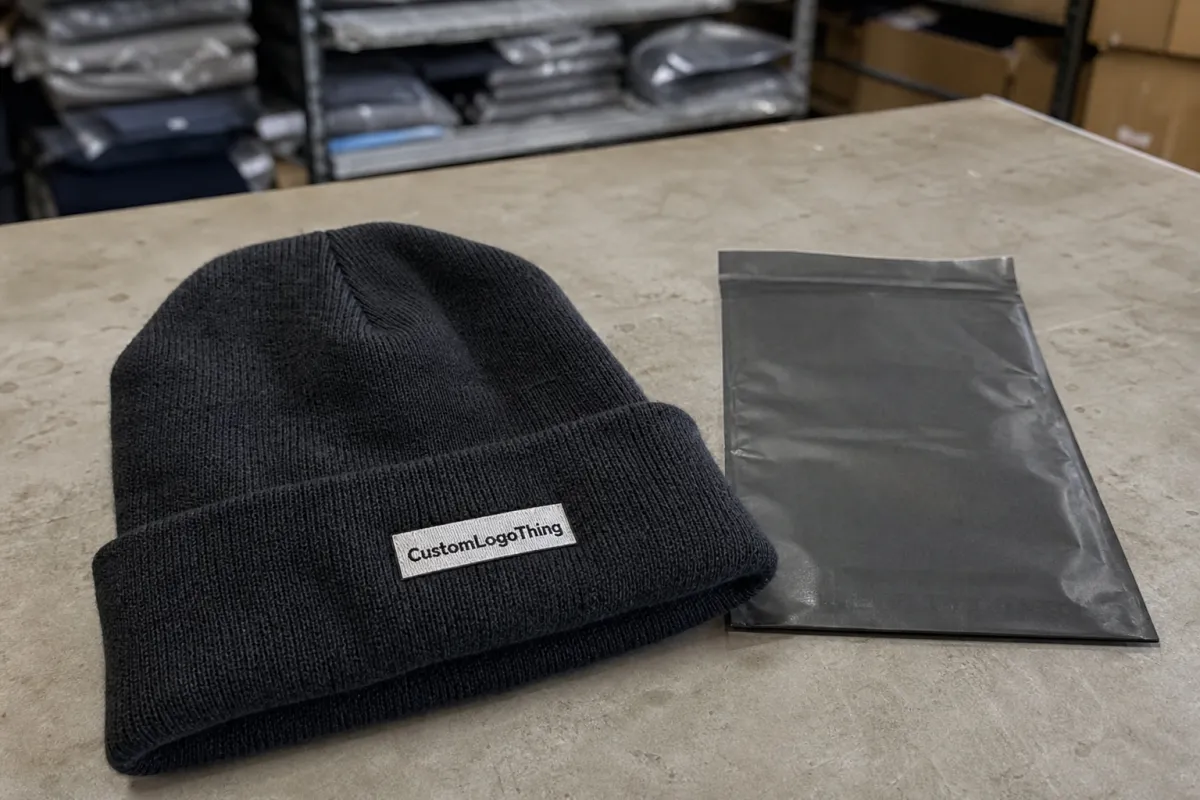
Placement changes the result as much as the art itself. Center-front embroidery on the cuff is the most visible and usually the easiest to align consistently. Side placement looks more restrained and fashion-led, but it is easier to miss visually. Patch branding adds texture and can elevate the piece, though it also adds thickness at the cuff edge. Buyers should approve one placement and one decoration method before asking for alternates.
A practical approval path is short: digital mockup, yarn or thread reference, then pre-production signoff. If the supplier can provide a photo of the pre-production unit, review it against the actual use case, not just the art file. A beanie that looks balanced in a mockup can read differently once it is folded, packed, or worn outdoors.
Thread sheen, patch edge thickness, and stitch density all change how ceramic fabric reads. Glossy thread can make the color feel colder. Matte thread can soften contrast and improve the premium look. Buyers who know the intended environment can make better decoration choices because the finish has to work in real lighting, not only in a studio render.
Bulk Order Cost, MOQ, and Unit Price Drivers
Pricing becomes easier to interpret once the order is stable. For ceramic cuffed knit beanies Bulk Order Planning, the main cost drivers are yarn selection, knit complexity, decoration setup, packaging, and freight. Every change to yarn, machine programming, logo application, or pack-out increases cost. Larger quantities spread fixed costs across more units, which is why unit price usually drops as volume rises.
As a rough guide, a simple custom cuffed knit beanie with one logo location may price around $6.50-$11.00 per unit for runs of 100-300 pieces. Mid-volume orders of 500-1,000 pieces often move closer to $4.20-$7.50. Larger runs can fall further if the spec is straightforward and the supplier is not sourcing special yarn. A wool blend, custom packaging, complex patchwork, or rush freight can move the total quickly.
| Decoration Method | Typical Setup Burden | Typical Add-On Per Unit | Best Use | Tradeoff |
|---|---|---|---|---|
| Flat embroidery | Low to moderate | $0.40-$1.10 | Simple logos with clean shapes | Less reliable for tiny text and fine detail |
| Woven patch | Moderate | $0.70-$1.80 | Sharper branding and better edge definition | Adds thickness at the cuff |
| Woven label | Low to moderate | $0.25-$0.75 | Subtle branding with a cleaner front panel | Less visible from a distance |
| Patch plus embroidery | Higher | $1.20-$2.40 | Premium presentation and stronger shelf appeal | Slower proofing and more approvals |
MOQ is often 100-300 pieces for a straightforward program, though fully custom knit construction or layered decoration can push it higher. If a supplier advertises a lower MOQ, ask what changed. Sometimes the item is a stock-style blank with custom branding rather than a fully custom knit body, which is useful for short promotions but not the same product.
Sample policy should be clear before prototype approval. Some suppliers charge a sample fee that is later credited against bulk, while others treat it as a separate development cost. Packaging can also change price and lead time. Retail boxes, hang tags, barcode stickers, and custom wrap all add steps.
Freight can change the economics more than the product itself. Air shipping is faster, but it can erase savings on an efficient production run. Ocean freight lowers transport cost on large orders, though it needs more planning. If the beanies are headed for retail, carton strength and transit testing matter just as much as the product feel.
Production Steps, Timeline, and Approval Gates
The production sequence is familiar: quote, proof, sample, bulk production, quality check, shipment. The points where orders slow down are also familiar. Artwork approval is the first gate. Color confirmation is often the second. Sample signoff is the last hard checkpoint before bulk production moves forward.
A realistic custom beanie timeline after final proof approval is often 12-20 business days for a simple order if the yarn color is already available. Add sampling, and the full cycle can stretch to 3-5 weeks before shipment. More complex knit structures, multi-step decoration, or special packaging can extend that window. Seasonal spikes matter too, since autumn production is usually busier than quieter months.
Production time and transit time should never be treated as the same thing. Buyers sometimes ask for a “two-week turnaround” without saying whether that means production only or production plus delivery. If the beanies need to arrive by a launch date, team event, or retail drop, the approval window and shipping method need to be built into the schedule before the purchase order is released.
A clean approval chain usually looks like this:
- Confirm ceramic shade, cuff depth, and quantity split.
- Approve the decoration method and artwork placement.
- Review the mockup or sample against the actual use case.
- Release bulk production only after final signoff.
- Verify pack count, carton labels, and shipping method before dispatch.
That sequence prevents expensive rework. A small revision on paper is cheap. A correction after 1,000 units are knitted is not.
If a supplier is willing to start production before artwork and color are approved, the order may be moving fast for the wrong reason. Speed helps only when the spec is stable.
Supplier Checks That Protect Reorders and Color Match
Price matters, but repeatability matters more once the first order lands. A low first-run cost is not much help if the ceramic shade shifts on the reorder or the embroidery density changes batch to batch. Reliable suppliers keep records that let them reproduce the same yarn code, decoration spec, and packing count without rebuilding the brief each time.
Ask how quality control works before goods leave production. Do they measure finished dimensions on each batch? Do they compare output against the approved swatch or signed sample? Do they photograph packed cartons? Those checks are basic, but they catch a wrong cuff depth, a misplaced logo, or color drift before the shipment goes out.
Communication speed matters, but clarity matters more. A fast answer that avoids the actual question is less useful than a slower answer that repeats the spec correctly. Reorder support is another useful sign. Ask how the supplier stores art files, yarn references, and packing instructions. If the answer is vague, the next order may become a new development project instead of a repeat run.
There is also a difference between a sample that proves the look and a sample that proves the process. The first tells you whether the beanie looks right. The second tells you whether the supplier can reproduce it at scale. For ceramic shades, that distinction matters because a clean single sample can hide variation if bulk yarn lots are not managed carefully.
If the order may repeat, ask whether the supplier keeps a written record of the exact yarn type, thread color, patch dimensions, and carton count. That record protects the reorder and helps if finance, logistics, and merchandising all need the same information later.
Order-Ready Checklist and Next Steps
The fastest way to get a reliable quote is to send one complete brief instead of a trail of partial answers. For ceramic cuffed knit Beanies Bulk Order Planning, the essentials are simple: final quantity, ceramic color confirmation, artwork file, decoration method, packaging choice, ship-to address, and target delivery date. Leave one of those out and the pricing may still arrive, but it will be based on assumptions that can shift the job later.
- Quantity: Break it out by color if the order is not single-color.
- Color: Confirm the ceramic shade against a physical reference or swatch.
- Decoration: Pick one primary method unless the design truly needs a mixed approach.
- Packaging: Decide on polybag, hang tag, retail carton, or custom label early.
- Timeline: Separate production days from transit days so the delivery promise is real.
- Ownership: Name one approver for visuals, one for budget, and one for timing.
That last point saves more time than most teams expect. If three people are making three separate calls, the supplier will wait for internal alignment. One person should own visual approval and one should own the schedule. Otherwise, the order drifts while everyone agrees in principle and nobody signs off in practice.
Once the spec is clear, the quote becomes useful. Once the mockup matches the actual product, the risk drops. Once the supplier can reproduce the color, cuff, and decoration without guesswork, the beanie order becomes a manageable production run.
How many units should I plan for a ceramic cuffed knit beanie order?
Start with the quantity that fits your budget tier, then check the supplier's MOQ and pricing breaks. If a second drop or reorder is likely, a slightly larger first run can reduce unit cost and keep the setup work to one cycle.
What affects the price most in a ceramic cuffed knit beanies bulk order?
The biggest drivers are decoration method, quantity, number of colors, packaging requirements, and shipping choice. Yarn blend and knit complexity also matter, especially if the order uses a custom body rather than a stock blank.
How long does production usually take after approval?
For a straightforward order, bulk production often takes 12-20 business days after final proof approval. Sampling, custom yarn matching, busy-season capacity, and shipping can extend the total timeline, so production time and transit time should be reviewed separately.
Can I mix logo placements or decoration methods in one beanie order?
Yes, but mixed methods add setup time and often increase the per-unit cost. Each placement may need its own proof, and that can slow approval if the artwork is small or highly detailed.
What do you need to quote ceramic cuffed knit beanies accurately?
Provide quantity, color reference, decoration method, artwork file, packaging request, destination, and target delivery date. If you already know the product will be reordered later, mention that too so the supplier can record the spec for repeat production.