Soap woven label Beanies Bulk Order planning usually goes off track for one ordinary reason: the beanie body gets approved first, then the label is treated like a small detail. It is not small. A woven label affects how the knit reads, how the product photographs, how the carton survives handling, and whether the final piece feels considered or improvised. A crooked stitch line or a weak contrast choice can make a clean hat look cheaper than it is.
Buyers who ship consistently tend to think in systems rather than single samples. They care about repeatability, not just one polished prototype. The best bulk orders are the ones where the label sits flat, the text stays legible, the color holds its place under retail lighting, and the packing method does not add avoidable damage. That sounds basic because it is basic. It is also where many orders fail.
Practical rule: if the woven label cannot be read on the proof and does not lie flat on a sewn sample, do not approve bulk yet.
Soap woven label beanies bulk order planning for buyers
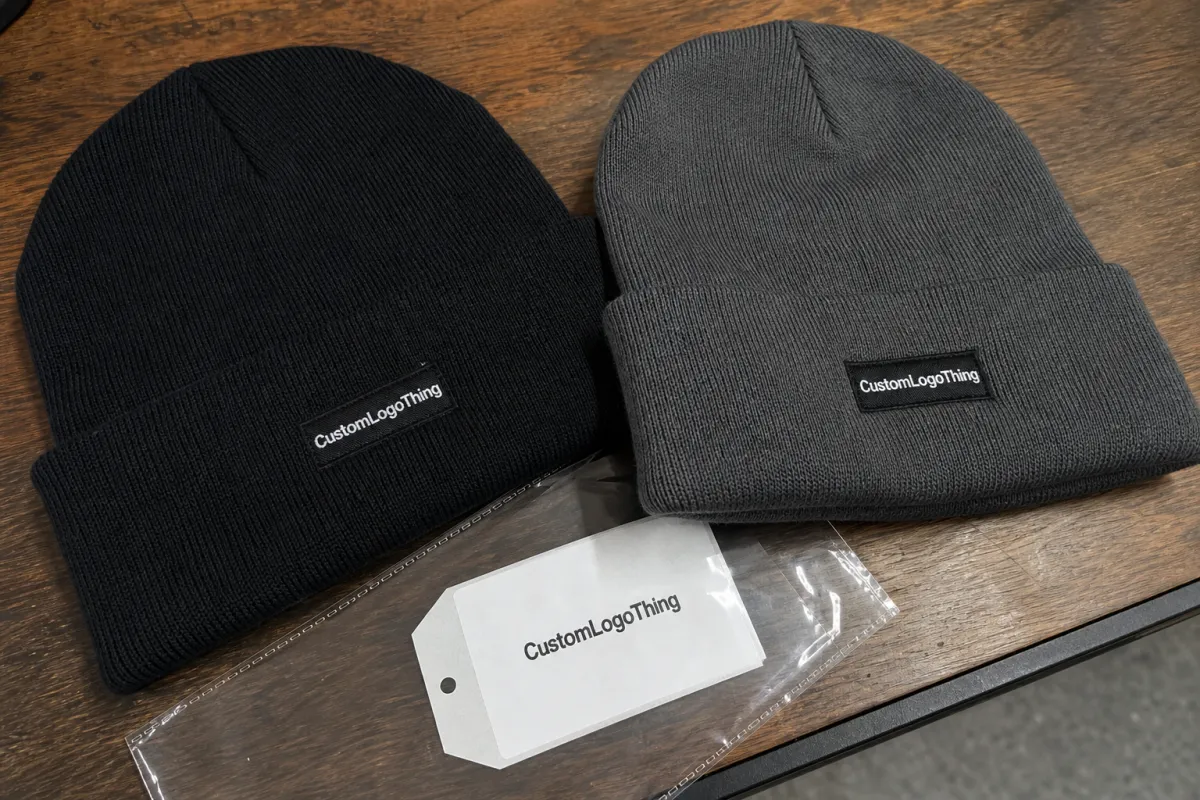
The first decisions should be about function, not finish. In soap Woven Label Beanies bulk order planning, the label has to answer a few simple questions: how visible should it be, where will it sit, and how much structure does the beanie body give it? A 20 x 50 mm center-fold label can look sharp on a cuffed rib knit beanie, but the same size may feel cramped on a slouchy style with more movement and less front-panel stability.
That scale difference matters more than most mockups reveal. A label that is off by 2 mm on a sample can seem harmless; repeated across hundreds of units, it becomes a production defect. Buyers often approve based on a single photographed sample and miss the fact that real bulk sewing exposes every weak point. If the label placement is not anchored to the seam line, the cuff edge, or another fixed reference, the batch can drift in a way that is visible once the pieces are packed together.
Durability should outrank the render. Thin thread, low stitch density, or an edge finish that frays under handling can look fine in a flat image and fail after a few wears. A good bulk plan accounts for wear, storage, stacking, and retail handling. If the label color clashes with the beanie body, the hat looks less expensive. If the carton count is inconsistent, the issue moves from cosmetics to fulfillment. If the stitch line is rough, the whole product reads as rushed even when the knit itself is acceptable.
Another early decision is whether the label is meant for retail branding or basic identification. Those are different jobs. A retail label needs clean edges, clear contrast, and a placement that still reads well in photos. A simpler promo run can tolerate a plainer build, but it should still look deliberate. Once a label looks improvised, buyers spend the rest of the project trying to hide that first mistake.
Beanie styles, label placement, and decoration choices that affect the brief
Beanie construction changes the label brief immediately. A cuffed beanie usually gives the most stable branding area because the folded section creates a flat, predictable face. A slouchy beanie moves more and shifts with wear, so a label that looks centered in a photo can sit slightly off once the garment is on a head. Rib knit stretches differently from a tighter flat knit, and that stretch changes the way a label lays against the surface. Fleece-lined styles add thickness, which can affect how much the stitch penetrates and whether the edge feels bulky.
Placement is not just a design preference. It controls visibility, comfort, and production tolerance. Front cuff placement is still the most common because it reads fast in retail and on camera. Side seam placement can look more understated and work well for fashion-driven programs. Hem-edge placement is often used on minimalist styles, but it requires tighter tolerances because even a small shift is easy to see. A patch panel can help on loose knits, though it adds another material, another sew operation, and another place for variation.
Woven labels usually hold up better than printed tags in repeat bulk production because the design is built into the weave rather than printed on top of it. Embroidery can look strong on thicker beanies, but small text tends to blur. Silicone patches create a more dimensional look and a heavier hand feel, which some brands want and others do not. For a clean retail read without too much production risk, woven labels sit in the middle for a reason.
| Decoration option | Typical look | Added cost per unit | Best use |
|---|---|---|---|
| Woven label | Flat, clean, brand-forward | $0.12-$0.28 | Retail beanies, repeatable bulk runs |
| Embroidery | Textured, stronger on thick knits | $0.20-$0.45 | Chunky beanies, bold logos, low text density |
| Silicone patch | Dimensional, modern, heavier feel | $0.35-$0.90 | Streetwear styles, statement branding |
| Printed tag | Light, simple, lower visibility | $0.08-$0.20 | Promo runs, budget-sensitive programs |
If the knit is dense and the logo is small, simplify the label. Dense fabric distorts fine borders and tiny text. A label with too much copy can look tidy in a flat proof and cluttered on a curved crown. Buyers sometimes try to fit a logo, tagline, web address, and wash line into a label that barely has room for one mark. The result is predictable: it reads as crowded, not premium.
Woven label specifications that control hand feel and durability
Once the placement is set, lock the label specs. Width, height, fold style, weave density, thread count, and edge finish all affect the finished piece. A common folded label might sit around 20 to 30 mm wide and 40 to 60 mm long, but the right size depends on the knit body and the visual weight of the artwork. A center fold creates a tidy stitched edge. An end fold can work when the label is sewn into a seam. A loop fold or Manhattan fold changes how much of the label shows and how the edge sits after sewing.
Material choice matters as much as size. Polyester damask woven labels are often used for finer detail because they support tighter text and cleaner edges. Taffeta is usually more economical and can be a good fit for simpler logos, but it does not resolve small type as well. Satin labels feel softer and can be useful where hand feel matters more than visual crispness. That tradeoff is easy to miss in a proof and obvious in the finished product.
Weave density creates the familiar tension between detail and comfort. Tighter weaves sharpen logos and make borders more defined, but they can feel stiffer on lightweight beanies. Looser weaves feel softer, yet fine lettering can blur or close up. For soap woven label beanies Bulk Order Planning, the practical question is not whether the label looks best in isolation. It is whether the label still looks right after being sewn into a knit surface that stretches, folds, and gets handled repeatedly.
Thread colors deserve discipline. One to four thread colors is usually the sweet spot for clean branding and manageable production. More colors are possible, but each additional shade increases the chance of mismatch across lots and extends sample approval. That risk rises when a brand uses multiple beanie body colors in the same program. A navy label on a black beanie may vanish; a bright white label on a muted earth-tone body can feel harsh. Contrast should be deliberate, not accidental.
Edge finishing is easy to ignore and hard to forgive once complaints arrive. A cut edge that sheds or frays under rubbing turns into a quality issue quickly. Ask how the label is cut, sealed, or folded, and whether the sewing method keeps raw edges from showing. For retail pieces, wash resistance and rub resistance should be part of the conversation. The label face is what the buyer sees first, but the edge is usually what causes the first return.
Transit testing matters too. A carton can look fine after packing and still arrive with bent labels, crushed folding, or loose pieces if the stacking method is weak. The International Safe Transit Association outlines useful testing logic for shipment abuse and carton risk at ISTA. For paper inserts or hang tags made from certified stock, the FSC chain-of-custody framework can help keep documentation clean. Those checks do not replace common sense, but they reduce preventable surprises.
Pricing, MOQ, and unit cost tradeoffs buyers should expect
Unit price almost always drops as quantity rises. That part is simple. The less obvious part is how much setup sits inside the first quote. Woven labels often include artwork prep, loom setup, sample proofing, and sometimes a separate production sample. On a small order, those fixed costs can make the price look high. On a larger order, they spread out and become easier to absorb.
For planning purposes, the add-on cost for a straightforward woven label on a basic beanie body often lands in the $0.12-$0.28 range on larger runs. More involved decoration, heavier material, or extra sewing steps can move closer to $0.35-$0.90 per unit. Those are planning ranges, not promises. The spread usually reflects artwork complexity, color count, finish, and how much labor the label requires after it leaves the loom.
MOQ logic is straightforward, even if sales quotes make it feel more complicated. Lower minimums let buyers test demand, but the per-unit cost is higher because setup is not smaller just because the run is short. Higher MOQs lower unit cost, but they also tie up cash and storage space if the design changes later. The right minimum is the one that fits the sales channel, the reorder pattern, and the amount of inventory a team can realistically move.
Compare quotes on the same basis. A useful quote should show:
- Sampling and revision count
- Label setup and sew-in labor
- Packaging method, such as polybag, hang tag, or barcode sticker
- Shipping method and carton count
- Rework allowance if a placement issue appears
Two quotes can look close and still hide very different assumptions. One may include retail packing, and another may leave that to the buyer. One may price a clean artwork file, while another adds fees every time the file needs cleanup. One may quote a sewn sample, while another is only pricing the woven label itself. If those differences are not visible on paper, they surface later in the schedule.
Process, timeline, and lead time from proof to delivery
The order flow should be boring. Inquiry, proof, sample sign-off, bulk production, inspection, packing, shipment. If a supplier cannot explain those steps clearly, the schedule probably has holes in it. A proof stage can take a few business days if artwork is clean and the label spec is already decided. A sewn sample may add another week, depending on factory load and how many revisions are needed. Bulk production often lands in the two to four week range after approval, though busy seasons can push that longer.
Shipping adds another layer. Air freight is faster and more expensive. Ocean freight is slower and usually cheaper per unit. If the beanies have a hard launch date, build backward from the date they need to be on shelves, not from the date the factory wants to start sewing. A retail calendar, a holiday drop, or an event launch will punish optimistic freight assumptions faster than any product defect.
Most delays come from the same places: late artwork, vague Pantone targets, too many revision rounds, and slow sample approvals. If the logo has a specific brand color, send a color code and, if possible, a physical reference. If the label has to match a seasonal beanie body, define that match before production begins. A clear spec sheet shortens every part of the process because fewer decisions are left open.
There is also a practical sequencing issue. If the label is approved before the beanie body is finalized, the result is usually cleaner. If the team keeps changing label size after the proof stage, the schedule slips. That is not a supplier problem. It is a planning problem. The most efficient orders usually feel almost dull on the production side because the decisions were made early and written down once.
For long-running programs, it helps to think in freeze points. Artwork freeze, label spec freeze, packing freeze, shipment freeze. Each one protects the next step from drift. Buyers who skip those checkpoints often end up paying for urgency later, either in rush freight or in rework that could have been avoided with a slower approval.
Supplier checks that prevent rework, complaints, and missed deadlines
Ask whether the supplier makes the woven labels in-house or outsources them. That answer matters because every handoff adds risk. In-house label production usually gives tighter control over timing, sizing, and color consistency. Outsourced trim work can still be acceptable, but it adds another point where fold style, thread color, or edge treatment may drift.
Do not settle for a flat label proof alone. Ask for a photo or video of the label sewn onto the actual beanie style. A label sitting on a table is not the same as a label stitched to a rib knit cuff. Curvature, stretch, and seam interaction all change once the label is attached. If the supplier cannot show the label on the product you are buying, the sample is not finished enough to approve.
Quality control should cover more than visual alignment. Buyers should ask how the factory checks stitch placement, label orientation, carton count, and packing consistency. If the order uses multiple colorways, sort accuracy matters too. A run that mixes black and charcoal beanies in the same carton can create avoidable customer service problems even if the labels themselves are perfect. Good suppliers talk about tolerances and inspection steps, not just about production speed.
A practical pre-production check list usually includes:
- Label size and fold type confirmed in writing
- Placement measured from a seam or cuff edge
- Sewn sample reviewed on the actual beanie style
- Thread colors matched to approved references
- Packing method and carton count confirmed before bulk starts
If a supplier is vague about those points, the project usually pays for that vagueness later. The best production partners answer spec questions directly, name the risks, and avoid promising unrealistic lead times. That kind of answer is more useful than a polished quote email. The work is repetitive enough already. The planning should not be.
What to send before requesting your bulk quote
The fastest quotes come from briefs that remove guesswork. A supplier does not need a long narrative; it needs enough detail to price the run without making assumptions that later become disputes. For soap woven label beanies Bulk Order Planning, the most useful quote request is usually a short packet with the beanie style, label artwork, and packing expectations all in one place.
Include the beanie construction first. A cuffed acrylic beanie, a heavyweight rib knit, and a fleece-lined winter style will not price the same way, even if the label is identical. Then add quantity by colorway, because a mixed run can change setup and packing labor. After that, specify the label dimensions, fold type, thread color count, and where the label should sit on the garment. A simple front-cuff placement is easier to quote than a side seam position that needs exact alignment.
It also helps to state what level of polish you need before bulk production. Some buyers want a lab dip or color reference, others want a sewn pre-production sample, and some only need a digital proof before moving forward. Those are not interchangeable. A clear request prevents the supplier from pricing the wrong level of service and helps keep the schedule grounded in reality.
The most useful quote details are usually these:
- Beanie style, fiber content, and approximate weight
- Order quantity by color and size split
- Label artwork file and intended label size
- Fold type, placement, and thread color count
- Packing method, carton target, and delivery window
If the beanies need retail barcodes, hang tags, or polybags, mention that at the same time. Those items can change both labor and carton volume. If you expect split shipments, call that out early as well. A clean brief does not just save time; it lowers the chance that the finished run looks different from the sample everyone approved.
Frequently asked questions
What is the usual MOQ for soap woven label beanies bulk orders?
Many programs become more price-efficient around 100 to 300 units, but the real MOQ depends on the beanie style, label complexity, and whether the supplier is setting up a fresh loom program. Lower MOQs are possible for sampling or first runs, though the unit cost usually rises because setup is spread over fewer pieces.
How many woven label colors should I use for a beanie order?
One to four thread colors is usually the safest range for clean detail, manageable sampling, and consistent repeatability. More colors can work, but they increase production time and make matching harder across full runs, especially when the order includes multiple beanie body colors.
What is the best woven label material for beanies?
Damask is often the best choice when the logo has fine lines or small text because it holds detail more cleanly. Taffeta can work for simpler graphics and lower budgets, while satin feels softer on the hand but may not carry sharp detail as well. The right choice depends on the logo, the knit weight, and how much visual crispness the brand needs.
How long does production usually take for soap woven label beanies?
A clean proof stage can take a few business days, and a sewn sample may add another week or so. Bulk production often runs two to four weeks after approval, though holidays, revision rounds, and freight method can extend the total schedule. The earlier the label spec is frozen, the easier the timeline is to protect.
Can I mix colors or sizes in one woven label beanie order?
Yes, but mixed runs depend on whether each colorway or size meets the MOQ and whether the factory charges extra for sorting, packing, or label changes. Mixed orders are easiest to manage when the label spec stays identical and the only variable is the body color.


