Chocolate Embroidered Beanies Bulk Order Planning Guide
Chocolate knit does more than look seasonal. It gives embroidery a warmer, more grounded backdrop than black, and that changes how a logo reads at scale. On a dark brown beanie, the brand mark can feel deliberate rather than loud, which is useful if the same order has to work for staff wear, retail shelves, winter mailers, or a year-end gifting program. The color does part of the aesthetic work before a single stitch is made.
That also means the order has less room for sloppy decisions. On knit accessories, small choices change the outcome fast: stitch density, cuff height, thread contrast, blank weight, and the way the artwork is simplified for a curved surface. A buyer who treats those details as afterthoughts usually ends up paying for them later, either in revision time or in a run that looks slightly off once it is unpacked.
For chocolate embroidered Beanies Bulk Order Planning, the right question is not just “How much does each hat cost?” It is “How well will this hold up across 100, 500, or 2,000 pieces, and what needs to be locked before production starts?” That is where the real savings live.
Why chocolate embroidered beanies make a smarter bulk buy
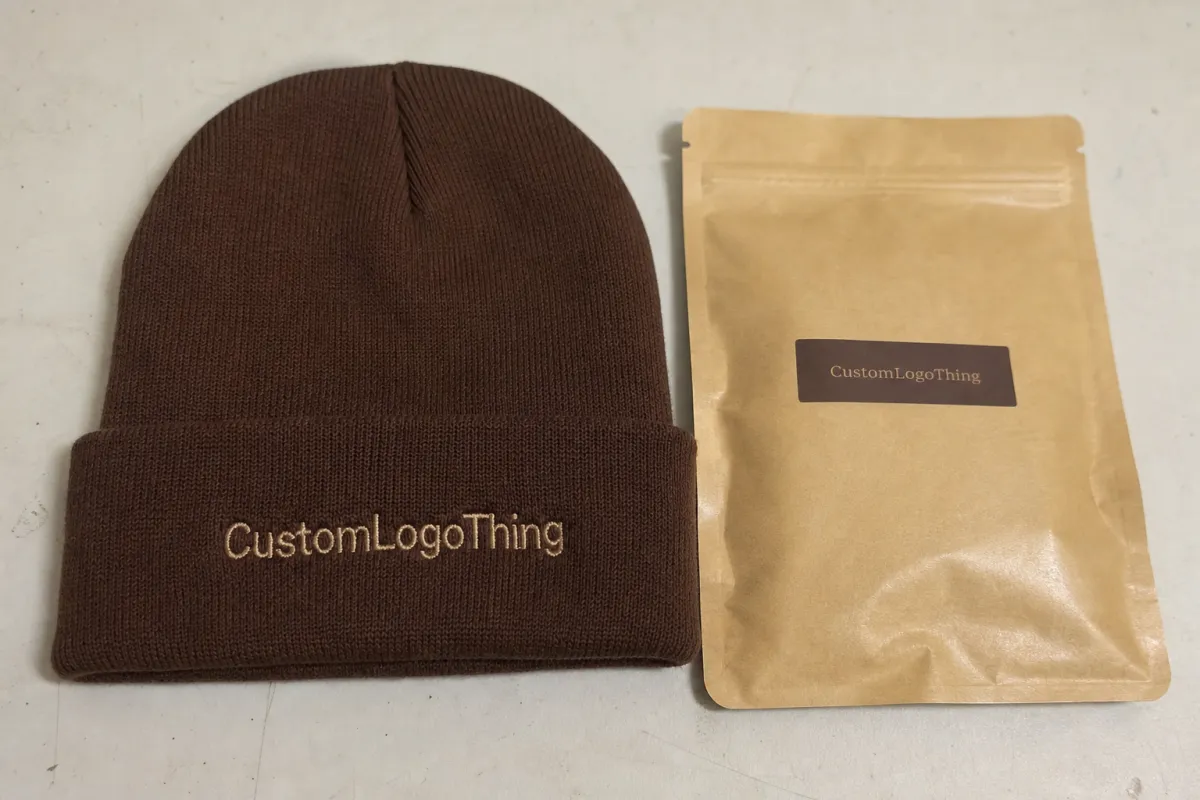
Chocolate works because it sits in an unusual middle ground. It has the authority of a dark neutral, but it is softer than black and less seasonal than brighter fashion shades. That makes it easier to carry across different programs without making the item feel tied to a single campaign. A deep brown beanie can read premium in a retail setting and still feel practical in an internal uniform package.
There is a production reason buyers like it too. Embroidery tends to look cleaner when the base fabric is stable and the color contrast is manageable. Chocolate gives enough depth to frame stitching without forcing the artwork to do all the visual work. In bulk, that matters. Fewer decorative tricks usually mean fewer digitizing revisions, fewer questions during proofing, and fewer surprises when the cartons are opened.
It also broadens palette options. Cream, warm white, tan, muted gold, black, and deep green all tend to sit well against chocolate. A brand does not need to build a custom color story around the hat, which is useful when the order has to align with existing merchandise or corporate identity rules. On textured knit, near-matching thread often disappears into the fabric anyway, so a slightly stronger contrast is usually the better choice.
One practical observation: brown knit is forgiving only up to a point. If the logo is too small, too detailed, or too close in tone to the hat, the result can go flat quickly. The item may still be technically correct, but it will not read well from a few feet away. Bulk orders magnify that problem because the mistake is repeated hundreds of times.
A clean beanie run is usually decided before the first stitch. If the logo, placement, and thread contrast are settled early, the production line has far fewer ways to drift.
Embroidery details that affect the final look and wear
Beanie construction is not a small detail. Cuffed and uncuffed styles behave differently, and the knit structure changes how the embroidery lands. A tighter rib knit gives the needle more control and usually keeps edges sharper. Looser knits can look softer at first but tend to swallow fine detail, especially after stretching and wear. For buyers, that means the blank choice is part of the decoration choice, not separate from it.
Placement has just as much influence on the final look. Centered cuff embroidery remains the most practical option for most bulk orders because it stays visible when worn and gives the art a predictable landing area. Offset placement can feel more editorial or fashion-driven, but it asks more from the artwork. The logo must still read cleanly when the cuff folds, the crown curves, and the hat is not perfectly centered on the head.
Logo size deserves more attention than it usually gets. A front mark around 2.25 to 3.5 inches wide is common, but that range is not a rule. A tall wordmark, a monogram, and a stacked emblem all behave differently on the same beanie. If the design is too wide, it can wrap awkwardly; if it is too tall, it can sit too near the cuff seam. The best size is the one that keeps the shape legible without crowding the knit.
Small text is the first thing to simplify. Thin strokes fill in, tiny counters disappear, and gradients rarely survive the jump from screen to thread. Even multi-color logos often look better after reduction, because embroidery rewards clarity more than complexity. On knit fabric, a cleaner single-color mark can outperform a busy version that seems sharper in artwork than it does in reality.
Thread contrast should be chosen for legibility before exact color matching. Cream and warm white usually read better than thread that is technically “close” to the knit but visually sinks into it. Muted gold can work well too, though it behaves differently under warm indoor lighting than it does on a monitor. If the logo relies on subtle distinction, ask for the proof to show the thread against the actual beanie color, not a generic background.
The reverse side matters as well. Stabilizer choice affects both durability and comfort. If backing material is too rough, the inside of the cuff can irritate the wearer. If it is too light, the stitches may not hold shape well enough for repeated use. Good embroidery should feel tidy on both sides, with backing trimmed and controlled rather than left bulky and scratchy.
Ask for a production-ready proof that shows scale, placement, stitch direction, and thread selection before sign-off. That step is not administrative clutter. It is the point where the order either becomes predictable or starts collecting risk.
Specifications to lock down before you request a quote
The quote is only as useful as the spec sheet behind it. If the request says “simple logo on beanie,” the supplier has to guess at too many variables: knit weight, cuff depth, fabric blend, embroidery dimensions, thread count, and packing method. Two quotes that look similar on the surface may be built on very different assumptions. That is how buyers end up comparing apples to oranges and calling one of them “cheaper” when it is simply less complete.
Start with the blank. Confirm whether the beanie is cuffed, uncuffed, slouch, or fisherman fit. Then note the fiber content, because acrylic, acrylic-wool blends, and recycled yarn all behave differently under stitch tension. A heavier rib knit can support more substantial embroidery, while a lighter knit may need a more restrained approach. The difference is visible, not theoretical.
Artwork format matters almost as much as the garment spec. Vector files are best because they give the digitizer clean paths to work from. If the design includes type, icons, or fine line work, say which parts cannot be simplified and which parts can be adjusted for stitch clarity. That level of direction saves time later and prevents a proof from drifting away from the brand mark.
Even one-size beanies vary in fit. Crown depth changes how the hat sits, and cuff depth changes where the logo lands once the cuff is folded. Buyers sometimes ignore those variables because “one size fits most” sounds like a fixed spec. It is not. A few millimeters in fold height can move a logo enough to make the placement feel either crisp or awkward.
- Beanie style: cuffed, uncuffed, slouch, or fisherman fit
- Fabric blend: acrylic, acrylic/wool, recycled yarn, or mixed fiber
- Garment weight: light, mid-weight, or heavy rib knit
- Decoration size: final width and height in inches
- Thread count: one-color, two-color, or multi-color stitching
- Packing: bulk packed, individually bagged, or retail-ready
If the logo has small type or a high-stakes placement, ask for a digital proof and, when the order is large enough to justify it, a pre-production sample. Sample approval slows the schedule a little, but it usually costs less than correcting a full run. That is especially true when the embroidery sits near seams or depends on exact alignment with the cuff edge.
Cost, MOQ, and quote details that shape unit price
Unit price moves for predictable reasons. The blank beanie is one. Stitch count is another. Thread color count, placement complexity, digitizing fees, packaging, and freight also shape the number. A simple one-color logo on a standard acrylic blank can price very differently from a dense two-color emblem on a heavier knit with custom bagging and retail inserts. If those differences are not visible in the quote, the price comparison is not reliable.
MOQ changes the math in ways buyers sometimes underestimate. Lower quantities carry more setup burden per piece because digitizing, proofing, and machine setup are spread across fewer units. In many bulk programs, a straightforward embroidered beanie can fall around $4.50-$7.50 per unit before freight, while larger runs may move into the $3.75-$6.25 range depending on blank quality and stitch density. Heavier knit, more elaborate artwork, and custom packaging can push the price higher. None of that is unusual; it is the normal cost of labor and material variation.
Packaging deserves a separate line in the comparison. Individual polybags, retail folding, hang tags, and inserts all add time and materials. A quote that excludes them may look attractive until the buyer remembers that the hats still need to be shelf-ready or gift-ready on arrival. The same applies to shipping. Freight can erase a small per-unit savings if the order is packed inefficiently or shipped on a tight deadline.
Comparing quotes line by line is the safest method. One supplier may include digitizing, mockups, or basic bagging in the base price. Another may list those as separate charges. The headline number is rarely the full story, and the cheapest-looking option often becomes the most expensive after extras are added back in. That is not a sales tactic; it is a math problem.
The table below shows how the economics often break down.
| Option | Typical unit range | Best fit | Watchouts |
|---|---|---|---|
| Stock acrylic beanie, 1-color embroidery | $4.50-$6.50 | Team wear, internal events, promo drops | Basic handfeel, less premium finish |
| Mid-weight knit, 2-color logo | $5.75-$8.25 | Retail, holiday gifting, branded merch | Higher blank cost, more stitch time |
| Heavier rib knit, dense embroidery | $6.75-$9.75 | Premium programs, fashion-forward collections | More setup control needed, higher labor |
| Any option with individual bagging | + $0.20-$0.60 | Resale, kit packing, organized distribution | Extra labor and packing materials |
If you are comparing broader order structures, the framework on our Wholesale Programs page can help line up quantities and packing expectations before pricing is requested. The point is not to squeeze the quote into the lowest possible number. It is to make sure every line reflects the actual job.
Process and timeline from art approval to shipment
The production path is usually straightforward, but only if each step is defined. Inquiry, quote, artwork review, digitizing, proof approval, pre-production sample or check, full production, quality control, packing, and shipment. Leave any one of those vague and the schedule starts to wobble. That is especially true with embroidery, where a small art change can force a new digitizing pass or a machine setup adjustment.
The most common delays are avoidable. Missing vector art, last-minute placement changes, thread substitutions, or unclear instructions around cuff position all add time. For a standard run, 12-15 business days after proof approval is a common production window. More detailed embroidery, higher quantities, or stricter packaging requirements can push that closer to 18-25 business days. Transit time sits on top of that, and weather, carrier congestion, or seasonal freight pressure can add another layer of uncertainty.
A good schedule is not just a ship date. It should show when approvals are due, when the run starts, and what cutoff protects the delivery window. That matters for employee gift deadlines, holiday launches, event giveaways, and retail resets where a few lost days can make the order less useful even if the product itself is fine.
For orders that need to arrive in sorted groups, the packing plan matters almost as much as the production plan. If the beanies have to be broken out by department, store, or kit, that work should be built into the timeline. A carton delivered on time is not the same thing as a distribution-ready order.
Transit durability is worth thinking about too. Cartons need to survive stacking, handling, and re-sorting. Standards such as ISTA are useful for understanding how packaging should hold up in transit, while FSC guidance becomes relevant if your order includes paper inserts, hang tags, or retail packaging made from certified board. That may sound peripheral, but in bulk orders, the box often gets handled more than the garment itself before it reaches the end user.
What a reliable supplier should control on repeat orders
Repeat orders should get easier, not harder. A dependable supplier keeps the important history in order: spec sheets, artwork files, thread references, stitch counts, placement notes, and packing instructions. If the same beanie is reordered next season, the buyer should not have to rebuild the job from memory. That wastes time and raises the chance of subtle drift.
Quality control is where repeat programs stay consistent or slowly fall apart. In bulk, the supplier should check centered placement, stitch density, clean backing, cuff shape, and packed counts against the purchase order. Knit fabric stretches, and embroidery machines are precise only when the setup is disciplined. A small shift in tension or hooping can make the logo appear slightly off across a whole carton stack, even if each individual hat looks acceptable in isolation.
Communication habits tell you a lot. Clear proof turnarounds, direct answers on MOQ, and early warnings about material substitutions are strong signs. A supplier that gives conservative timelines and accurate information is often more useful than one that promises speed and then starts revising the schedule midway through production. Accuracy travels farther than hype.
Experience with knit accessories matters because beanies behave differently from flat garments. The crown curves. The cuff folds. The fabric has stretch and recovery. Those three things change how the artwork should be simplified and where it should sit. A supplier who understands that will usually recommend a cleaner design, a better stitch direction, or a more realistic placement before the order locks.
That kind of control is especially valuable on larger programs. The buyer is not just purchasing hats; they are buying consistency across dozens or hundreds of identical pieces. The margin loss on a repeated error is rarely dramatic on one hat and often obvious on one whole run.
Next steps to place a clean bulk order
Once the decision list is short and specific, the order becomes much easier to manage. Gather the logo file, confirm the beanie color, choose the embroidery placement, estimate quantity, and define the in-hand date before asking for pricing. That preparation usually leads to a cleaner quote and a faster proof cycle. More important, it reduces the number of decisions that have to be made under time pressure.
- Send the logo in vector format if possible.
- State the exact beanie color and style.
- Confirm embroidery size and placement.
- Share the quantity range and delivery deadline.
- Include the shipping destination and packaging needs.
It helps to say what the order is for. Internal wear, retail resale, and event distribution all imply different packing standards. A plain bulk pack may be enough for staff distribution, while retail or gifting often needs individual polybags, hang tags, or cleaner folding. Those choices are not cosmetic only; they change labor, materials, and lead time.
Before approving the proof, check five things carefully: logo size, thread contrast, cuff position, spelling, and packing instructions. If the artwork has been simplified, make sure the core brand shapes still read correctly. If the thread is meant to contrast with the chocolate knit, confirm that it still does so in the proof and not just on a bright monitor.
If you want a broader starting point for larger programs, our FAQ page covers common production questions without adding noise. A good order should be simple to compare, simple to approve, and simple to place once the details are settled.
Solid chocolate embroidered beanies Bulk Order Planning comes down to disciplined choices: lock the blank, confirm the stitch details, compare quotes line by line, and build in honest lead time. Done well, the result looks intentional rather than rushed, and the order arrives ready to wear instead of needing explanation.
What is the minimum order for chocolate embroidered beanies bulk orders?
Minimums vary by blank, decoration complexity, and supplier setup, so the useful number is the one tied to your exact spec. Lower quantities usually carry a higher unit cost because digitizing and machine setup are spread across fewer pieces.
How long does embroidered beanie production usually take?
After proof approval, many standard runs take about 12-15 business days. More detailed embroidery, larger quantities, or special packing requirements can extend that timeline.
Can I match my logo thread to a chocolate beanie color?
Thread can be chosen to complement the knit, but exact color matching is rarely the best goal. On textured fabric, legibility usually matters more than trying to make the thread disappear into the base color.
What should I send when asking for a quote on bulk beanies?
Send the logo file, target quantity, beanie color, embroidery placement, delivery deadline, shipping zip code, and any packaging needs. The more complete the request, the more reliable the quote.
Are chocolate embroidered beanies better for retail or employee gifts?
They work well for both. The color feels neutral and premium, and embroidery gives the piece a durable branded finish that does not rely on trend-heavy styling.

