Chocolate Printed Poly Mailers Bulk Order Planning Checklist
If your team is working through chocolate Printed Poly Mailers bulk order planning, the real question is not whether the bag looks good in a mockup. It is whether the bag survives a courier route, holds its seal, and still lands under a unit cost that leaves room for margin. Chocolate-colored mailers tend to do that job well. The darker surface hides scuffs, dust, and tape abrasion better than white film, so the package usually reaches the customer looking more composed than a bright bag that has been handled three times too many.
That matters because a mailer is doing three jobs at once. It protects soft goods from moisture and rough handling, it carries the brand, and it has to be cheap enough to ship at scale. For apparel, accessory kits, subscription drops, and lightweight direct-to-consumer orders, a printed poly mailer often beats a carton on cost and storage alone. It also changes the first impression. The parcel sits in a truck, on a conveyor, and at a doorstep before anyone opens it. That means the print is not decoration; it is part of the product experience.
Chocolate is a smart base color for that reason, but it is not a shortcut. The film gauge, closure strength, artwork coverage, and order quantity all shape the final result. A good bulk plan treats those variables as a system, not separate buying decisions.
Why Chocolate Mailers Look Better After Transit
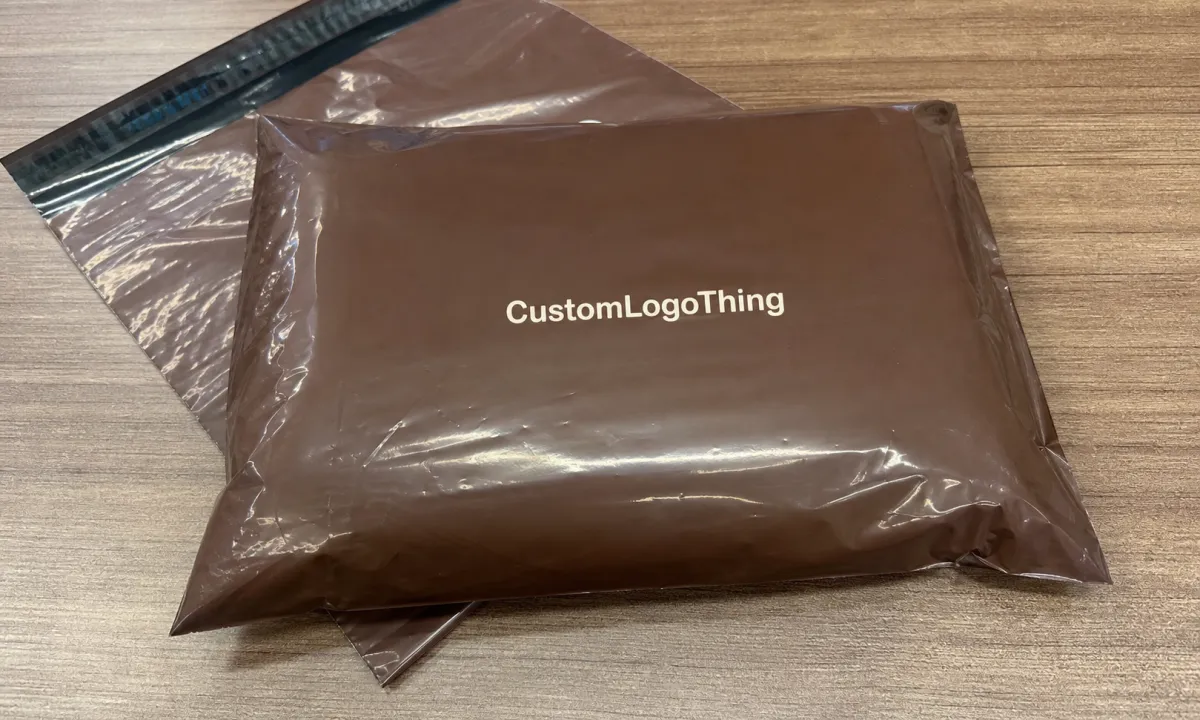
Dark mailers are practical first and stylish second. A chocolate finish hides the visual noise that builds up in transit: scratches from bin contact, fingerprints, dust, barcode label edges, and the faint whitening that some films show after repeated bending. White mailers can look crisp on a light table and tired after one cross-dock transfer. Chocolate usually keeps its face longer.
That is useful for brands trying to look established without switching to rigid packaging for every order. A printed mailer with a simple logo repeat or a restrained front-panel mark can make a 200-piece drop feel more organized than the same shipment in a plain pouch. For small and mid-size sellers, that consistency matters almost as much as the artwork itself. Customers read packaging as a sign of process. If the parcel looks thought through, the brand often feels thought through.
The freight side is just as important. Poly mailers are light, flat-storing, and inexpensive to move compared with corrugate. A warehouse can keep thousands of them in the space one pallet of boxes would occupy. That lower storage footprint becomes more visible once order volume rises and packaging starts competing with product inventory for rack space. The difference is rarely dramatic in a single week, but over a quarter it can change how much inventory a team is comfortable carrying.
If the package survives the route but looks cheap on arrival, the customer notices. If it looks premium but fails in transit, the packaging failed twice.
That is the balancing act behind chocolate Printed Poly Mailers bulk order planning: the bag has to look deliberate, protect the product, and keep unit economics under control. Miss one of those three and the order becomes expensive for the wrong reason.
Specs That Actually Change Performance
Buyers often ask for custom poly mailers as though all films behave the same once the logo changes. They do not. Material blend, thickness, seal quality, closure adhesive, and print coverage all affect how the bag performs. A lighter film can be perfect for tees and socks. Put the same film around a hoodie bundle or a boxy accessory kit and the weak point shows quickly, usually at the top seam or the closure strip.
Most custom mailers fall somewhere in the 2.5 mil to 4 mil range. Around 2.5 to 3 mil is generally fine for lightweight apparel and accessories that do not have sharp edges. Once the packout gets heavier or awkwardly shaped, 3.5 to 4 mil is safer. That extra material is not just about puncture resistance; it also affects how the bag folds, how the seal holds under tension, and how the package behaves when stacked. A thicker film can still fail if the dimensions are wrong, though. Oversized bags leave the contents sloshing around, which stresses the seam during transit. Too small, and the packer overworks the closure or distorts the print area.
For print, a single-color logo on one side is usually the most economical route. Full-bleed coverage costs more because it uses more ink, more setup time, and more quality control. The shade of chocolate itself matters too. A deep brown can make white logos pop; a warmer brown may read softer and less contrasty. That difference is small on screen and obvious on the finished bag. If the artwork depends on fine lines, small text, or low-contrast tones, test them on the actual film, not just the digital proof.
Specs worth locking before you request a quote
- Inside dimensions and usable fill space, not just the nominal bag size.
- Film gauge and whether it matches the heaviest product in the shipment mix.
- Closure type, including adhesive strength and whether the strip supports returns.
- Print coverage, number of colors, and whether the design is one-side or two-side.
- Finish and opacity, especially if the contents or inner labels should stay hidden.
- Recycled content or PCR percentage, if sustainability claims are part of the packaging brief.
For packaging programs that need a broader performance reference, industry standards from ISTA are useful because they keep the conversation on handling, drop risk, and transit stress rather than aesthetics alone. That matters because the prettiest print can still fail if the seal opens or the film is too thin for the route.
One practical caveat: if you specify recycled or post-consumer material, expect some variance in color depth and surface finish. That is not a defect by itself. It is a material reality. Chocolate can hide that variance better than bright whites or pale pastels, which is one reason dark mailers often behave nicely in mixed-material runs.
Planning Size and Quantity Without Overbuying
Quantity planning should begin with shipping history, not with a neat round number that looks tidy on a purchase order. Pull the last three to six months of outbound volume, then separate stable demand from promotion spikes, seasonal swings, and one-off campaign lifts. If average monthly shipments are 1,800 parcels and a launch is likely to add 20 percent, the working volume is already 2,160 before safety stock enters the picture.
That buffer should cover damage, address corrections, returns reuse, and the simple fact that a production delay is never convenient. The number does not need to be heroic. It needs to be enough that the team does not run short the week a campaign lands. For many programs, a 5 to 10 percent cushion is sensible. Faster-moving brands may want more if their replenishment cycle is slow or freight lead times swing.
Size planning is just as important. Most brands do better with two to four standard mailer sizes than with one oversized pouch forced to fit every SKU. A tee, a hoodie, and a multi-item kit do not live in the same dimensional world. Put them in the same bag and one of two things happens: the smaller item floats around and looks sloppy, or the larger item strains the seal. Either result adds cost later, usually through rework or avoidable returns.
There is an inventory lesson hidden here. Small runs are tempting because they feel safe, but repeated small reorder cycles often cost more than one well-planned production batch. Setup, proofing, and freight do not get cheaper because the order is rushed. If the design is likely to stay in rotation for several months, ordering enough to cover the next replenishment window is usually smarter than buying just enough to survive next week.
A useful rule: if the assortment changes every month, keep flexibility in the order rather than locking everything into one SKU. If the packout is stable, spend the time getting the size split right and reduce the number of emergency reorders. The right answer depends less on ambition than on how predictable the shipping pattern really is.
What Drives Price and MOQ
Unit price on custom mailers is shaped by more than order quantity. The strongest drivers are bag size, film thickness, print method, number of print colors, print coverage, closure style, and freight destination. A quote that looks low at first glance can rise quickly once those details are matched against a like-for-like spec. The opposite happens too: a higher initial quote may be fair if it includes a heavier film, cleaner print, and better packaging of the finished product.
MOQ exists because setup costs are real. Plates or print preparation, machine calibration, color matching, and packing labor have to be paid before the first unit ships. On a small run, those fixed costs sit on top of fewer bags, so the unit price rises. As the run gets larger, those same costs spread out and the per-piece price drops. That is normal, not a trick. The only mistake is buying more inventory than the business can move before the artwork or packout changes.
| Run Size | Typical Unit Range | Best Fit | Tradeoff |
|---|---|---|---|
| 1,000 to 3,000 pcs | $0.24-$0.42 each | Test runs, short campaigns, first-time artwork | Highest setup cost per bag |
| 5,000 pcs | $0.16-$0.30 each | Steady monthly shipping and moderate growth | Good balance, but still sensitive to print coverage |
| 10,000 pcs | $0.11-$0.24 each | Established programs with repeatable packout | Requires more storage and better demand planning |
| 25,000 pcs+ | $0.08-$0.18 each | High-volume, stable designs, multi-month coverage | Inventory risk if artwork or size changes |
Those ranges are directional, not a promise. A heavier film, two-sided full coverage, metallic ink, or a special closure will push the number upward. A simple one-color logo on a standard size usually sits lower. The only meaningful comparison is between quotes that match on thickness, dimensions, print sides, and freight terms. If one quote omits those details, the price is not really lower. It is less complete.
For buyers handling multiple packaging lines, wholesale programs can reduce the scramble of piecemeal reordering. The point is not to buy more than needed. It is to buy with fewer emergency decisions and less wasted shipping. That difference shows up most clearly when several SKUs need replenishment at once.
Production Timelines and Proof Control
A clean production schedule usually follows the same sequence: artwork review, digital proof, sample or mockup confirmation if needed, production, inspection, packing, and dispatch. The trouble tends to start before production, not during it. Missing dimensions, vague logo files, and last-minute copy changes create more delays than the printing itself.
For a standard custom run, many orders take about 10 to 18 business days after final proof approval. Freight is separate and can add several days or more depending on route and customs. Rush orders are possible in some cases, but they rarely erase the time needed for proper proofing. They mostly compress the schedule and raise the chance of a corrective step later. If a launch date is fixed, build in room for proof revisions and shipment booking.
The proof deserves real attention. Check logo placement, text size, background shade, seam clearance, and any copy that sits near the edge trim. Tiny errors become expensive once thousands of units are printed. A return note cut off by the seal line or a misaligned logo is not a small issue; it is a batch-level problem.
If the bag size or print style is new, ask for a sample or a close mockup before committing to volume. That step is especially useful for full-bleed artwork, because the way a design wraps around folds and seams often differs from what a flat screen shows. A chocolate base can make the final piece look cleaner, but it can also change how strong the contrast appears. White text on brown is not always the same as white text on screen.
Production checkpoints worth tracking
- Artwork locked: final files, copy, and color expectations are set.
- Proof approved: placement, size, print sides, and any notes are signed off.
- Material confirmed: film gauge, closure, and bag dimensions are fixed before run.
- Inspection complete: color, seam strength, and count accuracy are checked.
- Dispatch booked: freight terms and shipment timing are confirmed before departure.
That sequence looks basic because it is. Basic is what keeps an order from drifting.
Supplier Checks and Quality Control
Not every supplier that says “custom” is set up for repeatable output. Some are good at quoting and weak at managing tolerances. Others can produce a nice sample but struggle to keep the next batch consistent. The questions you ask before ordering should reveal the difference quickly.
Start with material details. Confirm the film blend, thickness, dimensions, closure type, and print process. Then move to color control and registration tolerance. A capable supplier should be able to explain how they handle alignment, what happens if the first run misses the approved proof, and how they prevent seal failure. The explanation does not need to be fancy. It does need to be specific enough to act on.
Quality control should include more than looking at one finished bag. For a bulk run, the useful checks are color consistency across cartons, seam integrity, adhesive performance, and count accuracy. If the printed area includes small text or thin lines, rub resistance matters too. Ink that looks fine in a photo can smear once packed against another bag or rubbed by warehouse handling. That is one reason dark film is forgiving: the background hides minor transit marks, but it also makes weak print contrast more obvious if the artwork was poorly chosen.
Production photos help, but only when they match your format. A generic image of a different mailer proves very little. Ask for examples that mirror your size, print coverage, and closure type. If you are buying a chocolate mailer with a white logo and return message, request the closest comparable run they can show. If the design is full-bleed, ask for that style rather than a simple front print.
The cheapest quote usually becomes the most expensive line item once a reprint enters the conversation.
There is also a communication test that buyers often ignore. Suppliers who answer spec questions quickly and clearly tend to be easier to work with if something shifts after the order is placed. Suppliers who hide behind vague language usually do the same thing when a correction is needed. That pattern matters more than people admit, because packaging issues are often solved in the margins: a revised proof, a faster carton count, a small change in bag length. Clear communication keeps those fixes small.
Putting the Order Together
Before asking for a formal quote, lock the basics: final size, artwork, quantity split, and delivery window. If those four items are still moving, the price will move with them. That is not a sign of a difficult supplier. It is a sign that production has not been pinned down yet.
Compare quotes on the same spec set. Match thickness, dimensions, print sides, closure type, and freight terms before deciding whether one offer is better than another. Then weigh MOQ against actual shipping demand. A lower per-piece price is not helpful if the extra inventory sits in storage long after the design has aged out.
That is the cleaner way to approach Chocolate Printed Poly Mailers Bulk Order Planning: treat it like procurement, not decoration. The best programs are usually the ones that look ordinary on paper and excellent in use. They arrive on time, fit the product, hold the seal, and keep the unit cost where finance expects it to be.
Chocolate works because it is less fragile visually than white. Printing works because it turns a plain shipping item into part of the brand. Bulk planning works because it forces all the variables into the open before the order gets expensive. That combination is what keeps the packaging from becoming an afterthought.
How many chocolate printed poly mailers should I order for a first bulk run?
Start with actual monthly shipment volume, then add a buffer for promos, damage replacements, and slow replenishment. If the design or size is new, a smaller first run is safer than overcommitting to a bag that may need revision after real-world use.
What MOQ is typical for custom chocolate poly mailers?
MOQ depends on size, film gauge, and print coverage. A simple one-color design on one side usually has a lower threshold than full-bleed artwork or multi-color printing. Ask for the MOQ by SKU, not just the broad product line.
How long does production usually take after proof approval?
Many runs take about 10 to 18 business days after final proof approval, with freight added separately. Late artwork changes, material substitutions, or international shipping can extend the timeline.
Which specs should I compare when requesting a quote?
Compare size, thickness, print colors, print sides, closure type, and freight terms. If those do not match, the quotes are not truly comparable even if the headline price looks close.
Can chocolate printed poly mailers work for heavier products?
Yes, if the film gauge, seal strength, and dimensions are matched to the actual product weight and shape. For heavier kits, confirm tear resistance and closure performance before ordering at scale, especially if the shipment will be repeated over several cycles.


