Buyer Fit Snapshot
| Best fit | Custom Plastic Envelopes Manufacturer projects where brand print, material claims, artwork control, MOQ, and repeat-order consistency need to be specified before quoting. |
|---|---|
| Quote inputs | Share finished size, material target, print colors, finish, packing count, annual reorder estimate, ship-to region, and any compliance wording. |
| Proofing check | Approve dieline scale, logo placement, barcode or warning zones, color tolerance, closure strength, and carton packing before bulk production. |
| Main risk | Vague material claims, crowded artwork, missing packing details, or unclear freight terms can make a low unit price expensive after revisions. |
Fast answer: Custom Plastic Envelopes Manufacturer: Material, Print, Proofing, and Reorder Risk should be specified like a repeatable production item. The safest quote records material, print method, finish, artwork proof, packing count, and reorder notes in one written spec.
Production checks before approval
Compare the actual filled-product size with the drawing, then confirm tolerance on folds, seals, hang holes, label areas, and retail display edges. Reserve space for logos, QR codes, warning copy, and material claims before decorative graphics fill the panel.
Quote comparison points
Review material grade, print process, finish, sampling route, tooling charges, carton quantity, and freight assumptions side by side. A quote is only useful when the supplier can repeat the same color, closure quality, and packing count on the next order.
A Custom Plastic Envelopes manufacturer does more than slap a logo on a bag and call it finished. The good ones solve a shipping problem before it turns into a customer complaint: a weak mailer splits at the corner, rain gets in, returns climb, and the brand pays twice. Once for the replacement. Again for the annoyed customer. That is usually the point where a buyer stops looking at stock options and starts looking for a custom plastic envelopes manufacturer that can build something that actually survives the trip.
From a packaging buyer’s point of view, the job sounds simple. It is not. A Custom Plastic Envelopes manufacturer turns size, film gauge, seal style, print coverage, and closure needs into a mailer that fits one product and one shipping lane. Miss any of those pieces and the result shows up fast. The bag may look branded, but it performs like an afterthought. That means damage claims, packing slowdowns, and customers asking why their order arrived looking half-baked. Nobody wants that mess.
Custom packaging gets treated like a branding exercise with a shipping bill attached. That is only half the story. The right Custom Plastic Envelopes manufacturer helps cut wasted space, reduce moisture damage, and make every parcel feel deliberate. In retail packaging and direct-to-consumer shipping, that deliberate feel matters. It tells the customer someone planned the shipment instead of grabbing the nearest poly mailer and hoping for the best.
For many brands, the decision sits between stock poly mailers and a custom spec. Stock mailers are fast and usually cheaper upfront. Custom envelopes are more specific, and that specificity can pay back quickly if the product is odd-shaped, fragile, high-value, or visually sensitive. A good custom plastic envelopes manufacturer does not push customization just to sell more plastic. They help you decide when the fit is worth paying for and when a stock mailer is perfectly fine.
What a Custom Plastic Envelopes Manufacturer Really Does
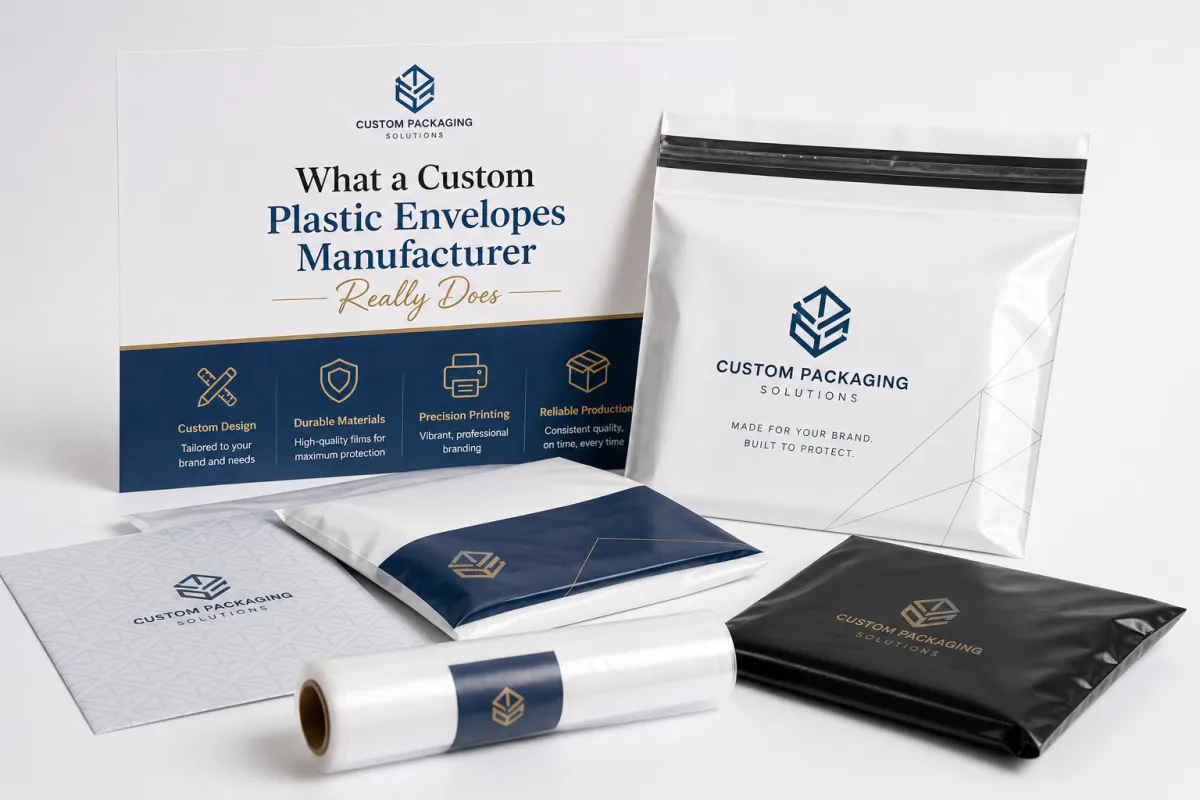
The plain-language version: a custom plastic envelopes manufacturer takes your shipping problem and builds a plastic envelope around it. That means translating product dimensions into a usable outer format, choosing a film that protects the contents, and setting the closure, print, and finish so the mailer works in real packing conditions. If the envelope is too large, you waste material and create a sloppy presentation. If it is too tight, the seam gets stressed and fails. Neither outcome is charming.
That balance is where experience matters. A custom plastic envelopes manufacturer looks at the product first, not the artwork. Is the item flat, bulky, or oddly shaped? Does it need opacity because the contents are sensitive? Will it travel through humid weather, rough parcel sorting, or repeated handling? Each answer changes the spec. A mailer that works for a catalog insert may fail for apparel with sharp accessories attached. Packaging has a way of punishing vague thinking.
There is also a practical difference between stock poly mailers and custom envelopes that buyers often underestimate. Stock mailers are built around broad use cases, so they are flexible but generic. A custom version can be sized to reduce void space, printed to support package branding, and tuned for closure strength or finish. For some brands, that upgrade is not about luxury. It is about making product packaging easier to ship at scale.
From a cost perspective, the real value is broader than the print area. A custom plastic envelopes manufacturer can cut repacking time because the mailer fits better. They can lower damage rates because the film and seal match the product. They can even improve warehouse flow because staff are not reaching for five different stock sizes all day. I have seen buyers focus on unit price and miss the labor cost hiding in the background. That is a very expensive way to save a penny.
"The cheapest mailer is rarely the cheapest packaging decision if it causes returns, rework, or brand damage."
There is a reason many packaging teams compare envelopes and custom printed boxes in the same planning meeting. The formats solve different problems, but they both affect brand perception, product protection, and packing labor. A custom plastic envelopes manufacturer is essentially offering a lighter, faster path for shipments that do not need corrugated protection but still need control. For slim apparel, documents, samples, and non-fragile goods, that can be exactly the right move.
For buyers who want a technical reference point, the ISTA test protocols are useful when discussing handling, vibration, and transit risk. A serious custom plastic envelopes manufacturer may not run every ISTA method in-house, but they should understand why those tests matter when a buyer is shipping across long distances or through multiple handoffs.
How a Custom Plastic Envelopes Manufacturer Builds the Mailer
Most projects start with a spec conversation, not a production file. The buyer gives the product dimensions, target quantity, shipping method, and any branding goals. A custom plastic envelopes manufacturer then translates that into film type, thickness, dimensions, and closure style. Flat mailers are common for slim products, while gusseted designs help when there is a little extra depth. The more exact the brief, the fewer surprises later. That part sounds boring because it is boring, and boring is good here.
The film choice is one of the first real decisions. Low-density polyethylene, co-extruded films, and other flexible structures can all be used depending on the job. Thickness is usually discussed in microns or mils, and the right number depends on product weight and the amount of handling expected. A custom plastic envelopes manufacturer will often suggest a thicker structure when the contents have corners, edges, or a tendency to poke through during transit. If the item feels borderline in a sample, it is probably borderline in shipping too.
Printing comes next. Art files are usually reviewed for resolution, color count, bleed, and placement. A buyer may want one-color branding for a clean look, or full-surface coverage for stronger retail packaging impact. Either way, artwork should be prepared as production-ready files, not just a web image dragged into a spec sheet. A custom plastic envelopes manufacturer has to account for how the ink sits on the film and how the finished envelope folds or seals.
That is where packaging design becomes more than decoration. A bold logo near the opening, a strong contrast stripe, or a simple pattern can do more than cover the surface. It can help the packing team identify the right SKU at a glance, and it can make the parcel feel intentional when the customer opens it. In branded packaging, clarity usually beats clutter. I know that sounds unglamorous, but the boxy, overdesigned stuff often gets ignored anyway.
Good manufacturers will also check opacity, tear resistance, moisture protection, and finish. A glossy film may look bright, but it can show scuffs more easily. A matte or soft-touch finish can feel more premium, though it may affect cost. Some buyers prefer a slip finish for speed in packing lines; others prefer a grippier feel. A custom plastic envelopes manufacturer should explain those tradeoffs plainly, not hide them behind jargon or a stack of vague adjectives.
Sample runs are the sanity check. Before a large order goes into full production, many teams approve a proof or a short run to confirm the size, print position, and closure behavior. This is not a formality. It is the cheapest place to catch a bad fit. A custom plastic envelopes manufacturer that takes sampling seriously is usually saving the buyer from a much larger problem later.
For buyers who want to understand sustainability angles alongside performance, the EPA recycling guidance is a sensible reference point. It is not a substitute for a material spec, but it helps frame conversations about packaging design, disposal, and the claims a brand can reasonably make without overpromising.
What Drives Pricing, MOQ, and Material Choices
Pricing is where many buyers get surprised, and usually for predictable reasons. A custom plastic envelopes manufacturer is pricing not just a plastic bag, but a setup process, a material structure, a print job, and a conversion run. The biggest drivers are material gauge, size, number of printed colors, print coverage, closure type, and total quantity. Add special finishes, extra opacity, or reinforced seams, and the quote moves again. Nothing mysterious there, just a lot of moving parts with cost attached to each one.
Minimum order quantity matters because setup costs have to be spread across the whole run. If you order a small quantity, the per-unit price is often higher because the press setup, proofing, and waste allowance still have to be absorbed. Larger orders usually lower the unit cost, but they also tie up cash and storage. A thoughtful custom plastic envelopes manufacturer will explain the breakpoints instead of pretending every volume behaves the same.
Here is the useful version of that math. The cheapest unit price is not always the best value if it causes damage, slows packing, or forces a reprint. A lighter film might save a fraction of a cent per envelope, but if it increases seam failures or moisture complaints, the savings disappear fast. That is why experienced buyers treat material choice as a business decision, not just a purchasing one.
| Option | Typical Unit Range | Best For | Tradeoff |
|---|---|---|---|
| Stock poly mailer | $0.05-$0.12 | Fast, low-complexity shipping | Limited branding and less exact sizing |
| Simple custom envelope, 1-color print | $0.12-$0.22 | Basic branded packaging with moderate volume | Setup costs still matter on smaller runs |
| Heavier custom envelope, multiple colors | $0.18-$0.35 | Retail packaging, higher-value goods, stronger presentation | Higher upfront cost and longer proofing |
| Premium custom envelope with special finish | $0.25-$0.45+ | High-touch package branding and more demanding shipping lanes | Best value only when the presentation or protection justifies it |
Those numbers are broad, because they should be. Quantity, region, material mix, and freight all shift the final landed cost. A custom plastic envelopes manufacturer quoting 5,000 units may look expensive beside a 25,000-unit order, but the smaller run might still be the smarter move if the SKU is seasonal or the design is still being tested. Plenty of good projects start small on purpose.
Closure style also changes the economics. A basic peel-and-seal strip may be efficient for many shipments, but a stronger adhesive or resealable option can be worth the added cost for returns-heavy categories. If the product is likely to be opened, checked, and sent back, the closure should reflect that reality. A custom plastic envelopes manufacturer who asks about returns is asking the right question.
Another point many buyers miss is freight. A quote can look attractive until the shipping cost arrives. If the project involves a large palletized order, the final landed cost may shift significantly. Good procurement habits mean comparing the full picture: unit price, freight, sampling, waste, and the risk of a reprint. That is true for envelopes, and it is just as true in broader Custom Packaging Products planning.
For buyers comparing packaging suppliers, it helps to think in terms of fit, not just cost. A custom plastic envelopes manufacturer may quote a slightly higher number than a generic supplier, yet still create a better result because the envelope is sized for the product and the shipping method. That is especially true when the item is part of a larger branded packaging system rather than a one-off shipment. The spec may look a little fussy on paper; in practice, it usually saves headaches.
The Custom Plastic Envelopes Manufacturer Process and Timeline
Most orders follow a similar path: brief, spec confirmation, artwork review, sample approval, production, finishing, and freight booking. A custom plastic envelopes manufacturer that runs a disciplined process will usually force clarity early. That may feel tedious during the first conversation, but it saves days later. The more ambiguity in the first round, the more likely the project slips in proofing or production. I have watched that movie too many times.
Artwork revisions are one of the most common delay points. A buyer sends a logo file, then realizes the tagline is too small, then wants to move the QR code, then changes the color. Each revision may be small in isolation, but production files need to be locked before the run starts. A custom plastic envelopes manufacturer can move faster when the artwork arrives final, not exploratory. A maybe-finished file is not finished.
Samples are another bottleneck. If the buyer is approving a physical sample, allow time for shipping and review. If the mailer needs to be checked against a product insert, a carton, or another packaging component, that coordination takes longer than many teams expect. A realistic timeline often looks like a few days for proofing, a few more for sample evaluation, then production time based on quantity and print complexity.
As a rough framework, smaller, simpler jobs may move through proof to shipment in a couple of weeks once the design is approved, while larger or more complex runs may take longer. That depends on the plant schedule, the print method, and how many rounds of sign-off are needed. A custom plastic envelopes manufacturer should be honest about that. If they promise speed without asking questions, treat that as a warning sign.
Delivery planning matters just as much as production timing. If the order has to land before a product launch, a promotion, or a seasonal peak, freight timing should be built into the schedule from the start. A custom plastic envelopes manufacturer can usually help you shorten the path by working from exact dimensions, final artwork, and a clear delivery destination instead of a vague idea of what the envelope should become.
When the job involves transit-risk testing, some buyers also ask for methods aligned with handling standards. That is where industry references such as ISTA matter again. Even if the final shipment is not formally certified, the thinking behind the tests helps teams choose a mailer that survives normal parcel abuse.
Common Mistakes Buyers Make Before Ordering
The first mistake is vague sizing. A buyer says the product is "around this big" and expects the mailer to work. It usually does not. A custom plastic envelopes manufacturer needs exact dimensions, and if the product has depth, that matters too. A mailer that is too loose creates wasted space; one that is too tight can damage corners or make the sealing process awkward for the packing team. Guessing here is a pretty reliable way to buy twice.
The second mistake is approving artwork before the specs are fixed. Print placement, bleed, and safe margin are not abstract details. They determine whether the logo lands properly after the envelope is folded, sealed, or gusseted. A custom plastic envelopes manufacturer can often warn buyers about this, but only if they have the final structure in hand. Otherwise, the design may look fine on screen and awkward on the actual mailer. A nice mockup is not the same thing as a production-ready bag.
Third, many teams underestimate closure strength and moisture resistance. A mailer that performs in a dry warehouse can fail in a damp delivery lane. A seal that seems adequate on paper can peel under real handling. This is where sample testing earns its keep. A custom plastic envelopes manufacturer should be able to show how the seal holds, how the surface feels, and whether the envelope slumps or stays crisp.
There is also a habit of focusing almost entirely on unit price. That can distort the buying decision. If the budget ignores freight, proofing, and reprint risk, the "cheapest" option may be the most expensive by the time the project is finished. I have seen packaging teams save pennies and then spend dollars fixing the downstream mess. That is a bad trade in any product packaging program.
Another issue is choosing a finish for looks without thinking about use. Gloss can be bright and high-impact, but it may show handling marks. Matte can feel more restrained and premium, though it may not pop the same way under retail lighting. A custom plastic envelopes manufacturer should explain how the finish affects package branding and warehouse handling, not just show a sample under perfect lighting.
Finally, some buyers skip the comparison step. They approve the first quote and never ask for a second sample or a second opinion. That is risky, especially when the project will run for months. A smart buyer asks the custom plastic envelopes manufacturer for a sample comparison, checks the seal, the stiffness, the clarity of the print, and then decides whether the spec is worth locking in.
- Send exact dimensions, not estimates.
- Confirm print limits before artwork approval.
- Ask for sample mailers from more than one supplier.
- Check freight, lead time, and reprint exposure.
- Match the mailer spec to the shipping lane, not just the brand palette.
Expert Tips for Better Branding and Better Mailers
If the goal is strong branding, resist the urge to fill every inch. A clean envelope with one memorable color block, readable copy, and a clear logo often lands harder than an overworked surface. A custom plastic envelopes manufacturer can help you keep the design legible at production scale, which matters more than how it looks in a mockup file.
Design for the unboxing moment, even if the package is going out by mail. The customer sees the exterior first. That means contrast, hierarchy, and a short visual message matter. In practice, package branding works best when the envelope communicates the brand in a second or two. The same idea shows up in retail packaging and custom printed boxes: one strong idea beats five competing ones. The customer should get it fast, not after a second coffee.
Material choice should follow the product, not a default template. Apparel may tolerate a lighter structure than a boxed accessory with sharper edges. High-value goods may justify more opacity or a stronger seal. A custom plastic envelopes manufacturer should ask about product type, shipping distance, and return volume before recommending a film gauge. That conversation usually produces a better spec than starting with a generic "standard" mailer.
Ask for samples that let you compare more than print quality. Hold the envelope by the seam. Flex it. Check whether the flap closes cleanly and whether the opening is easy to use with gloved or fast-moving hands. Speed matters in fulfillment. A mailer that looks premium but slows the line may not be worth the premium. A practical custom plastic envelopes manufacturer will understand that immediately.
Here is a useful rule: if a slightly better mailer can cut repacking, damage, or customer service calls, it may pay for itself faster than you expect. That is especially true in subscription shipping, cosmetics, apparel, and accessory categories where presentation and protection collide. The buyer who thinks like a shipping operator, not just a designer, usually makes the stronger choice.
Many teams also benefit from building a wider packaging system instead of treating every item as an isolated project. A custom plastic envelopes manufacturer may be one part of a broader sourcing plan that also includes inserts, cartons, branded tape, and labels. That system thinking is what turns ordinary product packaging into a recognizable brand experience.
One more practical point: if sustainability messaging matters to your brand, keep the claims precise and documentable. Materials, recycling streams, and end-of-life guidance vary by region. A manufacturer can support the conversation, but the brand still needs to be careful about what it says. If you use recycled content or a recovery-friendly structure, back it with proof. That builds trust faster than vague green language ever will.
The best custom plastic envelopes manufacturer is not the one with the flashiest sample. It is the one that can connect design, material choice, shipping performance, and packing efficiency without making the process feel like a hostage situation. If you get that balance right, the package does its job quietly, which is exactly what good packaging is supposed to do.
Next Steps: Turn a Spec Sheet Into a Smart Quote
If you want a quote that is actually useful, start with the facts the custom plastic envelopes manufacturer needs to price accurately: finished dimensions, target quantity, film thickness, closure type, print colors, and delivery timeline. If the product has unusual depth, say so. If the envelope needs extra opacity, say that too. Clear inputs usually produce tighter pricing and fewer revision loops.
The fastest path is to send everything together. Product dimensions, artwork files, sample photos, compliance notes, and any recycling or labeling preferences should live in the same brief. A custom plastic envelopes manufacturer can quote faster when they do not have to wait for missing pieces. That also reduces the odds of a spec mismatch after the order is approved.
When the quotes come back, compare at least two or three options side by side. Look at unit price, MOQ, lead time, closure style, and sample quality, not just the headline number. Ask the custom plastic envelopes manufacturer to clarify whether the timeline includes proof approval, production, and freight. That distinction matters more than many buyers realize.
If you are uncertain about the spec, request samples before you sign off. A sample can reveal stiffness, seal feel, color accuracy, and real-world handling behavior in a way a spec sheet cannot. It is a small step, but it often prevents a bigger mistake later. That is especially true when the mailer is part of a larger branded packaging program and the customer experience has to feel consistent.
The practical sequence is simple: gather exact dimensions, choose the shipping lane, compare a few suppliers, request samples, verify lead times, then lock the spec. Do that, and your custom plastic envelopes manufacturer can move from estimate to production with far less friction. The clearest takeaway here is not glamorous, but it works: a better quote starts with a better brief, and a better brief starts with measurements that are real, not kind of close.
If you want to learn more about the company behind this kind of sourcing advice, see About Custom Logo Things.
What does a custom plastic envelopes manufacturer need to quote accurately?
Exact dimensions, including whether the mailer needs extra room for product thickness. The custom plastic envelopes manufacturer should also know film thickness, closure style, print colors, estimated order quantity, delivery destination, and target timeline so freight and lead time are not guessed later. If the item has sharp corners or a slippery surface, that helps too.
How long does a custom plastic envelopes manufacturer usually take from proof to delivery?
Sample and proof approval can take a few days if artwork is final and the spec is clear. After that, production time depends on quantity, print complexity, and the factory schedule. Shipping time is separate, so plan for both manufacturing and transit when you work with a custom plastic envelopes manufacturer. If the order is for a launch, give yourself more cushion than you think you need.
What affects custom plastic envelope pricing the most?
Material gauge, size, and number of printed colors are usually the biggest drivers. Lower quantities typically raise the per-unit price because setup costs are spread across fewer bags. Special features such as extra opacity, matte finish, or reinforced seams can increase cost but improve performance when the custom plastic envelopes manufacturer builds the right spec.
Are custom plastic envelopes better than stock poly mailers?
Custom versions make sense when brand presentation, exact sizing, or higher protection matter. Stock mailers can work for fast, low-complexity shipping where appearance is less important. A side-by-side sample comparison usually shows whether a custom plastic envelopes manufacturer is worth the upgrade for your product. If the product is simple and the lane is gentle, stock may be enough.
How can I reduce mistakes when working with a custom plastic envelopes manufacturer?
Send final dimensions, artwork, and quantity targets before asking for a quote. Request samples and confirm seal strength, print quality, and film feel before full production. Also check whether the quoted timeline includes approval time, production time, and freight time so the custom plastic envelopes manufacturer is quoting the real project, not just part of it. That saves a lot of back-and-forth later.

